
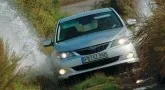
Spy shots of the Impreza circulated online long before the premiere, and even those with only a passing interest in cars managed to discuss the newcomer's looks. Many brand fans were somewhat puzzled by the new design: Subaru lost its signature features that everyone had grown accustomed to. But, as often happens, the production car differs noticeably from what we see in early photos and concepts. This is the case here: in person, the Impreza looks far more harmonious than in pictures. Its exterior hints at features familiar from other mass-market C-class representatives: the window line, sloping hood, and expressive wheel arches seem borrowed from classmates. Whether this is good or bad, everyone will decide for themselves, but there are very specific reasons for such a step. It's all about the new market policy of Subaru's management and tightening European legislation.
The Impreza first made its mark in 1991 and immediately became a leader, opening the segment of all-wheel-drive passenger cars. A little later, the "hot" WRX and STI versions appeared, and victories in rally championships only strengthened the model's image. As a result, the Impreza firmly earned a reputation as a hundred-percent sports car, which largely ensured excellent sales of turbo modifications. Naturally aspirated versions, however, always remained in the shadows. But managers of the Japanese company had long been planning to turn the Impreza into a truly mass-market product through affordable trims. This process was accelerated by European emission standards, which became increasingly stringent. And it was precisely with these that Subaru had problems: the main complaints concerned turbocharged engines.
As a result, turbocharged cars became significantly more expensive, and this is what prompted the launch of the new model. Despite the tight deadlines, the engineers approached the task very thoroughly, refining every component. The interior pleases with a sensible combination of practicality and comfort. The driver's seat is thought out to the smallest detail: all controls are at hand and intuitive. True, if the trim includes engine start via a Start/Stop button, the "knob" itself may not be found immediately — it's hidden to the left of the steering column, crowning the control unit for lights, mirrors, and instrument illumination.
The seats have a proper geometric shape that does a good job of saving your back from fatigue on long journeys. Adjustment ranges allow people of various builds to get comfortable. The engineers also didn't forget about seat injury safety in an accident. Rear passengers got 85 mm more living space — achieved by lengthening the body by 95 mm. True, the increase in dimensions had almost no effect on the trunk volume, which, frankly, is small.
Starting the engine greets you with... different sounds. Under the hood can be two engines: a 1.5-liter with 107 hp and a two-liter producing 150 hp. Peak power for the younger unit comes at 6000 rpm, for the older one — at 6400 rpm. Hence the conclusion: to get reasonably acceptable dynamics, you'll have to constantly rev the engine to the max. But it doesn't rev very willingly — there's practically no pickup at low revs. This love for high revs doesn't have the best effect on acoustic comfort. At the same time, the sound insulation itself is quite good and effectively cuts off external noises.
But you'll have to put up with the hum of the engine itself. Both engines are paired either with a 5-speed manual or a 4-speed automatic. The cutoff on the automatic kicks in at 6500 rpm, on the manual — at 7000 rpm. There's no talk of any incredible briskness: this is a calm city car. Acceleration to 100 km/h confirms this: with the 1.5-liter engine and manual — 14 seconds, with the two-liter — 9.6 seconds. With the automatic, you'll have to add another second to these figures. But the suspension, called Subaru DC3 (Dynamic Control Chassis concept), noticeably outpaces the engines' capabilities. It holds the line clearly, body roll is minimal, and the car confidently "stands" in corners. Energy intensity is also top-notch, although on serious bumps, noise occasionally appears in the cabin. Steering is informative, and responses to driver inputs have become sharper. The rear suspension has also been reworked: to reduce vibrations, its mounting now goes through four rubber mounts instead of the previous two.
Russian buyers are luckier than European ones: we have access to the WRX trim with a 2.5-liter engine. The most "hot" STI will appear in six months. It's possible that Europeans wanting a truly "hot" car will come to Russia for it — just as our car importers once went abroad. Indeed, times have changed! As for prices, the version with the 1.5-liter engine and manual costs 577,700 rubles; for the automatic, you'll need to pay an extra 40,800 rubles. The two-liter version with manual is priced at 730,800 rubles, with automatic — at 771,600 rubles.
Comfort and safety
The suspension of the new Impreza is the result of very serious and painstaking work. Up front — a time-tested design with MacPherson struts; at the rear — double wishbones of a new scheme. This allowed reducing the dimensions of all elements and positioning them more compactly, while also increasing the trunk by lowering the floor level. To lighten the suspension, some of its elements were integrated into the body, and to soften impacts, the mounting goes through a subframe. This scheme reduced the noise level in the cabin on bumps. With the new suspension, handling and stability were further improved, aided by the traditional symmetrical all-wheel drive from Subaru, adding confidence on any roads in any season.
Driving
Changes in the rear suspension improved comfort.
Interior
From an ergonomics standpoint, everything is fine, but the quality of the plastic disappoints. It turned out to be too hard and rough.
Comfort
Accommodating all four passengers in the cabin won't be much trouble, but the trunk isn't particularly spacious.
Safety
To increase body strength and meet safety standards, frameless doors had to be abandoned.
Price
Even having all-wheel drive doesn't guarantee the Impreza an easy life.
| Dimensions, mm | 4415x1740x1475 |
| Engine | petrol, 1498 cm3, 107 hp/6000 rpm |
| Transmission | manual, 5-speed |
| 0-100 km/h, s | 14.0 s to 100 km/h |
| Top speed, km/h | 175 |
| Competitors | Ford Focus, Mazda3, Toyota Auris |
Pros and cons
+ Energy-intensive and balanced suspension, ergonomic interior, all-wheel drive.
- Lack of low-end torque, small trunk volume.
Our opinion
The engineers managed to create a car that combines a set of qualities demanded by consumers. The result is a typical city car with decent performance. And the presence of all-wheel drive and a well-tuned suspension adds confidence on the road. The main thing now is to withstand the competitive struggle.