The first-generation Subaru Forester, which debuted in 1997, could not boast of rich equipment, outstanding sound insulation, a spacious interior, or a memorable appearance.
People valued this model for its honest all-wheel drive, boxer engines, frameless side windows, and the aura of rally victories that surrounded the brand. However, upon closer inspection, these advantages turned out to be not so indisputable. The low center of gravity provided by the boxer engines is almost imperceptible on a tall crossover. All-wheel drive with a center differential was available only on cars with a manual transmission. Versions with an automatic transmission had to settle for a viscous coupling, which slightly braked during maneuvers. By the way, the proprietary designation "symmetrical all-wheel drive" describes not the distribution of traction across the axles, but the very layout of the transmission.
Despite this, Forester sales remain at a decent level: last year in Russia, 6,670 such cars found their owners. This is, of course, noticeably less than the market leaders, but Subaru does not claim the status of a mass brand.
CRUISE WITH MANUAL
The current Forester leaves its predecessor far behind in terms of equipment. The steering column reach adjustment immediately catches the eye — a rarity for ordinary crossovers. This complements the traditional tilt adjustment. Also in the arsenal are a hood on gas struts, an electromagnetic drive for the tailgate lock, a switchable VDC stability control system, a key with remote locking, audio inputs for connecting an MP3 player, and on versions with a monitor, a video input. Starting with the 2.0XS trim, music and cruise control buttons appear on the steering wheel, and the latter works with the manual transmission as well.
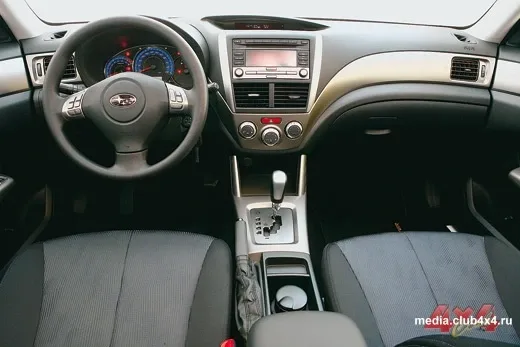
The options list includes engine start button, leather interior, and eight-way power adjustment for the driver's seat. Of course, climate control and heated seats with mirrors are present.
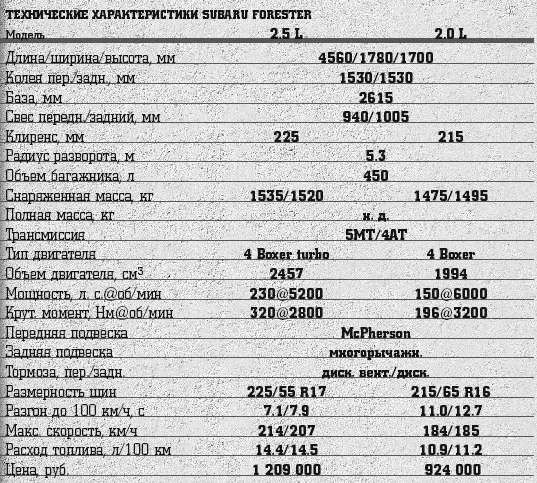
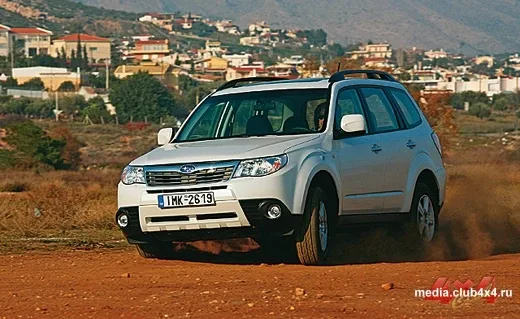
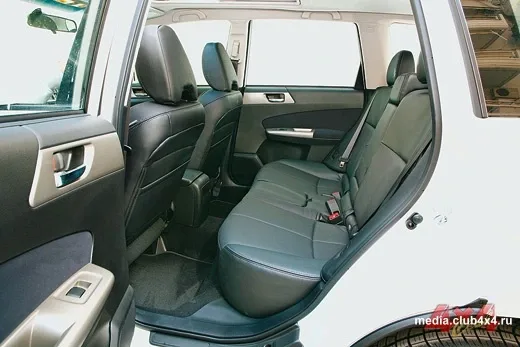
Has the Forester grown in size? Yes, and in all directions. The body has become 75 mm longer, and the wheelbase has increased by 90 mm. The 15 mm difference went to reducing the rear overhang. The main thing is that rear passengers are now unlikely to complain about a lack of legroom.
It is gratifying that the Forester has not followed the general crossover trend of reducing ground clearance. On the contrary, for versions with two-liter engines, the ground clearance has increased by 10 mm and is 215 mm, and for the modification with a 2.5 engine, it is as much as 225 mm.
CARE FOR PASSENGERS
The engineers paid serious attention to passive safety: zones of programmable deformation of the body, the behavior of the power unit in a collision. The chances of passengers surviving an accident have significantly increased, including in the most dangerous side impacts. Not only side airbags but also head curtains are responsible for this. By the way, the side windows are now framed — that is the price for safety.
DIESEL NOT EXPECTED YET
The boxer four-cylinder Boxer engines have been modernized to improve characteristics and reduce emissions. The base two-liter unit develops 150 hp, and the turbocharged 2.5-liter one — 230 hp. Later, an atmospheric version of this engine is promised, but it was not shown at the European presentation. The company's plans also include the development of a turbodiesel.
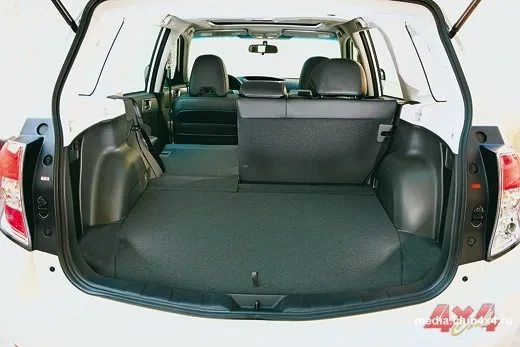
There were also changes in the chassis. At the rear, there are now double wishbones, at the front — still classic McPherson. We have probably dealt with the main innovations. I will not dwell on the blue instrument lighting, the needles that, when the ignition is turned on, briskly run from stop to stop, cup holders, the box between the seats, the full-size spare wheel, and the trunk volume. I'd better move on to the direct impressions of driving.
TWO DIFFERENT CARS
It would be a mistake to perceive the Forester as one model. Depending on the gearbox, its all-wheel drive transmissions differ fundamentally. Versions with a five-speed manual have retained the mechanical differential. Only a hill-start assist system has been added. The automatic holds the brakes for about a second after the driver has removed their foot from the pedal. I did not like this. You want to move off — the gas is already pressed, but the brakes do not release. At first, you do not understand what is happening at all. In short, you need to get used to it. It would be better if such an assistant were activated by a separate button. But the Forester with a manual transmission has a low-range gear (except for turbo versions). It is implemented through an additional shaft in the gearbox. True, the reduction ratio is modest — only 1.45. You feel its real benefit only when starting on viscous soil or when towing a heavy trailer.
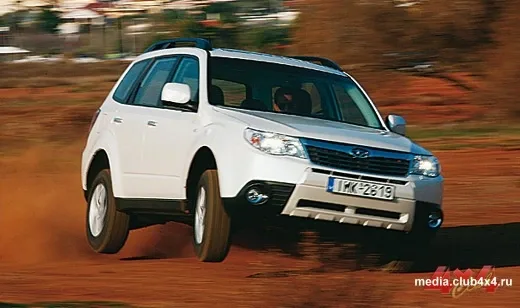
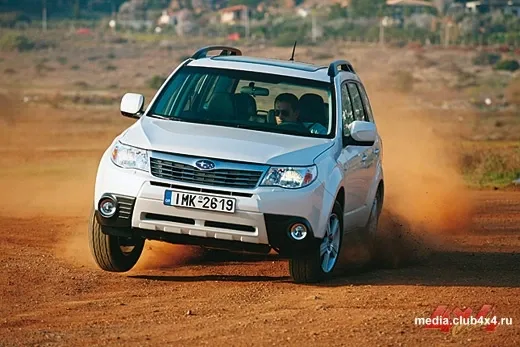
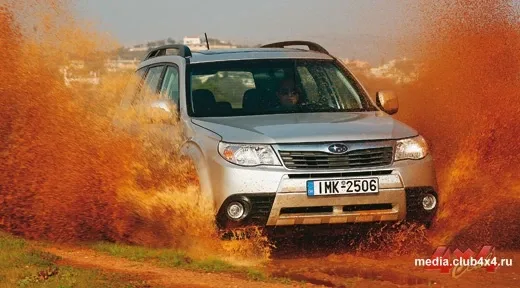
Versions with an automatic transmission do not have a differential. The distribution of traction between the axles is handled by an electronically controlled clutch. It has become quicker, as its "brains" now receive data from the stability control system sensors. This time we did not get to evaluate the behavior of the viscous coupling on slippery surfaces — at European presentations, this is almost always a problem. But during photo sessions, we easily achieved beautiful wheel hanging on difficult terrain. The crossover climbed where competitors with similar transmissions helplessly spun their wheels. And in general, in terms of off-road capabilities, the "forester" is good: the ground clearance is impressive, the bumpers are high, and the overhangs are small.
SADNESS AND JOY
As expected, the Forester with the base two-liter engine and automatic transmission is a bore. Only a novice after driving school will get pleasure from driving. The four-speed automatic shifts smoothly and imperceptibly during measured driving. But as soon as you press the gas to the floor — that's it, all is lost. The engine screams, but there is no acceleration. Manual mode does not save, and, by the way, the expected engine braking is practically absent in it.
The same car, but with a manual, is noticeably more interesting. Although, in my opinion, if the second gear were shorter, driving on winding roads would be more enjoyable.
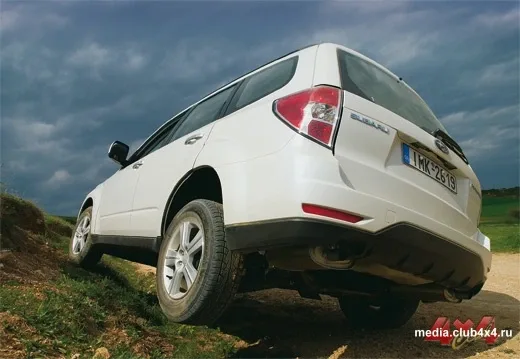
The top version with a two-liter turbo engine drives magnificently. There is practically no turbo lag, and the torque of 330 Nm is power. The steering wheel of such a Forester is more informative because it has a hydraulic power steering, not an electric one. But taking it with a manual transmission is probably not worth it. It does not have a low-range gear, and the clutch, which fails along with the flywheel, is a known ailment from the previous model.
If we distract from the engines, the new model behaves excellently on asphalt and dirt roads. There are practically no body rolls in corners, and the suspension perfectly swallows any irregularities. The balance between passenger comfort and driving chassis settings is excellent. As for sound insulation, it has become better, but no radical changes have occurred.
In conclusion, about prices. So far, due to currency fluctuations, the final figures have not been approved, but preliminary they are as follows. The base version 2.0X with a manual transmission will cost 924 thousand rubles, and the top 2.5XT with an automatic transmission — 1,209 thousand rubles.