However, the fate of this car is already sealed. When I return it, the car will have been in the hands of about thirty other journalists. After trips on country roads, the weak and inferior plastic engine protection will have five or six damages. Forest routes will leave about fifty scratches on the metallic paint. Alloy wheels will get a dozen chips due to potholes in the asphalt. Then the car will be written off and sold at a discount to some random buyer who has long dreamed of a Subaru but could not save up for a new car.
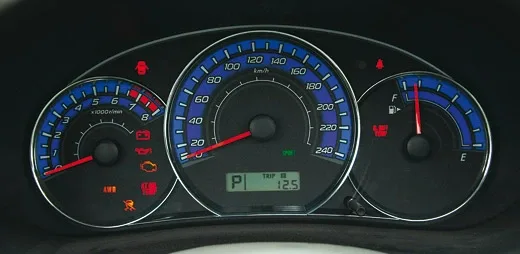
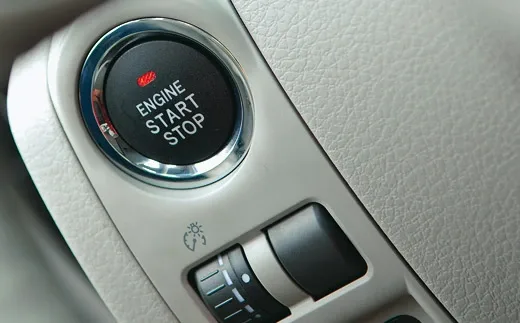
But for now it is at my disposal, and for three days in a row I press the gas pedal, not getting tired of driving, not allowing myself snobbish nitpicks about the interior, but simply enjoying the rare chance to drive this cheerful car. I press the sport button — and forget about both the turbo lag and the simple four-speed automatic: the Subaru starts like a cannon.
But for now it is at my disposal, and for three days in a row I press the gas pedal, not getting tired of driving, not allowing myself snobbish nitpicks about the interior, but simply enjoying the rare chance to drive this cheerful car. I press the sport button — and forget about both the turbo lag and the simple four-speed automatic: the Subaru starts like a cannon.
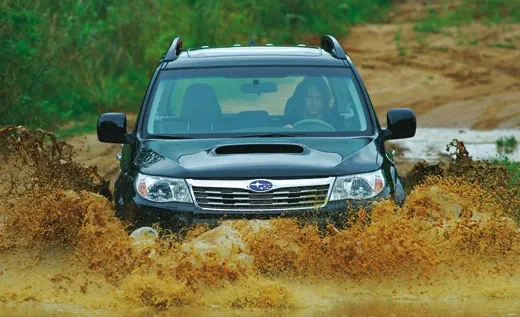
There are very few crossovers after getting acquainted with which no doubts remain. Forester is exactly such a case. It gives almost all automotive pleasures for quite reasonable money. Porsche Cayenne GTS reaches 100 km/h in 6.5 seconds. Subaru loses to it by 1.4 seconds, but at the same time gives so much childish delight that you won't find in any premium SUV. And it is cheaper by a hundred thousand dollars. With such savings, you can not be stingy on quality mats, a sunroof, and an air freshener in the ashtray — what else does a true car enthusiast need? True, there is one point because of which the Forester driver should not enter corners too briskly on broken asphalt, but I will tell about that later...
ELECTRONICS IS CAPRICIOUS
Since the main idea of this material has already been voiced, I will move on to details. The editorial office received a Forester in maximum configuration. With a 2.5 L engine, turbocharging, automatic transmission, and leather steering wheel. In spring, a European test of this model was already conducted (see 4x4 Club No. 5’2008). But European roads are incomparable with ours, and off-road is out of the question. As usual, we truly test the car only after its appearance on the Russian market.
The energy intensity of the suspension and the correctness of the traction control electronics are the main criteria for our country. If there are problems with them, the crossover has nothing to do here.
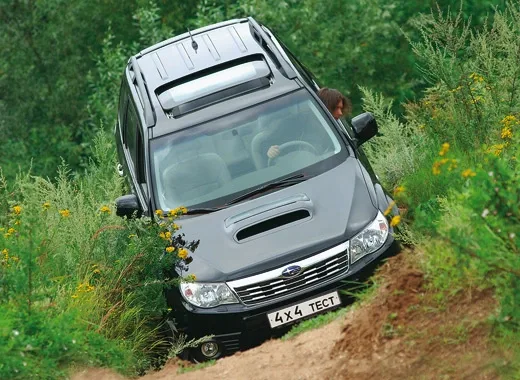
The energy intensity turned out to be excellent both on speed bumps and on a country road full of potholes and stones. Subaru passed these obstacles easily and comfortably. It's a pity that not everything is so smooth with the algorithms of electronic assistants. When diagonally hung, simply pressing the gas, admiring the effect, is not enough. You have to manipulate the pedal, sometimes very inventively — either releasing it for a moment, or pressing it, it seems, for an eternity. I'm afraid in deep snow this will turn into an unequal struggle with the elements.
ELECTRONICS IS CAPRICIOUS
Since the main idea of this material has already been voiced, I will move on to details. The editorial office received a Forester in maximum configuration. With a 2.5 L engine, turbocharging, automatic transmission, and leather steering wheel. In spring, a European test of this model was already conducted (see 4x4 Club No. 5’2008). But European roads are incomparable with ours, and off-road is out of the question. As usual, we truly test the car only after its appearance on the Russian market.
The energy intensity of the suspension and the correctness of the traction control electronics are the main criteria for our country. If there are problems with them, the crossover has nothing to do here.
The energy intensity turned out to be excellent both on speed bumps and on a country road full of potholes and stones. Subaru passed these obstacles easily and comfortably. It's a pity that not everything is so smooth with the algorithms of electronic assistants. When diagonally hung, simply pressing the gas, admiring the effect, is not enough. You have to manipulate the pedal, sometimes very inventively — either releasing it for a moment, or pressing it, it seems, for an eternity. I'm afraid in deep snow this will turn into an unequal struggle with the elements.
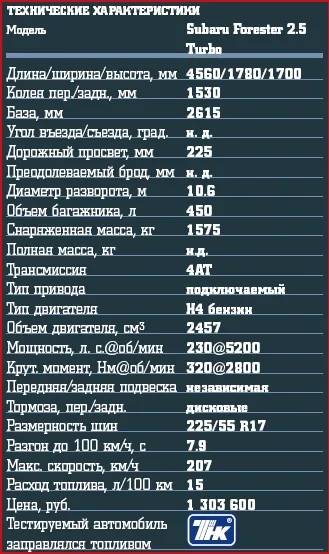
SPECIFICATIONS: SUBARU FORESTER
DO THE PROTECTION YOURSELF
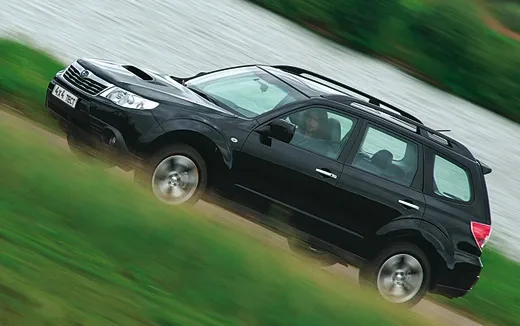
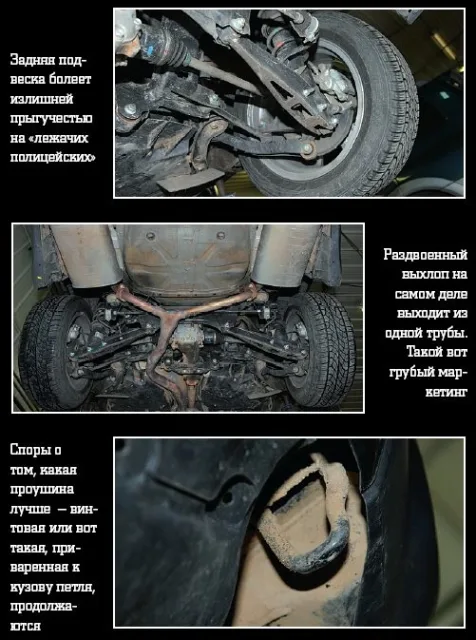
On the way back from the country route, I again felt that exciting drive that Forester gives. The elastic steering wheel, informative brakes, excellent seating position — sporty but comfortable — and... that very nuance I mentioned at the beginning. Striving to please everyone, Subaru made the suspension soft and combined this chassis with a 230 hp engine. On a straight line and on smooth surfaces, this combination works great — both directional stability and handling are at their best, but when the wheels hit bumps in a corner, the rear end bounces and almost throws you off the trajectory. However, fans of the brand know the answer: if you want to race, take an Impreza.
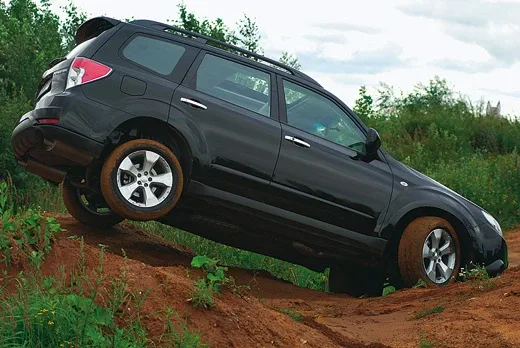
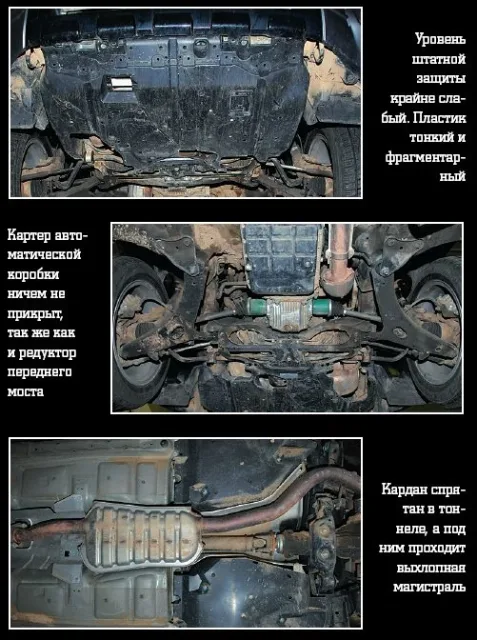
On the lift, other flaws were revealed. It turned out that there are units without protection or with very weak protection that can suffer off-road: front and rear differentials, engine and gearbox crankcases. The standard plastic shield is only for dust and dirt. Hence the conclusion: for off-road, only soft soils are suitable, moving over stones and logs exclusively at low speed, not jumping over bumps. For serious extreme driving, you will have to build a tuning "fence". It will reduce ground clearance, but on the turbo version the clearance is as much as 225 mm — it's not a pity to trim it.
On the way back from the country route, I again felt that exciting drive that Forester gives. The elastic steering wheel, informative brakes, excellent seating position — sporty but comfortable — and... that very nuance I mentioned at the beginning. Striving to please everyone, Subaru made the suspension soft and combined this chassis with a 230 hp engine. On a straight line and on smooth surfaces, this combination works great — both directional stability and handling are at their best, but when the wheels hit bumps in a corner, the rear end bounces and almost throws you off the trajectory. However, fans of the brand know the answer: if you want to race, take an Impreza.
On the lift, other flaws were revealed. It turned out that there are units without protection or with very weak protection that can suffer off-road: front and rear differentials, engine and gearbox crankcases. The standard plastic shield is only for dust and dirt. Hence the conclusion: for off-road, only soft soils are suitable, moving over stones and logs exclusively at low speed, not jumping over bumps. For serious extreme driving, you will have to build a tuning "fence". It will reduce ground clearance, but on the turbo version the clearance is as much as 225 mm — it's not a pity to trim it.
Subaru carefully does not advertise the geometric cross-country ability. Neither approach and departure angles, nor wading depth — none of this is published. By eye, I can say that the geometry is approximately like the Mitsubishi Outlander XL. Worse than the Toyota RAV4, and better than the Mazda CX-7.
YOU CAN SEE EVERYTHING
A few words about practicality. The trunk volume of 450 liters seems small, but do not forget that under the floor there is a full-size spare wheel. But passengers have enough space. Subaru boasts that the 965 mm of legroom for rear passengers is the largest in this class. But given that the boundaries of car classes are now very blurred, there is some stretch in this statement.
YOU CAN SEE EVERYTHING
A few words about practicality. The trunk volume of 450 liters seems small, but do not forget that under the floor there is a full-size spare wheel. But passengers have enough space. Subaru boasts that the 965 mm of legroom for rear passengers is the largest in this class. But given that the boundaries of car classes are now very blurred, there is some stretch in this statement.
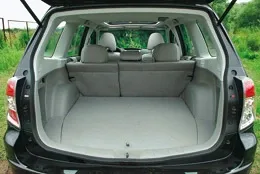
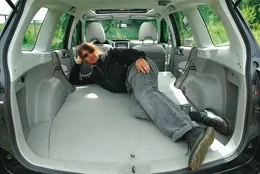
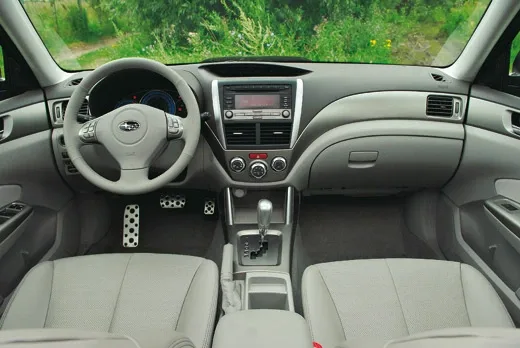
The last thing I want to praise Forester for is visibility. The engineers specially lowered the edge of the luggage compartment so that the driver could see a child one meter tall standing right behind the door. Apparently, they simply forgot about the parking sensors...
With a price from 923,600 rubles for the base two-liter version with a manual transmission and 1,303,600 rubles for the top modification that we tested, it will be worthy competition in its segment. True, we recently found out that in simpler versions, not only the engine disappoints, but that's for another time.
With a price from 923,600 rubles for the base two-liter version with a manual transmission and 1,303,600 rubles for the top modification that we tested, it will be worthy competition in its segment. True, we recently found out that in simpler versions, not only the engine disappoints, but that's for another time.