He is truly extraordinary. That's why for the comparative test we chose an atmospheric Subaru — it's much simpler with it. And we immediately found a pair — Nissan X-Trail 2.5 L. Engines of the same displacement, similar type of all-wheel drive, price roughly the same. Starting positions are equal — we can start. Let's go!
STRANGE METAMORPHOSES
The rivals share another detail. Both fell victim to modern marketing tricks. The X-Trail is built on a common aggregate platform with the compact Qashqai, which is immediately noticeable in its short wheelbase and small wheels. How else — after all, the hallmark of the Nissan–Renault alliance is cost reduction. The new Forester was molded from the old "forester," but not in the classic way, preserving beloved features, but on the contrary — diligently eradicating them. True, the 2.5 Turbo version behaves completely differently: there the suspension, brakes, and steering — everything pleases. The atmospheric Forester 2.5 compared to it is just a "vegetable," designed for the average driver.
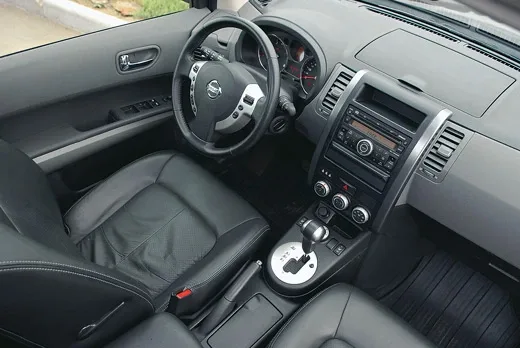

In motion, the rivals fully correspond to these crippled ideologies of our time. The X-Trail behaves like a slightly softened Qashqai. It cannot escape the fact that a massive body sits on a small wheelbase. And the Forester resembles a sporty station wagon that got a hasty and rather cheap "glamour" suspension: generally soft, but on speed bumps the rear end for some reason bounces like a "loaf."
START THE ENGINE!
Which one is scarier to drive fast? The Nissan — due to the combination of a high center of gravity, short wheelbase, and greater weight (by 77 kg). Although both crossovers lean in corners about the same, the Subaru's lean feels lighter, while the X-Trail's body, when tilting, lets you feel the force of inertia. On potholes and bumps, the X-Trail forgives road workers all surface flaws, but its wheel sinks into obstacles harder than the Forester's.
START THE ENGINE!
Which one is scarier to drive fast? The Nissan — due to the combination of a high center of gravity, short wheelbase, and greater weight (by 77 kg). Although both crossovers lean in corners about the same, the Subaru's lean feels lighter, while the X-Trail's body, when tilting, lets you feel the force of inertia. On potholes and bumps, the X-Trail forgives road workers all surface flaws, but its wheel sinks into obstacles harder than the Forester's.
We finished the asphalt stroll with "fun starts": I got into the Subaru and at the finish lost to my colleague in the Nissan by about a car length. We started again — and this time my opponent conceded a car length. After that, we swapped cars several times, tried sport and normal modes, but any advantage of one car over the other was explained only by the human factor. The Japanese crossovers go on par.
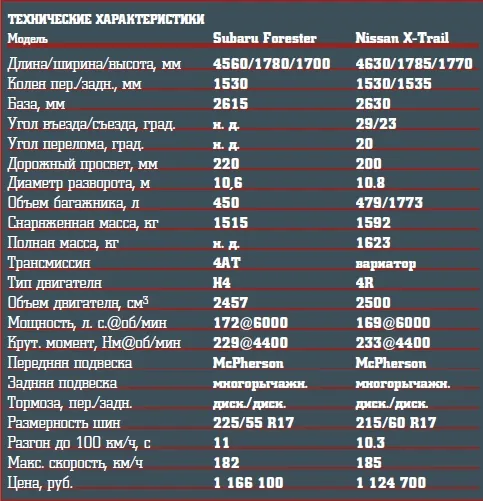
SPECS: SUBARU FORESTER
SPECS: NISSAN X-TRAIL
EITHER A PIT, OR A DITCH
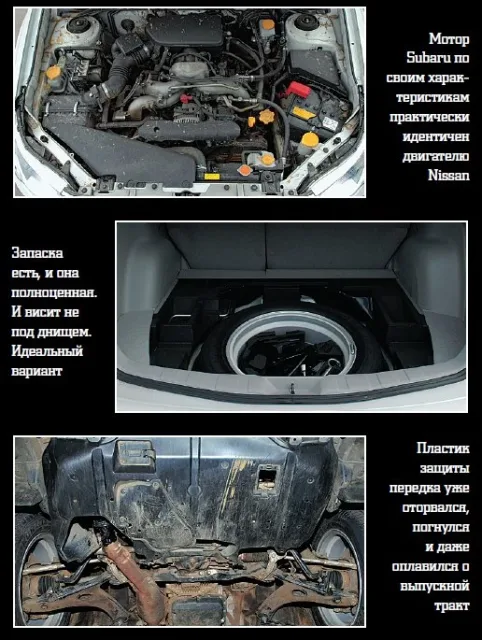
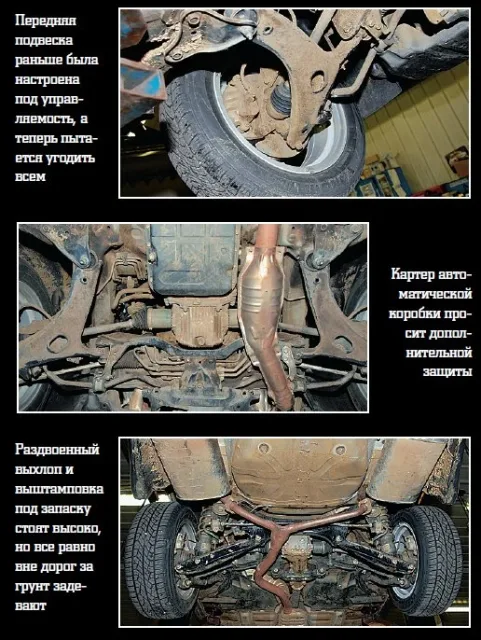
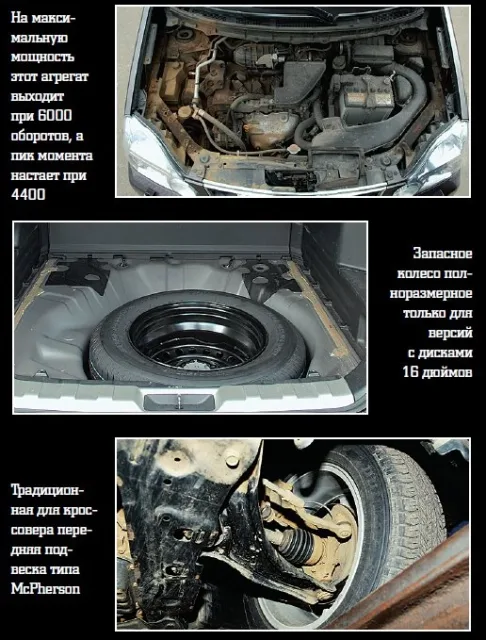
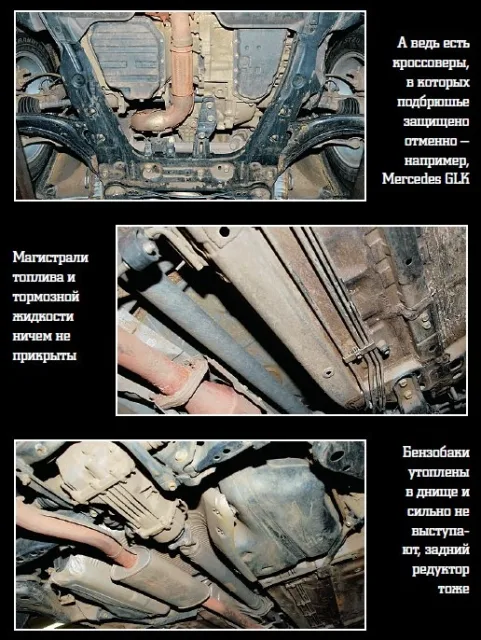
But the argument didn't end there. We continued off-road. True, first we had to assess how ready the "parketniki" are for rough terrain. Tires are all-season. Engine bay protection is weak on both. Geometric cross-country capability, i.e., space under the front and rear bumpers, is comparable, although Subaru, unlike Nissan, does not specify exact approach/departure angles for the Forester.
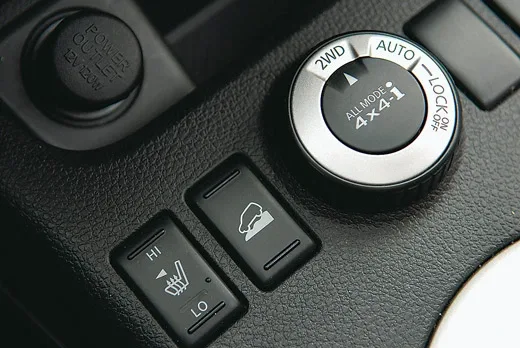
Transmissions differ. Overall, they work on a similar principle, engaging the rear axle when the front slips, but the Nissan has a CVT with virtual gears, while the Subaru has a four-speed automatic. The X-Trail is equipped with a clutch lock system in 4x4 mode, but the Forester is not. Practice shows that the so-called lock in modern multi-disc clutches is more of a marketing trick, which essentially leads to nothing but clutch overheating.
But the argument didn't end there. We continued off-road. True, first we had to assess how ready the "parketniki" are for rough terrain. Tires are all-season. Engine bay protection is weak on both. Geometric cross-country capability, i.e., space under the front and rear bumpers, is comparable, although Subaru, unlike Nissan, does not specify exact approach/departure angles for the Forester.
Transmissions differ. Overall, they work on a similar principle, engaging the rear axle when the front slips, but the Nissan has a CVT with virtual gears, while the Subaru has a four-speed automatic. The X-Trail is equipped with a clutch lock system in 4x4 mode, but the Forester is not. Practice shows that the so-called lock in modern multi-disc clutches is more of a marketing trick, which essentially leads to nothing but clutch overheating.
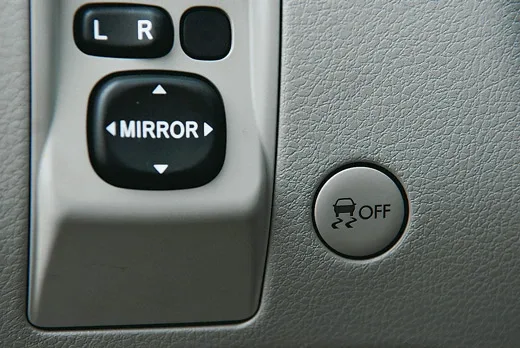
The Subaru has only one button for off-road — disabling ESP. But even that turned out to be unnecessary on rough terrain. We found a series of meter-high mounds, driving between which you can alternately hang wheels and test the electronic assistants. Here our argument — who beats whom — flared up with renewed vigor. To go or to stand, helplessly spinning? Both cars resolved this issue based on the small nuances of the specific driver's driving style. These are not the kind of cars where you can just press the pedals. You need to "get into it," feel how the clutch reacts to different degrees of accelerator pressure, how the electronics read the steering wheel angle. ESP could be turned off, but in conditions of diagonal hanging, on the contrary, it's hard without the electronic assistant.
In tricky spots, the lighter Subaru felt more confident. The Nissan is good in another way: its ride smoothness on dirt roads is better, while the Forester noticeably shakes.
In tricky spots, the lighter Subaru felt more confident. The Nissan is good in another way: its ride smoothness on dirt roads is better, while the Forester noticeably shakes.
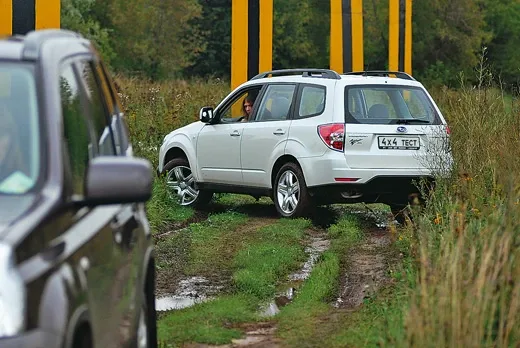

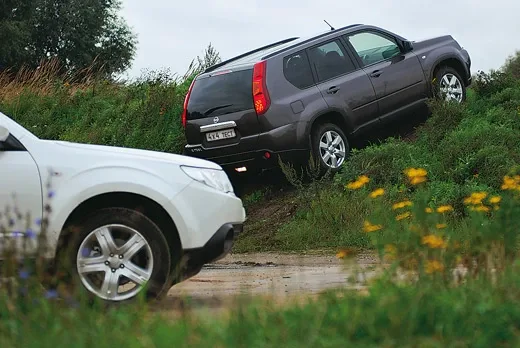
From the X-Trail's cabin, you see a full-fledged large hood that seems to emphasize the crossover's off-road nature, but once you get into a narrow gully with crumbling edges, this illusion disappears. But the light Forester with its "parketnik" look gets out of the trap noticeably easier. At the same time, we credit the X-Trail with the electronic hill descent assist system, which the Subaru lacks.
TRUNK VS PASSENGERS
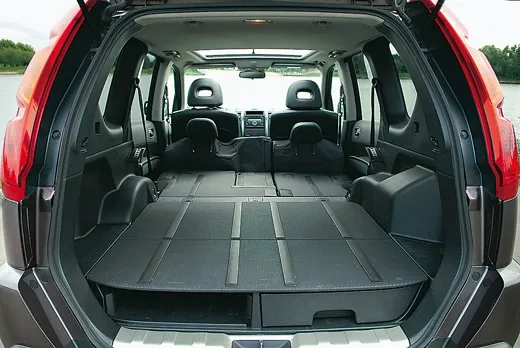
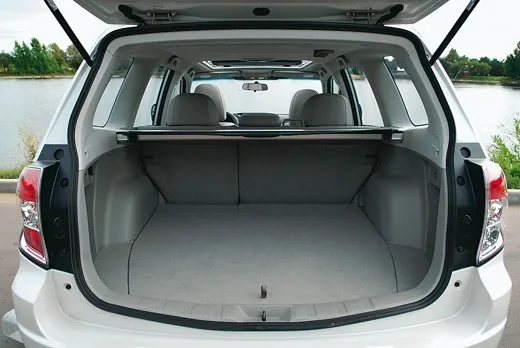
Given the roughly equal ratio of pros and cons on and off the road, you'll have to choose based on other parameters. For example, rear passenger legroom is greater in the Forester. But the Nissan has a more advantageous trunk volume. So, it all comes down to the question: who is more important — passengers or cargo?
TRUNK VS PASSENGERS
Given the roughly equal ratio of pros and cons on and off the road, you'll have to choose based on other parameters. For example, rear passenger legroom is greater in the Forester. But the Nissan has a more advantageous trunk volume. So, it all comes down to the question: who is more important — passengers or cargo?