
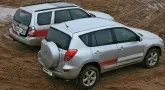
The closer the day of the comparative test approached, the more often we encountered misunderstanding from those around us. Some tried to talk us out of it, some twirled a finger at their temple, and some called the idea a pure adventure. But not a single skeptic could clearly explain why these two cars cannot be placed side by side. The arguments were different, but none convinced us. On the contrary, the desire to see the plan through only grew stronger. And then that day came.
This time everything fell into place perfectly. The comparison turned out to be absolutely correct. Both cars cost about the same — around 35 thousand dollars. Under the hoods were similar two-liter engines. And in length they differed little: the Forester is 11 centimeters longer than the RAV4. The wheelbase is also close: the Toyota has a 3.5-centimeter greater distance between the axles. The only noticeable difference is the curb weight: the RAV4, which also looks more massive, is 95 kilograms heavier than the Forester. In short, even before the start of road tests, we already understood that we had almost twins in front of us.
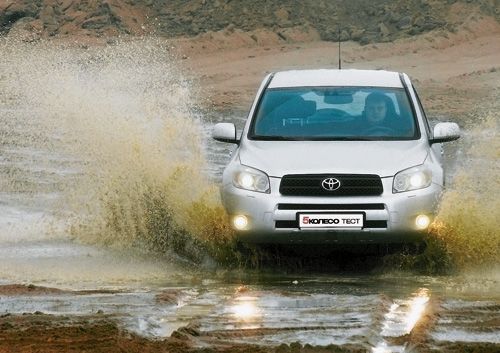
2006 Toyota RAV4
© Photo: 5 Koleso
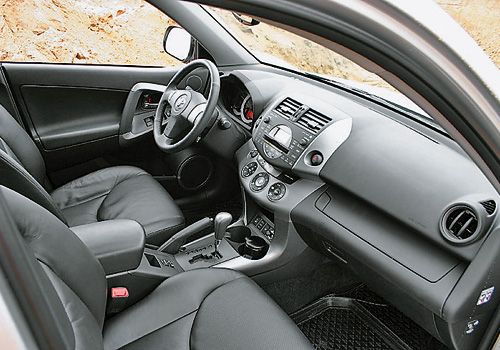
2006 Toyota RAV4
© Photo: 5 Koleso
The exterior also turned out to be related. Of course, the RAV4 is slightly taller, and the profiles of the cars are different, but when they stood side by side, it became obvious: the faces are almost identical. We were even a bit taken aback — we hadn't seen such similarity in cars of different brands for a long time. That's what it means to put cars side by side! But the most interesting was yet to come.
First, we looked inside. The RAV4 was first. You press a button on the door handle — the key fob, which allows you not to take out the key at all, lies in your pocket — the central locking activates, and... you enter a world of high technology. Hi-tech is everywhere: from the instrument panel to the center console. Impressive. The abundance of buttons, screens, aluminum inserts, and unusual shapes initially even confuses — you can't immediately figure out what is responsible for what. After some time, you understand: the top row of the console is given to the audio system, below is climate control, even lower are the seat heating buttons, hill descent assist (there is such a thing!) and windshield wiper heating. But all this, I repeat, doesn't fit in your head right away. It also surprised us that the trip computer switch was placed directly on the instrument cluster. Reaching your hand through the steering wheel is not very convenient. At a standstill, it's just uncomfortable, but while driving, it's already dangerous. But from a design point of view, the dashboard and instrument panel on the RAV4 are insanely interesting.
The Forester is more modest in this regard. There is less imagination here, but the style hasn't gone anywhere. Classics are classics. Clear, convenient, beautiful, especially when made from decent materials. Everything is simple and logical: every detail is in its place, and to find, say, the airflow temperature knob, you don't need to take your eyes off the road. A quick glance — and your hand is already where it needs to be.
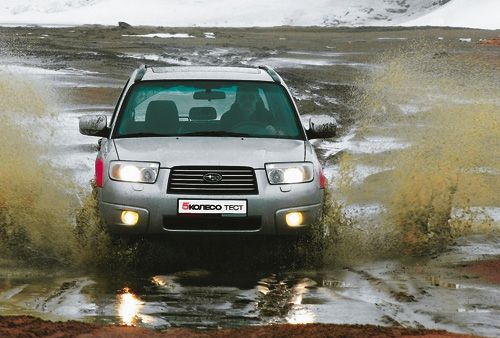
2006 Subaru Forester
© Photo: 5 Koleso
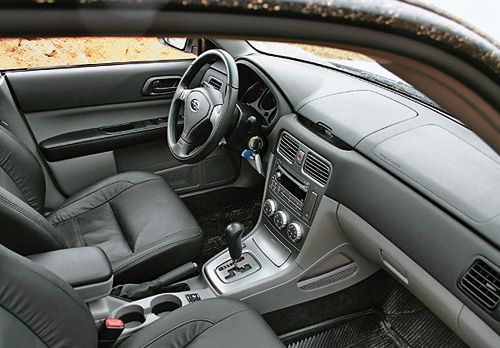
2006 Subaru Forester
© Photo: 5 Koleso
There is space in the cabin in both, but in the RAV4 it is noticeably more due to a more upright seating position — that's why it is taller. In addition, the Toyota's rear seats are adjustable: you can slide them forward or change the backrest angle, settling in with maximum comfort. The Forester's second row cannot boast such capabilities, but even here you can spend time in a long journey with pleasure.
The trunks are almost equal in volume, but the Subaru's is elongated in length, while the Toyota's is in height. The Forester is ready to accept 390 liters, the RAV4 — 450, but only if the rear seats are moved forward. If you slide them all the way back, the cargo area loses about fifty liters. The loading height is similar for both cars, but it is still more convenient to load things into the Forester: its fifth door opens upward, while the RAV4's opens to the side — and to the sidewalk side. To put something from the roadside, you'll have to go around the door. Such is the legacy of right-hand drive.
On the move, the characters of the cars also turned out to be similar. The Toyota is noisier than the Forester, and the noise comes not only from the engine but also from the wheel arches. Strange: we have ridden in the previous generation RAV4 more than once and don't remember such a thing. It seems the issue is precisely in the adjustment of the rear seats. Between the backrest and the pillar, a hand passes freely — right into the trunk, so the backrest doesn't at all hinder the noise from the cargo area. In the Forester, the trunk is reliably isolated by the backrest and the curtain, and the sound from the rear arches is almost inaudible.
Both the Toyota and the Subaru accelerated to a hundred in twelve seconds without much effort and just as calmly held high speed. According to the specs, the maximum speed for both is just over 170 km/h. On a country highway, handling is approximately at the same level, although the RAV4 reacts a bit sharper.
But we were more interested in the off-road section. Especially since the Toyota, unlike the Subaru, allows you to rigidly lock the center differential — which means its cross-country capability should be noticeably better. It should have been, but as it turned out in practice, only slightly better. Any section that the Toyota passed, the Forester overcame just as easily and effortlessly. Except that with the lock engaged, the RAV4 started off a bit more confidently. And otherwise — parity.
In short, this test showed: both cars can be safely put on the scales when choosing. And which way they will tip depends solely on personal preferences for one or the other Japanese brand.
Technical specifications Toyota RAV4 // Subaru Forester
Curb weight, kg – 1505 // 1410
Gross weight, kg – 2110 // 1685
Dimensions, mm:
— length – 4395 // 4485
— width – 1815 // 1735
— height – 1685 // 1590
Wheelbase, mm – 2560 // 2525
Trunk volume, l – 450 // 390
Maximum speed, km/h – 175 // 178
Acceleration time to 100 km/h, s – 12.0 // 11.9
Reference fuel consumption (combined cycle), l/100 km – 9.1 // 7.7
Fuel tank volume, l – 60 // 50
Engine:
— type – inline, 4-cylinder // flat, 4-cylinder
— displacement, cm3 – 1998 // 1994
— power, hp at rpm – 152/6000 // 158/5600
— torque, Nm at rpm – 195/4000 // 186/4400
Transmission – automatic, 4-speed
Tire size – 205/70R16 // 215/60R16
Suspension (front and rear) – independent
Brakes (front/rear) – disc, ventilated/disc
Steering – rack and pinion, with power steering
Price, $ – 37 800 // 36 930.
Advantages and disadvantages
Toyota RAV4
+ Torquey engine, lock in the center differential.
— Insufficient sound insulation, complex center console.
Subaru Forester
+ Power mode in the automatic transmission, symmetrical all-wheel drive, good sound insulation.
— Lack of adjustments for the rear row of seats.
Who won?
All other things being equal, both cars are capable of satisfying the ambitions of a potential buyer. The difference is only that the Toyota RAV4 is a completely new car, while the Subaru Forester is a restyling of the 2002 model. What to choose depends only on your preferences for one or the other brand.
April 21, 2006
Author: Oleg Kalaushin
© 5 Koleso