
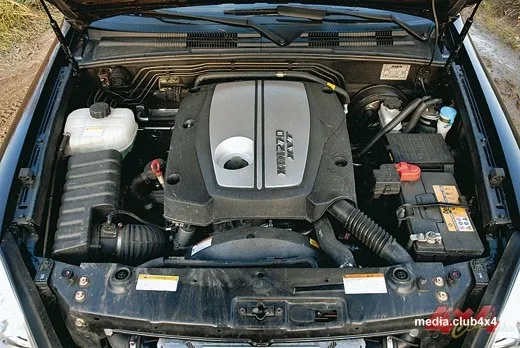
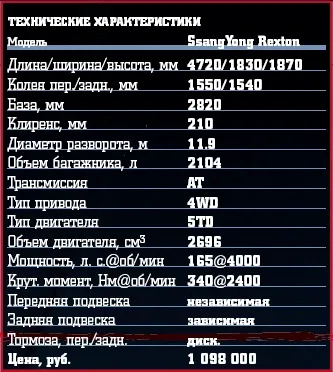
Under the hood of the Rexton II hides a refined diesel unit from Mercedes-Benz — the 270CDI, known for its reliability and durability. True, we will only be able to tell how the Korean modernization affected its lifespan in a few years, when the car appears in our section on used vehicles. Perhaps everything will be fine. For now, the engine only annoys with a dull rumble at idle and an unpleasant whine when the tachometer needle goes into the red zone. With the new engine, the Rexton II accelerates smoothly and quite briskly. It doesn't pull from the very bottom, but then it confidently picks up and holds the pace all the way to the top. There are no factory figures for acceleration, but it's unlikely to reach 100 km/h slower than 15 seconds. The maximum of 170 km/h is only a reality on a long highway with three empty lanes: at high speed, like the petrol version, the diesel Rexton starts to wander across the road. As for fuel consumption, it turned out to be higher than the stated 9.8 liters per hundred. I averaged about 12 liters, although a fair portion of the route was off-road.
CONTROVERSIAL TASTE
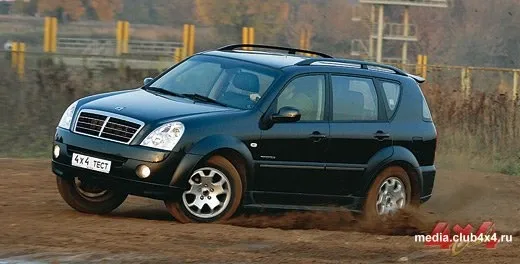
Nothing sparks as much debate around SsangYong as design. The Rexton II in this regard is perhaps the most restrained example. Again the familiar theme of obvious, albeit elusive, kinship with long-time partner Mercedes-Benz, again ovals and smooth shapes from the era of "biodesign." The car was traditionally styled by British designers, but under the strict control of Korean, or maybe already Chinese, now it's hard to tell. It turned out neat, but somehow uncertain. The previous Rexton looked even distinctive, the current one is bland. A typical representative of the middle class in the middle segment...
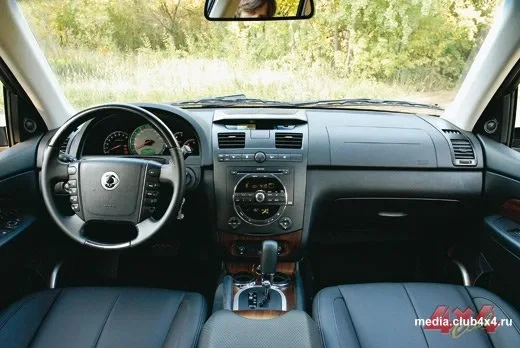
Inside, the changes pleased more. The "wood" trims partially gave way to ordinary plastic, the unusual center console and optitronic instrument cluster hint at a desire to keep up with the times, but certain little details spoil the overall pleasant impression. The interior doesn't give a sense of cohesive styling. Although, perhaps these are too subtle and subjective nitpicks. And anyway, aren't we expecting too much from SsangYong?
The manufacturer didn't overcomplicate ergonomics. The steering wheel is in place, the seats are moderately firm, lumbar support is lacking, but visibility is good and you won't mix up the pedals. In short, everything is usual and without excess. In the back, there's not too much space, but you can sit, and the climate is not harmful to health. Heating and ventilation are dual-zone, with automatic recirculation. The climate control works surprisingly quietly: even on the third speed, no hum or whistle, yet the airflow is powerful!
WORK BEYOND CLASS
The Rexton II now has three drive schemes: classic part-time with low range for versions with a solid rear axle, a semblance of automatically engaged all-wheel drive, and regular permanent all-wheel drive without low range — for cars with fully independent suspension. In other words, in one body, both a real SUV and a crossover coexist...
First about asphalt. A powerful torquey engine, automatic transmission with tiptronic and paddle shifters, independent suspension all around, and permanent all-wheel drive — all this makes driving on regular roads quite comfortable, until you have to turn sharply. The selection of springs, shock absorbers, and possibly bushings is the Achilles' heel of all recent SsangYong models. On small joints and cracks, the car shakes as if in a fever, and on large bumps, you might hit your head on the ceiling.
AND WITHOUT RADICALISM?
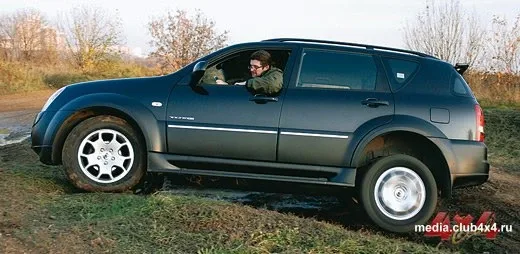
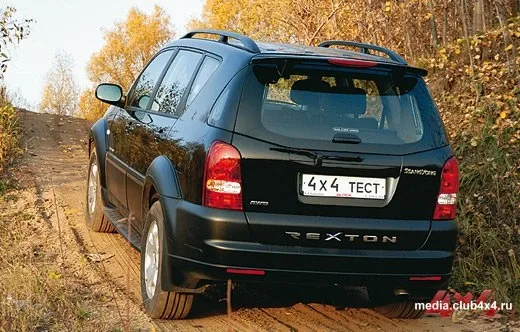
Off-road, the diesel Rexton behaves decently, the main thing is not to go where you shouldn't. Since the car has no low range or center differential lock, it's more correct to treat it as a crossover: don't storm swamps, avoid steep climbs, stay away from plowed fields, and don't turn off the EDC stability system. But the HDC descent assist is better to use, but wisely. The body geometry and engine protection are the same as those of similarly sized crossovers, but the mass is higher (a full 2700 kg!), so the chance of getting stuck in mud is greater. It's the electronic assistants — EDC and HDC — that won't let the wheels spin, help get out of diagonal hanging, hold the trajectory on a slippery slope, and prevent digging into snow or sand. With automatic descent, you need to be careful: the brake pedal should be released in advance, before starting to move, because the system needs time to react. During this time, the car can accelerate considerably, and when HDC finally engages, it brakes too sharply. This is not only unpleasant for passengers but also dangerous: after nosediving, the Rexton II might hit its front bumper on a rock or bump. And its suspension is soft...
For the tested version, they ask 1,210,000 rubles (approximately $49,000). Is the Korean diesel crossover worth that money? Let's put it this way: in this price category, it has plenty of competitors — both among crossovers and full-fledged SUVs. And many of them can offer more for less.
CONTROVERSIAL TASTE
Nothing sparks as much debate around SsangYong as design. The Rexton II in this regard is perhaps the most restrained example. Again the familiar theme of obvious, albeit elusive, kinship with long-time partner Mercedes-Benz, again ovals and smooth shapes from the era of "biodesign." The car was traditionally styled by British designers, but under the strict control of Korean, or maybe already Chinese, now it's hard to tell. It turned out neat, but somehow uncertain. The previous Rexton looked even distinctive, the current one is bland. A typical representative of the middle class in the middle segment...
Inside, the changes pleased more. The "wood" trims partially gave way to ordinary plastic, the unusual center console and optitronic instrument cluster hint at a desire to keep up with the times, but certain little details spoil the overall pleasant impression. The interior doesn't give a sense of cohesive styling. Although, perhaps these are too subtle and subjective nitpicks. And anyway, aren't we expecting too much from SsangYong?
The manufacturer didn't overcomplicate ergonomics. The steering wheel is in place, the seats are moderately firm, lumbar support is lacking, but visibility is good and you won't mix up the pedals. In short, everything is usual and without excess. In the back, there's not too much space, but you can sit, and the climate is not harmful to health. Heating and ventilation are dual-zone, with automatic recirculation. The climate control works surprisingly quietly: even on the third speed, no hum or whistle, yet the airflow is powerful!
WORK BEYOND CLASS
The Rexton II now has three drive schemes: classic part-time with low range for versions with a solid rear axle, a semblance of automatically engaged all-wheel drive, and regular permanent all-wheel drive without low range — for cars with fully independent suspension. In other words, in one body, both a real SUV and a crossover coexist...
First about asphalt. A powerful torquey engine, automatic transmission with tiptronic and paddle shifters, independent suspension all around, and permanent all-wheel drive — all this makes driving on regular roads quite comfortable, until you have to turn sharply. The selection of springs, shock absorbers, and possibly bushings is the Achilles' heel of all recent SsangYong models. On small joints and cracks, the car shakes as if in a fever, and on large bumps, you might hit your head on the ceiling.
AND WITHOUT RADICALISM?
Off-road, the diesel Rexton behaves decently, the main thing is not to go where you shouldn't. Since the car has no low range or center differential lock, it's more correct to treat it as a crossover: don't storm swamps, avoid steep climbs, stay away from plowed fields, and don't turn off the EDC stability system. But the HDC descent assist is better to use, but wisely. The body geometry and engine protection are the same as those of similarly sized crossovers, but the mass is higher (a full 2700 kg!), so the chance of getting stuck in mud is greater. It's the electronic assistants — EDC and HDC — that won't let the wheels spin, help get out of diagonal hanging, hold the trajectory on a slippery slope, and prevent digging into snow or sand. With automatic descent, you need to be careful: the brake pedal should be released in advance, before starting to move, because the system needs time to react. During this time, the car can accelerate considerably, and when HDC finally engages, it brakes too sharply. This is not only unpleasant for passengers but also dangerous: after nosediving, the Rexton II might hit its front bumper on a rock or bump. And its suspension is soft...
For the tested version, they ask 1,210,000 rubles (approximately $49,000). Is the Korean diesel crossover worth that money? Let's put it this way: in this price category, it has plenty of competitors — both among crossovers and full-fledged SUVs. And many of them can offer more for less.