The instructions for this car can be safely set aside. Japanese cars intended for the domestic market do not carry any lofty ideas like "technology as an object of admiration" or "car as a companion." There is not even the concept of "the car is part of the family." The technology itself seems to dissolve, leaving only the function – to get you from one point to another. Comfort as such is absent; there is only convenience. Design is also not sought after – for the Japanese, this word means something more down-to-earth and utilitarian.
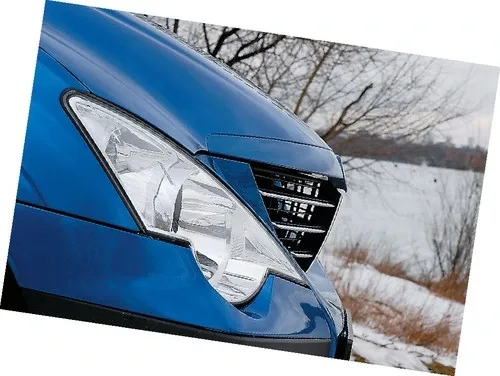
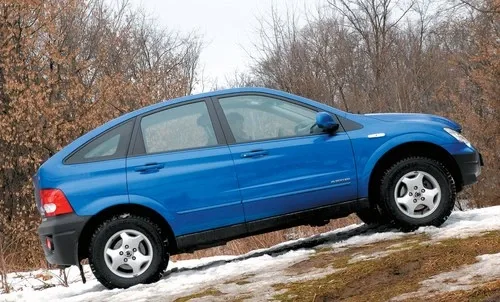
Right-hand drive cars have not a drop of American pompousness and love of luxury, nor European meticulousness in matters of handling and ergonomics. The list could go on endlessly, and one specific car is to blame for this – the round-angular Korean all-wheel drive SsangYong Actyon.
Simply getting behind the wheel and driving to your destination without thinking won't work. This "Korean" provokes thought and raises questions that you want to find answers to. You're drawn to settle down somewhere on a lawn and think it all through to the end, trying to logically justify the existence of such a contradictory creation of engineering thought.
I'll say right away: this car is not for everyone. And it's not even about its bold, not to say daring, design.
CRAWL OR FLY
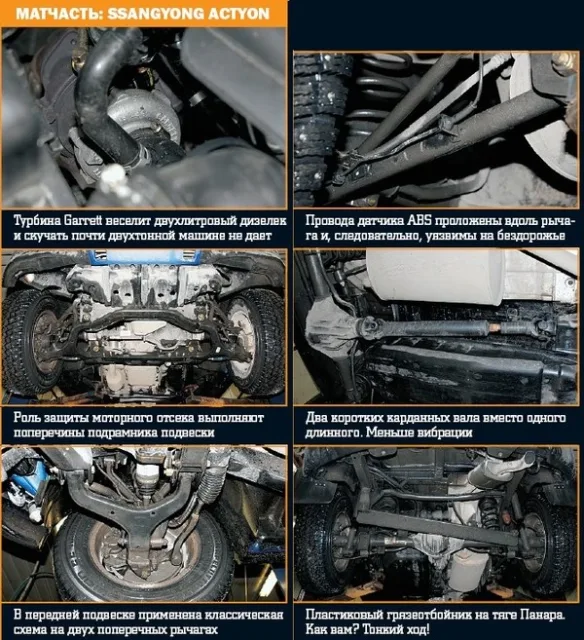
The Actyon is so woven from contradictions that they have become its norm, but I'll still try to systematize them. The "Korean" has a serious engineering base: a classic frame and a solid rear axle. This is usually found in universal SUVs or heavyweights like the Tahoe or Expedition. But the Actyon clearly doesn't fit into that company. Its mass is not that great, and for the title of universal vehicle, it lacks a couple of important details: a low-range gear and a normal trunk (the older brother Kyron has all this). The Actyon's design seems to have declared a strike. Bumpers, optics, slanted body lines – everything resists practicality. It doesn't want to and won't work.
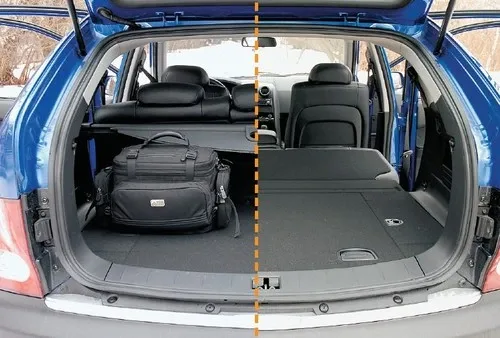
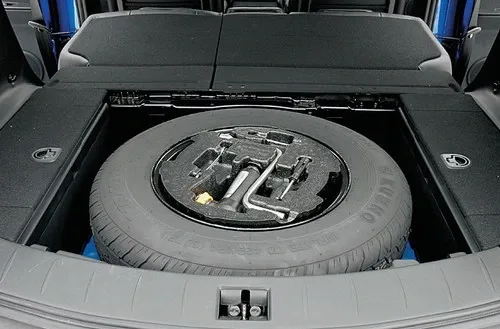
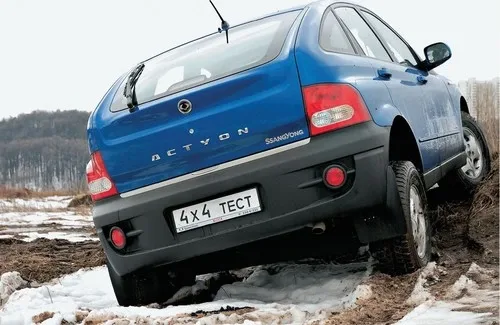
The Actyon was built on the basis of the heavier and longer Kyron. The latter had a spacious trunk, but here they abandoned it. Instead, the full-size spare was removed from under the floor and moved into the cabin. And in its place under the rear overhang, a large void formed, where you could hide a small James Bond curled up in a ball.
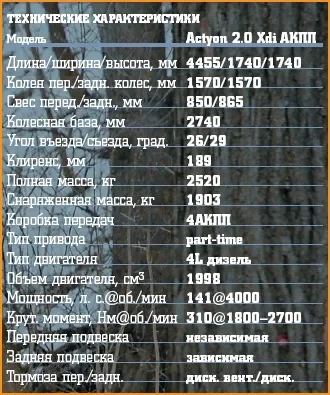
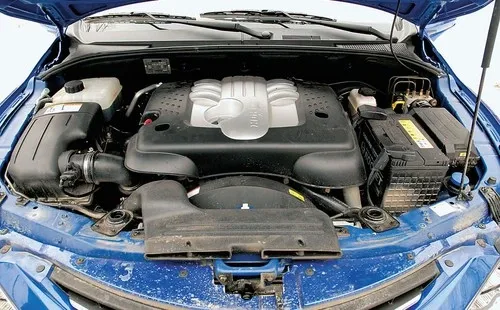
The Kyron also had a proper transfer case. Here it was also removed. As a result, the Actyon's wheels were left alone with the diesel engine, which by budget standards seems simply insane due to its 310 Nm of torque. The engine is excellent: it quickly and confidently buries the wheels in snow, sand, or mud.
The result is something strange. Let me try to describe it again. A body-on-frame diesel machine. But due to the reduced transmission, it's not suitable for off-road. Because of the semi-truck construction, you can't really speed up on the highway either. And you can't carry luggage larger than a tennis bag.
In the city, without parking sensors, it's utterly dreary – due to the design solutions, you can't feel the rear of the car at all. A legitimate question arises for the manufacturer: did you want to make a youth crossover? Such a bold design and deliberately impractical car should be a crossover. And the classic frame and curb weight of 1900 kg are completely unnecessary for it. It seems they simply didn't have enough budget for a new suspension and unibody. I can't find any other reasonable explanation.
EVERYDAY EXTREMIST
It's interesting who would be the person to make such a purchase, and what they would do with this car. The answer is simple: the Actyon owner has no clearly defined tasks. He is an impulsive and frivolous person. A kind of everyday extremist, a romantic accountant. It's on such people that our economy rests. So, without further jokes, let's move on to the test drive.
At the beginning of the test, I made a mistake that you should not repeat. Never get behind the wheel of an Actyon right after European subcompacts. I tested the "Korean" after two days spent driving a Fiat Panda, and was simply stunned by the wild body roll and the complete lack of steering feel. Only the next day, when the impressions of the "Italian" had faded, did I realize: for an SUV of this design, the handling here is quite normal.
The peppy two-liter turbodiesel with common rail system and not-too-large dimensions awakened a desire to actively maneuver between lanes (naturally, within the bounds of testing). During the trip, two almost mutually exclusive facts became obvious: SsangYong is not respected on the road, and SsangYong attracts everyone's attention. The rudeness is quite explainable – a car for $30,000 in Moscow is no longer let ahead. But the fact that in the capital you can surprise someone with a Korean car is a bit strange (even a Lexus RX400h driver pulled out his phone to film me on camera).
KNEES UP
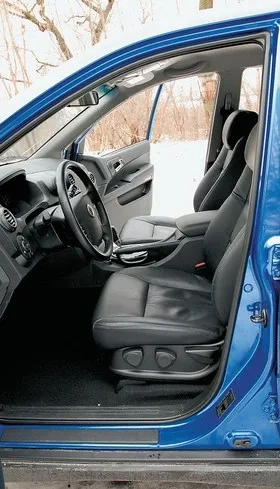
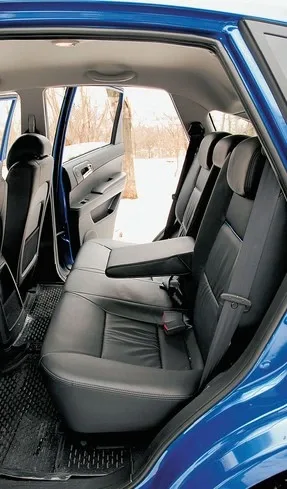
The design is both the strength and the curse of the Actyon. On the outside, it looks great, but inside you feel like a victim of the slanted front end – the ceiling presses unpleasantly on your head. And when you turn around, you realize that the rear pillars, as thick as baobabs, completely block visibility when reversing. In a panic, you start looking for the first aid kit because your heart breaks from the groan of things crushed in the tiny trunk. Sitting in the back is also uncomfortable – the knees of rear passengers end up too high.
It's good that besides the appearance, the "Korean" has other virtues. One of the main ones is the ability to easily overcome bad roads. Potholes, ruts, and bumps are swallowed quite quickly. Pressing the gas before another section of road repair, you don't feel like an executioner of the suspension. Everything happens dynamically and comfortably. For our roads and our driving style, the suspension is tuned just perfectly. The Actyon is not afraid of "speed bumps" and completely ignores tram tracks. It was on these obstacles that I got the most pleasure from the test.
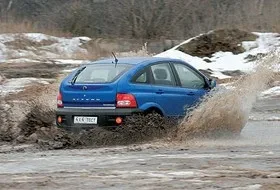
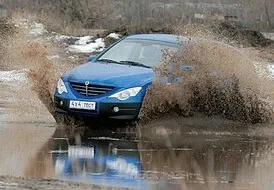
The two-liter diesel is also excellent: it's elastic, torquey, and relatively quiet. Its characteristics are more than enough even for the heavier Kyron.
The gasoline version of the Actyon with a 2.3 L engine was not available in the test fleet. However, it is this engine that is the most powerful and torquey among all all-wheel drive vehicles competing with the Actyon.
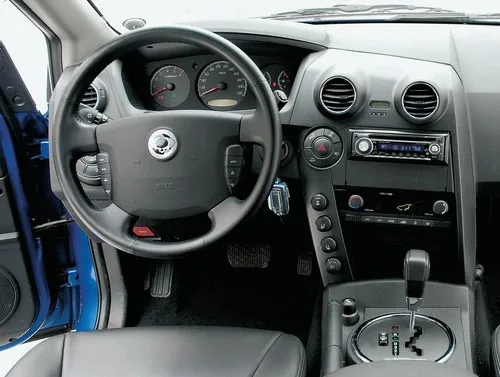
Through the obvious pluses of the engines and suspension, the weeds of the Koreans' ill-conceived ergonomics rudely break through. Why do you have to reach for the automatic transmission lever? Why are the seat heating buttons accidentally pressed by your right knee? Why do you also have to reach for the climate control? Couldn't they have made the rear seat more comfortable, or better yet, completely reworked the entire rear of the body? Again, you want to get out of the car, sit on a bench, and ponder. And here's the thought I come to.
For many car enthusiasts, this car will turn out to be useless and meaningless. Racing it is too heavy – almost two tons of weight and "frame" handling. Carrying cargo – the trunk is too small. And going off-road with such design and without a low-range gear is simply stupid. But all this can be forgotten if you need an inexpensive all-wheel drive vehicle that bounces perfectly over broken asphalt, rails, and "speed bumps." Perhaps I could even become its owner myself, because I rarely need a king of off-road, but a lord of potholes is needed constantly. As for the drawbacks... Have you ever sat in a Chinese pickup truck? If so, then $31,000 for a Korean machine assembled at a plant in Tatarstan (where the "Oka" used to be made), with alloy wheels, an automatic transmission, a modern diesel, ABS, climate control, and power accessories, will seem like a quite reasonable sum.
Expensive? Then $29,000 for a similar car with almost the same options, but with a manual transmission and the most powerful gasoline engine among competitors with a volume of 2.3 liters.
But before assessing the adequacy of the price, answer yourself a couple of simple but extremely important questions: at what speed are you used to driving on the highway, and do you like off-road?