
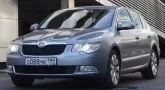
The new Superb faced two challenges. The first is the burden of history: a name that returns to service after a long hiatus. And the second is its immediate predecessor. We at MOTO magazine got to know it better when it stayed with us for a long-term test — over a couple of months we studied it inside and out. The car took all the best from the old Passat but suffered from one significant flaw — it completely lacked an image. And even the phenomenal amount of space for rear passengers didn't make up for that flaw.
Why do I call these problems? Because the new Superb aims for status cars. And past, half-forgotten successes and the dubious reputation of its predecessor are poor allies here. It was necessary to start with a clean slate, which is what they did at Skoda. The segment of affordable business sedans is almost a closed club, and getting in on the first try is difficult. The first modern generation of Superb lingered at the entrance for a long time, never daring to enter. The only plus of that car was that it revived the historical name that had been dormant for almost seven decades. Now it's on everyone's lips again, and the successor has every chance to succeed if it meets the requirements.
The development of the Superb was approached with incredible thoroughness. The car was nurtured like a beloved child on whom great hopes are placed. "Super B," as the Czech flagship is affectionately called by the people, will lead the entire lineup of younger models in the coming years. The face of the whole company directly depends on how it looks and behaves. Our test car had one oddity — a manual gearbox. Moreover, had the trim been simpler, the manual transmission would have looked organic here. Timur Aliev from the Russian office gave us the explanation for this illogicality.
It turned out that the car was from the first batches — there was no choice; we took what was available. The automatic (DSG) costs about 50,000 rubles extra. We've long been familiar with its operation, so I personally was only glad about the "manual." It's a great opportunity to truly test the driving qualities. The first impression of meeting the new Superb is incomparable to what the old one once produced. The exterior is a success — it exudes strength and dignity. The car is elegant, and the expressive headlights look thoughtful and noble. A true leader! Contemplating it gives aesthetic pleasure — this is a refined, very European design. Without flashiness or a desire to show off. Harmony of form and content.
If you cover the Skoda emblem on the steering wheel and put behind the wheel a person who has never been in a Superb, they are unlikely to determine what kind of car this is from the vast VW Group fleet. Or which class to assign it to. There is not the slightest "rawness" in the cabin — the fit of parts and assembly are perfect, as if the model had been on the assembly line for a long time. The materials are excellent. Even hard plastics look solid. Alcantara, wood-like inserts, chrome, and a color monitor with beautiful graphics add a touch of luxury to the interior. Audi? Volkswagen? No, it's a Skoda. Sitting behind the wheel with the optimistic "horseshoe," you realize this is a D-segment car — the width of the cabin and dashboard tells you so. But as soon as the rear door closes behind you, you're transported to a higher class, almost to the executive segment! There's tons of space, comfortable and quiet. There are even footrests on the floor…
True, the footrests never came in handy for me. Looking around more carefully, I realized that it's far from the executive class here. Apart from the air vents and the information display at the end of the center tunnel, there are no amenities in the back. You can't even adjust the temperature. So in the back, it's definitely D-class, but with traditionally improved Skoda layout. Unexpectedly spacious.
And if you move even further, to the trunk? Of course, everyone knows about the Superb's trump card — the fifth door that turns it into either a hatchback or a sedan. This is another confirmation of its cross-class nature. What's more practical or what's more solid? You choose.
So which segment should the Superb be assigned to — affordable business or the usual D? There's no clear answer. It's both here and there. Therefore, the circle of competitors is wide, but I'd highlight three: Toyota Camry, Nissan Teana, and Ford Mondeo. In such company, the Superb looks fitting. And how does it drive compared to them? A comparative test is an objective thing, but after a weekend behind the wheel, I concluded: in its "cross-class" niche, it's the most agile. It drives in a German way. Piech's unification genes have blossomed — the Superb feels like an Audi, VW, and SEAT all at once. That's its strength. I don't want to nitpick, and there's nothing to nitpick about. Except perhaps the overly firm suspension — all three competitors ride smoother. But that doesn't mean passengers suffer in the Superb. A lot depends on the driver here.
And the driver behind the wheel is only happy. The 1.8-liter engine is sufficient, shifts are precise, body roll is minimal, and the electric power steering is very informative. You set the car on a trajectory in a fast corner — it goes through without a single squeak of the tires. Excellent tuning! The responsiveness is such that it feels like you're in a car a class lower. Though it's unclear — D or C? In any case, the question of the Superb's class isn't the main thing for me. I was interested in whether Skoda managed it. The answer has been received. The new Superb is a true leader and flagship, a fully realized solid car. For both the driver and the passenger. The only thing hindering it now is unformed public opinion. But wait. I think the issue will be resolved in favor of the Czech model. After all, opinion is formed from positive facts, and the Superb has plenty of them.