Stop, Desire
We all remember the story about the golden fish and the old woman who never managed to become happy. And what was her happiness? Maybe in a new trough? Or in a noble title? No — she just needed to stop in time. It's the same with cars: at first, a ten-year-old Volkswagen Golf seems like the ultimate dream, then you want a Ford Mondeo, and at the end of this race for size and price, even a Mercedes S-class no longer seems prestigious enough. But where is that very stopping point? The Czechs offer their answer — the new Skoda Superb.
 |
New Skoda
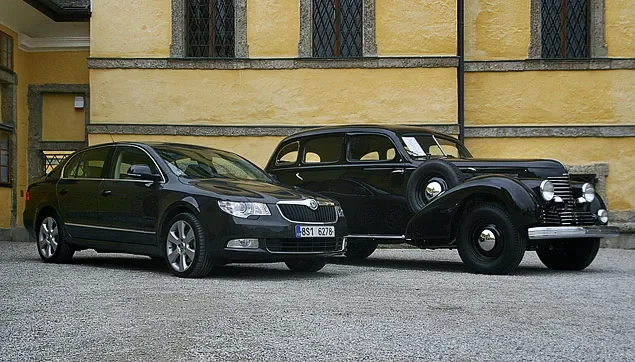
The previous Superb, frankly, wasn't quite a "Skoda." Volkswagen, which owns the Czech brand, decided to run an experiment: would there be people willing to pay three times more for a "Skoda" than for a Felicia? But Germans don't like wasting money, so in the early 2000s, engineers in Mlada Boleslav were given a ready-made Chinese Passat and some funds to turn it into a Skoda. They only managed to change the radiator grille, headlights, instrument dials, and the rear door trim with a niche for an umbrella. However, the experiment succeeded — over a hundred thousand such "Superbs" were sold in Europe. So it was decided to make a second generation, and this time the development was entrusted to the Czechs themselves. Not from scratch, of course — it's based on the Golf/Passat platform — but the car got its own face, style, and unique features. The main one is the Twindoor double door.
By the way, I always thought that large and expensive hatchbacks were a thing of the past. They were once popular, but by the 90s they remained only with the French (Citroen and Renault), and attempts to revive the "five-door business class" like the Renault Vel Satis, Opel Signum, or Fiat Croma failed miserably. Now the basic body for the D- and E-class (and the boundary between them is becoming increasingly blurred) is considered to be the sedan. But Skoda remembered the old idea... and, it seems, hit the mark.
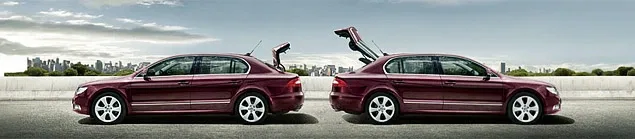 |
Formally, there's nothing revolutionary here: the Czechs made a hatchback where rear passengers don't get blown when the trunk is open. A similar scheme was once devised by the French, placing an additional glass behind the fifth door of the Citroen XM. But around the Superb, for some reason, a crowd always gathers, and everyone looks at the fifth door. At the Geneva Motor Show, the public watched from morning to evening as the Superb turned from a sedan into a hatchback and back with one button. Later, at the Austrian test drive, passersby stopped, pointed, and the boldest approached and asked questions. Unfortunately, in German.
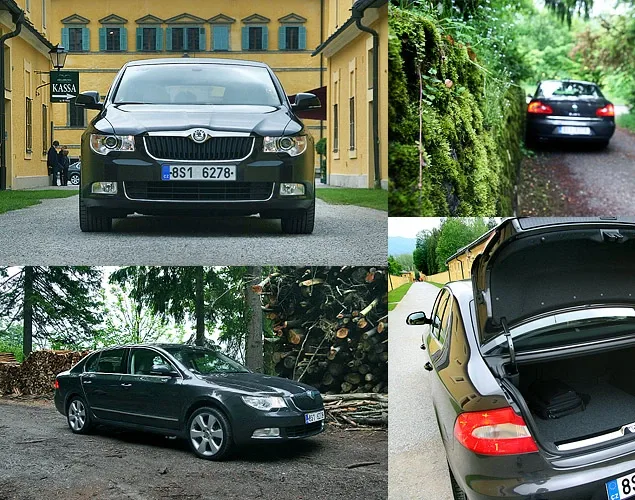 |
Back then, I could only answer "nicht sprechen." And now I can tell you: Twindoor is a technology and at the same time a trademark for which Skoda received a patent. Making the door itself, which folds in two, wasn't difficult, the Czechs admit. But they had to tinker with the sealing system. Now Skoda wants to make such a door its calling card — most likely, it will appear on other models in the coming years.
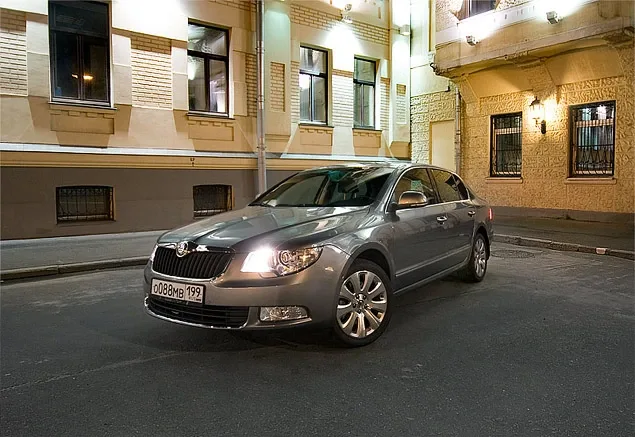
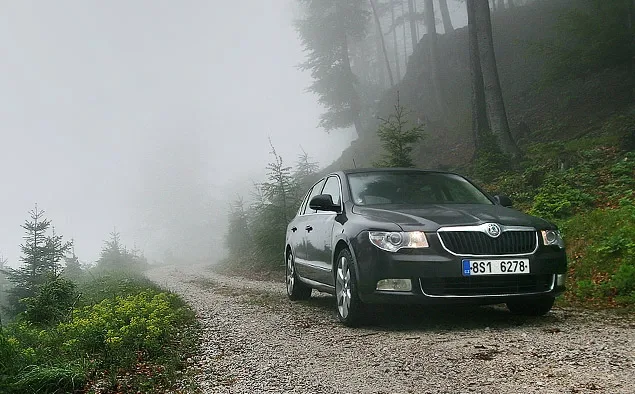
If you think about it, the double door not only increased the cost — it seems to me, it also tied the designers' hands. After all, frankly, the new Superb is hard to call truly beautiful. Original — yes. Solid — yes. Interesting — yes. But to maintain body rigidity, the rear pillars had to be made very wide. Marketers, of course, say it's intentional: they say passengers' heads are now not visible, like in a Bentley. Maybe, but the "Superb" lacks that English elegance for which Bentley is famous.
 |
So who and why needs such a car? The answer is simple — "Skoda" has its own audience. Once these were people who wanted to buy a cheaper car — they chose the "Felicia." Then the Octavia appeared — "for the young and family-oriented"...
Ten years passed, and those who drove the then "Skodas" have grown up in every sense. Now they are not just "young and family-oriented," but successful businessmen. But not those who switch to stuffy "Mercedes" at the first opportunity, but those who don't like to shout about their status. Those who aren't ashamed to wear an Armani jacket with jeans from a London sale. Those who on weekends might stop by IKEA, bring home a wardrobe, and assemble it with their own hands. These are the potential buyers of the Skoda Superb. In Europe. And for them, as the Czech marketers calculated, the main thing is how the car looks inside, how cozy it is. So the developers put the most effort into the interior.
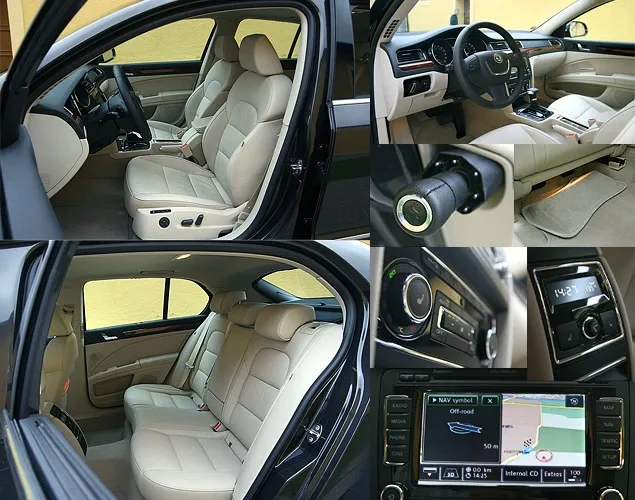 |
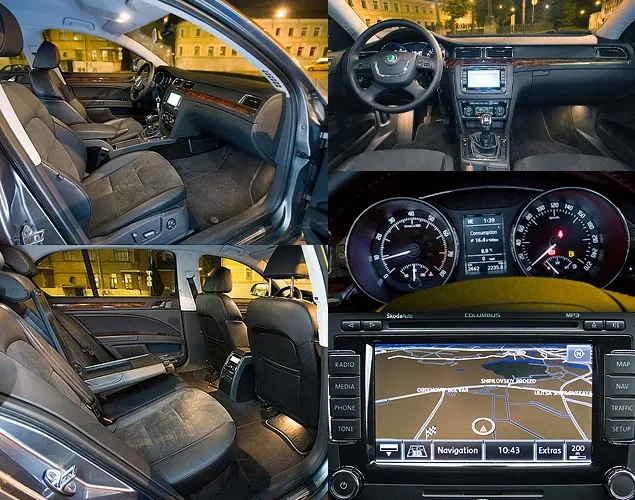
And not in vain. At first acquaintance with the car, you open your mouth in surprise — the Skoda looks more expensive and "premium" than its older brother, the Volkswagen Passat. There's no hard, booming plastic here (and journalist hands, as you understand, feel even what's impossible to reach), instruments with almost jewelry-like calibration, many (but not too many) chrome "accents," and finally, a pleasant green-white backlight instead of the Passat's deathly blue with red. Skoda folks say it's a "conscious" color — it matches the shade of the emblem.
The first-generation Skoda Superb was famous primarily for its rear passenger space. The new car has even more reasons to boast — both the double door, and a multimedia system with a 30-gigabyte hard drive, and an adaptive lighting system that narrows the light beam with increasing speed... But in terms of cabin space, the Skoda is also among the class leaders — after all, despite the base being reduced by 4.5 centimeters compared to its predecessor, the new layout with a transverse engine allowed preserving all the "living space." So in the back of the "Superb," it's still spacious and free, like in a long-wheelbase S-Class.
Mr. "Superb"
And how does the new car drive? Magnificently! Superb! The comparison with the "Passat" comes to mind again. Here is the same almost perfect German ergonomics with moderately firm and "dense" seats, the same powertrains, almost the same suspension. Only for some reason the car feels much cozier and more human. For example, the gasoline engines with direct injection here lack the Passat's almost diesel-like sound — the Czechs say they worked seriously on this.
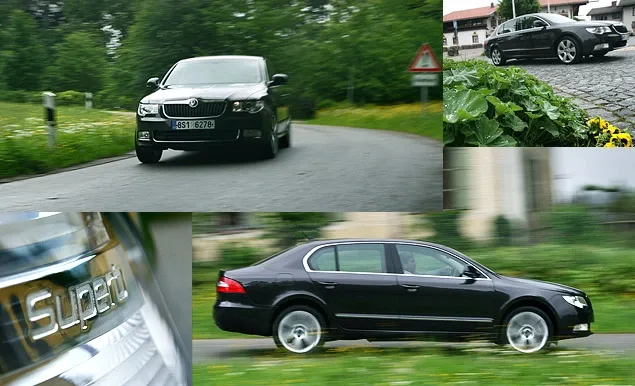 |
The "Superb" has a composed but not stiff suspension — moreover, with astonishing energy intensity. Excellent sound insulation, an informative yet "transparent," not overloaded steering wheel. Superb!
Five engines are planned for the new "Skoda." The model range opens with four-cylinder gasoline engines with direct injection and turbocharging (1.4 L, 125 hp; 1.8 L, 160 hp), and for the top version, a naturally aspirated V6 with a volume of 3.6 liters and 260 horsepower is offered. A 1.9-liter diesel is installed on the Greenline modification — the most "eco-friendly" of the flagship Skodas. The engine, which developed almost 150 hp on the Fabia RS, is detuned to 105, and the gear ratios in the transmission are made "long" — all to reduce "appetite" and CO2 emissions. For those who like to "have fun" on diesel — a two-liter diesel with 170 horsepower.
Interestingly, none of the engines is paired with a traditional "automatic" — for the "weak" engines (1.4 TSI and 1.9 Greenline), only a "manual" is provided, and for powerful engines — also a robotic DSG gearbox with two clutches (seven-speed for the 1.8 TSI and six-speed for the two-liter diesel). And the flagship of the lineup — the Superb 3.6 — is available only with DSG and all-wheel drive.
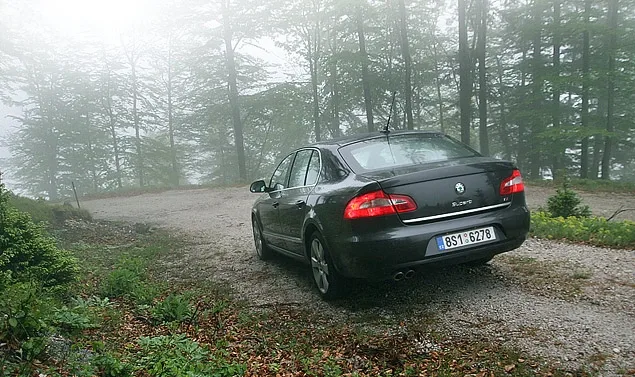
In Russia, most likely, the Superb version with the 1.8 TSI engine will be the most popular. This unit is a completely new variation of the turbo engine of similar displacement, which is already well known to Russians from the Volkswagen Passat. It's quite peppy, economical, but slightly sluggish at low revs. I was much more curious to try the car with the turbocharged "four" 1.4 TSI. It's logical to assume that such a large car as the "Superb" with this engine would be frankly slow. However, in reality, it's different: thanks to low-pressure turbocharging, the car starts briskly almost from idle, although a slight sluggishness and a barely noticeable "turbo lag" are still present. And a noticeable difference from the 1.8 version appears only at speeds over a hundred. As for fuel consumption in the car with the 1.4 — judging by everything, it will be a very pleasant surprise.
 |
When it comes to diesels, I was lucky enough to drive only the powerful two-liter Superb paired with a DSG gearbox. As is typical for Volkswagen engines, the working range here is quite limited — roughly from two to four thousand rpm. However, thanks to the dual-clutch transmission, which shifts gears very quickly and completely imperceptibly, the engine always stays "on its toes," allowing all 170 horsepower to be used to the fullest.
Sales of the second-generation Skoda Superb in Russia started right after the Moscow Auto Show. All modifications are brought to us except the Superb 1.9 Greenline — obviously, there will be no demand for such puny, albeit eco-friendly, "sedan-hatchbacks" here.
Prices... Perhaps it would be more accurate to say — interesting. On one hand, 790 thousand rubles for a car with a 1.4 engine in base trim is more expensive than what they ask for a Passat, and noticeably more than a Ford Mondeo, which has become significantly cheaper with the start of Russian assembly. But on the other hand, the Superb already comes with climate control, an MP3 stereo, alloy wheels, an umbrella compartment, and, of course, the signature dual rear door in "standard" trim. And besides, who said IKEA shoppers only buy cheap things? They buy what they like, and in large quantities. The main thing is to stop in time.
Meanwhile in Russia... Mikhail Tsymbal
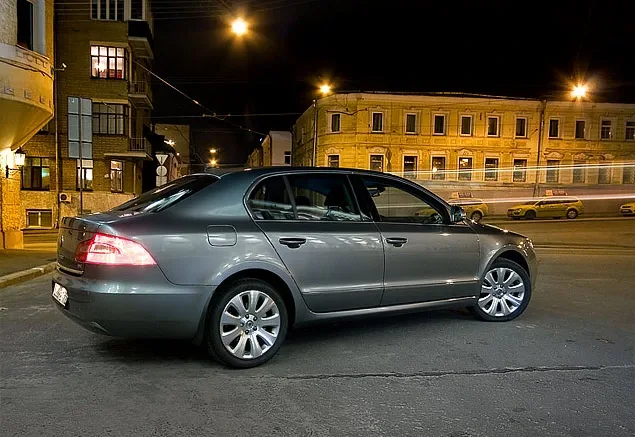
A few days before this article was published, we gave the Superb a short test drive directly in Moscow. The "sedan-hatchback" we got had a 1.8 TSI engine, which Dima above predicted would be the most in-demand in Russia. But the gearbox turned out to be not at all popular here — a six-speed manual. Although, most likely, in our country such cars will be bought exclusively with an "automatic." More precisely, with the seven-speed DSG "robot." However, the test car was equipped with almost all available options for the Superb: active headlights, an advanced multimedia system with a hard drive and Russian (!) navigation, as well as the Park Assist parking assistance system. This, by the way, is such an amusing thing that, perhaps, every new Skoda Superb owner will long agonize over what to show off to friends first: the fact that the car "parks itself," or the Twindoor transformer door. From the rich list of options, our Superb lacked only the sunroof with electric drive and solar panels, the Webasto auxiliary heater, and mechanical sunshades on the rear doors. But even without them, the car's price was a hefty 1.112 million rubles.
By the way, about navigation. To be honest, in its current form it's inconvenient to use. And it's not about the interface: that's fine thanks to the large touchscreen display and clear menu structure. The problem is that the Superb's navigation system doesn't know many Moscow streets or even entire residential areas. Not to mention small alleys or densely built courtyards. So until more detailed maps appear, it can only be used as a regular map. As for the other functions of the Superb's multimedia system, there are no complaints at all — a pleasant interface, a built-in hard drive that can hold a decent music collection, and excellent sound! And it's best to enjoy it from the rear seats. Yes, yes! After getting the Superb at the dealership, the first thing I did was not get behind the wheel, but go to the back — I wanted to check if the new sedan had become more cramped due to the new platform with its complex rear suspension, since the old torsion beam was more compact. It hasn't! There's still not just a lot of space here, but A LOT. In terms of rear legroom, the Superb can easily compete even with the long-wheelbase Mercedes S-Class — let alone regular sedans! Even my favorite footrests haven't gone anywhere. And the umbrella in the door is still there. The first impressions from riding in the back seat of the Superb — the new car has become noticeably more comfortable and quieter than its predecessor. Except, perhaps, for overly noisy tires: their hum is practically the only extraneous sound entering the cabin, especially on rough asphalt. At the same time, neither the engine nor aerodynamic noises are almost audible inside. And the rear axle no longer thumps at joints, and passengers don't notice vibrations from small bumps, waves, or cracks in the asphalt at all: at small suspension travel, the ride is amazingly comfortable. But I wouldn't call the Superb's chassis languid, like, for example, the Toyota Camry or some "American." On the contrary, the suspension feels European-assembled and dense, but its tuning has that very refinement that distinguishes a German car (even with a Czech passport) from any other.
Behind the wheel, the almost five-meter Superb doesn't feel big: quick but smooth responses to steering inputs, a responsive gas pedal, and superbly tuned brakes that allow you to modulate deceleration with pharmaceutical precision. And, of course, an excellent 160-horsepower engine that pulls always and everywhere! The capabilities of this 1.8-liter engine combined with an honest manual are enough in any situation: want to accelerate sharply — go ahead! 250 Nm of torque, available from 1500 rpm, pulls the one-and-a-half-ton "sedan-hatchback" literally from idle, even in sixth gear. Moreover, unlike other turbo engines, it doesn't go flat as revs rise, but happily spins to the redline. But on the Superb, you don't want to "drive aggressively" at all... On the contrary, here you want to drive measuredly and smoothly, especially if there are passengers in the back. You want to start off gently, accelerate smoothly but powerfully, and brake just as smoothly. You want those sitting in the back to feel cozy — just like the driver feels, surrounded by beautiful instruments with soft white or green backlighting. Who sits in comfortable seats with leather-suede upholstery and a host of adjustments. And around whom the radio "Jazz" softly plays, under which it's so pleasant to admire the views of nighttime Moscow. Especially from the rear seats... Technical specifications of the Skoda Superb 1.8 TSI
|