
Czech Combi'nator
We have already told you about the new Superb. But to be honest, during the tests of the hatchback (which is more correctly called a "sedan-hatchback"), we never fully understood for whom the Czechs made this car and who actually needs it. On the one hand, due to its large dimensions and solid interior finish, the flagship of the Czech lineup easily qualifies for the executive level. But on the other hand, the Skoda brand is still associated with an inexpensive Eastern European alternative to Volkswagen, and with such an image, it is not easy to compete for the attention of businessmen and officials.
Without "show-offs"
Unification
The Skoda Superb Combi wagon, like the hatchback, is based on the stretched platform of the latest Volkswagen Passat with the internal index B6 PQ46+. Despite the abundance of letters, the Superb has only two close "relatives" — the Volkswagen Passat itself and the Passat CC. |
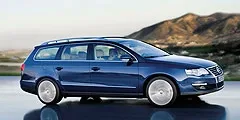
However, after the presentation of the Superb Combi wagon, held in mid-October near Milan, we finally understood why and how this model came to be. Apparently, the creators of the Superb simply decided to make a car in which all the key "Skoda" virtues — spaciousness, functionality, and meticulous interior work — would be revealed more strongly than in any other car from Mlada Boleslav. In short, they gave free rein to their working perfectionism.
The idea is not new, but at first, when the Superb just debuted, there was much talk that Skoda was going to create an image model capable of competing almost with premium brands. But after the appearance of the wagon, there was no doubt left: the main task of the engineers was to make the most practical and comfortable car in the "D" class. And there is no need to look for executive pomp here.
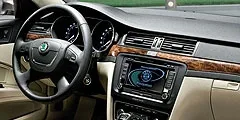
Although it is present: expensive leather, seats with memory settings, an audio system with a 30-gigabyte hard drive and eight speakers, and a full arsenal of active and passive safety systems. But all these "bells and whistles" take a back seat — their purpose is not to impress, but to make trips in the car as comfortable as possible.
In practice
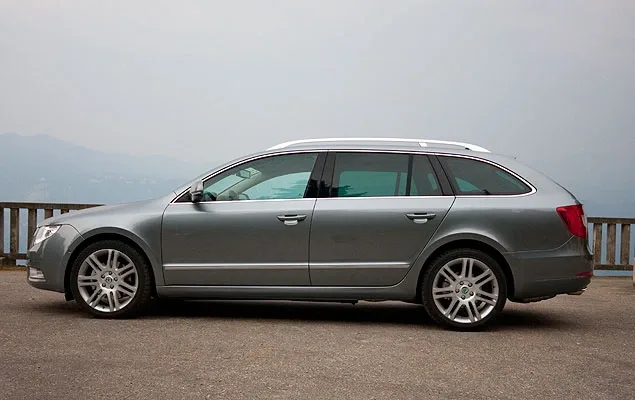
The main trump card of the Superb Combi is its unconditional spaciousness and practicality. Thanks to the long wheelbase (2761 millimeters, same as the "sedan-hatchback"), there is plenty of room in the rear seat of the Superb even by executive segment standards. And, of course, the Czech wagon has the largest trunk in its class — 633 liters. For comparison, this is almost twice as much as in most golf-class cars. And with the rear seats folded down, the useful volume of the Superb's cargo area grows to 1865 liters.
At the same time, the "Skoda people" took care not only of the cargo capacity of the wagon but also of the convenience of using it. For example, they remembered those who would dirty their trousers on the bumper while trying to get bags from the depths of the bottomless trunk, and came up with a mechanism that allows the false floor, which covers the lower compartment with the spare tire, to slide outward. This innovation also reduces the risk of scratching the rear bumper when loading heavy items.
Interior
|
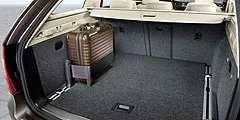
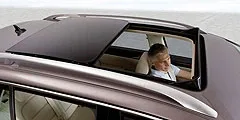
For the Superb Combi, an electrically powered tailgate is optionally available, and when it opens, the curtain covering the trunk automatically retracts halfway. And such pleasant little things as hooks for bags (there are six of them here) and a standard flashlight that attaches magnetically to any metal surface are included in the basic equipment of all wagons.
Find five differences
Otherwise, the Combi is almost no different from the hatchback — "Volkswagen" engines, the latest fourth-generation Haldex all-wheel drive, a six-speed manual, as well as six- and seven-speed robotic DSG gearboxes. In short, that very "filling" without which Skoda cars would hardly be so popular today.
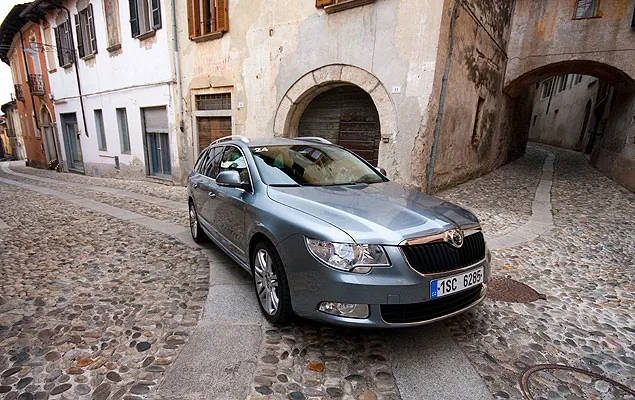
As a result, in motion, the wagon behaves the same as the "hatch" — the exemplary German handling inherited by the Czech flagship from the Passat along with the chassis has not gone anywhere. The car responds clearly, but without nervousness, to the driver's actions, and this feeling is facilitated not only by the competent settings of the power steering but also by carefully selected characteristics of the shock absorbers and springs, thanks to which the Superb confidently, without rolls and pitching, goes through any turns.
There are also no complaints about the energy intensity of the suspension — the Superb Combi easily "swallows" large irregularities like speed bumps. But at the same time, the car quite detailedly transmits to the driver information about all the small cracks in the asphalt encountered along the way. Perhaps this is a feature of the Superb wagons specifically — in this modification, the rear suspension is reinforced with heavy luggage in mind.
Good heredity
The Superb wagon (like the hatchback) has five engines inherited from Volkswagen: three gasoline and two diesel. And all five can be safely recommended — even the base 1.4 TSI gasoline engine with 125 horsepower provides decent dynamics for a large car. True, to feel the pickup, you will have to rev it up to 3500–4000 rpm, and at such frequencies, the sound of the four-cylinder engine persistently breaks through the sound insulation into the cabin.
But with the 1.8 TSI with 160 horsepower, the Superb Combi drives excellently even from idle — this engine reaches its peak torque of 250 Newton-meters at 1500 rpm. In fact, the 1.8 TSI is the most balanced engine for the Superb: it provides both decent acceleration to 100 km/h in 8.7 seconds and moderate fuel consumption (7.3 liters per 100 kilometers in the combined cycle). In addition, for the wagon with this engine, you can order both a six-speed manual and a seven-speed preselective DSG gearbox, and even Haldex all-wheel drive.
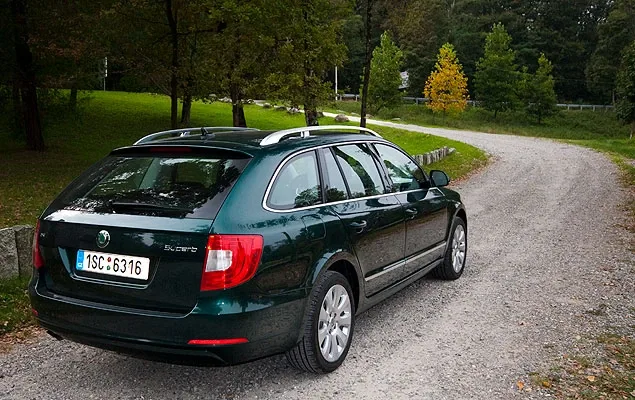
But buyers of the Superb Combi with a V-shaped "six" of 3.6 liters do not have such freedom of choice: the wagon with a 260-horsepower engine is not sold without all-wheel drive, and only one gearbox is available for it — a six-speed "robot" with two clutches.
However, this is the most dynamic car — it accelerates to 100 km/h in 6.6 seconds. True, you don't want to "rev" the Superb because of its size. Especially after glancing into the cabin rearview mirror and seeing that the fifth door is about four meters behind.
And in general, by temperament, the Superb suits both two-liter diesel engines best, which are not yet supplied to Russia. The weaker one develops 140 horsepower, and the more powerful one — with the Common rail system — already 170 horsepower. In principle, the 140-horsepower one is enough for the wagon, which reaches 320 Nm of torque already at 1800 rpm. And the 170-horsepower engine produces 350 Newton-meters.
Conclusion
To sum it up briefly, the Czech engineers managed to create a truly convenient and the most comfortable car in the entire Skoda lineup — even the Yeti crossover, which is not yet sold in Russia, yields to it in this regard. But here's the catch: by focusing solely on practicality and coziness, the creators of the Superb completely forgot about the exterior. From some angles, the car looks awkward — the stretched Passat platform combined with simple door stampings makes the hatchback look like a wedding limousine, and the estate resembles a giant thermometer.
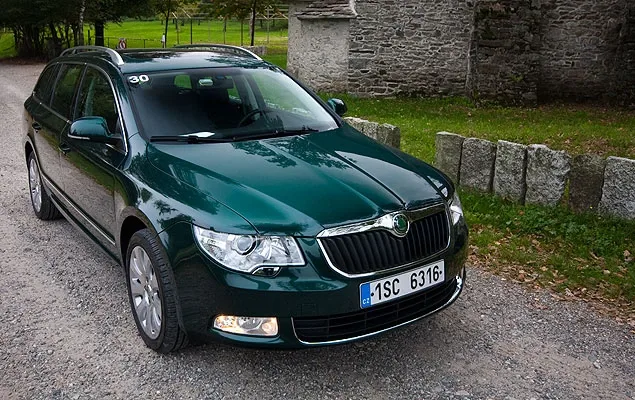
Nevertheless, the Superbs have already managed to gain their audience, and the estate has every chance to find fans here as well. The secret is that the unusual concept of the Czech flagship has formed a circle of loyal buyers around it.
We are talking about current owners of Fabias, Octavias, and Roomsters, who have already grown attached to their cars. When they want something more from Skoda, they will surely pay attention to the Superb. And in the estate body, this car becomes even more practical, and for a loyal brand fan, its value increases manifold.
Alternative
|
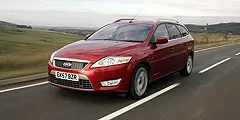
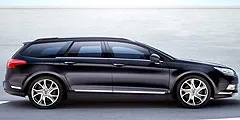
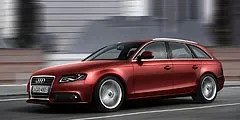
Of course, the Czech flagship will also appeal to those who have not dealt with Skoda before, but in my opinion, there will be noticeably fewer of them than brand loyalists. In Mlada Boleslav, they are unlikely to worry about this — the army of Skoda fans is growing steadily and quite quickly. Moreover, the Czechs managed to become one of the few automakers whose sales did not fall during the crisis but, on the contrary, went up.
Technical specifications of Skoda Superb Combi 1.8 TSI
| Length, mm | 4838 |
| Width, mm | 1817 |
| Height, mm | 1510 |
| Wheelbase, mm | 2761 |
| Curb weight, kg | 1533 |
| Engine displacement, cm3 | 1798 |
| Power, hp/rpm | 160/4500-6200 |
| Torque, Nm/rpm | 250/1500-4500 |
| Acceleration time from 0 to 100 km/h, s | 8.7 |
| Maximum speed, km/h | 218 |
| Fuel consumption in combined cycle, l/100 km | 7.3 |
| DISCUSS | [ comments: NONE ] |