
Škoda Octavia Scout. Be prepared — always prepared!
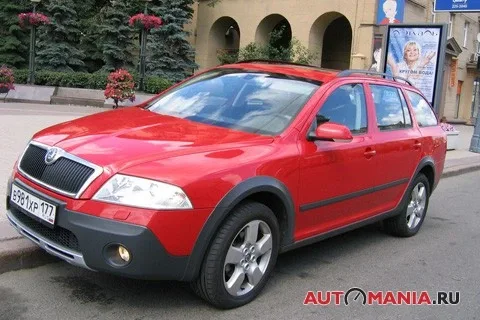
The Czech engineers turned out to be remarkably far-sighted, releasing the Scout right in time for the centenary of the Scout movement. Our test car coincidentally matched this date — August 1.
The idea, it would seem, lies on the surface: take a regular estate, equip it with all-wheel drive, raise the body, hang plastic body cladding and retune the suspension. Voila — here is a car that blurs the boundaries between an SUV and a regular passenger car. Competitors have been using this recipe for a long time: the Volvo XC-70, built on the basis of the V-70, the Audi Allroad from the A6 Avant, and the Subaru Outback, which used to be an estate but is now only a hatchback. We do not include the Subaru Forester in this list — it never had a donor in the form of an estate. The VW Group plays with such experiments the most. Besides the Allroad, there is the Cross Golf, which is not officially available to us, the Spanish Seat Altea Freetrack, which we recently drove, and our today's subject — the Octavia Scout. If the Allroad is a separate story with a price tag of nearly 2 million, the XC-70 is a classic of another division, and the Outback has lost its estate body, then it turns out that the Scout will compete only with its own "classmates" within the group.
Let's look into the essence. The Freetrack and Scout stand on the A5 platform from the fifth-generation Golf, on which the Jetta, Touran, Octavia, Toledo, Altea and, surprisingly, the Audi TT are based. There is no direct competition between them, and the Scout itself is pure marketing and a designer's invention.
A cocktail the Volkswagen way
The interior greets you with familiar features. The dashboard is from the Golf, but with one difference: the scales for engine temperature and fuel level are placed at the top, not the bottom. The speedometer and tachometer are identical. It is good that the night lighting is not red, like in Audi, but a soft greenish — the eyes do not get tired. True, the brightness of the on-board computer display is not adjustable, unlike the instrument lighting, but due to the pleasant shade, it is not too annoying.
The steering column stalks are a familiar mix from VW and Audi, especially the algorithm for controlling the on-board computer. The center console is in the spirit of the Passat, but stricter, all in dark tones. Only bright inserts are missing. The interior is trimmed with soft rubberized plastic. The seats, upholstered in leather with Alcantara, look expensive and solid. There are many adjustments, but all manual. Alcantara is not only beautiful but also practical — you do not slip on it, the seating feels secure, and the lateral support is good. In winter, such a seat is not icy, in summer — not scorching. The driver and front passenger have access to dual-zone climate control, and seat heating is available both front and rear. So after a winter fishing or hunting trip, you can warm up quickly.
The steering wheel adjusts both for height and reach, though also manually. Even if you get into the car in complete darkness, you immediately understand who you are dealing with. On the glove box, there is an off-road grab handle, and on the lever of the 6-speed "automatic" — the inscription 4×4. First impression: inside, the Skoda is assembled solidly, monumentally, and if it were not for the badge on the steering wheel, it could easily be mistaken for a VW.
Under the hood — the same VW
And if you look under the hood, everything is familiar there too. The traditional 2-liter FSI engine with 150 horsepower, which we remember from the Passat. Note that FSI engines are picky about fuel and do not digest 92-octane gasoline. So before a trip to the countryside, it is better to make sure there is normal fuel there. The gearbox is only manual, but do not expect explosive dynamics: acceleration to 100 km/h takes 10.0 seconds.
But the engine pleases with torque. Accidentally engaged fifth instead of third — the Skoda will still go. In the city, you can calmly drive in 5th and 6th gears. The engine is almost inaudible in the cabin; a light hum reminds you of movement, and if the sound becomes louder — it means the tachometer needle has approached 5000 rpm.
Champion in the trunk
The chassis is perfectly balanced: the suspension swallows serious bumps without unnecessary jolts. Compared to most crossovers, this "wagon" drives just wonderfully, only in sharp turns, due to the length and high ground clearance, slight rolls appear. The brakes are exemplary, convenient and well-thought-out, as befits the Germans.
An estate should be spacious and convenient for loading. The Scout is in perfect order here: 580 liters in the normal state and 1620 liters with the seats folded down, which form a flat floor. Not all SUVs can boast such figures, let alone "raised" estates. The Allroad has a volume of 565 liters, the XC-70 — 575, and the Forester — only 450. The trunk is so deep that you have to reach to the backs of the rear seats. From the outside, you would not think there is so much space inside. The loading height is small, the opening is wide, the shape is correct, without protruding parts. And also, on the floor and on the sides, there are mesh holders hung so that things do not roll around the trunk.
Risk of getting a fine
Under the floor lies a full-size spare wheel, but it can cause a fine if a too-attentive traffic police inspector catches you. Traffic rules prohibit installing tires of different sizes on one axle. The spare in the Scout is 205/50 R17 on a stamped disc, while the car has Dunlop SP Sport 225/50 R17 on alloy wheels. So, although the spare is not a space-saver, in case of a puncture it is better to immediately look for a tire service.
Made for our roads
And what about off-road capability? Maybe the car is destined to conquer city curbs and jump over broken tram tracks? The Scout has a solid ground clearance — 185 mm, 15 mm more than the popular Nissan Qashqai. The "scout" is far from the XC-70 with its 210 mm, but it has already caught up with the Allroad in terms of ground clearance.
And here the Scout shows itself well. Below is an impressive steel sheet covering the engine compartment, so you can drive on forest roads and snow without fear. We did not venture into serious off-road this time, but once Moscow was hit by a downpour. The sewer system, as usual, could not cope, and on my street in a lowland a whole lake formed, in which several cars got stuck. A couple of SUVs risked crossing, and I wondered — should I? I regretted that there was no "magic button" like on the Allroad that raises the body, but I remembered the 185 mm and decided. The SUV drivers were surprised, but the Skoda did not let down and confidently overcame the water obstacle.
Like its relative, the Seat Altea Freetrack, the Scout is equipped with the same all-wheel drive system. The rear axle is engaged automatically at the slightest wheelspin via the electronically controlled Haldex coupling. During sharp starts on slippery surfaces, a partial lock engages, eliminating excessive wheelspin — this is very useful on snow.
Concluding the off-road topic, it is worth noting that the approach and departure angles of the Skoda are decent (although they are not specified in the characteristics for some reason), so light off-road is within its power. The center of gravity is low, so you can safely tackle climbs and descents diagonally without fear of tipping over. It is only a pity that there is no low-range gear. Driving the Scout is a pleasure; you feel confident and safe, especially when the asphalt ends.
Fuel consumption pleased. Usually, manufacturers underestimate the appetite of their cars, but here it is the opposite. The passport states 8.7–11.7 liters per hundred. Over five days of testing, we fit into 9.4–11.2 liters. An excellent result for a 2-liter engine with all-wheel drive. The savings are due to the 6-speed manual; an "automatic" is not offered even for an extra charge.
Do not offend the Czechs, they tried for a reason
As soon as this "scout" reached the Russian market, journalists immediately dubbed it "Allroad for the poor." There is certainly a grain of truth in this. However, the Czechs are unlikely to like such a characteristic — they clearly did not try for this. True, even considering the difference in price of one and a half million rubles, calling this car budget-friendly would not be right. Rather, it will appeal to loyal fans of the VW Group. But the price of the top version (and it was exactly such a car that we got for the test) with a large set of useful options does not seem exorbitant — 1,169,541 rubles (surprisingly, without kopecks!). If you compare with SUVs from Hyundai, where a decent car starts at this figure, and to bring it to mind you will have to pay extra, then everything is not so scary.
For those who are used to the fact that snow or rain is not a reason to refuse a trip to fishing or a ski track, and for whom a spacious trunk is a mandatory condition, the Octavia Scout may turn out to be a quite successful choice. Well, if you are closer to home comfort and measured city driving, then for the same money it is worth looking at the Nissan Teana.
Music — pause
The biggest disappointment of everything we found is the audio system. Even armed with a special instruction manual (a separate booklet!), we could not set up the receiver as we wanted. First, we could not adjust the tone controls (although the FM radio and CD themselves sound quite decent). Second, we could not disable this "feature," which apparently many car manufacturers like — the automatic volume increase with speed. To disable it, we would have to perform this operation for each station separately — a lot of hassle. Personally, this function just annoys me. Why should I listen to the announcer's shouts when accelerating on the highway?
But the shelves to the left of the steering column and above the center console, on the contrary, pleased, as did the abundance of cup holders, the cooled glove box, and the box under the front passenger seat. The Follow Me Home function is also good: if the switch under the steering wheel is in "Auto" mode, the car will greet you with light, and if you switch it to low beam mode, it will light your way to the entrance at night. The mirrors, despite their rather strange shape, turned out to be excellent.
And finally, the parking sensors (we only had rear ones). Instead of a rear-view camera, when reverse gear is engaged, they display a schematic top view of the car on the screen, and as you approach an obstacle, stripes appear on this image showing how close you have come.
We express our gratitude to the Skoda Auto division of the VW company representative office in Russia and personally to Timur Aliev for providing the car for the test.
Technical specifications
| Dimensions (mm) | 4581 x 1784 x 1533 |
| Wheelbase (mm) | 2578 |
| Ground clearance (mm) | 185 |
| Curb weight (kg) | 1490 |
| Gross weight (kg) | 2150 |
| Tires | 225/50 R17 |
| Trunk volume (l) | 580/1620 |
| Engine displacement (cm3) | 1984 |
| Max. power (hp) | 150 |
| Max. torque (Nm/rpm) | 200/3500 |
| Max. speed (km/h) | 200 |
| Acceleration time 0-100 km/h (s) | 10.0 |
| Fuel consumption (avg. l/100 km) | 8.7-11.9 |
| Tank capacity (l) | 60 |
| Turning diameter (m) | 10.8 |
| Gasoline | A 95/98 |
| Price (base) (rub.) | 945 000 |
Additional equipment installed on the test car
| 6 airbags, including side curtains | 24 829 |
| Alarm with interior volume sensors and central locking with remote control | 7 242 |
| Third rear headrest | 855 |
| Headlight washer | 4 048 |
| Central display mexi-DOT | 3 733 |
| Xenon headlights | 23 210 |
| Steering wheel audio controls | 5 308 |
| Glasses case | 540 |
| Rear ashtray | 855 |
| Ski bag in rear seat | 3 643 |
| Side mirrors with anti-glare coating and entry lighting | 6 477 |
| 6-disc CD changer | 11 245 |
| Cruise control | 5 802 |
| Audio system with 12 speakers and Audience system with two tuners | 26 314 |
| Power sunroof | 28 292 |
| Rear parking sensors | 11 245 |
| Rear seat heating | 5 308 |
| Leather-Alcantara upholstery | 55 595 |
| Total | 1 169 541 |
For the "metallic" color you will have to pay an additional 11,830 rubles.
Our reference:
These days the World Organization of the Scout Movement turns one hundred years old. Scouting means reconnaissance. It was founded by the English officer Robert Stephenson Smyth Baden-Powell. While defending one of the fortresses, he noticed how boys imitated adult warriors. And so the idea was born to create a detachment of young scouts.
In the Soviet state, the movement was banned; it was believed that pioneers were good, and scouts should be beaten. Scouts returned to Russia in the 90s, and now there are already several tens of thousands of them.
The scout fire is a kind of tribute to the founders of the movement. It was first lit on the shores of foggy Albion, and in April 1909 - near St. Petersburg. Then there was the fire of revolution and the ban on the scout movement. It could not have been otherwise. Russian pathfinders were patronized by Emperor Nicholas II himself.
There is no single color of scout ties. There are yellow, green, blue, and red, which resembles the pioneer scarlet. After all, the familiar pioneer organization, created under the patronage of Krupskaya, is the same scouts.
The call "Be prepared - always prepared", bonfires, drums, bugle - all this was borrowed by pioneers from scouts. Only the emblem changed. Instead of a line - a badge with a flame and the color of the tie.
Almost the same Zarnitsa. In the game you need to overcome obstacles, hide in the forest and walk all day with your eyes closed. The main idea of the pathfinders is duty to the Motherland and helping people.
Dmitry Shavyrin
Source – AUTOMANIA.RU