

Among station wagons made "for growth," the Skoda Roomster stands out. But the Czech brand also has a more familiar passenger-cargo option – the Skoda Fabia Combi, which is based on the same platform. Since it turned out that way, let's see how much these two concepts differ and what that means in real life.
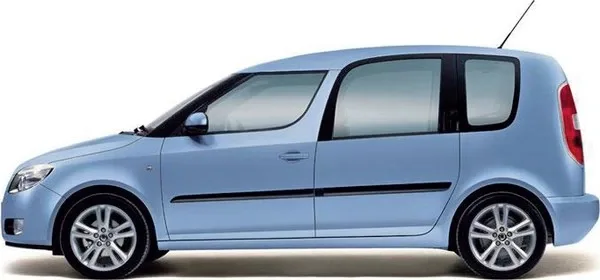
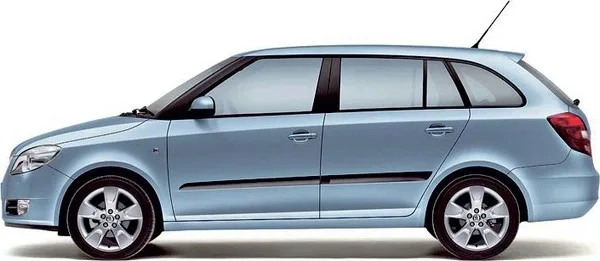
It's immediately noticeable: the Roomster is easier to park. It's not just that it's 3 cm shorter – visibility is better thanks to larger windows. And this will be appreciated not only by drivers: the high roof allowed the rear row to be raised by 46 mm relative to the front seats. Plus, the second-row seats can be slid back, adding legroom. Even in this position, the trunk remains spacious – 450 liters. And if you slide the seats all the way forward and squeeze the passengers a bit, you get 530 liters. In the Combi, the rear bench is rigidly fixed, so the trunk volume here is constant – 480 liters.
HONEST TEST
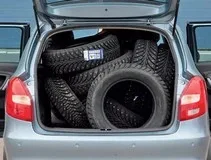
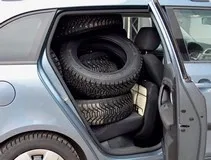
To test capacity in practice, we took a demonstrative load – wheels. Many people know how difficult it can be to load tires before a seasonal change. A sedan or hatchback without a trunk can't handle this, but station wagons, even compact ones, easily solve this task. In the Combi, when stacked "well-style," four tires 195/65 R15 fit freely, and one more fits on the side. In the Roomster, we loaded six wheels the same way.
If you lay the tires "herringbone-style," one more fits. True, with this scheme, you need to act carefully, otherwise, you can scratch the interior trim.
Both results are quite decent, especially considering that we haven't touched the passenger area yet.
NOT ONLY PRACTICALITY
Now we seat the rear passengers and fold their seats. With maximum load, the Combi fits 14 tires, and the Roomster – 16. It turns out that the advantage of the "tall" station wagon is not as big as it might seem – for ordinary cargo tasks, the standard model is enough. Especially since you rarely have to drive the car packed to the brim. Still, the Roomster, like other cars of this type, should not be considered "far-fetched." Unlike classic "barns," such cars offer not only maximum practicality but also maximum comfort. The high roof and large windows make the interior more spacious and brighter, improve visibility, and simplify getting in and out. And how do you like this design?
ROOMSTER
 |  | |||
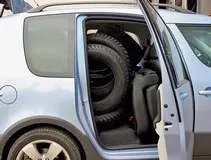 |
MORE SPACIOUS, BRIGHTER AND MORE COMFORTABLE In the back, two people live freely: separate seats move back and forth and change the backrest angle. Legroom is ample, and headroom too: you can sit, without removing your top hat |
FABIA COMBI
 |  | |||
 |
EXACTLY AS MUCH AS NEEDED Here, both headroom and legroom are less. The roof of a regular station wagon is lower, and the wheelbase is slightly shorter. However, this is enough to sit comfortably even if you are above average height |
Maxim Koloskov