
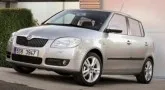
In April, a new generation of the Skoda Fabia hatchback hits the Russian market. The new model's main trump card compared to its predecessor is its dramatically changed appearance. These days, striking design matters a great deal.
The creators of the first Fabia, apparently, did not attach much importance to the exterior. At least, for Russian buyers this proved critical. The car's internals were solid, but the looks fell short. The result is predictable: over seven years, fewer than 20,000 such cars were sold here. Now they've decided to fix the mistake.
The Czech compact has grown, both literally and figuratively. From an inconspicuous "gray mouse," the Fabia has transformed into a self-assured lady, like the heroine of that very TV series. There are plenty of reasons for this. First and foremost, its attractive appearance. The car has gained expressiveness visible in every detail: from crisp side stampings to muscular wheel arches, a large grille, and elliptical headlights.
The wheelbase, as before, is 2462 mm. But despite a modest increase in length (plus 22 mm) and height (plus 47 mm), the interior has become noticeably more spacious. In the back, there's now enough room for both legs and head, so even tall passengers won't feel cramped. True, there can only be two of them. The 300-liter trunk easily accommodates a couple of hefty bags. If you fold down the rear seat, the compartment increases almost fourfold.
The driver hasn't been forgotten either. The steering wheel adjusts for both height and reach, and the seat with pronounced lateral support has plenty of mechanical adjustments, including height adjustment. Even a tall driver can get comfortable. The only thing missing on a long journey is more pronounced lumbar support. A wide armrest helps relieve the back a bit, but in the city it only gets in the way: because of it, shifting gears is inconvenient, as the gear lever is a bit short.
The instrument cluster pleases the eye and is informative. The silver bezels of the speedometer and tachometer evoke associations with more expensive cars. All readings, including the trip computer data, are perfectly legible. You'll figure out the stereo and air conditioning controls instantly, and you don't need to reach anywhere.
The plastic in the cabin is solid, neatly fitted, though a bit hard in places, but it doesn't look cheap. Even the imitation metal on door handles, around the vents, and on the gear knob, which in many cars looks out of place, is quite appropriate here.
In Russia, a full range of modifications is planned. Sales of the five-door hatchback start in April. In November, the estate will follow. A year later, the sedan. Initially, all engines will be available: four petrol units from 1.2 to 1.6 liters and three diesels (1.4–1.9 L). Later, the lineup will be trimmed, removing the least popular powertrains.
It seems one of the most popular versions will be the hatchback with a 1.4-liter engine producing 86 hp and a five-speed manual. In the city, this combination proved sufficient. The car starts briskly from traffic lights and overtakes confidently. True, you have to constantly rev the engine, and it gets noisy at high revs. Nevertheless, the Fabia responds adequately to the throttle, and the claimed 12.3 seconds to 100 km/h seems believable.
But as soon as we took two heavy passengers on board, the thrust seemed to evaporate. The car sagged, requiring frequent downshifts on hills or when overtaking. Acceleration beyond 120 km/h was achieved with great difficulty.
Handling pleased. The car follows the intended trajectory clearly, responding obediently to the steering. True, at speed, understeer sometimes manifested—the front end tended to push wide. The situation was corrected by the ESP intervening in time, but you'll have to pay extra for it.
The suspension confidently absorbs small and medium bumps. But on the speed bump in Zhulebino, the shock absorber reserve is clearly insufficient.
Mental Traits
The previous Fabia—compact, economical, and inexpensive—fully met European notions of the B-class. And in Europe, it sold excellently: there, practicality is valued above beauty. In Russia, however, people first look at appearance and prestige, and only then evaluate rational arguments. Hence the colossal difference in sales: over seven years, 1.5 million cars were sold in Europe, while here—90 times fewer.
Likes and Dislikes
Comfortable: The top version features separate climate control for driver and passenger.
Beautiful: Mini fans will surely like the optional white roof.
Driving
Holds the road well, but with a full load, there's a lack of low-end torque.
Interior
Spacious, well-finished. Ergonomics are well thought out: all controls are at hand.
Comfort
Many adjustments allow you to get comfortable, but the lumbar support of the backrest is weak.
Safety
Standard includes four side and two front airbags, ABS. ESP—for an extra charge.
Price
If promises are to be believed, the price will be attractive.
Pros and Cons
+ Striking design, economical engine, solid interior.
– Lacks torque with a full load, weak lumbar support.
Our Opinion
The Fabia has gained its own face that sets it apart from the crowd. Thanks to its attractive looks, the car has every chance to appeal to young buyers who previously passed it by. On the plus side—a spacious cabin, quality finish, and a wide choice of engines.