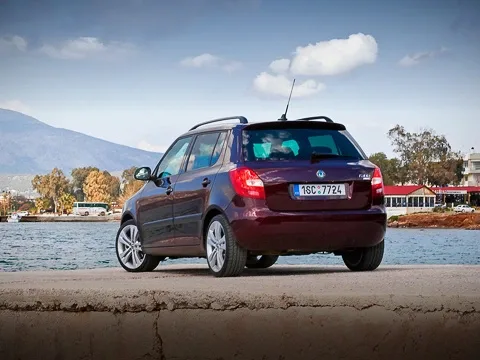
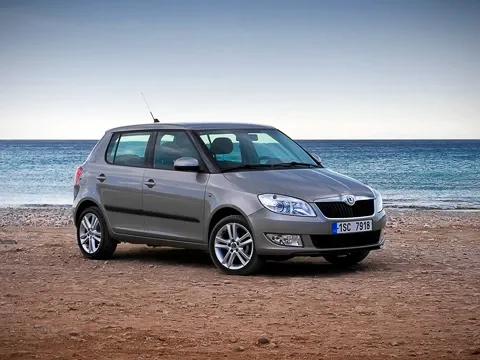
Greece is a country where complete opposites collide: on one hand, Athens, which weighs on your psyche with its crisis atmosphere, and on the other, the carefree turquoise of the coast under the bright sun. However, the model lineup offered to us for familiarization does not boast much variety. You can choose either versions with modernized 1.6-liter diesels producing 90 or 105 horsepower (such cars will not make it to Russia), or a new item — a 1.2 TSI turbocharged gasoline engine with 86 or the same 105 horsepower. However, there is no final decision yet on supplies of this engine to our country, so Russia can only wait.
After discussing our plans with my partner, I still reach for the keys to the gasoline Fabia, which produces a modest 86 horsepower and is equipped with a five-speed manual gearbox. It sits in the farthest corner of the parking lot. As I stroll past a row of equally neat "faces," I catch myself thinking that both the Fabia and the Roomster look more serious after the facelift. But the emotionality that press releases tout is more a product of self-suggestion. Both little cars, like women, skillfully dodge the awkward question of their age.
I get into the cabin. Settling into the firm and comfortable seat is a piece of cake. Finding common ground between hands and feet is no trouble: there is a huge range of adjustments for the steering wheel and driver's seat. Actually, I didn't expect any surprises from the Fabia in this regard. The only thing that might cause discomfort is the edge of the center console, which greatly bothers people with full hips. Colleagues complained about this.
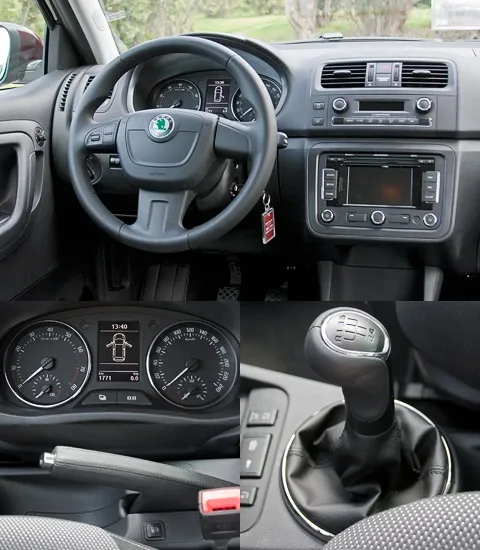
- The fact that everything in the cabin has changed is not visible in these photos. You need to turn off the sun: the green backlight has been replaced by a bluish one.
- The gearbox works quite precisely, but the lever throws could be shorter. The main ergonomic flaw went unnoticed: the clutch pedal has a long travel and is located too close to the brake.
On this very console, by the way, there are now climate control and audio system units that stand out with their original design. The control logic is, of course, entirely Volkswagen, but the styling is their own, Škoda. Large keys with clear symbols, convenient round temperature knobs, a display with rich graphics that doesn't glare in the sun and reads perfectly from any seat... You get used to such comfort very quickly.
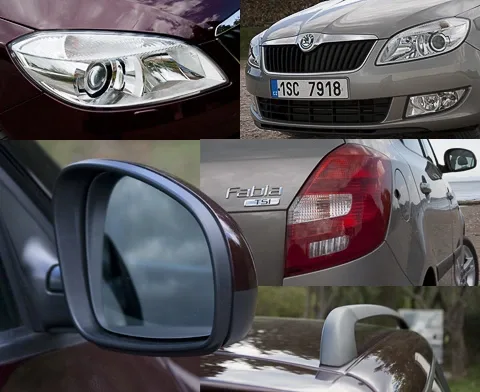
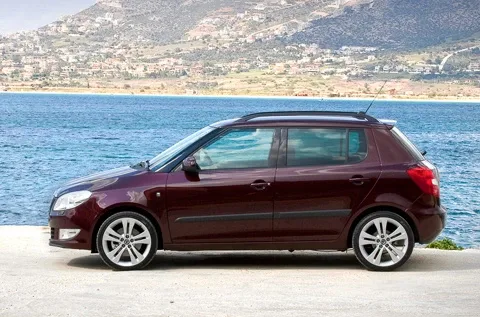
The easiest way to distinguish the updated Fabia is by the new front bumper with a wide air intake and large angular fog lights instead of the previous round ones. The rear and mirrors remain unchanged.
In terms of quality, the Fabia is still at its best; you can't take that away from it. The steering wheel, gear knob, and handbrake are wrapped in pleasant leather. Rough but pliable plastic on top of the console, precise efforts on the steering column stalks, a pleasant click of the turn signals, a spicy smell... Many B-class representatives could learn a thing or two.
And yet, there are questions for this Czech little one. The elegant interior door handle is nice to look at, but scary to use. This thin plastic bracket, no longer painted "to look like metal," looks so fragile that it could easily break. And the round climate knobs lack clear detents — it's easy to miss the desired temperature.
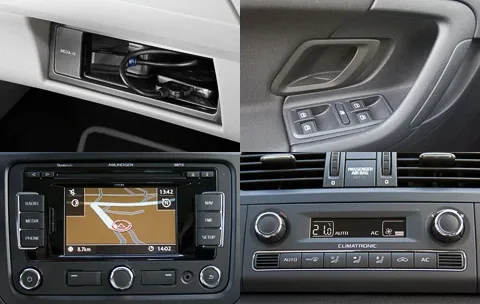
Previously, the Fabia and Roomster were equipped with navigation with a monochrome screen. After the update, it became possible to order the Amundsen multimedia system with a five-inch touchscreen display, full-color navigation, USB port, AUX input, and SD card slot.
Ahead — about three hundred kilometers of roads that wind along ancient cliffs washed by the Aegean Sea. The route is short, but the character of the 1.2 turbo engine with direct injection shows itself immediately. Its trump card is powerful torque at the very bottom. This eight-valve "four" confidently pulls the Fabia from low speeds whether in third or fourth gear. But mid and high revs are not its element: enthusiasm gives way to mild boredom as torque begins to fade.
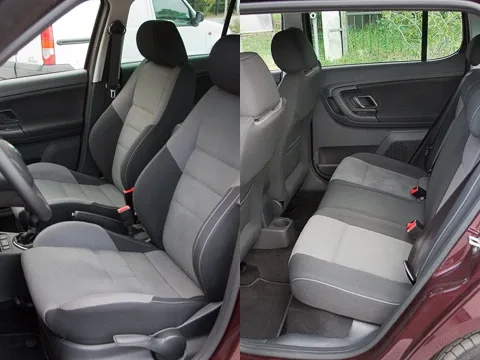
- Optional front seats with developed lateral support are simply magnificent. Such seats wouldn't hurt even some "hot" hatchback.
- In the back, you don't hit your head on the ceiling, and the upright seating provides enough knee room. A pleasant surprise.
I want something livelier! Let me switch to the most powerful gasoline version, with 105 horses and 175 Nm. The increase is felt. The peppy engine sound turns into torment for low-profile tires... But the dance is essentially the same — the song ends at three thousand revs. After that, the sleepy kingdom begins.
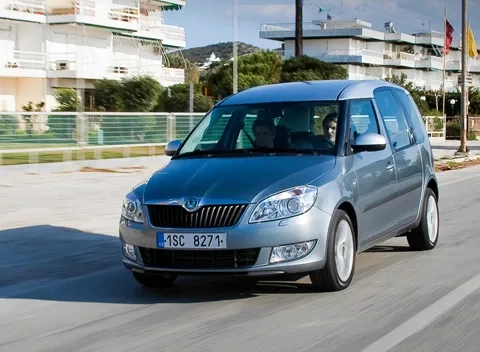
The decent sound insulation of the Roomster (and Fabia) was spoiled only by noticeable wind noise in the area of the lower edge of the windshield.
From time to time, the seven-speed "robot" with two "dry" clutches, familiar from the new Polo, which is installed on the top gasoline version, also falls into a drowse. It copes excellently with quick bursts at the limit or, conversely, with measured cruising on the highway — just switch the selector to the desired mode. But in traffic jams or at low speeds, the control unit starts scratching its head, pondering which gear to choose. And here, the smoothness of the Fabia's shifts is no longer at its best.
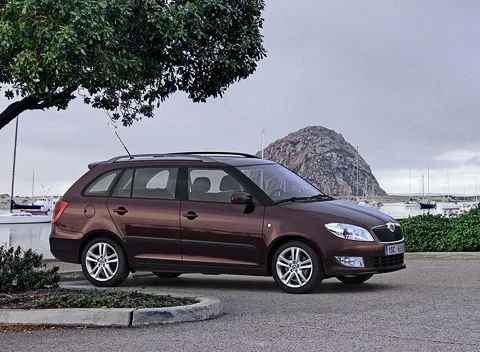
The Fabia Combi wagon after the facelift became eight millimeters longer (to 4247 mm), and the trunk volume grew from 480–1460 to 505–1485 liters — thanks to replacing the spare tire with a repair kit.
But there's no time to be bored: next is the Fabia Combi with the 90-horsepower 1.6 TDI turbodiesel. True, there are already four people in the cabin, and the trunk is packed to the brim with bags of photo equipment — but the torque here is an impressive 230 Nm. This little "wagon" is lively and even spirited. The wheelbase isn't longer, and at hand is a five-speed "manual." Funny, but here too, the engine's life is from 1500 to 3000 revs. However, the sensations are completely different: what is a moment for a gasoline engine is an eternity for a diesel.
In Europe, most buyers prefer a manual. Therefore, two pedals are available only on a couple of versions. The 105-horsepower 1.2 TSI "turbo" works with a seven-speed DSG "robot," while the 1.6 "atmospheric" (also 105 hp) comes with a six-speed "automatic."
Maneuvering in traffic is easy and pleasant. However, the Czechs didn't even touch the chassis settings. If it ain't broke, don't fix it... The Fabia still handles confidently, holds a straight line well, rolls moderately in corners, and remains informative enough. For the average buyer, that's just right. And for those who want a bit more, it's worth looking at the Roomster.
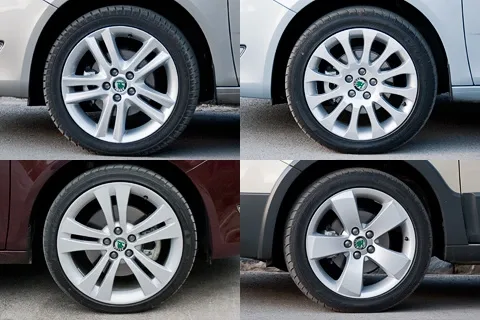
The choice of "shoes" is wide. Cast 17-inch wheels (bottom left) turn the Fabia into a show car, but even with low-profile tires, it doesn't become a merciless stool. True, in Russia, it would be a pity to exploit such beauty.
Yes, I mean not only cargo-passenger capabilities but also driving pleasure. The Roomster with its widened rear track delivers more drive than the Fabia. And this is despite the fact that I only got the raised Scout, which in extreme situations sometimes stresses with a lightening steering wheel and transverse rocking of the rear. A regular Roomster with a lower center of gravity should be even more spirited. It just doesn't fit in my head: why does the Fabia have a "hot" RS version, but the Roomster doesn't?
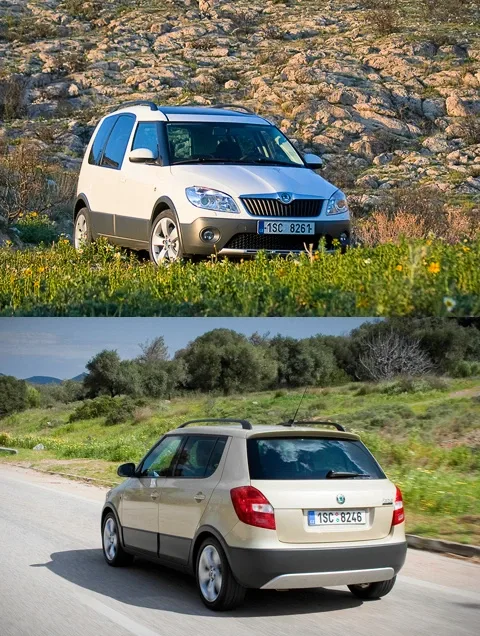
- In such surroundings, the Roomster Scout looks a hundred percent. The idyll crumbles only on dirt roads: after 30 km/h, the cabin fills with rumble and vibrations that are hard to bear.
- The Fabia also has a Scout version in a plastic body kit, which will still be supplied to Russia from the Czech Republic. By the way, the Roomster and Fabia with 105-horsepower 1.2 TSI engines during brisk driving consume no more than 8.5 l/100 km — a good result.
If only we could take something intoxicating from the "hot" Fabia and the Roomster. Mix, but don't shake. Alas, in terms of ride smoothness, both the Fabia and the Roomster are middle-of-the-road in their class. Passengers are offered a rich selection of vibrations, albeit fine-grained. Those sitting in the back have it harder in both cases — the rear beam noticeably handles bumps more harshly than the front struts. But the Škodas endure impacts steadfastly: quietly and without a hint of looseness.
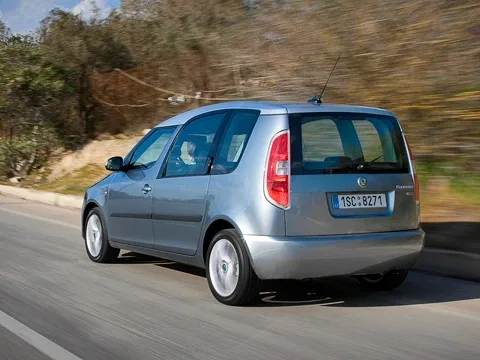
The great mood from the ride in the Roomster is also supported by excellent visibility.
My friend, who has six hundred thousand in his pocket, is probably wondering: is it even worth waiting for the updated cars when you can already head to the dealer right now? Especially since the new bluish instrument lighting won't appeal to everyone — the previous green one seemed cozier to many. But if the decision to wait has been made, the suspense won't last long: already at the end of April, the Kaluga plant is launching full-cycle production of the facelifted Fabias, and in June they will appear in showrooms. True, initially the choice of colors and trim levels will be limited, although the Czechs promise to quickly establish supplies. But we most likely won't see new engines — and we have only ourselves to blame. Who among us buys diesel Corsas in bulk? Or lines up for the 105-horsepower Polo with the 1.2 TSI engine? Too expensive? So manufacturers respond: affordable prices are only possible with high demand. It's a vicious circle — we wait for them, and they wait for us.
Technology
The Fabia is based on the PQ24 platform, which, in a slightly modified form under the index PQ25, was borrowed by the Polo. Up front — classic McPherson struts, at the rear — a semi-independent torsion beam. Like Volkswagen, Skoda has no all-wheel-drive version, and none is planned for the Roomster compact van either. Its "cart" is assembled from elements of the Fabia and the first-generation Octavia: from the latter, the Roomster got the rear floor section with a wider beam.
The main technical novelty of the facelifted Fabia and Roomster is the four-cylinder gasoline engine of the TSI family. This 1.2-liter engine received turbocharging and direct injection. A feature of the unit, which is offered in two variants — 86 hp with 160 N•m of torque or 105 hp with 175 N•m — is the compact cylinder head: thanks to it, the exhaust manifold is placed not on the side, but at the front. It's also noteworthy that all eight valves are controlled by a single camshaft, which is driven by a single-row chain.
Safety
As on the pre-facelift versions, the updated cars in the base Classic trim already have ABS and four airbags — two in front and two on the sides. Inflatable "curtains" can be ordered as an option for Classic, Ambiente, and Elegance, but on the Active they are installed from the factory. The stability control system is an option for all modifications without exception.
History
If you dig deep into history, the distant ancestors of the current Fabia can be considered the Czech compact cars of the 100, 105, 120, and 130 families, produced from 1969 to 1988. In those years, the lineup consisted almost entirely of sedans. Engines — four-cylinder, with displacements from 1 to 1.3 liters, and gearboxes — manual, four- or five-speed.
But the Skoda Favorit model deserves a separate mention — it is the most direct ancestor of the Fabia. It was shown in July 1987 at the engineering fair in Brno. It was the first front-wheel-drive Skoda and at the same time the last car of the brand created still in Czechoslovakia. Under the hood was a carbureted gasoline engine 1.3, producing from 54 to 68 horsepower depending on the version. Along with the Czechs, specialists from the British firm Ricardo Consulting Engineers and Porsche engineers worked on this unit. Later, the carburetor was replaced by a Bosch single-point injection system. Gearbox — only five-speed manual. The five-door Favorit hatchback weighed about 840 kg in curb weight, its body, created by the Bertone studio, had a length of 3815 mm and a width of 1620 mm. The lineup also included a station wagon and a pickup — they bore the names Forman and Pick-up, but the wheelbase for all was 2450 mm. By the way, the name Favorit had already been used in the brand's history: that was the name of a large sedan produced from 1936 to 1941.
The name Felicia for the hatchback, which was developed already under the leadership of Volkswagen, is also not new — in the 50s–60s, two-seater Skodas bore it. In essence, the Felicia (1994–2001) was a deep modernization of the very popular in Central Europe Favorit. The length and width of the body (3855 and 1635 mm) grew very little, the wheelbase remained the same. Three years after the start of production, the 1.3 engine (68 hp) was modernized, equipped with Siemens multi-point injection. Other four-cylinder engines appeared in the lineup: a gasoline 1.6 (75 hp) and a diesel 1.9 (64 hp). The five-speed manual gearbox was also refined. Thanks to cooperation with Volkswagen, the Czech compact got ABS, a driver's airbag, and air conditioning. Over seven years of production, 1,416,939 units were sold — hatchbacks, station wagons (Combi), and pickups (Pick-up/Fun).
The next model — the Fabia — was brought by the Czechs to the Frankfurt Motor Show in 1999. The car was built on the A04 platform shared with the Polo and Ibiza. Wheelbase — 2460 mm, length — 3960 mm, width — 1650 mm. Over seven-plus years, eight different engines in 16 modifications were installed under the hood. The weakest gasoline unit had a liter displacement and 50 hp, and the most powerful was a two-liter MPI with 120 horsepower. The diesels 1.4 TDI, 1.9 SDI, and 1.9 TDI produced from 64 to 130 hp (the latter — in the "hot" RS version). The gearbox could be chosen: in addition to the five-speed manual, a four-speed automatic was offered. The pickup was removed from the lineup, but a sedan appeared. Over eight years of assembly-line life, about 1.6 million Fabias were sold.
The second-generation Fabia appeared in March 2007 at the Geneva Motor Show. The new model grew in almost all dimensions: by 22 mm in length (3992 mm) and by 47 mm in height (1498 mm). The engine lineup — five engines: three gasoline (1.2, 1.4, 1.6) and two TDI turbodiesels (1.4 and 1.9), with power from 60 to 105 hp. The car has four stars in Euro NCAP crash tests and the title of "Car of the Year 2007" in Serbia. Perhaps this helped sales: in 2008, 246,561 such cars were sold worldwide, and in 2009 — 264,173.
Behind the Scenes
Before the trip, I imagined Athens as something like paradise on earth. Reality turned out to be completely different: the streets are littered with garbage, the walls of houses and shops are covered with street graffiti, there are plenty of dubious individuals and women of easy virtue around, and at night suspicious groups of young people roam the city. From such Athens, you want to leave as soon as possible.