
Shuanghuan S-ceo. «Boomer» from the Celestial Empire
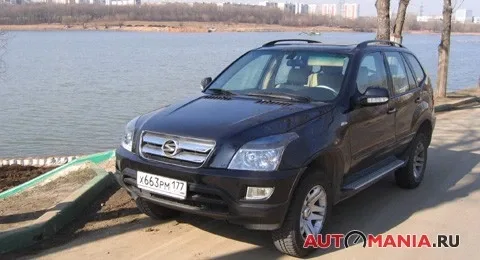
Test drivers of the automania.ru website were among the first to have the luck to test perhaps the most stylish jeep from the Celestial Empire with the hard-to-pronounce name Shuanghuan (pronounced «Shuanghuan»). The model is called S-Ceo. Over five days, I drove almost 1000 km on this SUV and can confidently say that I fully got used to the car. During these days, I filled half a notebook, noting all the pros and cons. And now I am ready to share my impressions with the site's readers.
Let's start with the appearance. Everything here corresponds to the well-known student rule: copied from one source – you get plagiarism, from two – a synopsis, from three – a compilation, and from four – it's already a dissertation, that is, you are a full-fledged author and creator. The S-Ceo has a full set of fruits of «creative thought». From the side, the car is a spitting image of the BMW X5 (only the license plate on the Chinese car is located at the bottom of the bumper, not in the center of the rear door). At the front – headlights like the Land Cruiser Prado, the fake radiator grille is just a spitting image of the Mercedes ML, the «S» emblem in a circle somewhat resembles the old one from Korean SsangYong. Inside, it's no less eclectic – the central panel resembles a Lexus, and the instruments are again something «Toyota-like» – large and with pseudo-neon backlighting (which, by the way, is surprisingly adjustable in brightness).
Inside, the trim is quite high-quality – light leather (as my friend said – «no worse than in his Gelendewagen»), full electric package, 5-CD player with a Blaupunkt receiver (exactly the same as in the Korean Chevrolet Lacetti), power steering, and even climate control. When handing over the car, the manager warned me that it works somewhat strangely, but didn't specify how exactly. I had to find out by trial and error. It turned out that after turning on the ignition, you need to press the «auto» button – then the climate system turns on. Full airflow, temperature +21 degrees Celsius in the cabin. But to change the settings – set the desired temperature, air flow strength, and airflow modes – you first need to switch to manual control. Even on «one», it's noisy in the cabin and the air flows are very strong. Pressing the «A/C» button doesn't help achieve the set temperature. If you set 18 degrees, the cabin somehow settles at 23. The outside temperature gauge works accurately only while driving. Stuck in a traffic jam, instead of 8-10 degrees, you'll unexpectedly see from 32 to 42.
However, this isn't the only «little thing» that will point out the country of manufacture to you. The paint, not only is it not «metallic», it's rather matte, and even on a clean car, it doesn't want to shine no matter how much you polish it. The side windows, upon closer inspection, turn out to be slightly crooked; they are not sunproof, meaning they let in sunlight, and the cabin heats up very much.
Regarding temperature in this car, there's another «big joke». If you want to warm up at night, you just need to press the button to the left of the steering wheel, which turns on the airflow to rear passengers. The rear deflector rotates around its axis, and the flow, even in the «LO» position, provides exclusively hot streams. Without pressing the button, you notice that the central armrest heats up while driving, almost to boiling temperature (I noticed it by accident, putting napkins there after lunch at McDonald's).
All five doors (including the rear one) also give away the car's Chinese origin. Everything is very stiff, tense, and opening them requires considerable force. There's only one airbag – for the driver, with a warning in the center of the steering wheel: «deploys only when seat belts are fastened».
The impressions from the gearbox (manual) are also not the most favorable. Without fully depressing the rather stiff clutch, 4th gear engages with a grinding noise. Additionally, I had to get used to the unusually long gear throws. And the gear knob is covered with such low-quality and poorly dyed leather that my right hand constantly became black after half an hour of driving.
But where the jeep has no complaints is in visibility and ease of handling. The turning radius is minimal, and the mirrors are very informative (they also have built-in additional turn signals).
As standard equipment, there are rear parking sensors that determine the distance to an obstacle with an accuracy of 10 cm.
As with most (in 90% of cases) Chinese cars – the S-Ceo has much borrowed from Mitsubishi, in particular, all steering column switches, mirror adjustments, and of course the engine – a standard 2.4-liter. Not immediately opening the hood (the button is too cleverly located), I was amazed that there are no sticks to hold it open; instead, there's a mechanism on hydraulic dampers. Another breakthrough by the Chinese into the 21st century. But the pan protecting the crankcase of this nearly 2-ton jeep is not metal at all, as one might expect, but made of thin plastic. This is an example of Chinese economy.
The cabin overall is very comfortable. In the back, there's plenty of space – almost like a limousine. In the center, there's a flat floor and no bulges from the driveshaft (like in the Honda CR-V). Among the pluses – a very comfortable steering wheel with two aluminum inserts. Your hands don't sweat on it; on the contrary, they cool down. But the biggest plus is an original Chinese invention not found on the Porsche Cayenne or Audi Q7. Even Bentley and Ferrari don't have this. When any door is opened, the hazard lights automatically turn on for about 30 seconds. For safety – simple and genius.
The transmission works quite well. At any speed up to 100 km/h, by pressing the button responsible for the transmission, you can easily switch from rear-wheel drive (2WD) to all-wheel drive (4WD). But it's better not to venture into impassable mud – there are no differential locks or low-range gears in this jeep.
Another achievement of the Chinese is the sunroof with electric adjustments and the same electric functions on the driver's (only) seat. There is seat heating, but the passenger airbag, as already mentioned, is somehow absent.
Among the drawbacks that the Chinese should fix, I'd include the fact that the fuel tank cap has no protection. It easily opens when bumped; you wipe the car from dust – the cap opens its «mouth». There's also no valve; if you fill up to the brim in the evening, you risk finding an empty tank in the morning – siphoning the gasoline would be no trouble at all.
Structurally, the S-Ceo is built as a body-on-frame SUV – moderately stiff and bouncing like a young kid. But it tires less than, for example, the short-wheelbase Mitsubishi Pajero Pinin that came off the assembly line. The car accelerates also in a «Mitsubishi way» (reminding me of the diesel L-200) – unhurriedly, no matter how much you press the gas. There's no acceleration figure in the specs, but I think it takes no less than 20-25 seconds to reach 100 km/h. Up to 100-120 km/h, the jeep drives quite decently, but if you exceed that mark, it gets noisy in the cabin, and a whistle comes from the exterior mirrors.
The advertising brochure informs potential buyers that the S-Ceo consumes 8 liters of gasoline per 100 km. That figure is understated by almost half. Taking the car with half a tank (30 liters), I used it up over 220 km. Do the math yourself – 14.5 – 15 liters. The good news is that you can use 92-octane gasoline.
In conclusion, let's touch on the cost of the car. The price is $32,500. On one hand, for this money, you could easily buy a 3-year-old Lexus RX 300 from America from «gray» dealers. On the other hand, a very telling conversation was with some guys at the McDonald's parking lot who were interested in the car. After lengthy questions about what kind of car this was, they uttered the following: «Thirty grand – not money for a car, and going hunting in a Niva or UAZ is beneath us, it's a shame to ruin a Pajero or Lexus, a Land Cruiser is expensive. But in this one, you can show up in the forest by the lake – quite decent, and if it breaks – no big deal. We'll buy another one».
Technical specifications:
| Dimensions (mm) | 4710 x 1870 x 182 |
| Wheelbase (mm) | 2850 |
| Curb weight (kg) | 1800 |
| Payload capacity (kg) | 455 |
| Ground clearance (mm) | 200 |
| Engine | 2.4 liters |
| Power (hp) | 125/5250 |
| Max. torque (Nm/rpm) | 190/2500 |
| Tires | 235/75 R 17 |
| Fuel tank capacity (l) | 60 |
| Maximum climbable grade (%) | 38 |
| Warranty 2 years or 50,000 km | |
| Price of tested model ($) | 33 300 |
Dmitry Shavyrin
We express our gratitude to the company "Atlant M-Asia" for providing the car for the test.
Source – AUTOMANIA.RU