
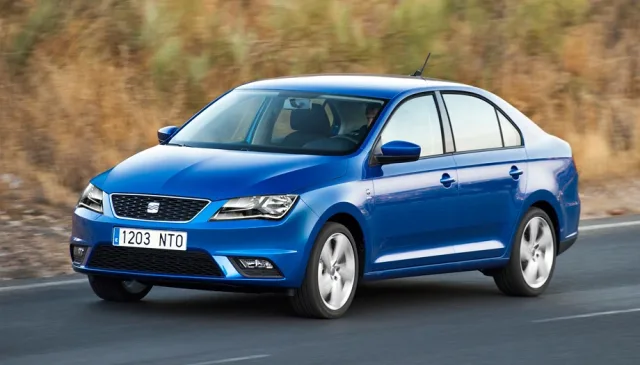
First of all, I flung open the fuel filler flap. No ice scraper! Just as there is no handy rubber holder for a mobile phone, no pockets on the sides of the front seat backrests, and no tray under the driver's seat where, according to the designers' intention, a safety vest should be stored... So, the five-door Seat Toledo is the already familiar Skoda Rapid liftback, only without such "simply ingenious" solutions? The cars are almost identical, but their birth stories are different.
For us, the cars will come from the Czech Republic, but the Russian representative office does not rule out assembly at one of our plants.
In general, SEAT was initially put in a very difficult position. The Skoda Rapid model was the primary one, and the Toledo is derived from it (even the dimensions are the same). The Czechs made the car for their own needs, for the needs of their customer, within the framework of their strategy. Hence the calm design and the emphasis on ease of operation. And the Spaniards got a ready-made car, from which the Skoda features were cut off and which needed to be adapted to Seat's ideology. How to do this in a segment where 33% of buyers are people over 60 years old?
The pleasing optics are typically Seat-like. Customers will be offered several wheel options ranging from 15 to 17 inches.
Of course, the Seat Toledo, through the efforts of chief designer Alejandro Mesonero, acquired its own face. The faceted headlights made the Toledo's gaze more confident and aggressive, the front bumper spread into a menacing grin, and the rear was adorned with angular taillights. Compared to the Skoda Rapid, the Spanish twin does indeed look brighter and more aggressive. It would be nice to continue in the same vein inside the cabin, but apart from the attractive three-spoke steering wheel with a contoured rim and the italic font of the instrument panel markings, the interior remained the same.
Even the steering wheel with a polyurethane rim is good both in appearance and feel, and the ergonomics allow you not to be distracted from driving. The interior door handles on the Toledo differ from those used on the Rapid. The standard equipment list includes six airbags, an electronic stability control system, air conditioning, and front electric windows. For an extra charge — a multimedia center with navigation, an improved audio system, Bluetooth protocol support, a USB input, and an SD card slot.
The instrument panel on the Toledo is easier to read than on the Rapid, but other ergonomic flaws remain: the absence of rear window switches on the driver's door, and the parking brake lever that interferes with the armrest. The manual transmission works with all engines except one: the turbocharged 1.4 TSI engine is only paired with the seven-speed DSG robot.
Next, we expected to hear from Seat's engineers that they had tried to give the car a lively character, make it a bit stiffer, a bit denser, and more composed, which corresponds to the ideology of the company from Martorell. And indeed, we were assured that although the suspensions of the Toledo and Rapid are structurally identical, the Seat got less compliant springs and shock absorbers, and the chassis was tuned in a sporty manner. In addition, the steering mechanism with electro-hydraulic power steering was also recalibrated.
The front seats lack lateral support and denser padding under the upholstery. Rear passengers, however, have no reason to complain — a comfortable bench, plenty of free space above the head and for the legs.
One thing to thank the creators of the Rapid for is the luggage compartment. With a volume of 550–1490 liters, neat trim, a wide opening, and a spacious underfloor with a full-size spare wheel — such a hold is something to envy!
But a trip around the environs of the charming city of Toledo confused all the cards. The Toledo liftback differs from its twin, but only slightly, and not in the direction the Spaniards told us about. The Seat has a slightly heavier steering wheel in all modes, but more body roll. And the difference in suspension tuning between petrol and diesel versions is hardly noticeable — on the Rapid, the heavy-fuel modifications are noticeably stiffer. The five-door Toledo is a moderately composed car, reliable in corners, and not the softest on bumps. Just like the Skoda Rapid. But from the Toledo, you expect different emotions, a different attitude, don't you?
Up to 120 km/h, the Seat Toledo is a quiet car, but after that mark, the cabin fills with tire roar and wind whistle around the side mirrors. Worse is something else — when you drive onto cobblestones or dirt roads, a low-frequency rumble from the wheels and suspension presses on your ears. A real torture!
The Toledo will be available on the Russian market only with petrol engines. First into battle will be modifications with 1.6 MPI (102 hp) and 1.4 TSI (122 hp) engines. We didn't get to ride in those, but we did get a chance in other versions available to Russians: with the 1.2 TSI turbo-four with 85 and 105 hp (160 and 175 N•m respectively). Regardless of output, the 1.2 TSI engine copes perfectly with its duties in the city — from 2000–2300 rpm, confident thrust appears, which fades only by 4000 rpm. And you can shift gears less often, although the manual gearbox mechanism (five-speed for the 85 hp version, six-speed for the 105 hp one) pleases with precise engagement and optimal effort on the lever. If only the clutch pedal had a shorter free travel.
A kilometer from a standstill, the Seat Toledo with 85 hp takes 33.5 seconds, and with 105 hp — 32 seconds. There are no complaints about braking, but the pedals could use reduced free travel.
Of course, if you rarely drive alone and often go on country highways, it's better to splurge on the 105 hp version. After all, after 100 km/h, life in the 85-horsepower engine almost ceases, while the more powerful variant retains its appetite for acceleration. But even better is the 1.6 TDI turbodiesel. With its 105 hp and 250 newton-meters, you turn into a child — restless, cheerful, and energetic. But as soon as bends appear on the road, you start to be capricious — the diesel Toledo cannot maintain the pace of petrol cars due to earlier and deeper understeer.
Like the Skoda Rapid, the Seat Toledo on the highway demonstrates rock-solid confidence, and on an arc, under a provocative throttle lift, it willingly goes into a gentle drift. But how will the cars of Russian specification, which will be fitted with a package for bad roads, behave?
So, the Toledo has no objective advantages over the Rapid. Therefore, in Martorell, they decided to differentiate the two cars by other means. For example, the Seat Toledo will be more expensive than the Skoda Rapid liftback, but only because the Spanish car's base equipment will be richer. In addition, Seat is already working on original accessories for the new model. This includes various body appliqués, bumper trims, spoilers, and all those things that will allow you to emphasize individuality. There was even talk of a "hot" FR version, which could be expected in a few years. Then, perhaps, the main question in Seat's history will be decided — whether the Spaniards can become profitable, or they will have to look for a new patron.
Specifications
| Seat Toledo | 1.2 TSI |
|---|---|
| Body | |
| Body type | liftback |
| Number of doors/seats | 5/5 |
| Length, mm | 4482 |
| Width, mm | 1706 |
| Height, mm | 1461 |
| Wheelbase, mm | 2602 |
| Track front/rear, mm | 1463/1500 |
| Curb weight, kg | 1161 (1175)* |
| Gross weight, kg | 1621 (1635) |
| Trunk volume, l | 550–1490 |
| Engine | |
| Type | petrol with direct fuel injection and turbocharging |
| Location | front, transverse |
| Number and arrangement of cylinders | 4, in-line |
| Number of valves | 8 |
| Displacement, cm³ | 1197 |
| Max power, hp/rpm | 85/4800 (105/5000) |
| Max torque, N•m/rpm | 160/1500–3500 (175/1550–4100) |
| Transmission | |
| Gearbox | manual, five-speed (manual six-speed) |
| Drive | front |
| Chassis | |
| Front suspension | independent, spring, McPherson |
| Rear suspension | semi-independent, spring |
| Front brakes | ventilated disc |
| Rear brakes | drum or disc depending on market |
| Tires | 185/60 R15 (195/55 R15) |
| Ground clearance, mm | n/a |
| Performance characteristics | |
| Maximum speed, km/h | 183 (195) |
| Acceleration time from 0 to 100 km/h, s | 11.8 (10.4) |
| Fuel consumption, l/100 km | |
| — urban cycle | 6.5 (6.9) |
| — extra-urban cycle | 4.4 (4.6) |
| — combined cycle | 5.1 (5.4) |
| Emission standard | Euro-5 |
| Fuel tank capacity, l | 55 |
| Fuel | AI-95 |
| * In parentheses — data for the 105-hp version. | |
Technology
The platform for the Toledo is the same as for the Skoda Rapid. And at the base of the Rapid lies the "cart" of the Volkswagen Polo sedan. But for the Czech liftback, the wheelbase was extended, the track widened, and suspension modules were borrowed from other Skoda models. For example, McPherson struts with lower A-arms at the front are taken from the Fabia, but the entire structure is reinforced and adapted for heavier engines and greater overall mass. At the rear, a torsion beam from the first-generation Octavia is installed. The thickness of the front anti-roll bar is 20 mm, the rear — 18 mm. According to Spanish specialists, the Toledo has stiffer shock absorbers with springs, as well as a more sporty suspension tuning. Which, by the way, is not noticeable on the road. It is also known that cars for the Russian market will receive recalibrated elements and increased ground clearance.
The engine with a displacement of 1197 cm³ is equipped with a turbocharger and a direct fuel injection system, the working pressure of which reaches 150 bar. There are two boost levels: 85 hp and 160 N•m, as well as 105 hp and 175 newton-meters (boost pressure — 1.6 bar). In the first case, the Seat Toledo accelerates from 0 to 80 km/h in 7.6 s, in the second — in 7.1 s. The highlight of the eight-valve engine is a compact cylinder head, which allowed the exhaust manifold to be placed not on the side, but at the front. By the way, the opening and closing of all eight valves is managed by a single camshaft driven by a single-row chain. For the first time, the turbo engine began to be installed on the Volkswagen Polo hatchback in mid-2009.