
In recent years, only the lazy haven't talked about how the once-legendary Swedish brand had finally died. Such conclusions were prompted by both our own impressions of the then-current Saab models and sales, which were steadily falling worldwide. Yet not so long ago, Saab was considered a car for intellectuals, and in the Russian realities of the early nineties, it was almost more prestigious than cars with a three-pointed star. I remember my first encounter with these "ground fighters" perfectly: in 1992, the representative office of the Swedish concern Axel Johnson AB, to which Saab belonged along with Scania, brought the first batch of the 9000 model to Russia and held a sales exhibition right at the embassy of "Tre Kronor". These were the very first eight Saabs to officially enter our country.
I also had the chance to drive both generations of the 9000 model and various versions of the 900s — eight- and sixteen-valve, with and without a turbo. By the way, it is these cars that devoted brand fans call "the last real Saab". I remember perfectly the hood that seemed to shift forward, the ignition lock from which the key cannot be removed without engaging reverse gear, the almost panoramic windshield with a slight angle of inclination, the incredibly comfortable seats with high backs, and the hysterically flashing "fasten belts" inscription on the dashboard. I also remember the powerful four-cylinder turbo engines with a noticeable turbo lag and how tenaciously the "nine hundred" held the road, with what pleasure and imperturbable Scandinavian calm it took corners. It seemed to fly over the asphalt! The car had character, had charisma. It resembled nothing else, and for that, it earned a small but very devoted army of fans.
When the Swedes found themselves under the wing of General Motors, the company, alas, began to rapidly lose its own identity. The new generation of the 9000, and then the 9-3 and 9-5 models, became only pale imitations of their predecessors. Unification with each year and each new generation methodically killed Saab. Last year's acquaintance with the 9-3 Sport Combi — the direct heir of those very 900s — evoked not delight but rather disappointment. Apart from the interesting exterior and engine, there was nothing of a Saab car in it. This year, the Swedes presented the updated 9-3 — the result of a very serious restyling. It seems that General Motors finally understood that Saab must remain itself. But isn't it too late? We tried to find the answer by getting behind the wheel of the new Saab 9-3 Sport Combi Aero.
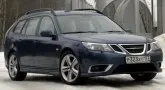
Oh, what a beauty it turned out to be! There are not many cars in the world, especially station wagons, with such a swift silhouette. No matter which side you look from — even standing still, it seems to fly forward. Just look at the boldly rising beltline! And the U-shaped front end? And the sloping rear with "milky" lights? Let the trunk be a modest 420 liters, but look how it looks! The Aero version includes a sports suspension lowered by 10 mm, an aerodynamic body kit, silver trim around the air intake and fog light niches, as well as two exhaust pipes with tuning. The 9-3 sounds very decent. Bassy but unobtrusive — just enough for those around to understand: this is not quite an ordinary Saab. From inside, this soundtrack is heard even less; the sound insulation is excellent. Moreover, the car retains heat for a long time and warms up quickly — family traits that come in handy for our climate.
Saab also holds the mark in the interior. Precise ergonomics and seating comfort have always been the Swedes' calling card. It's clear that they seriously worked on the quality of materials — good leather, soft plastic, excellent assembly. Instead of a scattering of buttons and small displays on the center console, three round controls for the dual-zone climate control and a touchscreen for the multimedia-navigation system appeared (the latest Cadillacs are equipped with the same screens, only theirs are slightly larger). All this, of course, has reduced the "airplane" associations, but many family traits remain in the cabin. The overall architecture leaves no doubt — this is a Saab. The ignition key is in its place, on the center tunnel. The boost pressure gauge too. The backlighting, as before, is the signature green color. The ventilation deflectors with familiar adjustment knobs are unchanged. The seats, upholstered in luxurious white-gray leather with black inserts, resemble in shape and profile those on the old 900s and 9000s. The seating position is low, legs stretched far forward. The three-spoke steering wheel with thumb rests fits perfectly in your hands.
Special attention is drawn to the Night Panel function — what a toy! In the dark, it activates the speedometer scale only up to 140 km/h — which is slightly above the standard speed limit on European highways. When this threshold is reached, the backlighting "turns on" the remaining divisions, up to 260 km/h. If you drive slower than the same 140 km/h for a few seconds, everything happens in reverse order. The 9-3 we got was equipped with an automatic transmission with manual gear selection, and during shifts, the number of the next gear flashes for a moment under the speedometer scale. When fuel runs out, the corresponding indicator lights up in the sparse darkness of the instrument panel. In general, all information arrives exactly when it's needed. And if such "information hunger" gets boring, Night Panel can be turned off, and the needles of all secondary instruments come to life with mesmerizing beauty. However, many of the listed features were also equipped on the previous generation 9-3. But that's not what matters to us now. What matters is to understand how the Aero drives.
255 horsepower from the turbocharged V6 easily accelerates the fairly compact station wagon. The engine is good: it pulls confidently from 2000 rpm. In terms of elasticity, it can't be compared with the four-cylinder "turbos" of past years, which only from 3500 rpm swiftly threw the car forward, and before that mark "rested" at the bottom of the turbo lag. Although there was a certain charm in that old character of "Saab" engines, modern market laws dictate different rules — a flat torque curve and ease of throttle control for the average driver.
Still, the V6 of this 9-3 deserves all praise. In combination with a manual transmission, it can accelerate the "aerocar" to 100 km/h in a very respectable 6.9 seconds. With the automatic — not critically slower, in 7.8 seconds. Moreover, the six-speed automatic transmission works excellently: upshifts are completely imperceptible, on kickdown there is a slight delay, but it's easy to get used to. There's also a manual mode, where gears can be changed independently using two paddles located not traditionally — on the back of the steering wheel — but on the upper side of the horizontal steering wheel spokes. There's no particular difference in shift speed between manual and automatic modes, but in manual mode, the engine can be revved to maximum, and when releasing the throttle, it can be effectively used for braking. However, there's no practical need to practice in manual mode: even when driving "half throttle", the 9-3 Aero is faster than the vast majority of traffic neighbors.
The power of the turbocharged V6 makes itself known not only by pressing your body into the seat back but also by slight tugs on the informative steering wheel when one or the other wheel grips the surface harder. Some might find such manners rough and unrefined, but personally, I like it much more than the empty, damped controls of most modern cars. In this 9-3, you feel some liveliness, authenticity, masculinity, if you will. You are truly driving the car, not just moving around. For those who don't like wasting engine thrust, in spring 2008, Saab will offer, for the first time in its history, an all-wheel-drive version of the 9-3 with the innovative active differential XWD. We look forward to it.
A very significant contribution to the liveliness of reactions and behavior of the 9-3 Aero is made by the suspension. Composed, elastic, quite stiff, providing quick responses, it allows you to feel the car finely even on winter Pirelli Sottozero tires, "shod" on the optional 18-inch wheels. The rear steering wheels, controlled by the ReAxs chassis geometry management system, also help.
At the same time, the Saab remains a very comfortable car. The suspension can barely handle only large irregularities like "speed bumps" — on them, the body noticeably shudders. On straight sections, the 9-3 behaves like an airbus on the runway: it accelerates briskly, smoothly, and without the slightest effort. Up to 160–180 km/h, acceleration comes easily. In corners, the front axle seems to be pressed to the asphalt by some invisible force: the Aero holds confidently even on cold winter surfaces.
It seems that GM finally understood how important Saab's brand traditions are, and now they are reviving them in a modern key. The updated 9-3 is quite capable of winning back the sympathy of old brand fans who have become disappointed. The car again feels spirited and oriented toward an active driver. Perhaps new buyers will also come: the 9-3 has a bright appearance, a wide choice of engines and trim levels. And a price of around $50,000 for the top Aero version looks very attractive against German rivals.
At the recent Detroit auto show, Saab showed the all-wheel-drive version of the 9-3 — Turbo X, with the slogan "Back to the Future". This emphasizes the course toward returning to roots in a modern execution. If the company continues in the same spirit, then the next, completely new 9-3, promised in a couple of years, will be even closer to its legendary predecessors. And it will be able to fly again...
Born to fly
In the updated 9-3 Aero, we saw a light at the end of the tunnel for the Saab brand. It seems that it is slowly but surely climbing out of the crisis of "losing face," which cost it its former popularity.
Test drive photos
Comments
No comments yet. Say the first word.