
Windblown
So what if our summer is short, rain is a frequent occurrence, and snow lies for almost half a year. Is that a reason to deny ourselves the pleasure of driving a car with an open top? At least on those rare sunny days that we do get.
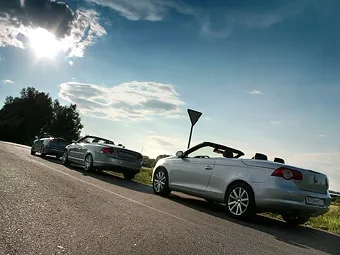
The other day we got our fill of vitamin D, taking three such cars for a test at once. All three are "Europeans" with almost identical price tags: from 50 to 60 thousand dollars. These are the Volvo C70, which we got even before its official premiere in Russia, the Volkswagen Eos, and the Saab 9-3. The latter is especially interesting because it is a true convertible with a canvas top. Many automakers are abandoning such designs, citing primarily their poor "vandal resistance," but Saab is not. It seems the Swedes have serious reasons for this.
Video: Convertibles and a kite
Reflection
A car with an open top is always beautiful. But such cars almost never look harmonious when the roof is up. In traditional convertibles, the appearance is spoiled by the "wrinkled" canvas, while cars with a hard top give away their imperfect proportions: designers have to make the rear too tall and long to hide the roof in it. However, Volvo and Volkswagen, despite belonging to coupe-convertibles, are practically devoid of this aesthetic flaw. A significant role here was played by the complex mechanism of folding the roof "in three." This scheme is more compact than the two-section one, like on the Peugeot 307 CC, but the transformation process from coupe to convertible and back in the Volvo and Volkswagen takes a long time and is only possible when fully stopped.
| Convertibles - photo gallery |
But that's just notes in the margins. In fact, all three cars look quite good. The champion of elegance, in our unanimous opinion, is the Volvo C70. The Saab wins with its stylish brutality, while the Volkswagen is perceived as a cute little sturdy fellow. The same layout in the cabin: the Volvo is the most elegant, the Saab is stylish, and the Volkswagen is solid and well-built, as befits a German car.
Feeling
All the convertibles we got were in quite "powerful" versions with turbo engines. The Saab has a 250-horsepower V6, the Volvo has an inline 220-horsepower "five," and the Eos has a two-liter TFSI with 200 horsepower. And oddly enough, it was the Eos, which is inferior in power to both "Swedes," that seemed the fastest to us. There are two reasons: a manual gearbox instead of an "automatic" and a very responsive engine that has virtually no turbo lag.
Impressed by the Eos's lively character, we decided that it would outpace both the Volvo and even the Saab in acceleration. To test this, we set up a small drag race, but the leader was still the Saab. The Volvo C70 lost to both.
When it comes to driving emotions, the Saab and Eos deliver them in full. The Eos is a real traffic-light "firecracker": full throttle, limiter, second, third... The Saab is a locomotive that rushes forward in response to the accelerator under a quiet whistle of the turbo. The Volvo is a cruiser. Its acceleration, of course, cannot be called slow, but in feel after the "Volkswagen" and "Saab," it "doesn't go." The "automatic" seems too sleepy, and the accelerator drive too thoughtful. However, as it turned out, this is mostly subjective perception, and in reality, the Volvo C70 is a quite dynamic car. But we'll write about that at the end of the article.
Test
The body rigidity of convertibles is usually lower than that of similar cars with a hard roof, while the mass, on the contrary, is greater. This, of course, affects the driving experience: with the top down, such cars seem somewhat "loose." And if we're talking about cars with a hard folding roof, then when raised, it rattles on bumps. Unfortunately, there's no escaping this — the design is too complex and heavy, with a large number of joints.
| Convertibles - photo gallery |
We identified the car with the "weakest" body using a simple experiment: we drove with the top down on a "typical Russian" road and watched the shadow of the windshield frame on the dashboard and the rearview mirror. In the Eos, they twitch the most. However, this is noticeable even without that: the plastic in the cabin creaks even on small bumps, the steering wheel vibrates, and the roof, if raised, periodically turns into a percussion instrument.
The Volvo is almost the complete opposite of the VW. The body here, in our opinion, is the strongest. Both the plastic interior parts and the raised hard roof are "silent" most of the time, waking up only on large bumps. And on smooth asphalt, comfort in the Volvo C70 is beyond praise: a "clean" steering wheel, no vibrations, and with the top up, it's very, very quiet. However, on bad roads, the Volvo completely changes its character. Not only the body is stiff, but also the suspension. It copes excellently with "rough" asphalt and small cracks, but handles more or less large potholes and bumps uncomfortably, transmitting strong jolts to the body. And the rather slippery wooden steering wheel starts to pull out of your hands.
The Saab on the move also seems much "sturdier" than the Eos, but falls slightly short of the Volvo C70, which on a good road is almost as comfortable and controllable as a regular coupe. But on bad roads, the 9-3 outperforms both competitors. There's no hint of Volkswagen's looseness or Volvo's excessive stiffness. The Swedish convertible drives with dignity on any asphalt. And there are no creaks with the roof up, and there can't be — it's soft. And this, by the way, is not the only advantage of such a design.
| Convertibles - photo gallery |
The "Saab" with the top up is the quietest of our trio at high speed, while in the Volvo and Volkswagen, the wind whistles at the joints of the roof panels. The 9-3 transforms from an open car to a closed one and back faster than the others. It can do this not only when parked, but also while moving. Finally, operating the roof does not require the engine to be running — just turning on the ignition is enough. But cars with a hard roof, if the engine stalls for some reason, cannot be closed...
Draft Check
Almost all modern open cars are convertibles and roadsters. Roadsters are much more "driver-oriented," but they only have two seats. Convertibles have a rear seat and can formally carry four people — both with the top open and closed.
The rear seat of convertibles is usually not used by anyone, so a wind deflector screen is installed above it, which protects the driver and front passenger from drafts. Such a screen was in the trunk of the test Eos, but in the Saab and Volvo, we only found mounting points for it, and the screen itself was missing.
Video: Wind and roof racing
Therefore, initially, we tested the convertibles under unequal conditions: the Eos had the screen, while the "Swedes" had a fully open cabin. Naturally, the driver and passenger in the Volkswagen were more comfortable. Even at speeds over 100 kilometers per hour, there were no drafts, the air conditioning coped well with the heat, and the heater in cold weather. In the Saab and Volvo cabins, on the contrary, even with the side windows up, it was quite windy, hot in the heat, and at night the driver and passenger froze — the power of the standard "non-convertible" heater was insufficient. During such trips, we unanimously remembered the Mazda MX-5 roadster, which has a special ventilation system for driving without a roof...
| Convertibles - photo gallery |
But as soon as we removed the screen, all the aerodynamic advantages of the Eos vanished. It turned out that the German convertible has even worse aerodynamics than the Swedish ones. For example, at a speed of 120 kilometers per hour, the wind lifted an empty liter juice carton from the rear seat. It soared up and hovered near the driver's head, scaring him considerably.
As for the rear seat, it's uncomfortable at any "non-urban" speed in all three cars. Neither the heater nor the air conditioning reaches there, but drafts do. If you drive without a headgear, after an hour your hair is literally clogged with sand. In both "Swedes," the rear is more spacious than in the Eos, and there's less wind there. Moreover, amusingly, in the Volvo, the wind is directed from above and in front, while in the "Saab," it's from behind... In short, aerodynamic wonders.
Inspection
Convertibles are by definition expensive and well-equipped cars. In the Saab and Volvo, almost all equipment has been carried over from the base 9-3 and S40. This includes the Saab's voice control system, the Volvo's built-in phone, and much more... At the same time, the Volkswagen Eos has an exclusively convertible "feature" — a sliding glass sunroof in the folding roof. Journalists remember this sunroof every time they write about the Eos. We do the same, but sincerely don't understand what the point of this clever mechanism is.
Video: Convertibles and their "features"
If we talk about which of the three cars makes the most expensive impression, it is undoubtedly the Volvo. Inside — first-class materials, many compartments with smooth closers, a steering wheel with wooden inserts, an original instrument panel, excellent multimedia with crystal-clear sound, as well as a power-adjustable front seat with memory settings — and this is far from the entire list. The Saab also looks decent, but it is perceived not as luxurious, but rather as stylish. Take, for example, the original air vents with a built-in cup holder. As for the Eos, the burgundy leather certainly pleases the eye, the build is impeccable, and the materials are tastefully selected. However, the feeling that all this has been seen somewhere before does not leave. The stereo, the blue backlighting, the instruments, the seats, and the door handles — all of this is painfully familiar. And in a convertible, you want something special, individual. Especially since this model is not just some Golf Cabrio or Jetta Cabrio, but stands a step higher in the Volkswagen hierarchy.
Practical side
What about practicality? When the roof is folded, it is hard to talk about it. The trunk shrinks to laughable volumes, access to it (except for the Saab) becomes extremely inconvenient, and there is nothing to say about the cabin — neither sound insulation nor protection from drafts and rain.
However, if you raise the hardtop, warmth and coziness settle in the cabin, and the trunk noticeably increases in volume, but the charm of open-top driving disappears.
| Convertibles - photo gallery |
We must not forget about fuel consumption. Here, the undisputed champion is the Volkswagen: it needs only 10-13 liters, while the "Swedes" ask for 15-17. True, the Saab partially justifies itself by being content with 92-octane gasoline.
In conclusion, we subjected all three cars to a leak test. They withstood an ordinary downpour without problems, but a more severe test with a high-pressure washer aimed at the joints of the side windows and roof revealed leaks in all of them. In the Volvo and VW, water seeped through at the junction of the windshield frame with the roof, and in the Saab — in the corner between the door, roof, and rear window.
Video: Water test
Observation
Now it is time to explain why the Volvo C70, which initially seemed sluggish to us, is not so simple. Doubts arose on the highway when the Saab, emitting a turbo whistle, surged forward, and the Volvo did not think of lagging behind. At the same time, the Saab driver was delighted with the acceleration, while the Volvo driver habitually complained that the car "does not go".
The answer turned out to be that the Volvo dulls the sensation of speed, largely because the speedometer in the C70 is much more accurate than in the Saab. If you set cruise control to 130 km/h on both cars, the Volvo will overtake the Saab and quickly pull away.
Conclusions
Each of these cars is good in its own environment. The Volkswagen is definitely an urban youth "firecracker". The Eos accelerates well, handles decently, but noticeably loses to the Swedes in comfort, especially at high speeds. The Volvo C70 is not as nimble, but very comfortable, yet completely unsuited for rough roads. The Saab 9-3 could be an ideal compromise if not for one "but". A soft top is always a risk of vandalism, as hooligans could simply slash it. And knowing this, many insurance companies refuse to work with such cars.
Lenta.Ru expresses gratitude to the Pereslavl Railway Museum for assistance in organizing the photo shoot. And to the Russian offices of Volvo, GM, and Volkswagen for providing the cars.