
About the Renault brand
France founded in 1898 Model range
General Information
The reliability of cars and the quality of after-sales service are factors that encourage a customer to purchase a car and remain loyal to the brand, which helps Renault to continuously increase sales. Renault offers a model range adapted to the climatic and road conditions of our roads.
Renault (Renault, Regie nationale des usines Renault) is a French state-owned automobile company, the largest in the country. It produces passenger cars, trucks, and sports cars.
The headquarters is located in Boulogne-Billancourt (a small town near Paris).
Corporate History
The company's history began with the first car assembled by Louis Renault in 1898, a light voiturette (from French voiturette - small carriage, cart) with a power of only 0.75 hp. The next step - model "A" with a "De Dion-Bouton" engine of 1.75 hp on a tubular frame turned out to be very successful, and Louis, together with his brothers, organized the company "Renault Freres". In 1899, the brothers had already sold 15 cars of this model. For his car, Louis designed a gearbox in which torque was transmitted to the rear wheels not by chains, but by a shaft with universal joints. This final drive scheme has remained unchanged to this day for rear-wheel drive cars. The brothers were passionate about car racing, and racing and sports models played an important role in their early business.
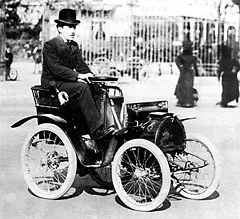
From 1900, the company began producing large and powerful cars. These were models AG1 with elegant and comfortable various bodies such as "capucine", "double-phaeton", "landaulet", and rare at that time closed limousines. In 1906, at the Berlin Motor Show, the company presented its first bus.
One of the first, in 1905, "Renault Freres" produced taxis with a "landaulet" body. These cars, nicknamed "Brownings" due to their black color and shape, became famous during World War I, when 600 Parisian Renault taxis were mobilized in the shortest possible time to transport 5,000 soldiers to the Marne River. After the famous battle, the taxis were nicknamed "Marne". A monument was even erected to this car. For the needs of the French army, the company also supplied other equipment, ships, aircraft engines (the first aircraft engine was assembled in 1908), and even tanks designed by Louis Renault.
In the pre-war years, "Renault Freres" actively cooperated with Russia. A limousine-landaulet on a Renault chassis was made for the emperor, and a "Renault-Bebe", a light car extremely simple to drive and maintain, was purchased for the heir to the throne. Confiscated from the "exploiters", Renaults, as is known, also carried Lenin.
In the 1930s, original buses with an open platform appeared.
Brilliant sporting results continuously accompany the company. Louis Renault himself, after the death of his brother, no longer got behind the wheel, but the company's cars invariably adorn numerous races.
After the war, the company's factories were almost completely destroyed by Allied bombing, and Louis Renault himself died in prison, accused of collaborating with the Nazis. In 1945, the company was nationalized and became a state enterprise, receiving its current name.
In 1946, Renault introduced the mass model 4CV, which, together with the famous Citroen 2CV, revived the French automobile industry.
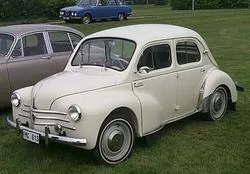
In 1949, the reconstruction of the factories was completed, and 500,000 4CVs were produced. In 1958, a new Renault engine plant was launched in Cleon (Normandy). The front-wheel drive Renault 4 became a popular "small people's car" (8 million units produced). In 1965, the world's first hatchback, the Renault 16, appeared under the Renault brand.
In 1966, Renault signed an agreement with Peugeot and Volvo to combine technical resources.
In the 1970s, the company entered a period of rapid growth: new factories appeared in northern France, joint ventures between Renault and Peugeot. The Renault 5 and Renault 12 became the best-selling French cars in the world.
Since 1979, after signing an agreement with American Motors Corporation, the company began to enter the prestigious American market. In 1982, the Renault 9 was launched in the USA under the name Alliance and won the Car of the Year title (this car also became a faithful companion of James Bond in one of the films in the series).
An important place in the Renault product range is occupied by trucks: the heavy truck division of Citroën, M. Berliet, and Saviem also merged into the company. In 1974-83, Renault controlled the well-known truck manufacturer Mack Trucks Inc.
In 1996, Renault was partially privatized, and currently the state controls 50.1% of the company's shares.
In 1995, the Next model was released, whose engine combines electric power with traditional fuel. The car has minimal environmental impact.
In 1998, an alliance was created with Nissan. Having sold about 6 million cars in 2004, the Alliance entered the top four global automakers.
After acquiring the Romanian car manufacturer Dacia in September 1999, and then in September 2000 the operating assets of the South Korean company Samsung Motors, the Renault Group operates three brands: Renault, Dacia, and Samsung.
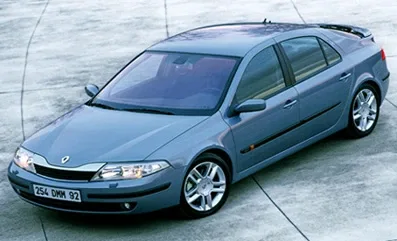
2001 - Renault Laguna II - the first car in the world to receive the highest safety rating, five stars out of five, according to the tests of the independent organization EuroNCAP.
Renault cars have written bright pages in the history of world motorsport. The Renault team has repeatedly won in Formula 1, the 24 Hours of Le Mans, the Paris-Dakar rally, and other prestigious competitions. Outstanding racing drivers have collaborated with Renault - Nigel Mansell, Alain Prost, Michael Schumacher.
Renault cars are currently produced in France, Spain, Belgium, Portugal, Slovenia, Turkey, China, Taiwan, Colombia, Argentina, Morocco, Malaysia, and Uruguay.