
You know, the old Logan is not a handsome car, but it is distinctive. I like its design minimalism, which is dictated by the construction features and production specifics. And cars like the Sandero, which carefully mask their poverty, are a dime a dozen. Its two-box aesthetics have even more cold calculation than the angular silhouette of Russia's number one foreign car.
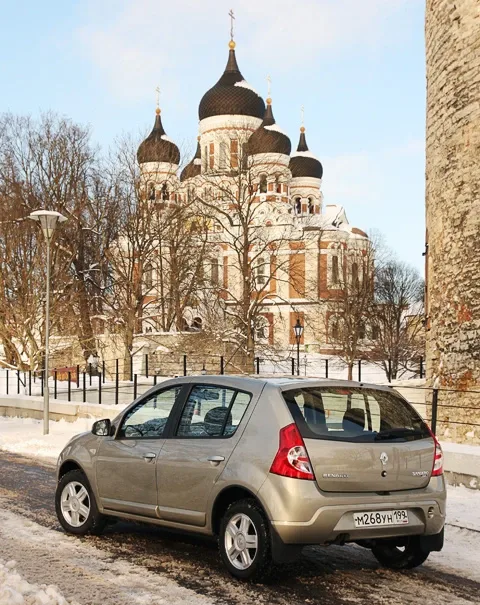
The Baltics in early spring are still asleep under a thin crust of salty ice. And the Sandero, rolling off the Avtoframos assembly line for every third customer, does not enliven the landscape around Tallinn. No matter how hard I looked through the camera viewfinder for a favorable angle, I could not find one that would make the Sandero attractive. Although it is obvious that the paint shop at Avtoframos will now be more cheerful. Who buys red Logans? But a brightly colored hatchback will surprise no one.
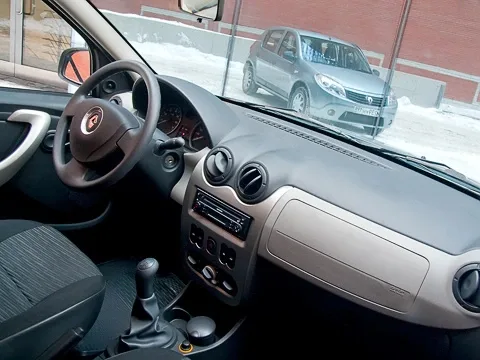
Fully unified with the Logan.
Talking about the interior is like reading a TV program out loud. The same level of emotion. But functionality does not suffer from this. The steering column adjusts for height, but you still have to sit with bent knees, and from under the lowered sun visor, a driver of my height can see only about fifty meters of flat road.
The accelerator is pressed too close to the center tunnel for driving in winter shoes. All pedals are light, and the clutch is almost weightless, although this does not cause difficulties when starting off. The 1.6 V16 engine with 102 hp (only these were available in Estonia) pulls well at low revs and reaches 6500 rpm with not the most unpleasant sound. The gears are short: first ends at 50 km/h on the speedometer, second at almost 90. As a result, subjectively the Sandero is by no means a complete vegetable.
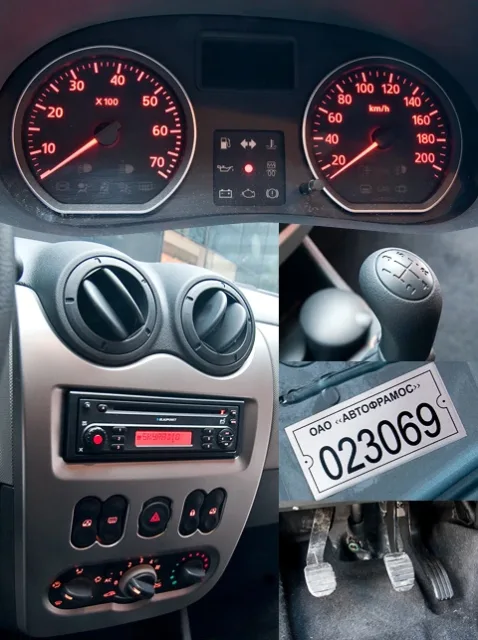
- On cheaper versions, the instrument scales are black with orange backlighting, and the interior is limited to a minimum of silvered trinkets.
- The travel of the five-speed manual gear lever is long, but the drive is quite precise.
- The pedal box is cramped.
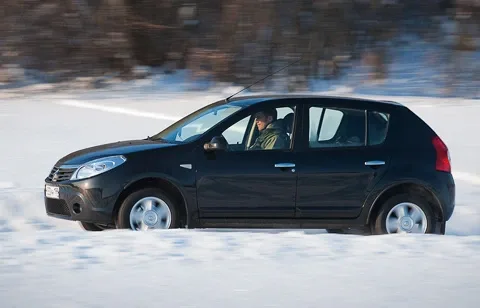
In addition, Renault was very lucky with the weather. Snow emphasizes only the best in the hatchback's habits: good directional stability, simplicity, and predictability of reactions. And the body roll, which the Logan chassis is rich in on asphalt, is successfully masked by the limited capabilities of non-studded tires. Lateral forces simply do not have time to twist the suspension without a front stabilizer before sliding begins.
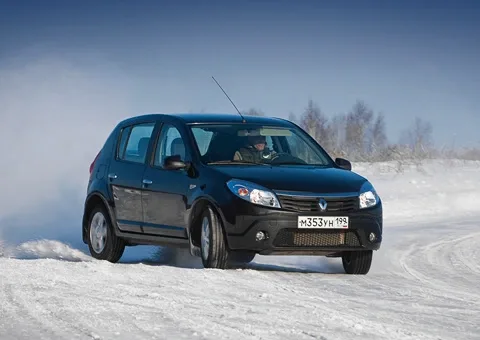
When you lift off the throttle, the car goes into a gentle, easily controlled drift, so on the luxurious Estonian dirt roads the Sandero encourages a semi-racing pace and delivers budget driving pleasure. Fortunately, the steering and brakes are quite informative. At the same time, the hatchback handles bumps exemplarily, maintaining decent ride smoothness even on a frozen washboard. And only the body, it seemed to me, resonates more strongly on bumps than the sedan, filling the cabin with an unpleasant low-frequency buzz unusual for a three-box. A difference in rigidity?
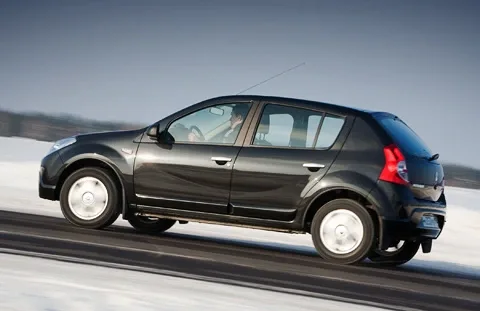
Contrary to expectations, the reduction of the hatchback's wheelbase by 42 mm compared to the Logan not only did not make the Sandero more nervous in handling, but also did not radically affect passenger comfort. In the back, there is still enough knee room provided that a tall driver prefers a near-vertical seating position. There is enough space for feet under the seat, but I would like more headroom. And instead of inner handles on the rear doors, there are the same shabby stamped recesses familiar to all Logan owners...
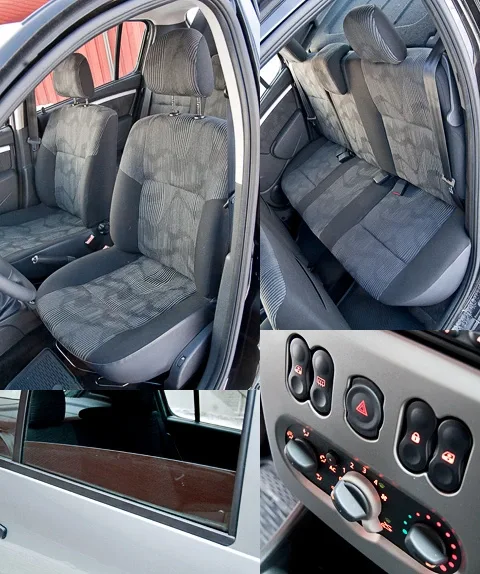
- The driver's seat on base versions is not height-adjustable, while on more expensive ones it is equipped with a "jack" and heating. Front occupants can adjust the height of the seat belt anchor.
- The air conditioning control unit is located low, and the recirculation mode is activated by an additional ring that sits under the central airflow knob.
- In the back, there are three headrests, and the middle one, when folded, does not obstruct the view.
- The rear door windows do not lower all the way.
By and large, I think the public will receive the car warmly. After all, prices start at 319 thousand rubles. And if you trade in an old car under the scrappage program when buying a Sandero, then even from 269 thousand. And the five-door does not intend to grab stars from the sky — it is positioned as younger and more urban. There are not so many hatchback fans in the target audience. Although, for example, in terms of pure practicality, the Sandero with a transformable interior and a convenient 320-liter trunk, in my opinion, surpasses the sedan...

- With the seats fully folded, the trunk volume grows from 320 to 1200 liters!
- A slippery handle is built into the plastic island of the fifth door trim.
The first series of the French blockbuster "What Does a Russian Want" was shown to us five years ago. Since then, more than 252,000 Logans have been sold (54 thousand last year alone). Now a sequel has been put into production. A little later, a version with sign language interpretation will be released — a four-speed automatic for thirty to thirty-five thousand rubles. Meanwhile, a group of French screenwriters is rewriting the Russian synopsis for AvtoVAZ: instead of Project C — a Logan station wagon and pickup. And 90 specialists are courting 35 international supplier companies to build the Tolyatti Disneyland together. But the main thing is that, using Volkswagen as an example, the VAZ workers are being taught not to fear internal competition between cars on the same platform.
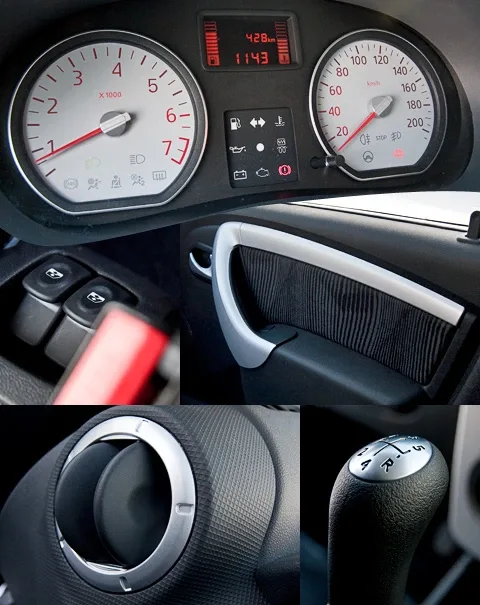
Distinctive features of the Prestige version are silver trims on the doors, air ducts, and gear lever, rear power windows, and a white instrument panel that lacks contrast when the backlight is on.
Renault dreams of being present in almost every market segment. So far, the French brand has not climbed above the family D-class, but even with shrinking sales, it is increasing its share. Naturally, with the help of Logans. The very B-class that was steadily shrinking before the crisis grew successfully last year to almost 40%, and the French call the Sandero nothing less than their tool for conquering the market. After all, every third car in this category is a hatchback. It is not surprising that the ratio in the Avtoframos model range is the same.
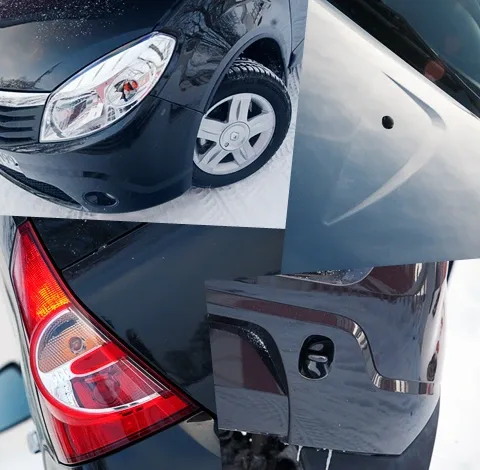
The most elegant stylistic solution seems to me to be the stampings on the Sandero's hood. But the cable, fixed at the rear in a fixed towing eye, will hardly spare the painted bumper.
And yet, every 25th car on the market today is already a Logan. And the Sandero is only an intermediate step in the truly Napoleonic plans of the Renault-Nissan-AvtoVAZ alliance to populate our roads with "budget" cars of the Logan breed. Already next year, the modernized VAZ assembly line, which, by the way, is now overseen by Nissan's Kaynagi, will see the Logan station wagon and pickup under the Lada brand. Then the Duster crossover will come to Avtoframos, and in Tolyatti — another Renault model and a new cheap Nissan on the same platform.
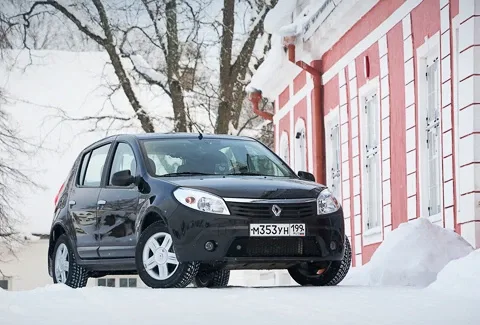
As a result, Russia could become the alliance's main trading platform altogether. Renault aims to take 8% of our market, Nissan claims another 8%, and AvtoVAZ, thanks to new products, counts on all 25%. The main trend is unlikely to change: the lion's share of these volumes will come from budget models. And if Ghosn's plan works out, will every third new car in Russia turn out to be a relative of the Logan? What a bright future.
Specifications
*Depending on trim level
| Renault Sandero | 1.4 | 1.6 | 1.6 16V |
|---|---|---|---|
| Body | |||
| Body type | hatchback | ||
| Number of doors/seats | 5/5 | ||
| Length, mm | 4020 | ||
| Width, mm | 1746 | ||
| Height, mm | 1534 | ||
| Wheelbase, mm | 2588 | ||
| Track front/rear, mm | 1480/1469 | ||
| Curb weight, kg | 975–1062 | 1048–1071 | 1082–1137 |
| Gross weight, kg | 1470 | 1470 | 1600 |
| Trunk volume, l | 320–1200 | ||
| Engine | |||
| Type | petrol | ||
| Location | front, transverse | ||
| Number and arrangement of cylinders | 4, in-line | ||
| Number of valves | 8 | 8 | 16 |
| Displacement, cm3 | 1390 | 1598 | 1598 |
| Max power, hp/rpm | 75/5500 | 84/5500 | 102/5750 |
| Max torque, N•m/rpm | 112/3000 | 124/3000 | 145/3750 |
| Transmission | |||
| Gearbox | manual, five-speed | ||
| Drive | front | ||
| Chassis | |||
| Front suspension | independent, coil spring, McPherson | ||
| Rear suspension | semi-independent, coil spring | ||
| Front brakes | disc | ||
| Rear brakes | drum | ||
| Tires | 165/80 R14 | 165/80 R14 (185/70 R14)* | 185/65 R15 |
| Ground clearance, mm | 155 | ||
| Performance characteristics | |||
| Maximum speed, km/h | 162 | 175 | 180 |
| Acceleration time 0–100 km/h, s | 13 | 11.5 | 10.5 |
| Fuel consumption, l/100 km | |||
| — urban cycle | 9.2 | 10 | 9.4 |
| — suburban cycle | 5.5 | 5.8 | 5.8 |
| — combined cycle | 6.8 | 7.2 | 7.1 |
| Emission standard | Euro-4 | Euro-4 | Euro-4 |
| Fuel tank capacity, l | 50 | 50 | 50 |
| Fuel | AI-92–98 | ||
Prices and trim levels
Legend: + — included in base trim; - — not available; o — option installed on test car
| Renault Sandero 1.6 16V (102 hp) | Expression | Prestige |
|---|---|---|
| Driver front airbag | + | + |
| Isofix child seat anchors | + | + |
| Power steering | + | + |
| Rear wiper | + | + |
| On-board computer | - | + |
| Air conditioning | O | + |
| Tilt-adjustable steering column | + | + |
| Heated and power-adjustable exterior mirrors | - | + |
| Driver seat height adjustment | - | + |
| Heated front seats | - | + |
| Immobilizer | + | + |
| Front fog lights | O | + |
| Engine sump guard | + | + |
| Steel wheels 14" | + | - |
| Options installed on test cars | ||
| "Safety package 1": ABS, front passenger airbag, rear center headrest | 19 800 | - |
| "Safety package 2": ABS, front passenger airbag | - | 19 300 |
| Metallic paint | 5500 | 5500 |
| CD player with MP3 support | 9000 | 9000 |
| Air conditioning | 22 000 | - |
| Alloy 15-inch wheels | - | 10 500 |
| Front fog lights | 4300 | - |
| Leather-wrapped steering wheel | - | 2200 |
| Base trim price | 386 000 | 428 000 |
| Tested car price | 446 600 | 474 500 |
Engineering 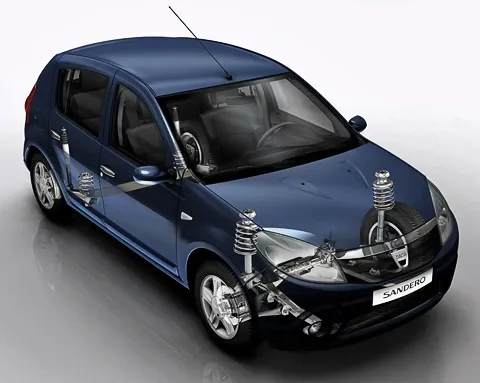
The Sandero is based on the global B0 platform, which is an economical derivative of the second and third-generation Clio platforms. The Sandero hatchback shares 70% of its components with the Logan, but the five-door's wheelbase is 42 mm shorter. All models except the most powerful 1.6 with 102 hp sixteen-valve engine do without a front anti-roll bar.
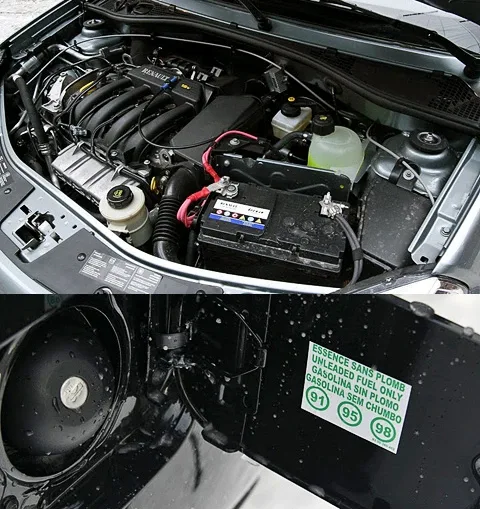
It is unlikely that the 102-hp 1.6 engine, despite its top-model status, will ever be fed "98" in everyday use. But just in case, there is a warning label on the fuel filler flap: the main thing is that the gasoline is unleaded. If both AI-92 and AI-95 run out at the gas station, you can, as a last resort, pour AI-98. And seriously, the use of fuel with an octane rating of at least 87 is structurally permitted. There will be no diesel versions in Russia, and we are waiting for the "automatic".
Safety 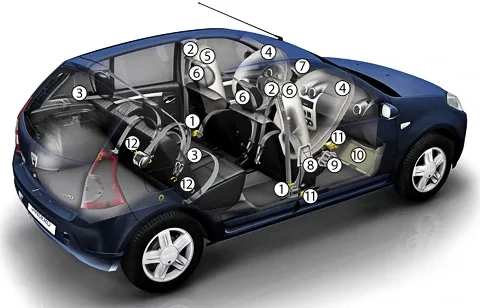
The Romanian version of the Dacia Sandero (pictured), supplied to Europe, can be equipped with two side airbags for front occupants, while in Russia the front passenger airbag is the limit of possibilities.
Passive safety features of the Dacia Sandero: 1 — pretensioner and force limiter; 2 — height-adjustable mount; 3 — three-point seatbelt; 4 — front airbag; 5 — side airbag; 6 — fixed headrest; 7 — front panel with energy-absorbing structure; 8 — thigh pads; 9 — additional thigh bolster; 10 — floor pad; 11 — airbag control unit with impact sensor; 12 — Isofix mount.
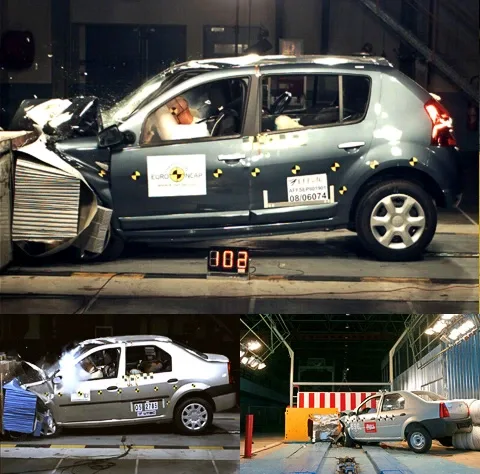
According to Euro NCAP crash test results, the Dacia Sandero hatchback earned three stars for adult occupant safety, four "child" stars, and one "pedestrian" star. This result is better than what the Logan showed when it participated in Euro NCAP tests in 2005 under the identical pre-reform methodology. In the frontal impact, the Sandero immediately scored 12 points out of a possible 16, while the Romanian Logan initially received 7.6 and then 8 points. Moreover, the Logan's child safety was rated only three stars. It is worth noting, however, that in the passive safety laboratory of the Dmitrov test site, as part of the Autoreview crash test program, the Russian-assembled Logan also withstood the impact with 12 points.
Behind the scenes 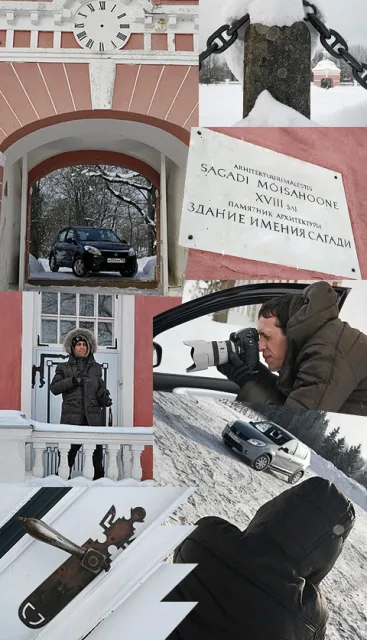
The most interesting thing in the Baltics is the roads. An hour is enough to understand why Baltic racers were the strongest in the USSR rally team. I went on this trip primarily because of Estonia: since childhood I dreamed of visiting Tallinn. In the end, I barely saw Tallinn, but I met a great guy, Sergei Krestov, a well-known automotive photographer. It's been a long time since I felt so comfortable with someone in the same crew. It would be interesting to work together with Seryozha on some DRIVE.RU project someday.