
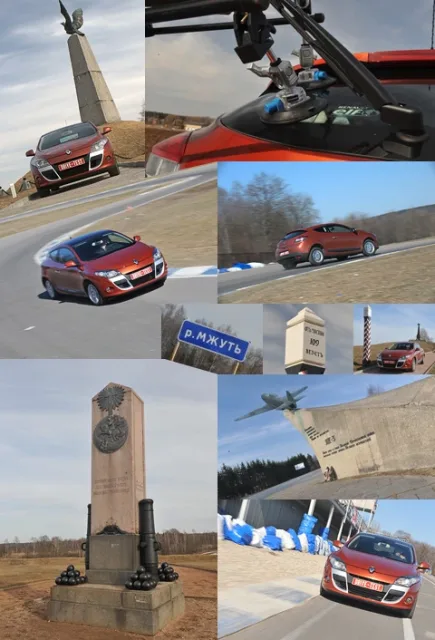
We really did send the Megane to the "Mayak" (Lighthouse). There, the orange little car with a two-liter engine producing 140 horsepower and a CVT was earning the Coupe prefix in its name. We also arranged a countryside trip in the Megane to places where the French are well remembered since 1812. The journey to the village of Borodino, located one hundred and ten kilometers from Moscow, gave us the opportunity to look at the car from a different, tourist perspective. But let's take it in order.
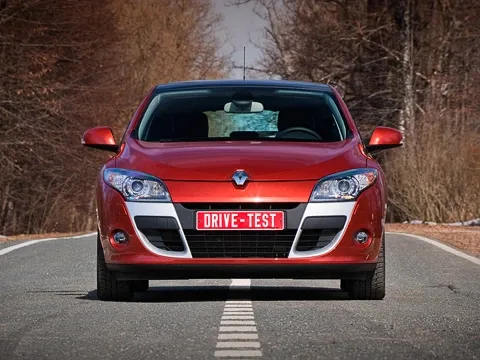
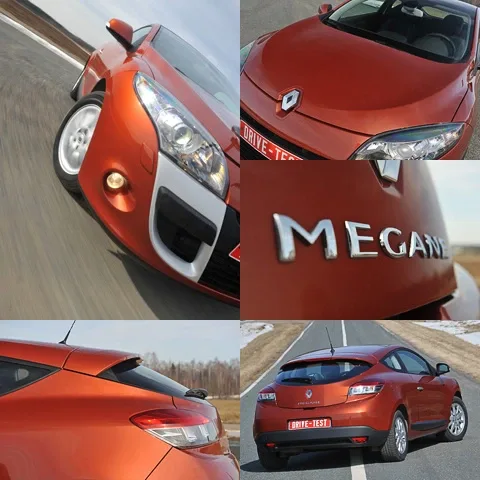
Thanks to the lowered suspension and the front bumper with "fangs," the Megane Coupe looks aggressive from the front. Don't believe your eyes! In fact, the car's character is docile.
One question kept bothering us: is the Megane a boy? Come on. Just look: here's a thrilling curve, there's a sexy crease. You look at the sprawling fiery-red body and think: "Damn, it's a 'girl'!" Here's a waist narrowed in a modern way, here are the lush hips of the rear wheel arches, and on top—a narrow neckline of glass panels. Definitely not a boy.
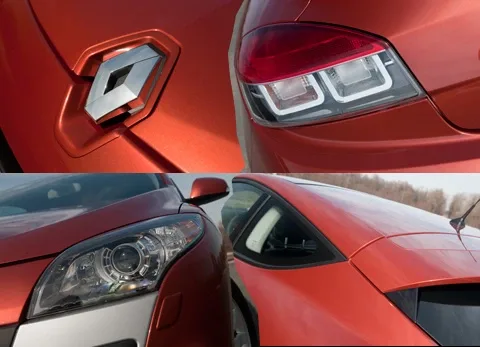
The production Megane Coupe differs noticeably from the concept car presented two years ago at the Geneva Motor Show. There are no scissor doors, and instead of rear-view cameras, there are ordinary mirrors. The wheels are also ordinary. But the body contours have hardly changed. There is also much in common in the details. It is the details that win the heart of the "French lady." The steel panel of the tailgate is cut by highly artistic stampings, and a sharp wave runs along the hood metal. At the front—"fangs" of air intakes, and you can admire the rear lights without getting tired. Whether in the dark or in daylight, they look magnificent.
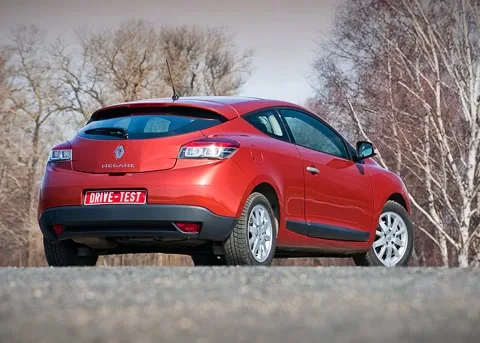
The U-shaped glass of the tailgate significantly impairs visibility through the interior mirror. Turning your head while maneuvering in dense traffic is also useless: little is visible through the side windows.
However, our photographer somehow cannot assemble the beautiful puzzle pieces into a single picture. As soon as the lens moves from a close-up to a general view, the Megane turns into a shapeless orange creature. Something chubby-cheeked, on short legs, and with a thick rear. The distance from love to hate in the case of the Megane is measured not in steps or even small steps—but in centimeters, and even more often in degrees. Squat down behind—I love it to bits! Stand up to full height—I wish my eyes didn't see it.
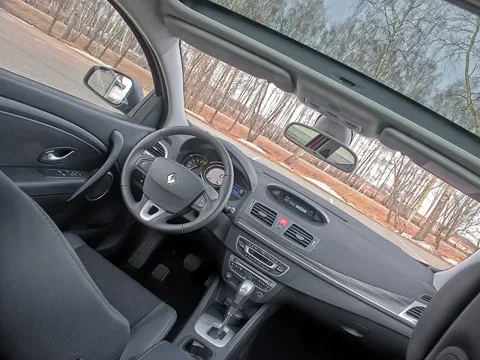
The pleasure of the high-quality interior is slightly spoiled by minor ergonomic miscalculations: tiny buttons for the systems on the central console, limited steering wheel reach adjustment, which is aggravated by the small travel of the driver's seat backrest relative to the vertical. But if you have short legs, long arms, and are also accurate, there will be no problems.
It's a different story inside! Wherever you look—love until death. The calm mood of the interior may not match the rebellious exterior, but the cabin looks great from any angle. The fit of the parts is flawless, and the quality of the plastic is the envy of all "Germans." But here too, the charm is in the details. The most ordinary buttons on the instrument panel and ceiling are lovingly decorated by the French with an S-shaped stroke. The same zigzag is on the thresholds.
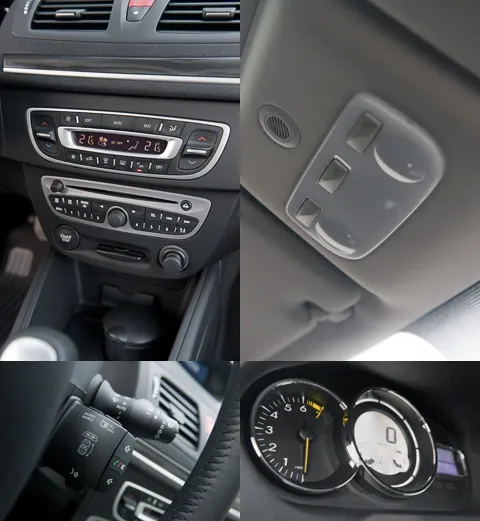
Details! A sight for sore eyes. However, in the dark, the glowing field of the digital speedometer is hard on the eyes. Note that the redline zone on the tachometer is yellow.
Despite the extremely modest trim with silver plastic, the Megane's interior does not look gloomy. On the contrary, a sense of proportion only emphasizes the quality of the interior. But not all details evoke positive emotions. I jump into the driver's seat, press the "Start" button—silence in response. After all, the chip card that has become traditional for Renault must be inserted into a special slot and only then start the engine. This ritual, it must be said, quickly gets boring. The scattering of small buttons for climate control and the radio forces you to get distracted while driving. The digital "porthole" of the speedometer lies shamelessly at low speeds.
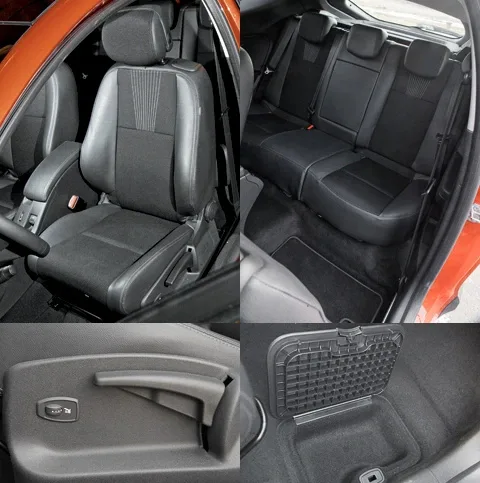
- The cushions of the front seats are excessively flat, but this does not cause inconvenience in corners. The developed lateral support of the backrest and tenacious fabric inserts help.
- Among the pleasant surprises are the height-adjustable front passenger seat and hidden compartments in the floor.
- In the back row, it is expectedly cramped. The margin in length and height is minimal, but two people up to 178 cm tall will fit here.
It is impossible to determine speed subjectively. The cabin is quiet: multi-layer noise insulation mats perfectly combat road noise. And the CVT, playing with the gear ratio, eliminates the impression of linear acceleration. As a result, the ride behind the wheel is barely felt. The suspension, which is stiffer here than in the five-door Megane, depends more on road quality than speed. It elastically absorbs small irregularities, but at bridge and overpass joints, the shock absorbers sometimes make you tense up. At the same time, on asphalt waves, strong vertical pitching manifests itself. And if there is a section with a noticeable dip on the highway, it is better to slow down. Because the ground clearance of the three-door Megane is twelve millimeters less than that of the five-doors. There is a risk of hitting the bottom during compression.
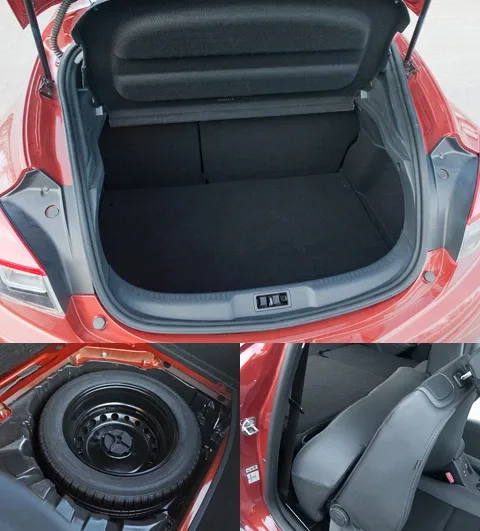
- The trunk is left at the mercy of the designers. The opening is narrowed by the rear lights, and the protruding bumper hinders loading. And to fold the rear sofa flush with the floor, you will have to manually remove the cushion. A folding mechanism is not provided.
- The full-size spare wheel is stored in a niche made of noise-absorbing plastic.
Fortunately, on the Mozhaisk Highway, completely broken sections are rare. And the roads around Borodino itself are exemplary. Smooth, with many varied turns, with ascents and descents. On such roads, you can savor the nuances of handling and assess the mutual understanding between the engine and transmission. The dynamics initially disappointed. The two-liter naturally aspirated F4R moved under the hood of the "third" Megane from the previous generation car, where it proved to be a modest worker. It produced its 136 hp and 190 N•m at medium revs, but was good in combination with the "manual." In the new Megane, the engine is both more powerful and torquier. But this increase is impossible to feel with the Nissan CVT.
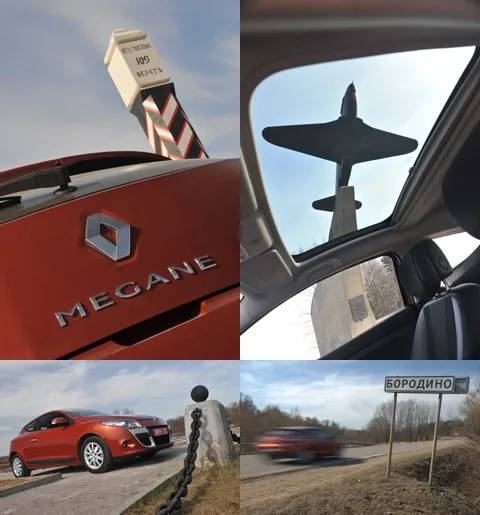
- In the vicinity of Borodino, everything is saturated with the spirit of past battles. In September 1812, a battle was fought here against the advancing French. In October 1941, attacks by the Germans were repelled with difficulty. Both went along the old Mozhaisk road to Moscow.
- Now the Mozhaisk road pleases with smooth asphalt and, despite the villages scattered around, surprisingly low traffic. Over a hundred versts of calm driving, the Megane's fuel consumption never dropped below the average value—11.2 l/100 km. But as soon as we drove more actively, it quickly grew by two-tenths of a liter.
There is no more sport in the gearbox than in the suspension tuned for "Comfort." Even less. When trying to accelerate from a low speed, the CVT completely ignores the accelerator movement by a quarter of its travel. The gearbox takes measures later and lazily. Even in the pseudo-manual mode, the change of "fictitious" gears occurs with delays. The continuously variable transmission is good when the Megane has gained speed. The delays in fuel supply disappear, and the "kickdown" instantly throws the tachometer needle into the yellow sector of the scale, and... the engine hangs at maximum power revs (about 6000 rpm), filling the cabin with a monotonous howl. The CVT has not been taught to accelerate "on torque."
Even if you manage to get adequate acceleration from the Megane within "one gear," the engine no longer pleases with a brisk pickup after the three-thousand mark, which I remembered from the previous two-liter Megane. It turns out that the power curve is smoothed by the air conditioner! It is known that its compressor can temper the ardor of any small-displacement car, but in the case of the Megane, the difference is not just noticeable—it is fundamental. I turn off the AC, and the "French lady" gains lightness. The burst of activity at medium revs is comparable to the pickup of a tiny turbocharger and pleasantly tickles the driver's nerves. And the CVT becomes more responsive.
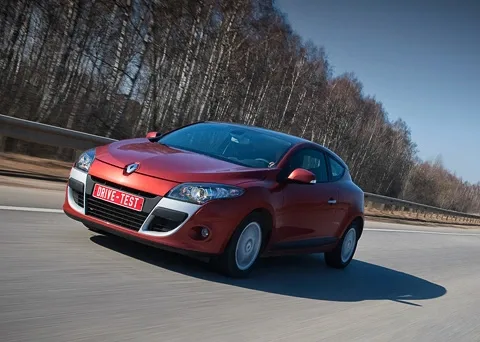
The settings of the steering and suspension are emphatically comfortable. The desire to rush headlong in the Megane, even with the Coupe body, somehow does not arise. It is much more pleasant to drive at your leisure, admiring the surroundings. Is that bad?
The concept called Renault Megane Coupe Concept was first shown to the public in Geneva in March 2008. The main thing remembered from this show car was the unusual doors: their lower metal and upper glass parts opened separately. And the concept's engine was started not with a key or Renault's signature card, but via a mobile phone with a specially installed program.
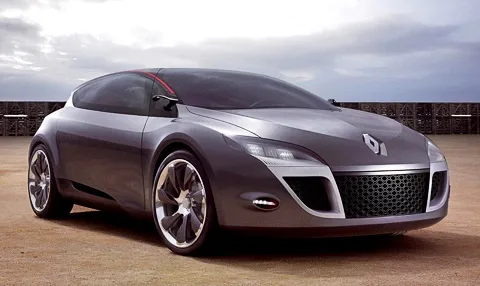
The show car's appearance easily reads the features of the future production car: a smoothly sloping roof, the recognizable curve of the rear side window, and headlights shaped like a drop that transition into silver "fangs" of the air intakes.
How It All Began
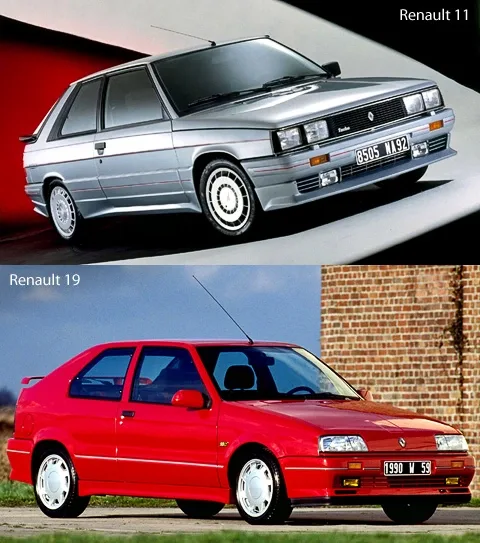
For a long time, Renault almost always used numbers in its names. In the C-class, the French had, besides sedans and five-door hatchbacks, three-door versions: the Renault 11 (1983–1988) and the Renault 19 (1988–1997). The latter is especially well known to drivers in Russia—it was with it that the brand's confident promotion in our market began.
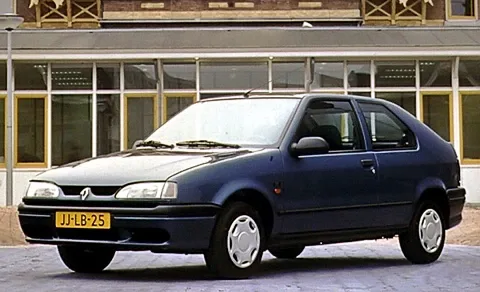
After the update in 1992, the Renault 19 noticeably freshened up: the front and rear parts of the body changed, and the interior began to look more modern.
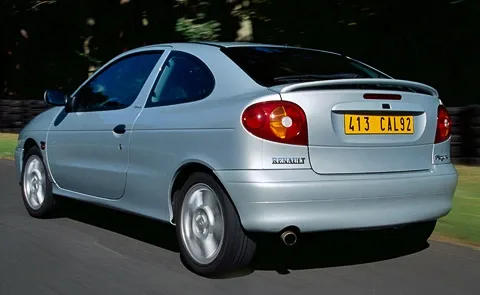
In 1995, the digital designations were replaced by the name Megane. The three-door Coupe variant stood out among its five-door siblings with its own rear end and a different set of engines.
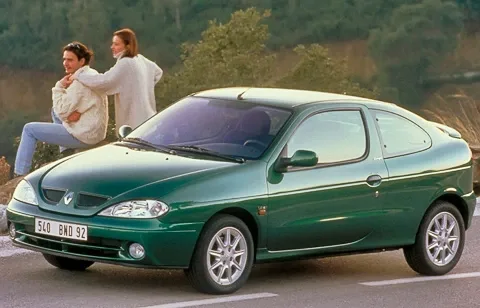
Four years later, the bestseller underwent modernization. The exterior was barely touched, but the technology made a leap. The real news was that an engine with direct injection appeared on an inexpensive car. The two-liter F5R unit, producing 140 hp, was created at Renault Sport. The previous 1.4 and 1.6 engines were also refined, raising output to 95 and 107 hp. And since 1999, the Megane Coupe could also be ordered with a 1.9 turbodiesel producing 98 hp.
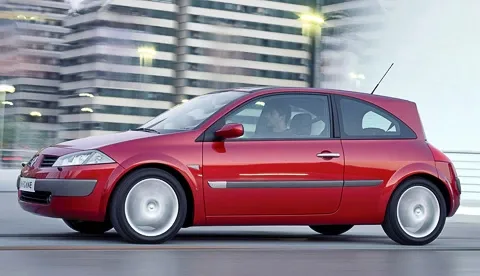
The three-door Megane II that appeared in 2002 caused a stormy reaction with its bold design: a two-tier rear with a protruding "tail" of the trunk and an almost rounded window line. It was this family that was named "European Car of the Year" in 2003.
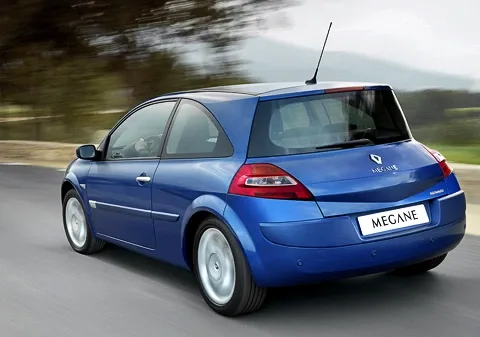
The petrol range of the "second" Megane started with a 100-hp 1.4 engine, and the top was a turbocharged two-liter with 163 hp. Four diesel options were offered: 1.5 (105 hp), 1.9 (115 hp), 1.9 (130 hp), and 2.0 (150 hp).
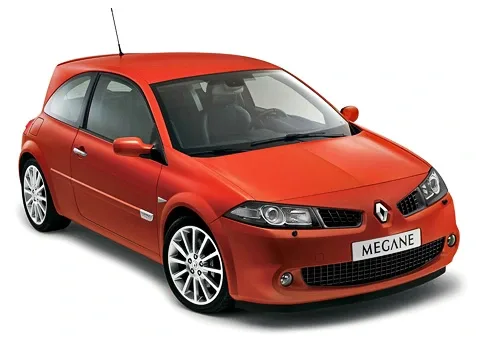
A separate story is the Megane RS, presented in 2004. Under the hood is a two-liter turbo engine with 225 hp. The curb weight is 1450 kg, the top speed is 236 km/h, and acceleration to 100 km/h takes 6.5 seconds. It remains to wait until the third-generation Megane RS reaches Russia.
Off the set
The days have become noticeably longer, and now there is more time for things, and less for sleep. After Borodino, we planned to stop by Kolomna to try the pastila at the local museum. But in the end, instead, we went to the Mayak, which we had already missed. Just like children who always find the carousel more interesting than a bench in the park.