
Renault Megane II is one of the most sought-after cars in Europe. Over three years, 2.5 million buyers from 75 countries chose it. It's time for an update.
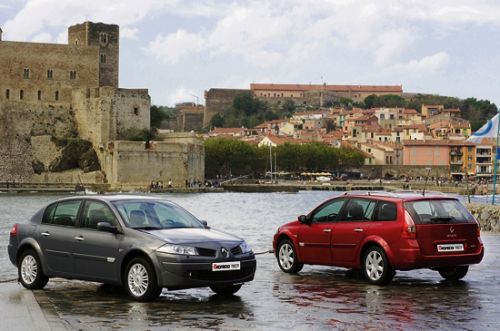
2006 Renault Megane
© Photo: Renault
At first glance at the modernized Megane, a natural question arises: "What has changed?" Only a careful comparison with the previous version helps to notice the difference.
The new front bumper is now fully painted in body color and has received a wide "smile" line. The radiator grille has become even more pronounced V-shaped. The updated headlights have added more aggression to the appearance. The rear has also been transformed: a different bumper and lights with horizontal, slightly convex sections for the reverse indicators. Fresh body paint options have also appeared, including Extreme Blue, Steel Grey, and Poivre Beige.
2006 Renault Megane
© Photo: Renault
The interior has hardly changed — except that the instrument panel is now illuminated in white, and among the new trim materials, there is an option to order a beige interior.
There are more technical innovations than visual ones. Sliding joints have appeared on the steering column shafts, reducing vibrations. Unfortunately, the electric power steering settings remain the same, and it still rather unpleasantly simulates feedback. This is especially felt on a long cornering arc when trying to hold a precise trajectory: the wheels react to the steering wheel as if in steps, and the driver receives no information about the maneuver.
The rain sensor has become more sensitive and now triggers even on light drizzle. The logic of the wipers has changed slightly — this should improve visibility in bad weather. However, both the hatchback and the sedan still suffer from wide front pillars that create blind spots. This is the price for five Euro NCAP stars. As a consolation, parking sensors are now available for the Megane, which were not offered before. A new activated carbon filter, which will be included in the base trim, should improve the cabin's ecology. The ventilation system has become quieter, and the air conditioner cools the cabin faster.
The previous 5-speed manual and 4-speed automatic have been joined by a 6-speed manual, which is paired with diesels and the two-liter petrol engine.
The range of power units includes seven engines with power from 85 to 175 hp. Special attention deserves the new 2.0 dCi diesel with 175 hp and excellent dynamics. It is packed with modern solutions: a variable-geometry turbocharger, a particulate filter in the exhaust, and a chain drive in the timing system. It is unfortunate that this advanced engine will not appear in Russia — traditionally due to the quality of local fuel.
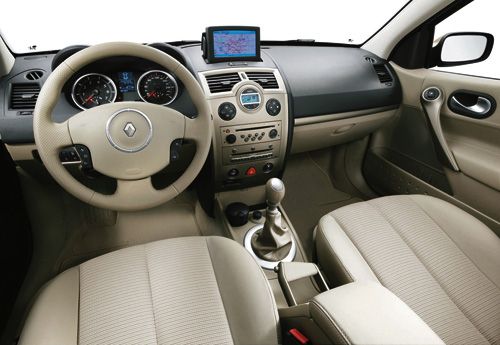
2006 Renault Megane
© Photo: Renault
Russian buyers will be offered petrol options: 1.4 L (100 hp), 1.6 L (110 hp), and 2.0 L (135 hp). The Megane 1.4 is clearly designed for the city, although it is strange that it consumes more petrol than the 1.6: in the urban cycle, 9.2 L versus 8.8 L per hundred. On the highway, the small engine wins only 100 grams. But the 1.6 version accelerates to 100 km/h 1.6 seconds faster. It seems that the slight savings and small price difference will incline buyers to choose the 1.6.
The most driving-oriented option is the two-liter engine with 135 hp. It provokes active driving. You can forget about a lack of torque: 191 Nm provides confident acceleration from 2000 rpm and up to the limiter. Special thanks to the transmission — in the city, you can drive on third gear from 20 to 120 km/h without shifting, almost like an automatic.
Those familiar with the pre-facelift version will not discover anything radically new. Due to the moderately stiff suspension, body rolls appear in corners, but they cannot be called dangerous. Acceleration and braking are accompanied by noticeable "nods." But there is no need to nitpick: the Megane is a mid-size city car without sporting ambitions. Although not without reservations.
The handling of the 5-door and 4-door versions differs: the hatchback, due to a stiffer body and shorter wheelbase, steers more precisely than the sedan. But you have to pay for this with comfort — the car ruthlessly transmits all road irregularities.
Currently, Avtoframos is deciding whether to bring the top version, the Megane Sport F1 Team, to Russia. Under its hood is a two-liter turbo engine with 165 hp. The interior differs noticeably from the "civilian" one: leather Recaro sports seats with excellent lateral support. You sit down — and feel like a pilot. Only four-point seat belts are missing. Compared to the previous Megane Sport, the rear shock absorbers have become 12 mm longer — so that the car adapts better to urban conditions.
The standard 15-inch wheels have given way to exclusive black 18-inch rims with Dunlop SportMaxx 235/40R18 tires. On the front bumper is a logo in the colors of Renault Formula 1 cars. Each owner will receive a numbered certificate of the Renault F1 Team club. A pleasant gesture.
What's the result? The designers did not radically change the appearance — and there was no need. The Megane remains one of the most successful European models, and the number of its fans in Russia is growing. The price of the new model has not yet been announced, but sales are scheduled to start in April.
Technical specifications of Renault Megane 1.4 // 1.6 // 2.0
Body – sedan
Number of seats – 5
Curb weight, kg – 1275 // 1200 // 1275
Gross weight, kg – 1825 // 1750 // 1825
Dimensions (length/width/height), mm – 4498/2026/1460
Wheelbase, mm – 2686
Trunk volume, L – 520
Maximum speed, km/h – 185 // 193 // 202
Acceleration time to 100 km/h, s – 12.7 // 11.1 // 9.4
Fuel consumption (combined cycle), L/100 km – 6.8 // 6.8 // 8.0
Fuel tank volume, L – 60
Engine:
- type – 4-cylinder, with injection
- displacement, cm3 – 1390 // 1598 // 1998
- power, hp at rpm – 100/6000 // 110/6000 // 135/5500
- torque, Nm at rpm – 127/3750 // 151/4250 // 191/3750
Transmission – manual, 5-speed // manual, 5-speed // manual, 6-speed
Tire size – 195/65R15 // 195/65R15 // 205/55R16
Suspension (front/rear) – McPherson type/torsion beam
Brakes (front/rear) – disc, ventilated/disc
Steering – rack and pinion, with electric power steering.
Advantages and disadvantages
+ Cabin ergonomics, ride smoothness.
– Visibility, operation of the electric power steering.
© 5 Koleso