
Reason and Feelings
There are people who create a heart for themselves with their mind,
others create a mind with their heart: the latter succeed more than the former,
because there is much more reason in feeling than feeling in reason.
P.Ya. Chaadaev
Before heading to the Russian presentation of the Renault Laguna III, I spent several hours studying owner reviews of the previous-generation Laguna. I was particularly interested in the question: what drove these people to buy it — sober calculation or emotions?
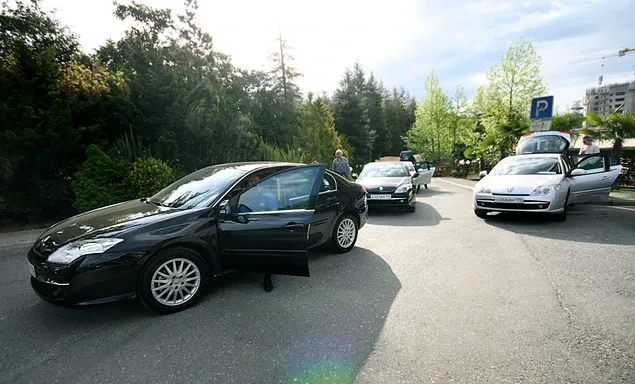 |
The fact is that just over a year ago we tested the previous-generation car, and there was no mutual connection between me and the Laguna then: it seemed too bland and inexpressive. I decided then that such a car is bought either by loyal brand fans who already had experience owning a Laguna from previous years, or by those who took it by chance, tempted by rich equipment at a modest price or the absence of queues.
After studying owner reviews online, I became more confident in this opinion — they all praised the car's practicality, comfort, and reliability. And only a few mentioned the Laguna's beauty or coziness. Pure logic and not a drop of emotion, it turns out…
Feelings.
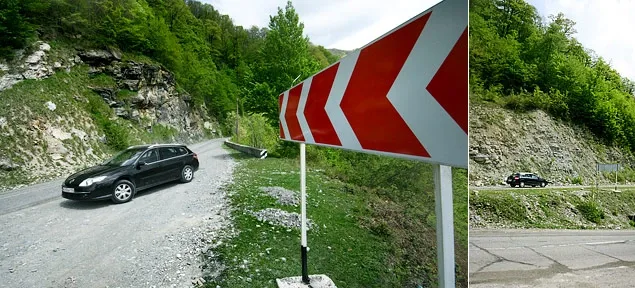
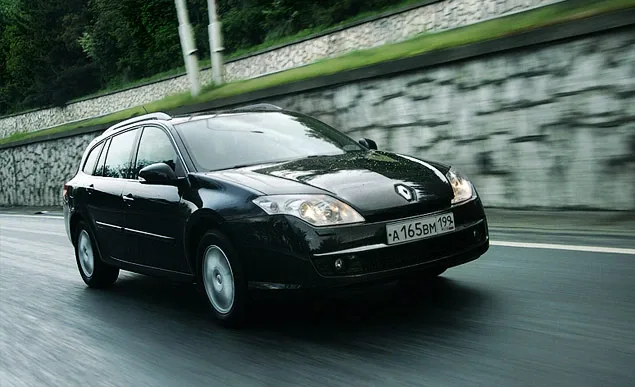
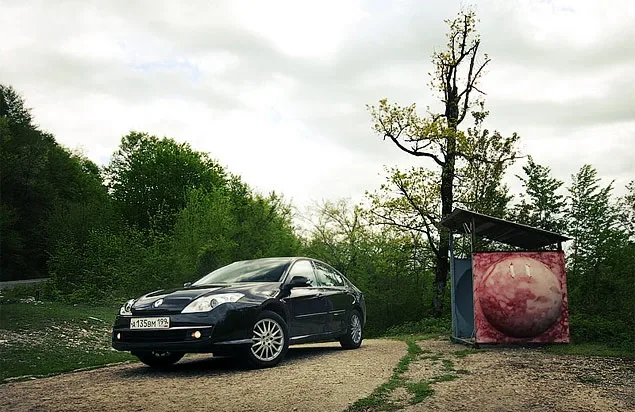
The new Renault Laguna is completely different: its exterior has gained that very emotionality that the predecessor lacked, and now you can truly be captivated by it! The estate particularly impressed me — in my opinion, the French have produced one of the most elegant cars in its class. Perhaps only the Mazda6 can compare with it.
 |
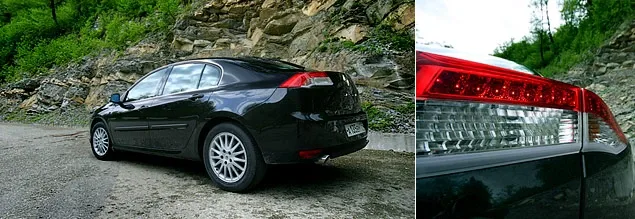
The new hatchback will surely please owners of the previous-generation Laguna — the designers managed to preserve the characteristic raised tailgate with an almost vertical lid, narrow rear lights, and even the recognizable "hips" of the rear fenders.
 |
In the Laguna III's cabin, you won't find a single part from the old model. Although the predecessor's interior was already distinguished by its laconicism, it has now become truly minimalist. On the "floating" front panel, only the essentials remain — a compact climate control unit and a thin strip for the stereo. The onboard computer control buttons are placed on the steering wheel even in the base trim, and the electronic handbrake has moved to the center tunnel — it's much more convenient to use there.
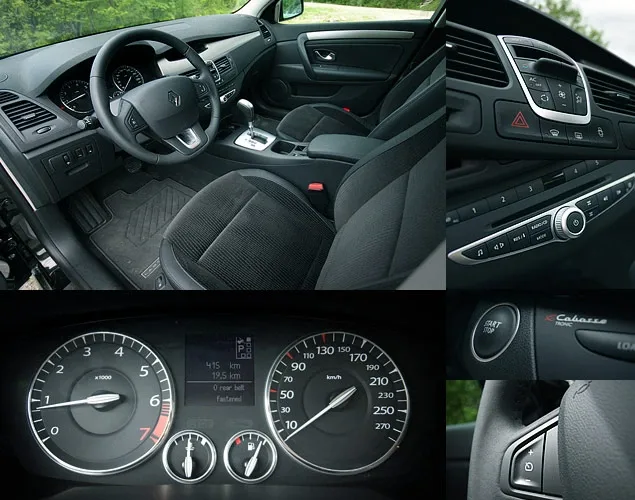 |
Owners of the Renault Megane won't see anything unexpected in the new Laguna's interior, but owners of the previous car will be pleasantly surprised — both by the materials and the build quality. The gaps between the front panel parts are minimal, and the plastic, even in the most affordable version, not only looks decent but is also pleasant to the touch. The top versions with two-tone interior trim and curved wood on the front panel look downright luxurious.
Reason.
If it weren't for such significant changes to the exterior and interior, the new Laguna could well be called a "deep restyling." Technically, the car has hardly changed: it uses the same platform with minimal modifications. The anti-roll bars have become slightly thicker, and the springs are 20 percent stiffer at the front and 50 percent at the rear. Thanks to this, the car noticeably rolls less in corners, and the increased rigidity of the steering column has eliminated the unpleasant feeling of "looseness" when driving over bumps.
As befits a new generation, the Laguna has become slightly larger outside and more spacious inside, but it weighs 15 kilograms less than its predecessor. The cabin width at shoulder level for passengers has increased by 10 millimeters, and rear passengers have gained an additional 20 millimeters of legroom.
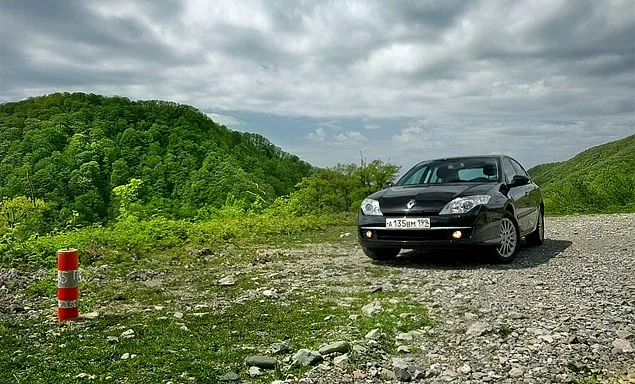
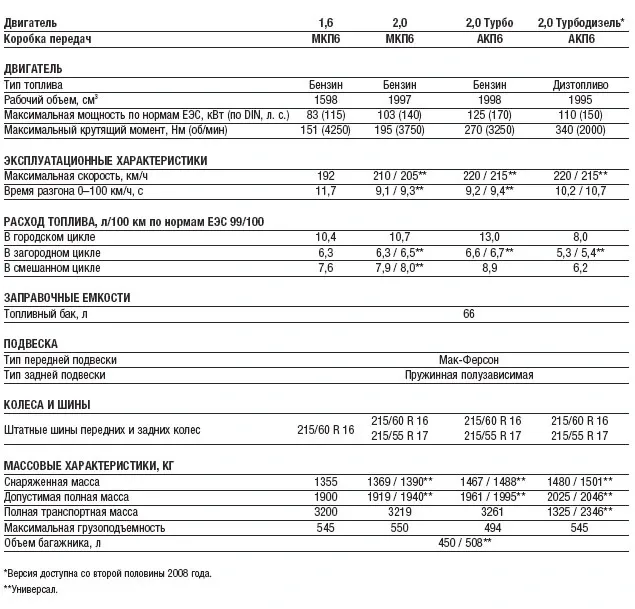
In Russia, the new Lagunas are offered with three gasoline engines to choose from. The base is a 1.6-liter engine with 115 horsepower, followed by a two-liter unit with 140 horsepower, and the lineup is capped by a two-liter turbo engine with 170 horsepower. All gearboxes are six-speed, and the most powerful engine is paired only with an adaptive automatic.
 |
For diesel engine enthusiasts, Renault has prepared one but very important piece of news — this summer, a Laguna with a two-liter turbodiesel producing 150 horsepower will appear on our market. This engine delivers a maximum torque of 340 Nm, consumes only 5.6 liters of fuel per hundred kilometers in the combined cycle, and is equipped with a six-speed automatic transmission.
The diesel for Russia, according to the French, is no different from the European version — it meets Euro-4 standards and is equipped with a particulate filter. But this is precisely where its "minus" lies: you'll have to fill such a car only with very, VERY high-quality fuel, otherwise you can easily lose the warranty. There's also a "plus" — the service intervals for the diesel Laguna are the same 15,000 kilometers as for its gasoline counterparts, and the cost of regular maintenance will be only slightly higher.
At the presentation in Sochi, there were no diesel cars, but all gasoline modifications were brought. The base version with the 1.6 engine and manual gearbox wasn't popular among colleagues: everyone was eager to get the "turbo" on 17-inch wheels. I, however, decided to start my acquaintance with the Laguna with the most affordable car.
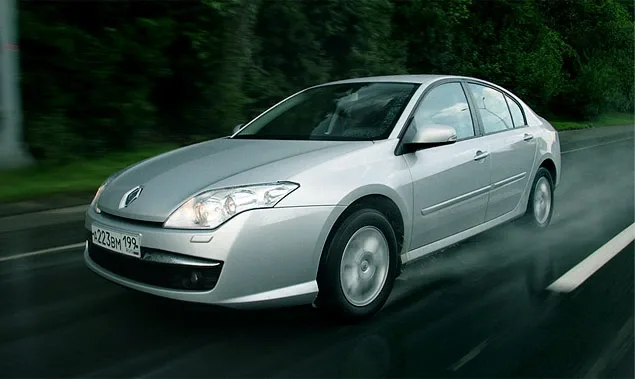 |
First impressions — quite decent! Thanks to very close gear ratios (100 kilometers per hour in sixth gear is already 3000 rpm), the Laguna 1.6 accelerates fairly briskly and doesn't make you feel deprived in city traffic. The clutch pedal, however, is overly "long," which makes the left leg quickly tire in traffic jams, and smooth starts don't always work out.
But on the highway, the 115-horsepower engine is, of course, not enough for the big Laguna. Especially during prolonged overtaking or on mountain serpentines: to drive fast, you have to keep revs above 4-5 thousand and constantly work the gear lever. I won't say it's very annoying, but you're unlikely to get pleasure from such driving.
Therefore, it's better to drive at a measured pace and not break traffic rules. Then the Laguna 1.6 will seem like a very comfortable car — the suspension silently swallows large potholes and seems not to notice small bumps. And no pitching on gentle waves. Rolls are felt, but they are quite small, and the steering is perfectly tuned — moderately sharp and informative, it filters out unnecessary information about the road condition well, without straining the driver with steering wheel vibrations on poor surfaces.
At the next crew gathering point, I switch to the estate with the two-liter naturally aspirated engine and manual gearbox. Mmm! A completely different matter! And although this engine has a very smooth character with a barely noticeable "pickup" at high revs, 140 horsepower is still better than 115. On such a Laguna, overtaking is no longer scary, and you can have some fun: the engine happily revs to the "cutoff" and endows the one-and-a-half-ton car with decent dynamics.
 |
This engine, by the way, is quite fresh — it was developed by the Renault-Nissan alliance to replace the old two-liter unit that was previously installed on the Nissan Primera and is still used on the X-Trail. The new engine is structurally similar to its predecessor and is equipped with a timing chain drive. It can be found on some Japanese Nissan models, the European Qashqai, and top versions of the Renault Clio.
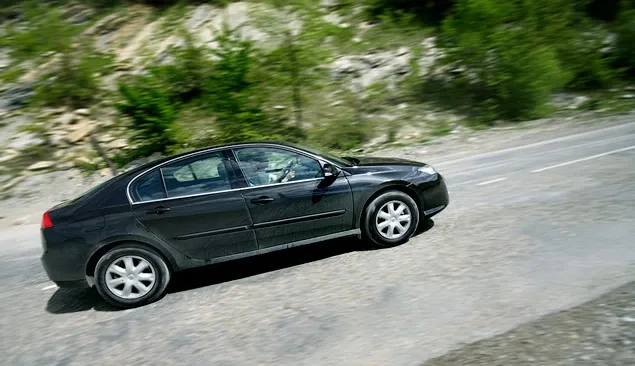
The last car change, and I find myself behind the wheel of that very "two-liter turbo" — the most powerful version of the new Laguna. The most powerful, but, as it turned out, not the fastest. The 170-horsepower engine paired with an automatic gearbox, if you can put it that way, doesn't "burn rubber." Moreover, the turbo-Laguna accelerates to 100 km/h a tenth of a second slower (!) than its naturally aspirated sibling. It's more fuel-hungry in the city, almost 100 kilograms heavier than the non-turbo version, and shod with 17-inch wheels, which make the car feel stiffer and noisier.
 |
So, what is it for, you might ask? Let's start with the fact that an automatic transmission can only be ordered with a turbocharged engine. So drivers who don't want to lose comfort in city traffic jams don't have much of a choice. Moreover, the turbo Laguna is a great companion for long trips. The reserve of 270 Newton-meters of torque allows for quick and effortless overtaking, and the adaptive gearbox, once accustomed to the driver's driving style, downshifts at the right moment on its own. And another plus: on a suburban highway, the difference in fuel consumption between the atmospheric and turbocharged units is small.
Reason or feelings?
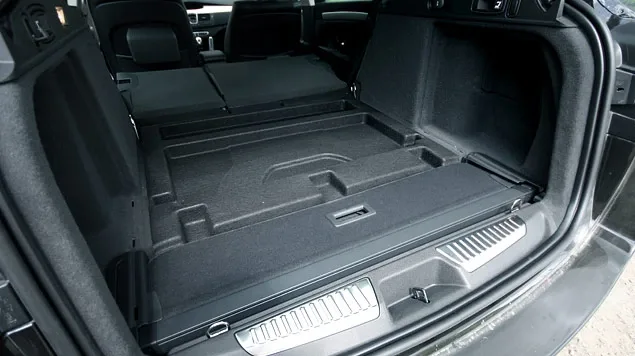
If I were asked right after the test to name the "Laguna of my dreams," I would, without hesitation, choose the station wagon with the two-liter atmospheric engine. Such a car looks more attractive than the hatchback and is more practical: thanks to the longer rear overhang, the trunk with the rear seatbacks up holds 50 liters more — a full 508 liters. If you fold the seatbacks, the volume grows to 1593 liters, which is 200 liters more than the hatchback. Additionally, the trunk has side niches, compartments for small items in the "double floor," and the seatbacks fold both from the cabin and from the trunk side.
 |
Such a station wagon in the Dynamique trim, which includes cruise control, combined fabric and leather interior trim, stability control, and more, costs 845,925 rubles. A similarly equipped hatchback will be 40,000 rubles cheaper.
The version with the turbo engine in the same trim is 84,000 rubles more expensive — its price is 889,400 rubles. For the top trim, you'll have to pay 968,900 rubles.
 |
The base version of the Renault Laguna III with the 1.6-liter engine is priced at 694,625 rubles. For this money, the buyer gets a hatchback on stamped wheels, but with air conditioning, fabric interior, audio system, power windows, and heated front seats. However, this modification lacks stability control, and it cannot even be added for an extra charge. In the richer Dynamique trim, ESP is available as an option. A full list of trims and options can be viewed at this link.
 |