
Constructor
Renault Koleos is a traveler's car: it was designed in Japan, assembled in South Korea, and became French only thanks to the badge. First, in 2007, the Korean Samsung QM5 rolled off the assembly line, and only four months later in Geneva the public was shown the same car under the Renault brand. Europeans, despite the native diamond on the hood, were cool towards the new model. Was it worth the effort? I tried to figure this out by driving across Europe in a diesel crossover that was to become the second Renault model in Russia with a 2.0 dCi engine in 2009.
In press releases, the Koleos is called the "first all-wheel-drive crossover in Renault's history." But what about the Megane Scenic RX4? Back in 1999, Renault tried something similar: ground clearance was increased to 210 millimeters, a spare tire was mounted on the tailgate, and all-wheel drive with a viscous coupling, engaged automatically, was developed by the Austrians from Steyr Daimler Puch. Essentially, it was almost a real SUV. However, the model did not achieve success, and five years later it was discontinued. Recently, the RX4 was resurrected as the front-wheel-drive Megane Scenic Conquest, which has been in production for only a year. But that's not the whole backstory of the Koleos — there were other reasons...
In 2006, Carlos Ghosn, president of Renault and Nissan, announced an ambitious plan: by 2009, to make Renault the most profitable automaker in Europe and increase annual sales by 800,000 cars. Bets were placed on the new Laguna and the next Megane, but the Koleos was also supposed to play along, filling the empty niche of compact crossovers. However, statistics stubbornly contradict these plans. In 2005, Renault sold 2.53 million vehicles (together with Dacia and Samsung), and in 2007 — even less, 2.48 million. The current financial crisis and sales for nine months of this year (1.8 million) hint that the three-million threshold is no longer within reach for the French. Unless they include the new asset — the Lada brand — in the reports. But that would already look like manipulation.
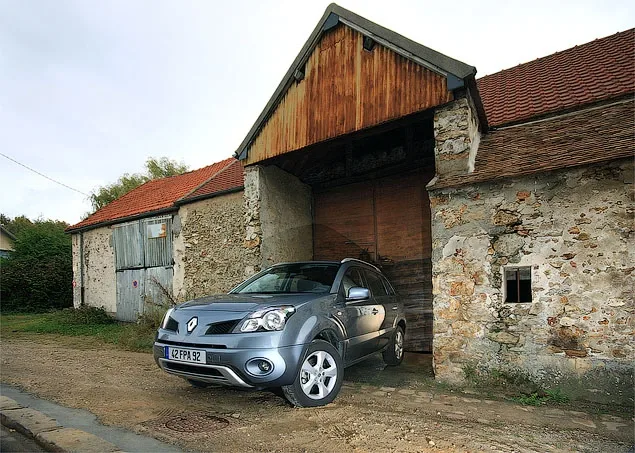
But the Koleos cost the company almost nothing. First, at the 2006 Paris Motor Show, a concept was shown that set the styling, and then the car itself was assembled like a constructor: platform from the Qashqai, petrol engine and all-wheel drive from the X-Trail, the CVT familiar from Nissans, and a six-speed automatic from Japanese Jatco. Renault already had its own diesel. The result — minimal investment with maximum return. They didn't even need their own factories: the capacities of Renault Samsung Motors in Busan were enough.
The French position the Koleos as a crossover with enhanced off-road capabilities. But what can it offer against the Nissan X-Trail? It turns out there is something. With the same technical characteristics as the practical Nissan, the Koleos got better geometry: approach angle — 27 degrees, departure angle — 31. It's far from the Jeep Cherokee with its impressive figures, but the Koleos beats the VW Tiguan by six degrees in departure angle, while losing only one degree in approach. And the X-Trail's figures are even more modest — 28 and 23 degrees. Plus, the Koleos has protective bumper trim, a simple interior that you wouldn't mind getting dirty, a hill descent and ascent assist system, and all-wheel drive that works perfectly on the X-Trail.
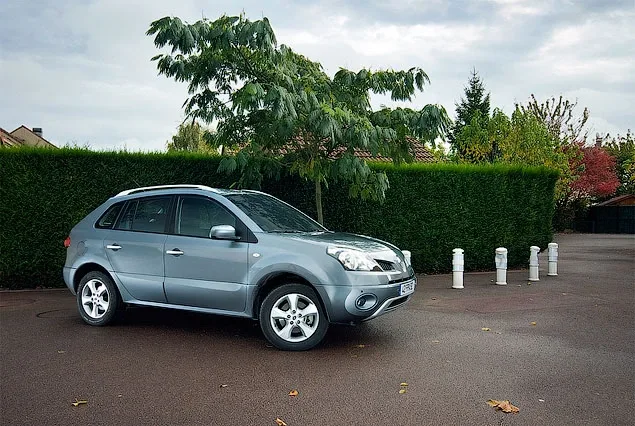
Inside, though, it's a bit dreary: an inexpressive instrument panel, a small monochrome display on the center console, which can be replaced with a color one with navigation for an extra charge. But among the simple materials, the bright spot of "navigation" looks alien. Even the two-section transparent roof (front part is a sunroof) and leather seats don't make the Koleos premium — the car just seems a bit more alive.
The audio system is controlled by a steering column joystick that takes getting used to, and on the steering wheel itself there are only cruise control buttons. The dual-zone climate control changes temperature in half-degree increments, but if there's only one person in the car, you'll have to adjust both zones — there's no "Mono/Dual" button here.
But the interior functionality is top-notch: a two-section tailgate, plenty of cubbies, a double floor in the trunk, niches in the floor, and even a panoramic mirror to keep an eye on rear passengers. But as a cargo hauler, the Koleos hasn't gone far from the Megane: trunk volume behind the rear seatbacks is 450 liters (up to the headrests), and with the seats folded — 1,380 liters, slightly more than a Volkswagen Golf. The advantage over the golf class is felt mainly by rear passengers, who aren't cramped even three across, and they aren't annoyed by outside noise — the Koleos has excellent sound insulation. Almost…
Under the hood of the first test car was a 150-horsepower 2.0 dCi diesel — a joint development of the Renault-Nissan alliance. In 2005, it was installed on the Megane, and a version boosted to 175 horsepower on the Laguna and the "hot" Megane RS. Two years later, the engine moved under the hoods of the Qashqai and X-Trail. In Russia, the Koleos, like the diesel Laguna, will only get the weaker version. I was lucky enough to try both.
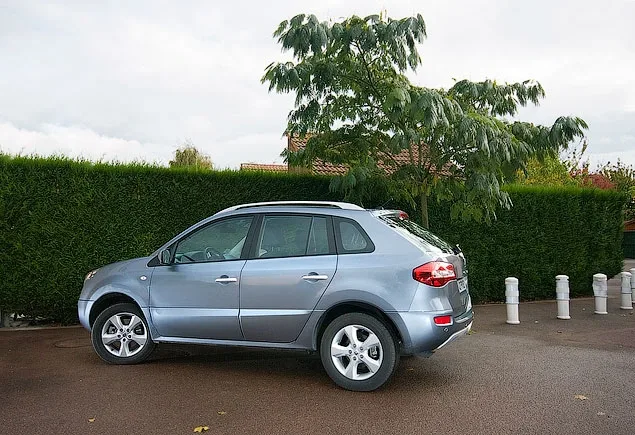
Surprisingly, I didn't feel a fundamental difference in dynamics between the 150- and 175-horsepower diesels — it's only noticeable in the numbers. The more powerful engine accelerates the Koleos to 100 km/h two seconds faster — in 9.9 seconds, but it's also noticeably noisier: the French seem to have underdone the engine bay insulation. However, for France, acceleration to 100 km/h isn't the main thing. There are speed cameras everywhere and strict speed limits. I learned about speeding fines firsthand: for nine "extra" kilometers per hour, I had to pay 45 euros! And where did I manage to get caught by a camera — I was always driving by the rules.
Comfort is another matter. Long distances, by European standards, are easy on the Renault Koleos. Comfortable seats with height adjustment and a steering column adjustable in four directions make it easy to find a comfortable driving position. On a smooth highway, the car glides along, and the driver can relax behind the wheel.
The city is a different story: at low speeds, the Koleos is not fond of it, largely due to the six-speed manual, which requires careful handling: release the clutch a bit sharper or don't press the gas enough — and the engine immediately stalls. Moreover, the gearshift lever seemed too loose to me.
The lateral support of the seats in corners is lacking, but we shouldn't forget that the Koleos is a crossover. And off-road, lateral support is more of a hindrance: the driver has to constantly look out the side window to assess the situation and often get out of the car. So bucket seats are not the best choice for such a vehicle. But all the off-road ambitions of the "Frenchman" evaporate at the first encounter with a large pothole — the stiff suspension with periodic bottoming out off asphalt causes a lot of discomfort.
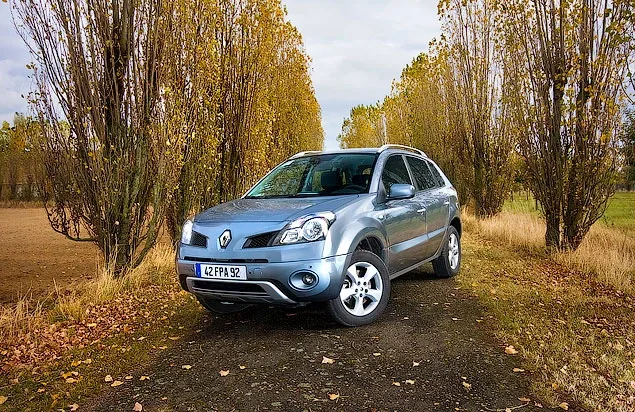
So calling the Koleos truly driver-oriented can only be done with a big stretch. As speed increases, the electric power steering does add weight to the wheel, but in fast corners, the crossover behaves as if it's at its limits: slightly overdo the speed at the entry — and the car already protests with tire squeal, and the contact with the road seems to dissolve. Meanwhile, the electronic guardian ESP behaves quietly, observing what's happening and preferring not to interfere unless absolutely necessary.
Overall, the Renault Koleos is a car with character. If you don't expect the impossible from it, it won't give you reasons for disappointment. The French crossover is quite capable of becoming a worthy alternative to the golf class for those who are used to parking on curbs and can't imagine life without it. Its price in Russia ends exactly where more "loaded" competitors like the VW Tiguan and Ford Kuga just begin: the base Koleos with the 2.5-liter petrol engine starts at 869,000 rubles, and the top version with leather interior, bi-xenon, six airbags, and five Euro NCAP stars thrown in — 1,074,000 rubles.
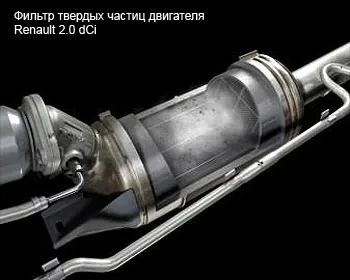 The Saga of "Euro-4" The Saga of "Euro-4" By the way, in official materials Renault persistently claims that the two-liter diesel on the "Laguna" for Russia is equipped with a diesel particulate filter (DPF), which allows it to meet "Euro-4" standards. If this is really the case, then owners of diesel Renaults will have to be very careful in choosing a gas station — quality fuel is produced by only a few manufacturers (or at least they claim so), and regular use of low-quality diesel will quickly kill the filter. And here the question arises: will Renault replace it under warranty? Or will the company blame the owner — saying, you're at fault, you went to the wrong place... Diesel particulate filters (DPF) capture particles of unburned soot that enter the exhaust system with exhaust gases and burn them off. This cleaning process is called regeneration and can occur in two ways — passive and active. The passive method is simple: accumulated soot burns off by itself when the exhaust temperature rises significantly, which happens, for example, when driving on the highway. During active regeneration, the engine control unit itself raises the exhaust gas temperature by changing the injection algorithm when soot fills about half the filter volume. If the car sits in traffic jams for a long time, regeneration may not complete, and then a warning light on the dashboard signals a clogged filter. The problem can be solved by a 10-minute drive at a speed of at least 70 kilometers per hour. If the filter continues to be ignored, its repair or, more often, replacement will cost the diesel car owner a considerable sum. That is why, by the way, some European automakers advise city dwellers to look at gasoline versions — because their lifestyle is an eternal traffic jam. Earlier, besides Renault, other manufacturers also announced supplies of Euro-4 compliant diesels to Russia. And in some cases it turned out that these cars had no particulate filters in the exhaust cleaning system at all, and the information about their presence was simply a literal translation of a foreign advertising brochure for the model... <\/div> <\/td> <\/tr> <\/tbody><\/table> <\/div> <\/div> <\/p> <\/p> Technical specifications of Renault Koleos 2.0 dCi 150 horsepower (175)<\/h3>
|