
Dmitry Frolov, BUSMARKET LLC
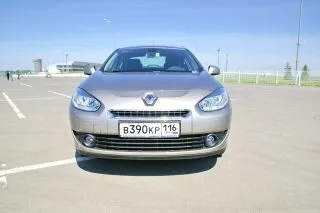
Previously, I wasn't a big fan of Renault cars, but the Fluence changed my mind. This model immediately wins you over with its looks—the French designers managed to create a memorable body. Add to that confident road behavior and solid interior finish.


Right away, behind the wheel, I noticed the comfortable seat with lateral support, the large instrument cluster, and pleasant-to-the-touch materials. The plastic here is soft—in case of an accident, it won't become a source of injury upon impact. The steering wheel is sharp and instantly responds to the driver's actions. The suspension deserves special praise: it easily handles potholes and minor surface defects, while keeping the car confident in corners.
When my turn came to test the car on the lot, I felt almost childlike delight. I sat down, said, "Well then, let's begin..."—and the Fluence didn't disappoint. It easily navigated obstacles, precisely carved through turns, and the brakes—a separate story: the car stops instantly, just press the pedal.
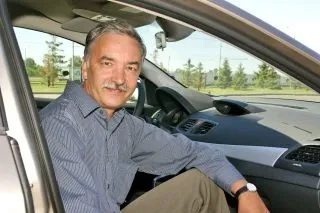
At my height of almost two meters, I sat freely in the back seat—my knees didn't touch the front seatback. I was also pleased with the sunshades on the rear windows, saving from the sun, and the dual-zone climate control. In the heat, you drive in complete comfort.
Among the drawbacks, I'll note two: sound insulation and not-so-brisk acceleration (we had the version with an automatic and a 1.6 engine). With a manual transmission, I think this drawback would be less noticeable.
For me, the Fluence is a city car that successfully combines comfort and safety. I didn't want to get out of it—the car really impressed me.
Vadim Sadykov, "Avtoclub-Kazan"
Have you noticed that all the latest models in the C-class look beautiful and even solid? Take, for example, the Chevrolet Cruze or Kia Cerato. The Renault Fluence also has its own zest—after all, it's France! Moreover, the C-class has noticeably grown in size, turning into true family cars. But for a reasonable price, manufacturers have to save on something. Most often, interior materials and sound insulation suffer. Personally, this always annoys me: the car is big and fancy outside, but inside—hard, cheap plastic. Imagine my surprise when I discovered that the dashboard and door cards are trimmed with soft, quality material. Even in the D-class, not every car can boast such plastic. Since the manufacturer "splurged" on the trim, they had to save on something else. The answer came right after starting the engine: sound insulation. The noise level of the engine outside and inside the cabin is almost the same. The rear wheel arches are covered with plastic, not soft felt like in D-class cars—this also adds extra noise.
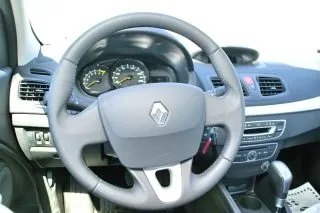
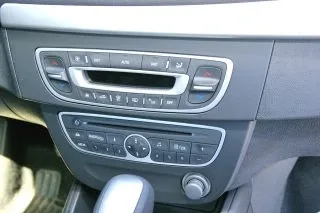
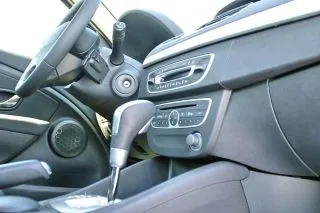
Inside, everything is laid out neatly and within reach. The rear seat cushions aren't short, and there's enough legroom in the back. However, in the front passenger seat, the protruding center of the dashboard is somewhat bothersome (more psychologically). The left knee almost touches the plastic, while on the right, there's a huge space up to the dashboard. The armrests are long and comfortable. Though, it's unclear how quickly the fabric upholstery on them will get dusty. The instrument panel is beautiful and easy to read, but the low-beam indicator is dim—in sunglasses, it's almost invisible. The stereo with six speakers sounds decent, even at near-maximum bass. But I couldn't figure out how to tune to a specific radio station. Strange: such algorithms should be intuitive for any driver.

The tire size 205/65/15 with a high profile surprised me—it's almost like a crossover! Even 195/65/15 usually adds smoothness, and here there should be even more comfort. But in reality, the car turned out to be quite stiff. On the "snake" test, it held up excellently, eagerly diving between cones. But on our roads, it might shake you around quite a bit. There's also an interesting feature: single bumps at speeds around 80 are passed very softly.
For now, only one engine is available—1.6. Later, a two-liter (with CVT) will appear, producing 138 hp and 190 Nm at 3700 rpm. But let's return to the 1.6. The engine seems the same, but the settings for the manual and 4-speed automatic are different. With the manual—110 hp and 151 Nm, with the torque curve consisting of sharp angles. I think on the manual, there will sometimes be a good surge: boom—and the car "takes off." But with the 4-speed automatic, the torque graph is heavily smoothed. The numbers are lower: 106 hp and 145 Nm at 4250 rpm. Renault engineers clearly worked hard to smooth out the drawbacks of the 4-speed automatic. More details on why four gears are always too few can be read on the "Avtoclub-Kazan" website in the article "Simply About Complex: Gearbox Ratios." With this tuning, driving should be sedate and unhurried. In the city, the car is suitable for that. But a sharp press on the gas only makes the engine howl loudly, without adding much acceleration. On a highway with one lane each way, this will become a big problem when overtaking trucks.

Who is this car for? With the 1.6 engine—most likely, older people. They'll appreciate the spacious cabin and quality of the trim. And if desired, the sound insulation can be upgraded yourself.
Alfred Mardanov, "Avtoclub-Kazan"
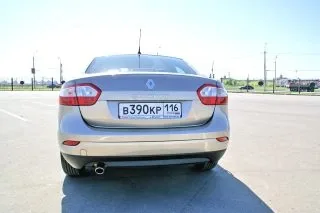
The first feeling this car evokes is surprise. Exactly surprise. Externally, it's made in a style that's not "Renault-like" at all. Where did those controversial solutions familiar from other Renault models go? Here—a sleek concept, no chopped shapes. The car seems slightly flattened, pressed to the ground, and the hood... well, the photos will speak better than me. The rear lights together with the trunk lid from a distance resemble "Mazda" motifs, right? It's all explained simply: they were designed by a former Mazda designer. That's probably why the look stands out from the general Renault lineup. The second feeling that doesn't let go is class affiliation. It's obvious to the naked eye: by size, the car clearly surpasses the entire C-class and is ready to play on the D-class field, but the manufacturer doesn't let it into that segment. It seems they decided to plow the virgin land between classes C and D. The Megan is already almost the biggest in its class, and the Fluence is noticeably bigger than it. That's the puzzle. Although all these class quirks are purely journalistic. The average buyer deeply doesn't care what class it is and what conventional rules apply. The main thing is that the car meets their requirements and desires.
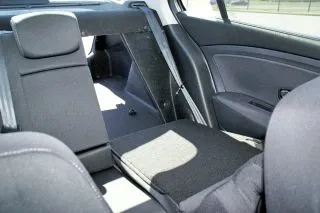
Before taking the keys to the brand-new car at the dealership, we, of course, dove headfirst into studying the interior. Vadim twice made me jump in surprise, enthusiastically exclaiming about the soft plastic in the trim and the presence of air vents for the rear row. The material is indeed pleasant—warm and pliable both on the dashboard and door cards, and cars of a higher class would envy it. Vadim was the first to get behind the wheel, Dmitry sat next to him, and I climbed into the back seat. And then a surprise awaited me: Dmitry, being almost two meters tall, moved his seat all the way back, but it didn't bother me at all. There was plenty of free space between my knees and the front seatback. Then Dmitry sat behind himself and also didn't complain about cramped space. Simply put, the cabin pleases with space both in length and height. The seats here aren't some cut-down "stools," but full-fledged ones with a normal cushion length. And even three people in the back won't be cramped in the shoulders—the car is almost as wide as the Laguna. And those very air ducts that pleased Vadim are not superfluous here: such a spacious cabin vitally needs proper air circulation.
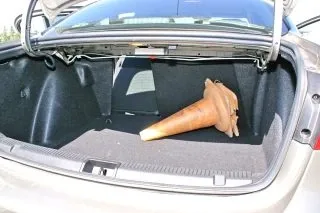
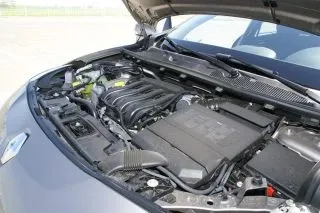
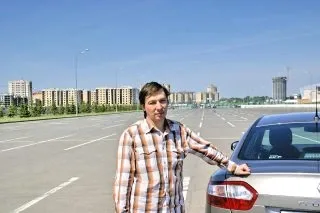
At the test site, we were greeted by bright sunshine and dry asphalt. While setting up the cones for the slalom, I thought there was clearly not enough engine here, and I decided to increase the distance for acceleration more than usual. As I suspected, though there's nothing surprising: 1.6 liters and even paired with an automatic — that's not about 'launching'. But the car responds clearly to the steering wheel, holds its course confidently, and doesn't deviate from the chosen trajectory. In one of the runs, I knocked down a cone at the last gate — I just didn't have time to turn the nose. But that was more my provocation than a careful execution of the exercise: I came out too wide from the previous gate. The 'moose test' went flawlessly, though. The only limitation was the tires, which started squealing pitifully even in the most harmless situations. All test participants unanimously noted the excellent performance of the brakes — grippy and very effective. You need to be careful with the brake pedal, otherwise you can brake harder than planned. The steering wheel is weighted, not empty at all, and the connection to the wheels is clearly felt. In other words, the car is not some amorphous thing, but quite lively in its reactions. If only it had a more powerful engine — oh!
The highway, like a litmus test, immediately reveals all the peculiarities of the engine and gearbox. Four gears are already a relic of the past, and it works not quite familiarly. You need to choose the right mode, otherwise it seems the automatic doesn't know which gear to select. To not burden you with technical details, I'll just say how to handle it. If you want to accelerate, don't press the pedal to the floor for kick-down — it won't help: lots of noise, but little movement. Press halfway and hold until the revs rise above average, and only then press further. You can also press the pedal twice, but again not all the way. This way the Fluence accelerates noticeably more briskly, and fuel consumption is much more modest. At the site, during short runs, I didn't have time to properly assess the seating comfort, but on the highway you can already look around calmly.
I liked the instrument panel with a visor protecting it from the sun. Two gauge scales are positioned at a slight angle to the driver, with large dials, while fuel level, automatic transmission selector position, and other things are displayed electronically. There's also a small screen in the center of the panel, also under a visor — it shows information from the stereo and the onboard computer. In climate control, there's a pleasant detail — rocking levers for temperature selection. Up-down, up-down — and large numbers of the desired temperature appear on the display. At speed, the steering wheel became even heavier and quite elastic. I don't like thin steering wheels — they slip out, but here there's an excellent grip and leather trim. Switching the automatic to manual mode adds some drive, but not too much. The manual mode has foolproof protection: the gearbox will shift up itself when the tachometer needle reaches the red zone. Average fuel consumption on the highway dropped sharply, but in the city it slowly but surely crept up to 10.6 liters. By the way, in the city the automatic 'came to its senses' and adapted to our driving style, making it noticeably more responsive. Calm driving through city streets brings its own pleasant moments: the car clearly attracts the glances of other drivers, and you can't help but notice it.
If spaciousness is the main thing for you in a car, then for this reasonable money you can safely take it. Something similar was with the KIA Spectra — an inexpensive spacious car with an automatic. But unlike it, the Fluence is still a modern car with an interesting appearance and, mind you, a very high-quality interior. As Vadim accurately noted, it's more of a mature family car for practical people.