
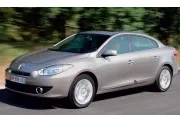
With the arrival of winter, the weather in the vicinity of Izmir remains pleasant: the asphalt is dry, and the thermometer does not drop to uncomfortable levels. So I've been actively working the accelerator pedal for quite some time. However, the Fluence maintains Olympic calm: acceleration in a straight line is measured and stately. The familiar 1.6-liter gasoline engine producing 110 horsepower clearly has no desire to surprise, although its reserve is more than enough in city traffic. It seems the French chose the name for this golf-class sedan very accurately.
The word fluency itself translates from English as "smoothness." And everything here is subordinated to this smoothness: both the reactions to pressing the gas and the way the suspension handles bumps and turns. If you overdo the speed on an arc, the car smoothly and predictably goes into a slide. However, the Fluence does not provoke aggressive driving at all — with its light and completely uninformative steering wheel, the desire to show off in corners disappears by itself. But on a straight line, the sedan behaves impeccably, without the slightest sign of nervousness, and on a broken road it methodically smooths out all joints and potholes.
DIESEL — THE CHOICE OF A PRACTICAL PERSON
The version with the 1.5-liter diesel engine (the same 110 hp) seems not so much more spirited as more comfortable to drive. This modest unit picks up well at medium revs, and it is paired with a more collected six-speed manual gearbox, while the gasoline engine got a "five-speed" with a somewhat vague lever travel. By the way, it is for this turbodiesel that the French are announcing the latest robotic unit with two clutches.
Those who need a truly brisk Fluence will have to wait for the modification with a 2.0-liter gasoline engine (140 hp), for which a Nissan CVT will be offered as an option. In general, from the entire range of power units available to the manufacturer, the simplest ones were chosen for this model, although a fresh platform was used: at the front — suspension from the third-generation Megane, at the rear — from the Japanese Nissan Sentra. But to achieve maximum comfort, the engineers deliberately "relaxed" the chassis and steering.
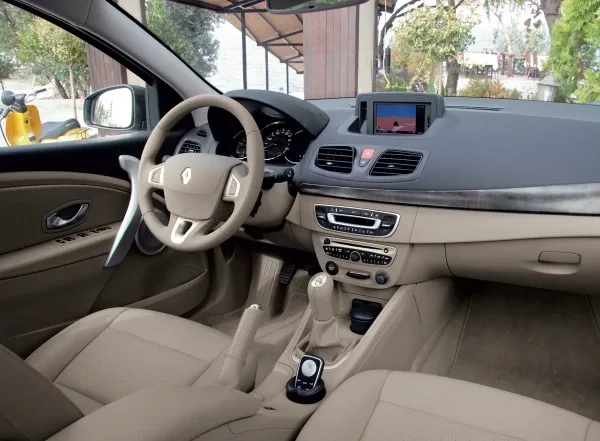
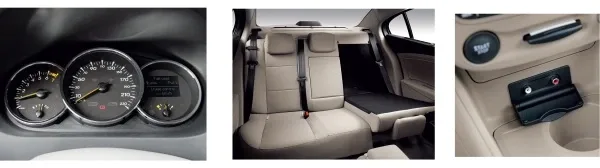
The interior, which moved from the Megane, is full of details familiar from the Laguna and pleases with the quality of finishing materials: textured plastic, a pleasant-to-the-touch panel, neat leather upholstery. The differences, however, are noticeable: the Fluence's instrument panel is simpler, with analog scales, and the navigation system is chosen cheaper. True, this navigation will give a head start to some branded developments both in image clarity and interface convenience.
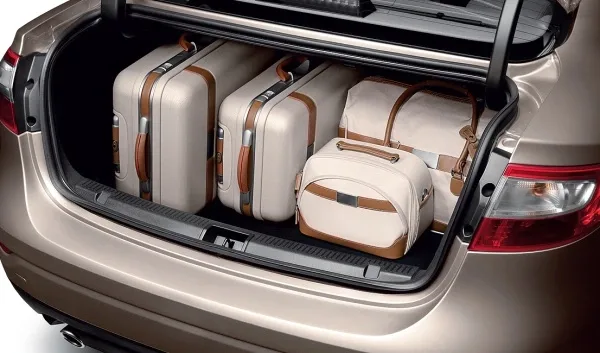
The front seats do not have pronounced lateral support, but there is so much space in the second row that it is worth comparing with representatives of the business class: with a body length of 4.6 meters and a wheelbase of 2.7 meters, the Fluence has clearly outgrown the standards of its class. And large sedans, as we know, have always been in demand here.
Sales of the Fluence in Russia will start in January. In initial trim levels, the new model is unlikely to be more expensive than its predecessor, especially since the French hinted at the possible organization of assembly of the model in our country.
NAVIGATOR — PERSONAL ASSISTANT
The Fluence navigation system promises to be the most affordable among proprietary ones. There is no touchscreen here, but the control unit located in the cup holder is quite convenient.
TECHNICAL SPECIFICATIONS
ENGINE
1598 cm³, gasoline, 4 cylinders,
110 hp at 6000 rpm,
151 Nm at 4250 rpm
TRANSMISSION
Manual, 5 gears, front-wheel drive
DYNAMICS
maximum speed — 185 km/h,
acceleration 0–100 km/h — 11.7 s
DIMENSIONS (mm)
length — 4618
width — 1809
height — 1479
FUEL CONSUMPTION
average — 6.5 l/100 km
The word fluency itself translates from English as "smoothness." And everything here is subordinated to this smoothness: both the reactions to pressing the gas and the way the suspension handles bumps and turns. If you overdo the speed on an arc, the car smoothly and predictably goes into a slide. However, the Fluence does not provoke aggressive driving at all — with its light and completely uninformative steering wheel, the desire to show off in corners disappears by itself. But on a straight line, the sedan behaves impeccably, without the slightest sign of nervousness, and on a broken road it methodically smooths out all joints and potholes.
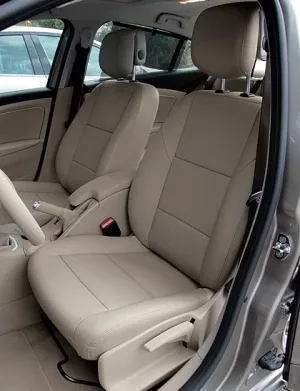 | SEAT FOR ANY HEIGHT
The front seats are hospitable to people of all body types — even a basketball player in winter clothing will not find a reason for dissatisfaction. |
DIESEL — THE CHOICE OF A PRACTICAL PERSON
The version with the 1.5-liter diesel engine (the same 110 hp) seems not so much more spirited as more comfortable to drive. This modest unit picks up well at medium revs, and it is paired with a more collected six-speed manual gearbox, while the gasoline engine got a "five-speed" with a somewhat vague lever travel. By the way, it is for this turbodiesel that the French are announcing the latest robotic unit with two clutches.
Those who need a truly brisk Fluence will have to wait for the modification with a 2.0-liter gasoline engine (140 hp), for which a Nissan CVT will be offered as an option. In general, from the entire range of power units available to the manufacturer, the simplest ones were chosen for this model, although a fresh platform was used: at the front — suspension from the third-generation Megane, at the rear — from the Japanese Nissan Sentra. But to achieve maximum comfort, the engineers deliberately "relaxed" the chassis and steering.
The interior, which moved from the Megane, is full of details familiar from the Laguna and pleases with the quality of finishing materials: textured plastic, a pleasant-to-the-touch panel, neat leather upholstery. The differences, however, are noticeable: the Fluence's instrument panel is simpler, with analog scales, and the navigation system is chosen cheaper. True, this navigation will give a head start to some branded developments both in image clarity and interface convenience.
The front seats do not have pronounced lateral support, but there is so much space in the second row that it is worth comparing with representatives of the business class: with a body length of 4.6 meters and a wheelbase of 2.7 meters, the Fluence has clearly outgrown the standards of its class. And large sedans, as we know, have always been in demand here.
Sales of the Fluence in Russia will start in January. In initial trim levels, the new model is unlikely to be more expensive than its predecessor, especially since the French hinted at the possible organization of assembly of the model in our country.
NAVIGATOR — PERSONAL ASSISTANT
The Fluence navigation system promises to be the most affordable among proprietary ones. There is no touchscreen here, but the control unit located in the cup holder is quite convenient.
| USEFUL OPTIONS
The audio input can be replaced with a USB port or another connector. And the key card is provided even in the starting version. |
TECHNICAL SPECIFICATIONS
ENGINE
1598 cm³, gasoline, 4 cylinders,
110 hp at 6000 rpm,
151 Nm at 4250 rpm
TRANSMISSION
Manual, 5 gears, front-wheel drive
DYNAMICS
maximum speed — 185 km/h,
acceleration 0–100 km/h — 11.7 s
DIMENSIONS (mm)
length — 4618
width — 1809
height — 1479
FUEL CONSUMPTION
average — 6.5 l/100 km