
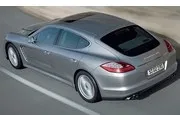
In the previous issue, my colleague Robinson already detailed the design of the Panamera, but the question of what it resembles remained open. Seeing the car in person, one can only say one thing: this is a real Porsche! Next to the numerous versions of the 911 model, it seems like a true giant — this is the widest body even among five-meter sedans — yet the brand's style is instantly recognizable.
The body is primarily steel, but a quarter of the materials are light alloys. Aluminum went to the front section, rear side members, tailgate, and the doors themselves. The trunk floor and spoiler tray are made of ordinary plastic. And the door frames and front load-bearing elements are made of magnesium, which is light and ductile. Despite the external similarity to the 911, the Panamera's layout is as classic as it gets: the engine and gearbox are mounted longitudinally at the front, with drive to the rear or all wheels. But the massive battery, subwoofer, and other electrics have moved to the trunk — all for the sake of perfect weight distribution, where the front axle carries 52% of the mass and the rear 48%.
The promised "six" is not yet available: for now, the base model is considered the Panamera S with a naturally aspirated V8 4.8 producing 400 horsepower, and the top model is the supercharged Panamera Turbo with the same "eight" but now with 500 horsepower. Both engines are upgraded Cayenne units: direct injection, more magnesium and aluminum in rotating parts, and optimized friction pairs. An electronic thermostat allows the engine to warm up faster and, in combat modes, raise the operating temperature to 110 degrees. The point of all the refinements is not so much an increase in power as in efficiency. For example, an adjustable oil pump and power steering with reduced consumption save about 0.4 liters per hundred. And have you ever seen a Start-Stop system on a sports car? In the city, it saves up to 1.5 liters of gasoline, but it's tuned sportily: it starts the engine in a fraction of a second, not after pressing the gas, but already at the moment of releasing the brake pedal. Even the powerful brakes work for savings — the pads move away from the discs faster, eliminating residual braking.
MANY DISCS
The only automatic for the Panamera is the PDK (Porsche Doppelkupplung). Seven gears are strung on two shafts, and shifting is handled by two synchronously working clutches. Power to the front axle is transmitted by an electronically controlled multi-disc clutch. All traction goes to the rear wheels by default, but during wheelspin, the clutch instantly transfers up to 100% of the torque forward. There is also an active rear differential, assisted by electronics that brake the spinning wheels.
Aerodynamics are refined to the smallest detail: only the muffler "cans" protrude from the flat underbody, and the drag coefficient of the Panamera S does not exceed 0.29. Starting at 90 km/h, a retractable spoiler handles downforce. But the engineers did not limit themselves to aerodynamics — they meticulously polished the body curves to eliminate external noises. In the cabin, you only hear the bubbling roar of the "eight" and the powerful sound of the audio system!
WHERE IS ITS BUTTON?
Comfort is generally one of the key concepts for the Porsche Panamera. In the elastic cushions of the rear "buckets," you sit tightly but comfortably, and passengers get both ventilation and three-stage heating. A single climate control unit serves all four occupants, distributing air through 20 deflectors.
A short ride as a passenger in the Panamera Turbo convinced me: this Porsche really can be very comfortable. The air suspension swallows a stretch of broken asphalt, only slightly rocking the occupants. You only realize the road is truly broken when you switch the chassis to the "extreme" Sport Plus mode.
With the keys on the central tunnel, you choose not just the algorithm of the electronics and "tighten" the suspension — it's like changing the car! In Sport Plus mode, the Panamera "squats" by 25 mm, and the retractable spoiler increases the angle of attack. On the turbo engine, boost pressure briefly rises during acceleration.
The PDK gearbox works faster, engaging gears with a jolt. Explosive exhaust roar, short wheelspins on every gear... No body roll, terrible G-forces in corners, but the Panamera doesn't even squeal its tires in turns. A real sports car!
The transmission withstands an unlimited number of hard launches in Launch Control mode, which is activated simply: hold the brake pedal with your left foot and press the accelerator fully with your right. As soon as the engine reaches the right revs, a sound signal sounds — you can release the brake... After the jolting start, the second surge will only occur when shifting to third gear — the change from first to second is very smooth due to the synchronized operation of the PDK clutches.
Impressive! But even after such a vivid demonstration, the Germans meticulously calculate the efficiency of the innovations: the PDK gearbox saves 0.8 liters per 100 km, the active chassis with "smart" brakes and special tires saves another 0.7 liters, the set of measures to reduce friction in the engine saves 0.4 liters... As a result, the rear-wheel-drive Panamera S with the PDK gearbox consumes only 10.8 l/100 km in the conventional average European cycle. True, on the on-board computer screen of the Turbo version after runs on the test track, we saw completely different numbers...
In Russia, this car will appear in the fall. The most affordable 400-horsepower Panamera S with manual transmission and rear-wheel drive will sell for $159,638 (1,277,100 UAH), with the PDK gearbox — 168 thousand rubles more, and the all-wheel-drive version will cost $172,902 (1,383,210 UAH). The top version Panamera Turbo will be offered only with all-wheel drive — at least $237,567 (1,900,531 UAH).
Manufacturer's data
ENGINES
gasoline
V6 3.6 (300 hp)
V8 4.8 (400 hp)
V8 4.8 (500 hp)
TRANSMISSION
manual, 6 speeds
or PDK with dual clutches,
7 speeds,
rear or all-wheel drive
DIMENSIONS (mm)
length – 4970
width – 1931
height – 1418
ON SALE
in Russia from autumn