
 According to the official classification, the three-letter GTS index traditionally denotes Porsche versions distinguished by a “balanced combination of long-distance suitability and sportiness.” In essence, the GTS version is the result of factory, and therefore exceptionally high-quality and intelligent, sport tuning of the original model. And although in the case of the GTS the base model was not the standard Cayenne but its already “sportified” S version, the tuning undertaken is rather from the same realm denoted by that very letter, rather than the added GT abbreviation in its classic sense. That is, the car became even more sporty, not more “touristic,” and Porsche marketers insist that it is now “the most sporty version in the Cayenne lineup.” According to the official classification, the three-letter GTS index traditionally denotes Porsche versions distinguished by a “balanced combination of long-distance suitability and sportiness.” In essence, the GTS version is the result of factory, and therefore exceptionally high-quality and intelligent, sport tuning of the original model. And although in the case of the GTS the base model was not the standard Cayenne but its already “sportified” S version, the tuning undertaken is rather from the same realm denoted by that very letter, rather than the added GT abbreviation in its classic sense. That is, the car became even more sporty, not more “touristic,” and Porsche marketers insist that it is now “the most sporty version in the Cayenne lineup.” |
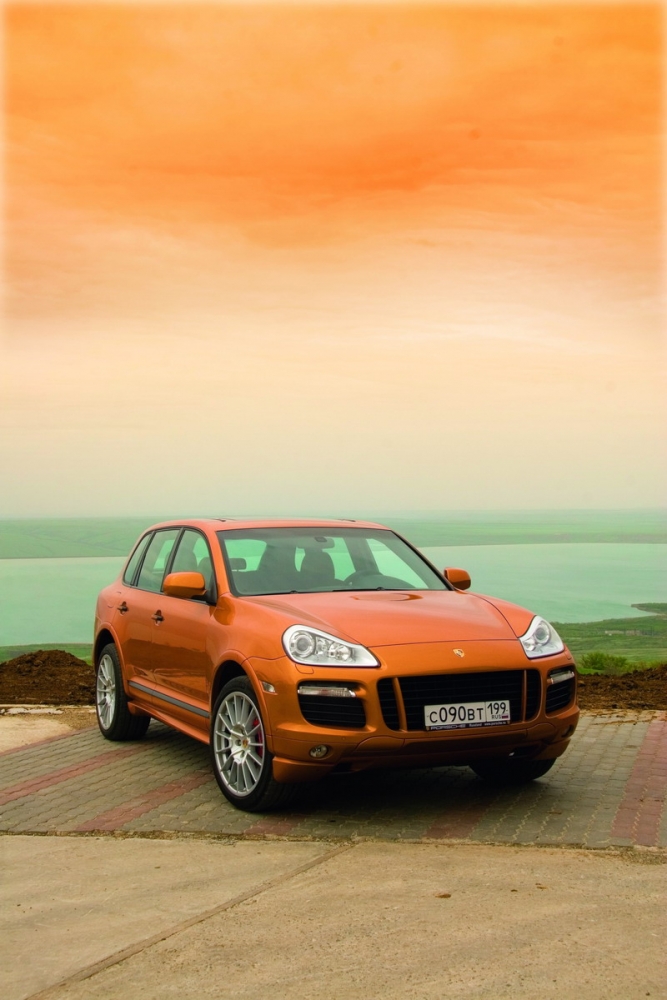 This is intended to be confirmed not only by the new exclusive body colors – red GTS Red and golden Nordic Gold Metallic – but also by its sport body kit, corresponding interior changes, suspension and transmission upgraded for a more sporty driving style, and, of course, the increased power of the naturally aspirated V8 engine from 385 to 405 hp. And here, naturally, a legitimate question arises: what about the 500-horsepower Turbo version, which reaches a top speed noticeably higher by 25 km/h and accelerates to 100 km/h a whole second faster? Well, as is often the case in the automotive industry, the concepts of “most powerful” and “fastest” are not always identical to “most sporty.” And proof of this is, for example, the possibility of purchasing the Cayenne Turbo exclusively with an automatic transmission, while the GTS version in the “base” is equipped with a classic manual gearbox. Porsche representatives themselves explain that when working on the GTS, they aimed not at achieving the highest power and speed, but at giving the car a more “driver-oriented” character and a sporty spirit overall. That is, a kind of bow was made towards adherents of classic values, for which “purebred” Porsche sports cars are famous. So, following the update of the entire Cayenne lineup undertaken a year and a half ago, designed to refine the rather awkward appearance of these cars and emphasize their sporty component, such a step a couple of years before the appearance of a fundamentally new generation of this SUV looks completely logical and justified. Well, and what the Cayenne GTS is like not in words but in action, we had the opportunity to learn in the expanses of Stavropol, where Porsche Russland, following the opening of its next dealer center, organized a test drive of the new model. This is intended to be confirmed not only by the new exclusive body colors – red GTS Red and golden Nordic Gold Metallic – but also by its sport body kit, corresponding interior changes, suspension and transmission upgraded for a more sporty driving style, and, of course, the increased power of the naturally aspirated V8 engine from 385 to 405 hp. And here, naturally, a legitimate question arises: what about the 500-horsepower Turbo version, which reaches a top speed noticeably higher by 25 km/h and accelerates to 100 km/h a whole second faster? Well, as is often the case in the automotive industry, the concepts of “most powerful” and “fastest” are not always identical to “most sporty.” And proof of this is, for example, the possibility of purchasing the Cayenne Turbo exclusively with an automatic transmission, while the GTS version in the “base” is equipped with a classic manual gearbox. Porsche representatives themselves explain that when working on the GTS, they aimed not at achieving the highest power and speed, but at giving the car a more “driver-oriented” character and a sporty spirit overall. That is, a kind of bow was made towards adherents of classic values, for which “purebred” Porsche sports cars are famous. So, following the update of the entire Cayenne lineup undertaken a year and a half ago, designed to refine the rather awkward appearance of these cars and emphasize their sporty component, such a step a couple of years before the appearance of a fundamentally new generation of this SUV looks completely logical and justified. Well, and what the Cayenne GTS is like not in words but in action, we had the opportunity to learn in the expanses of Stavropol, where Porsche Russland, following the opening of its next dealer center, organized a test drive of the new model. |
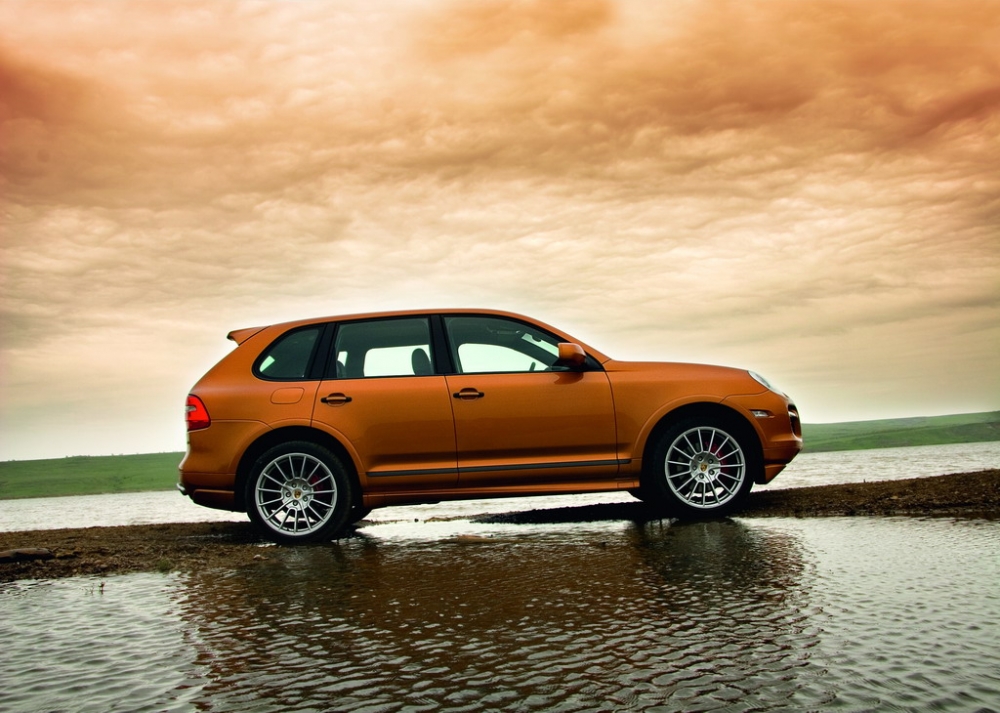
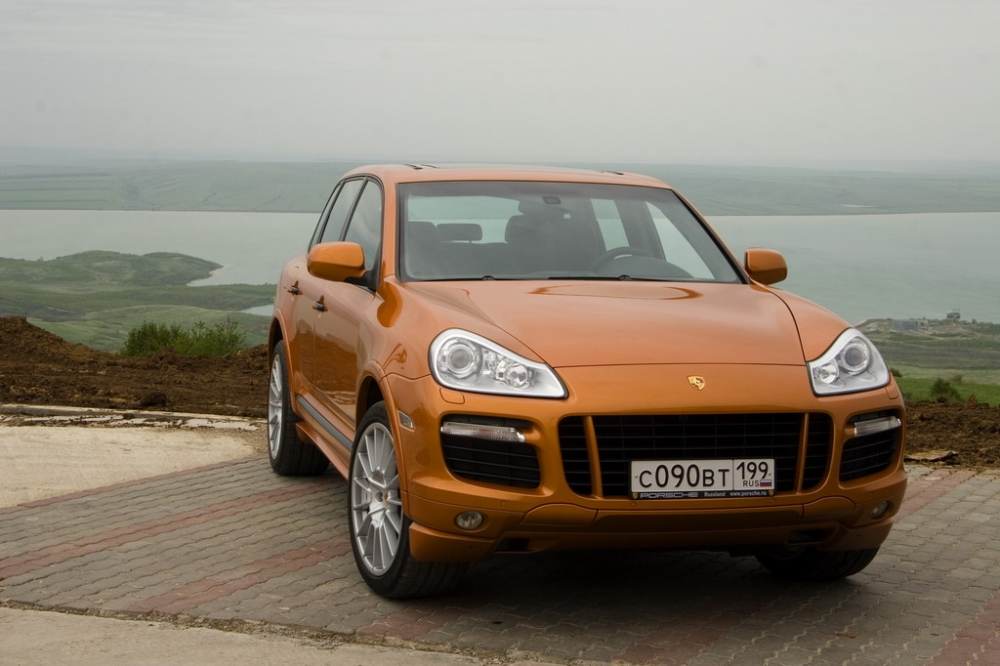 If not for the painting in new bright colors compared to traditional black or silver, which noticeably enliven the rather heavy-looking car, the GTS could initially be mistaken for the top Turbo version. At the front – the same significantly wider than the “donor” Cayenne S “mouth” of the radiator air intake, the same horizontal “fog lights” integrated into its side sections, and at the rear – the same dual chrome exhaust pipe tips. But the hood is flat, without the pair of knife-shaped protrusions on the hood that distinguish the Turbo. “Instead” of them, there are fender flares protruding about 1.5 cm on each side, which, along with 21-inch Cayenne Sport wheels shod with 295/35 mm tires, give the car additional “muscularity.” The sporty appearance of the luxury SUV is complemented by branded red brake calipers and a reduced ground clearance of 24 mm. If not for the painting in new bright colors compared to traditional black or silver, which noticeably enliven the rather heavy-looking car, the GTS could initially be mistaken for the top Turbo version. At the front – the same significantly wider than the “donor” Cayenne S “mouth” of the radiator air intake, the same horizontal “fog lights” integrated into its side sections, and at the rear – the same dual chrome exhaust pipe tips. But the hood is flat, without the pair of knife-shaped protrusions on the hood that distinguish the Turbo. “Instead” of them, there are fender flares protruding about 1.5 cm on each side, which, along with 21-inch Cayenne Sport wheels shod with 295/35 mm tires, give the car additional “muscularity.” The sporty appearance of the luxury SUV is complemented by branded red brake calipers and a reduced ground clearance of 24 mm. |
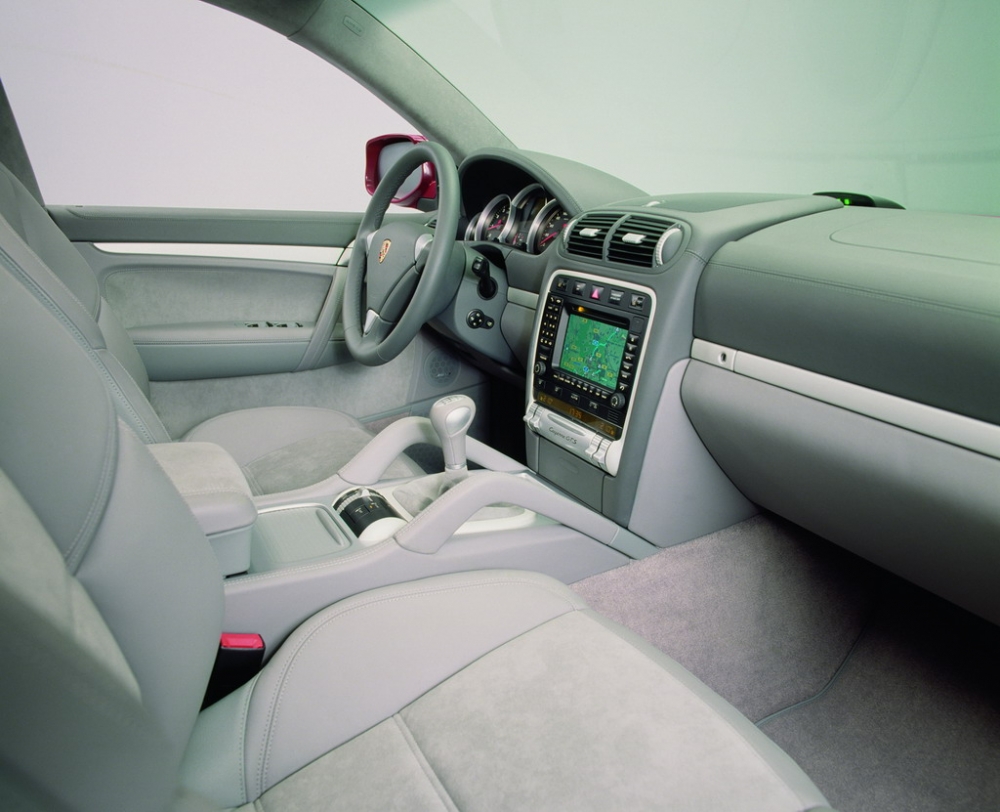
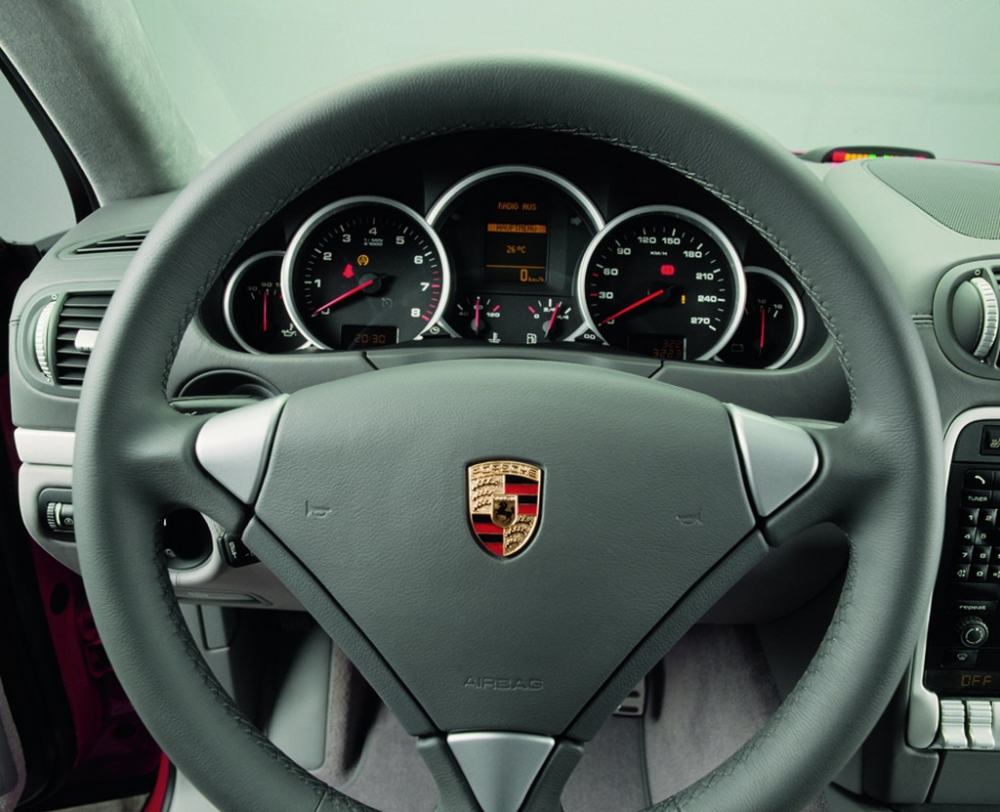
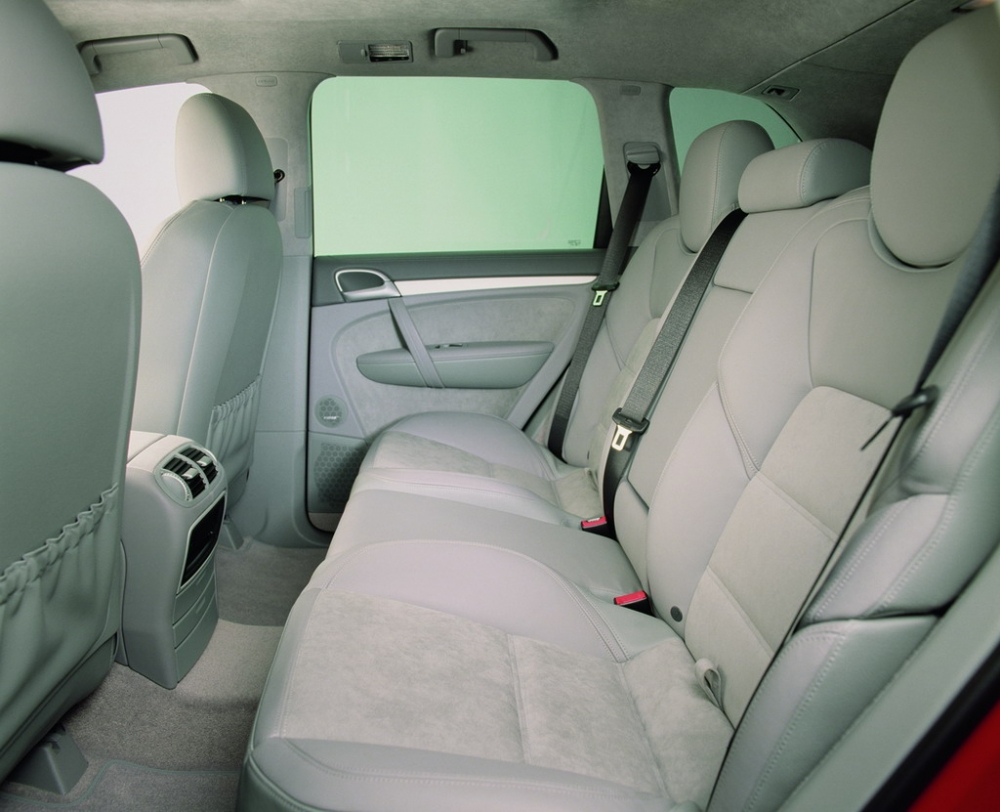
 In the interior trim, as befits, there are no excesses, but it cannot be called Spartan either – a combination of natural leather and Alcantara combined with decorative inserts made of satin-finished aluminum. The main feature of the GTS interior, not counting the steel plates with the model designation on the thresholds, is the special sport seats for the driver and front passenger with enhanced lateral support and 12-position adjustment. Rear passengers are not forgotten either: the second row of seats is molded for two people (also providing more developed lateral support), although if desired, a third can also fit there. In the interior trim, as befits, there are no excesses, but it cannot be called Spartan either – a combination of natural leather and Alcantara combined with decorative inserts made of satin-finished aluminum. The main feature of the GTS interior, not counting the steel plates with the model designation on the thresholds, is the special sport seats for the driver and front passenger with enhanced lateral support and 12-position adjustment. Rear passengers are not forgotten either: the second row of seats is molded for two people (also providing more developed lateral support), although if desired, a third can also fit there. |
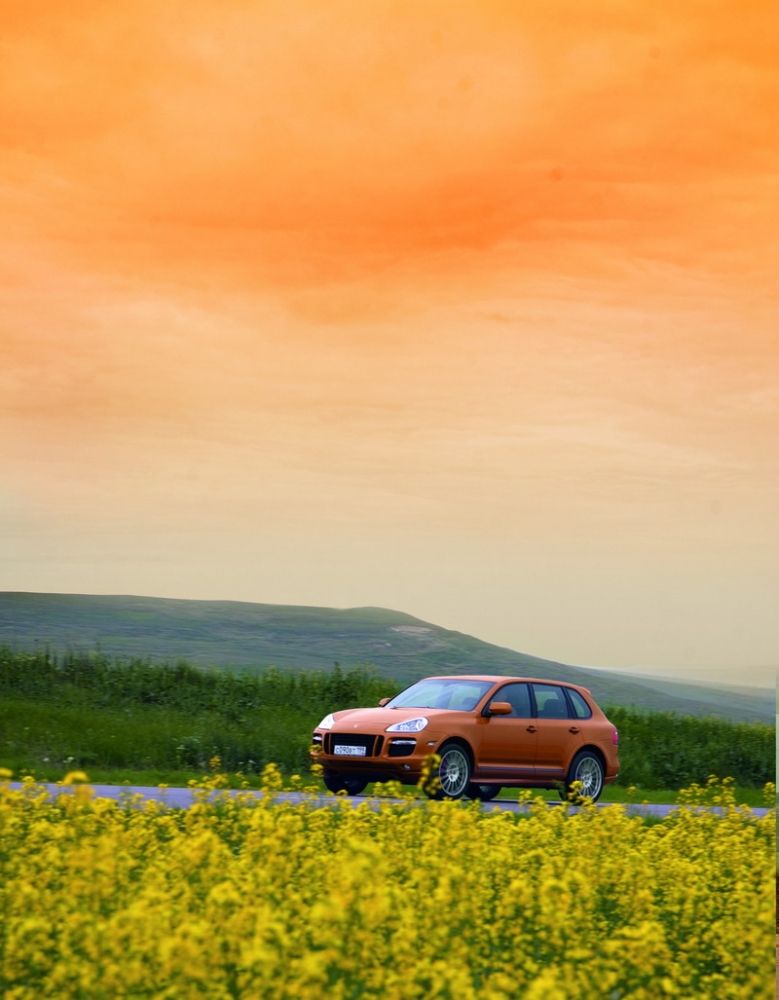 All this, by and large, is, of course, only “scenery,” but in terms of design, the GTS hides something much more interesting: for the first time for the Cayenne, the active Porsche Active Suspension Management (PASM) suspension is combined with steel springs, as on “purebred” Porsche sports cars! (Air suspension is also possible as an option, and in this case too, the ground clearance will be 20 mm less than that of the Cayenne S.) At the same time, the springs and front stabilizer are stiffer than those of the Cayenne S, while the rear suspension stabilizers are tuned more elastically, which, combined with reduced ground clearance, is designed to ensure greater chassis composure, a lower center of gravity and, as a result, sharper handling and better stability in corners. In addition, increasing the negative camber angle of both front and rear wheels allows the Cayenne GTS to withstand higher lateral accelerations. It must be said that the Porsche SUV, in relation to cars of this class, previously stormed corners with rare confidence, and several days spent at the beginning of last year behind the wheel of all three updated versions of the Cayenne convinced me that it is not in vain positioned as sporty. And without the ability to compare cars directly, moving directly from one to another, it is difficult to fully feel the difference between the previous and the new version. So I, frankly, cannot put my feelings into some exact measure. All this, by and large, is, of course, only “scenery,” but in terms of design, the GTS hides something much more interesting: for the first time for the Cayenne, the active Porsche Active Suspension Management (PASM) suspension is combined with steel springs, as on “purebred” Porsche sports cars! (Air suspension is also possible as an option, and in this case too, the ground clearance will be 20 mm less than that of the Cayenne S.) At the same time, the springs and front stabilizer are stiffer than those of the Cayenne S, while the rear suspension stabilizers are tuned more elastically, which, combined with reduced ground clearance, is designed to ensure greater chassis composure, a lower center of gravity and, as a result, sharper handling and better stability in corners. In addition, increasing the negative camber angle of both front and rear wheels allows the Cayenne GTS to withstand higher lateral accelerations. It must be said that the Porsche SUV, in relation to cars of this class, previously stormed corners with rare confidence, and several days spent at the beginning of last year behind the wheel of all three updated versions of the Cayenne convinced me that it is not in vain positioned as sporty. And without the ability to compare cars directly, moving directly from one to another, it is difficult to fully feel the difference between the previous and the new version. So I, frankly, cannot put my feelings into some exact measure. |
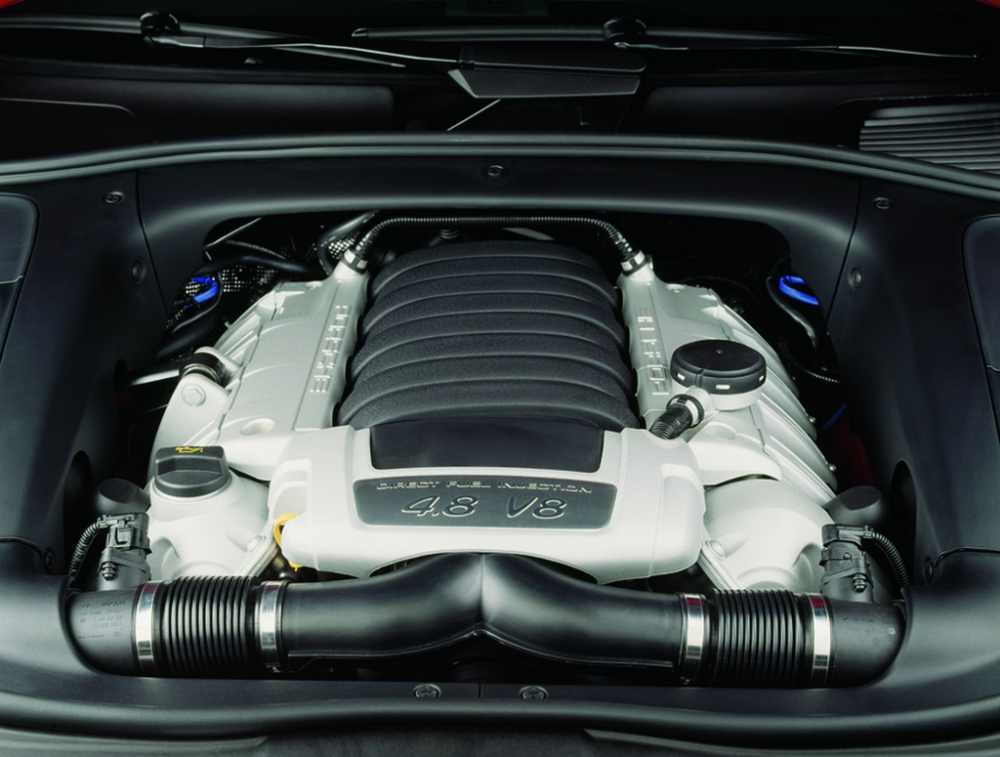
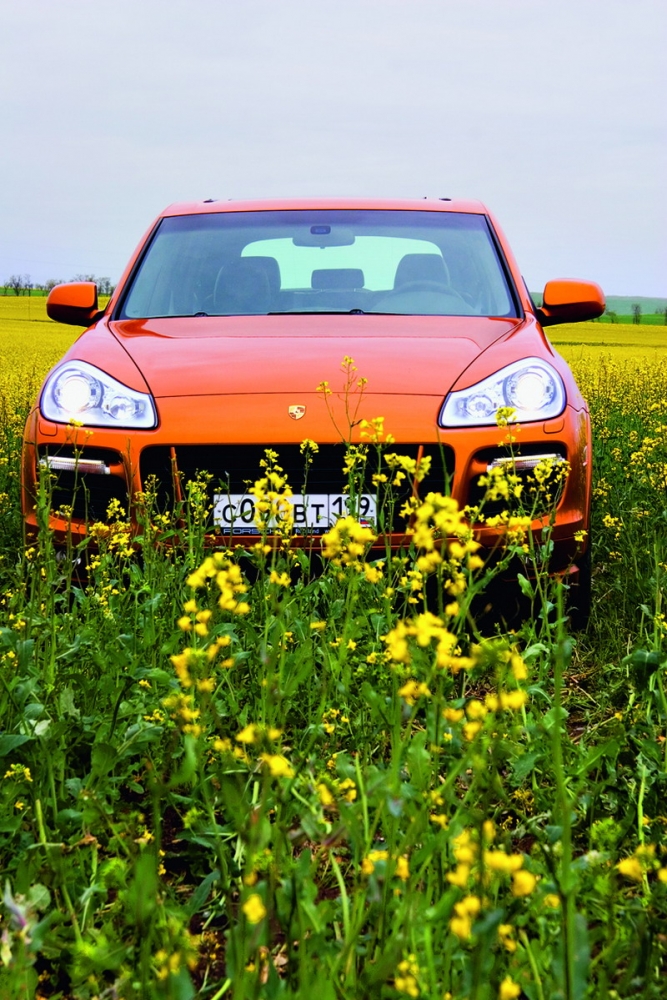 But the fact that the GTS makes the impression of a very composed, dynamic and sportily responsive car for such a “behemoth” is undoubted. Let's put it this way: the hurricane, almost unbridled, often simply excessive power that distinguishes the Turbo version has given way to a more rational (in the sporty sense, again) and refined use of the car's considerable potential. At the core of this potential, of course, is the excellent naturally aspirated V8 with Direct Fuel Injection (DFI) from the Cayenne S – a true golden mean between the much less powerful V6 and its own turbocharged version. Therefore, probably, the exhaust system of the GTS does not sound as intimidating as that of the Turbo version, but it is convincing enough to evoke respect for the car and a desire to “step on the gas.” The VarioCam Plus bisystem, which the engine is equipped with, regulates not only the opening phases but also the stroke of the intake valves. As a result, maximum power is provided when there is a need to use it, and a “gentle” mode when there is no such need, combined with the engine's highest elasticity (acceleration from 80 to 120 km/h on the penultimate gear takes only 6.6 seconds) and smoothness of its operation. Figuratively speaking, such an engine is like a thinking living organism that mimics every second, taking the optimal form according to the conditions of “habitat.” But what did the 20 horsepower added to the engine due to the modernization of the intake system go to, if the top speed remained the same as that of the Cayenne S? But the fact that the GTS makes the impression of a very composed, dynamic and sportily responsive car for such a “behemoth” is undoubted. Let's put it this way: the hurricane, almost unbridled, often simply excessive power that distinguishes the Turbo version has given way to a more rational (in the sporty sense, again) and refined use of the car's considerable potential. At the core of this potential, of course, is the excellent naturally aspirated V8 with Direct Fuel Injection (DFI) from the Cayenne S – a true golden mean between the much less powerful V6 and its own turbocharged version. Therefore, probably, the exhaust system of the GTS does not sound as intimidating as that of the Turbo version, but it is convincing enough to evoke respect for the car and a desire to “step on the gas.” The VarioCam Plus bisystem, which the engine is equipped with, regulates not only the opening phases but also the stroke of the intake valves. As a result, maximum power is provided when there is a need to use it, and a “gentle” mode when there is no such need, combined with the engine's highest elasticity (acceleration from 80 to 120 km/h on the penultimate gear takes only 6.6 seconds) and smoothness of its operation. Figuratively speaking, such an engine is like a thinking living organism that mimics every second, taking the optimal form according to the conditions of “habitat.” But what did the 20 horsepower added to the engine due to the modernization of the intake system go to, if the top speed remained the same as that of the Cayenne S? |
 The answer lies in the transmission, which was also revised. Increasing the final drive ratio from 3.55 to 4.1 made it possible to significantly “shorten” it and thereby reduce the car's acceleration time from 0 to 100 km/h by half a second. However, as is known, improving acceleration dynamics in this way inevitably entails a decrease in top speed, and the addition of 20 “horses” as a result became compensatory. And this is correct, since, again, as is known, for a sports car its relative dynamic characteristics are much more important than absolute speed. Therefore, one must assume, the final drive of the optional Tiptronic S automatic transmission was also “shortened” in exactly the same way. And given that it is very difficult to imagine the average (even if “sport-oriented”) Cayenne owner preferring to “bother” with a manual rather than comfortably rely on an “automatic,” this is an even more sensible decision. The answer lies in the transmission, which was also revised. Increasing the final drive ratio from 3.55 to 4.1 made it possible to significantly “shorten” it and thereby reduce the car's acceleration time from 0 to 100 km/h by half a second. However, as is known, improving acceleration dynamics in this way inevitably entails a decrease in top speed, and the addition of 20 “horses” as a result became compensatory. And this is correct, since, again, as is known, for a sports car its relative dynamic characteristics are much more important than absolute speed. Therefore, one must assume, the final drive of the optional Tiptronic S automatic transmission was also “shortened” in exactly the same way. And given that it is very difficult to imagine the average (even if “sport-oriented”) Cayenne owner preferring to “bother” with a manual rather than comfortably rely on an “automatic,” this is an even more sensible decision. |
 Although, on the other hand, an automatic transmission, even with the promising letter S, even with paddle shift mode, still significantly devalues the GTS's claim to special sportiness. And no matter how you “shorten” the gears, the main advantage of Tiptronic S remains the smoothness of its operation, not its speed. And driving a Cayenne S with a manual gearbox at the time seemed more exciting than with an “automatic”: shifting gears “live” makes driving the car noticeably sharper and more interactive. The same, one must assume, is the case with the GTS. But it is already important that the choice still exists, even if one person out of a hundred prefers the “manual.” Although, on the other hand, an automatic transmission, even with the promising letter S, even with paddle shift mode, still significantly devalues the GTS's claim to special sportiness. And no matter how you “shorten” the gears, the main advantage of Tiptronic S remains the smoothness of its operation, not its speed. And driving a Cayenne S with a manual gearbox at the time seemed more exciting than with an “automatic”: shifting gears “live” makes driving the car noticeably sharper and more interactive. The same, one must assume, is the case with the GTS. But it is already important that the choice still exists, even if one person out of a hundred prefers the “manual.” |
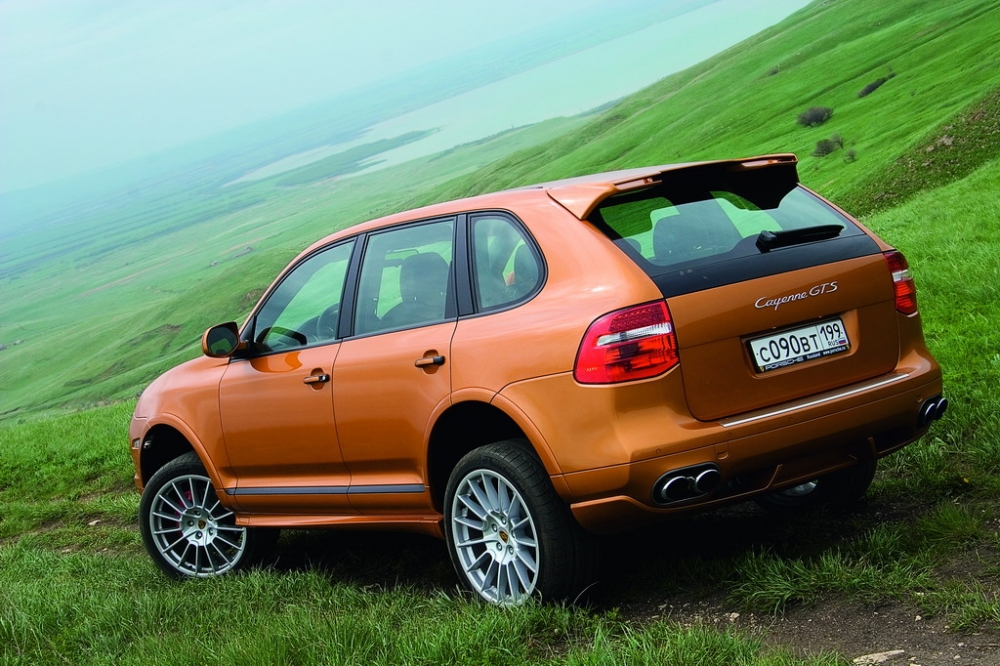
 And so, the native off-road terrain clearly attracts most Russian Cayenne owners no more than a Vietnamese flea market on the city outskirts a couple of dozen kilometers from an expensive central boutique. However, the rare, mesmerizing beauty of the “Wolf Gate” tract near Stavropol, where the main test drive route started, and the “purity of the experiment” drew us away from the asphalt onto the hills surrounding the huge reservoir, covered with alluring fresh green grass, but with quite steep slopes and spring-soaked (up to the formation of large sticky puddles) dirt paths between them. Not every, far from every car denoted by the SUV abbreviation allows such carefree and confident riding over picturesque expanses outside the highway without fear of getting stuck in serious off-road conditions! The ability to lock the center differential and engage the low range, the ABD electronic imitation system for inter-wheel locks, the ASR traction control system, hill-start assist systems (Porsche Drive-off Assistant in the base configuration with manual transmission and Hill-Holder with automatic) – all this together honestly fulfills its purpose and endows the Cayenne GTS with very serious off-road capabilities. If you want to arrange a “Russian roller coaster” attraction without leaving the cozy and comfortable interior of your car – please! And so, the native off-road terrain clearly attracts most Russian Cayenne owners no more than a Vietnamese flea market on the city outskirts a couple of dozen kilometers from an expensive central boutique. However, the rare, mesmerizing beauty of the “Wolf Gate” tract near Stavropol, where the main test drive route started, and the “purity of the experiment” drew us away from the asphalt onto the hills surrounding the huge reservoir, covered with alluring fresh green grass, but with quite steep slopes and spring-soaked (up to the formation of large sticky puddles) dirt paths between them. Not every, far from every car denoted by the SUV abbreviation allows such carefree and confident riding over picturesque expanses outside the highway without fear of getting stuck in serious off-road conditions! The ability to lock the center differential and engage the low range, the ABD electronic imitation system for inter-wheel locks, the ASR traction control system, hill-start assist systems (Porsche Drive-off Assistant in the base configuration with manual transmission and Hill-Holder with automatic) – all this together honestly fulfills its purpose and endows the Cayenne GTS with very serious off-road capabilities. If you want to arrange a “Russian roller coaster” attraction without leaving the cozy and comfortable interior of your car – please! |
 And at the same time, you are not at all tossed around in the cabin against everything possible, and you are not thrown out of the seat – fantastic ride smoothness is preserved! Special thanks for this should be given to the active PASM suspension! Continuous automatic adjustment of shock absorber stiffness depending on driving conditions and three forced modes – Komfort, Normal, and Sport – allowed the designers not to seek compromises in settings. Regardless of what is under the GTS's wheels – a smooth road or potholes – you feel as if in an airplane seat in first class. But still, the true element of the Cayenne GTS, despite all its eclecticism with an obvious bias towards the SUV family, is the asphalt highway. Finally, you can press the cherished “Sport” button included in the base configuration (which “tightens” the suspension, sharpens the accelerator response, and changes the exhaust sound to an even lower and juicier one), “floor” the gas pedal and, as they say, full speed ahead! And at the same time, you are not at all tossed around in the cabin against everything possible, and you are not thrown out of the seat – fantastic ride smoothness is preserved! Special thanks for this should be given to the active PASM suspension! Continuous automatic adjustment of shock absorber stiffness depending on driving conditions and three forced modes – Komfort, Normal, and Sport – allowed the designers not to seek compromises in settings. Regardless of what is under the GTS's wheels – a smooth road or potholes – you feel as if in an airplane seat in first class. But still, the true element of the Cayenne GTS, despite all its eclecticism with an obvious bias towards the SUV family, is the asphalt highway. Finally, you can press the cherished “Sport” button included in the base configuration (which “tightens” the suspension, sharpens the accelerator response, and changes the exhaust sound to an even lower and juicier one), “floor” the gas pedal and, as they say, full speed ahead! |
 The steering wheel is quite sharp – only 2.65 turns from lock to lock, but not nervous – it provides precise and at the same time comfortable control, although, perhaps, it would not hurt to have a bit more weight. Helping, again, are the truly necessary for such a car and quite correctly operating stability control system and all-wheel drive with the PTM traction management system. The latter in normal mode directs 62% of torque to the rear wheels and 38% to the front, but at any moment redistributes traction to ensure confident cornering in this case. The brake pedal, alas, is traditionally for the Cayenne – frighteningly soft and uninformative at first, but the brakes (front discs – 350x34 mm with 6-piston calipers and rear – 330x28 mm with 4-piston) are absolutely adequate to the engine's power and provide the necessary deceleration of such a heavy car, including emergency braking. The steering wheel is quite sharp – only 2.65 turns from lock to lock, but not nervous – it provides precise and at the same time comfortable control, although, perhaps, it would not hurt to have a bit more weight. Helping, again, are the truly necessary for such a car and quite correctly operating stability control system and all-wheel drive with the PTM traction management system. The latter in normal mode directs 62% of torque to the rear wheels and 38% to the front, but at any moment redistributes traction to ensure confident cornering in this case. The brake pedal, alas, is traditionally for the Cayenne – frighteningly soft and uninformative at first, but the brakes (front discs – 350x34 mm with 6-piston calipers and rear – 330x28 mm with 4-piston) are absolutely adequate to the engine's power and provide the necessary deceleration of such a heavy car, including emergency braking.The tested GTS was also equipped with the optional PDCC roll suppression system. It is based on split active anti-roll bars with an integrated hydraulic motor. The latter, upon a signal from roll-sensing sensors, instantly changes the stiffness of its stabilizer, which, along with the active suspension, results in not even a compromise, but a 100% combination of ride smoothness, sharp handling, stability, and off-road capability. You prepare at the entrance to a fast corner or a hairpin for the car to sharply lean to the opposite side, but... no such luck. And no matter how hard you try in the heat of the moment to outsmart the system with an even sharper steering input, it still proves faster and minimizes body roll. So for greater sportiness, the GTS version should also include the PDCC system as standard, even though it would increase the car's price. But when have Cayenne buyers ever checked their wallets and been stingy when choosing their 'high-speed carriage'? In any case, Porsche, through the GTS, attempted to kill two birds with one stone: to further invigorate demand for its SUV, which was already far from 'dead' even in anticipation of the new Cayenne generation, and at the same time, somehow reconcile fans of the brand's classic sports cars with the fact of such a vehicle's existence. And peacemakers, as is known, sometimes have to demonstrate and use force to accomplish their tasks. Which is exactly what the Cayenne GTS does. |
Peacemaker
As if “apologizing” to the orthodox adherents of the brand for its own “apostasy,” which, to satisfy the feverish market demand, gave birth to the superhit called the Cayenne, Porsche tirelessly strives to give this “means of status mobility” an increasingly sporty character. The next step in this direction was the introduction of the Cayenne GTS version.
Test drive photos
Comments
No comments yet. Say the first word.