
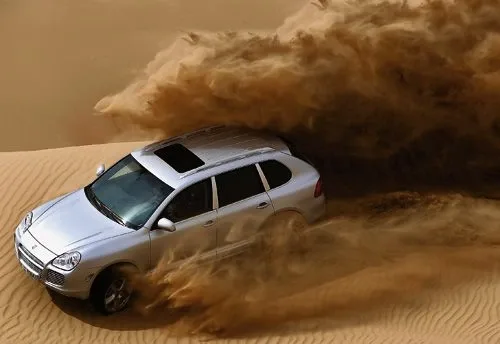
520 horsepower and acceleration to 100 km/h in 5.2 seconds — such figures are usually attributed to race cars or supercars. But no, these are the characteristics of the production SUV Porsche Cayenne Turbo S with a reinforced twin-turbo V8. Understanding why the Germans made the most powerful SUV on the planet is difficult until you press the gas pedal to the floor.
2006 Porsche Cayenne Turbo S
© Photo: Andrey Myazin, 5 Koleso
A colleague, walking around the silver "Cayenne" in a circle, wonders aloud who needs such power. Externally, the car almost doesn't reveal its crazy internals. Except that an attentive eye will notice some details: four exhaust pipes, twenty-inch low-profile wheels, and brake calipers painted with red lacquer.
2006 Porsche Cayenne Turbo S
© Photo: Andrey Myazin, 5 Koleso
Okay, let's see what this super-Cayenne is capable of. You turn the key — and where is that aggressive roar of the five-hundred-horsepower engine, that signature sound symphony? However, this is not a disappointment at all. True strength doesn't need ostentatious bravado. But on the track, it spills out in full.
The huge mass of 2.2 tons is completely unnoticeable — the torque with a peak of 720 Nm carries the SUV forward as if it were a racing projectile. The mass-to-power ratio of the Turbo S is only 4.3 kg per "horse," so the "S" accelerates almost like a Carrera 911 S.
2006 Porsche Cayenne Turbo S
© Photo: Andrey Myazin, 5 Koleso
Compared to the predecessor, the 4.5-liter "V8" has become more powerful by 70 horsepower. This was achieved through larger intercoolers, raising the boost pressure to 1.9 bar, and factory firmware of the control unit. Now the "Cayenne" shoots to 100 km/h in 5.2 seconds, and the top speed reaches 270 km/h.
There is no desire to race to the limit figures. But it can be confirmed: up to 180 km/h, the Turbo S demonstrates phenomenal responsiveness. Judging by the sensations, at this speed it hasn't even used half of its potential. The six-speed adaptive automatic shifts gears smoothly and precisely, perfectly suited for active driving.
2006 Porsche Cayenne Turbo S
© Photo: Andrey Myazin, 5 Koleso
In parallel with the engine, engineers also worked on the chassis. The air suspension acquired new settings within the PASM system. It has three stiffness modes. In "comfort," the ride is quite soft, but at the same time composed, without rocking. And in "sport," the five-meter SUV takes sharp corners almost without body roll.
A more powerful and faster car also needs more serious brakes. At the front, there are now discs with a diameter of 380 mm (30 mm more), almost 40 mm thick, at the rear — 358 mm instead of the previous 330. Plus, engineers improved cooling: new ventilation channels more effectively save the brakes from overheating.
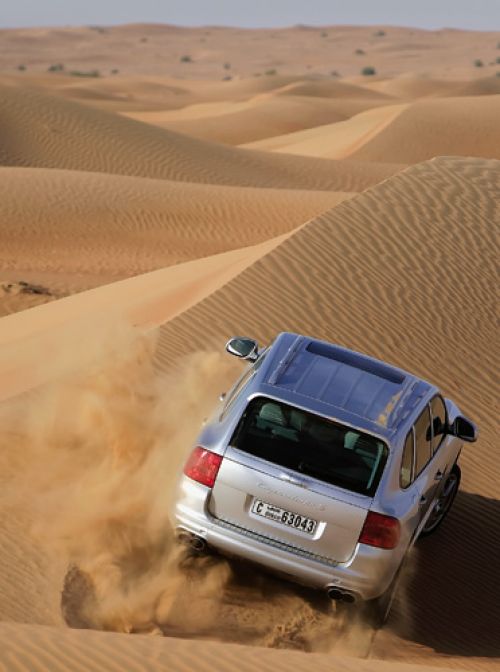
The refined suspension and boosted engine performed excellently not only on smooth asphalt in the vicinity of Dubai, but also in the sands of Arabia, where we were sent for off-road adventures. After lowering the tire pressure to one atmosphere, the Turbo S easily climbs high dunes, maneuvers between dunes, and confidently crawls over shifting sands, as if it is the master here, not the camels with their perfect all-wheel drive.
The versatility of the model is impressive. It is simultaneously an SUV, a "luxury car," and a sports car (in terms of power, the Turbo S in the Porsche lineup yields only to the Carrera GT). And in each of these roles, it looks impeccable.
The regular Porsche Cayenne Turbo costs from 118,000 euros, and the base price for the "S" in Russia is 136,000. Is it worth paying an extra 18,000? European fans of the brand might be puzzled by such a question — given the rising fuel prices and the universal fashion for economy. Sales of large SUVs in Europe fell last year. But Russia is a different matter! If you're going to walk, then walk in style, if you're buying a "Cayenne," then get the top version! Almost half of the Cayennes sold here are turbocharged. And for the newest version, according to dealers, a queue formed even before the start of official sales.
Technical characteristics of Porsche Cayenne Turbo S
Curb weight, kg – 2355
Gross weight, kg – 3080
Dimensions, mm:
- length – 4787
- width – 1928
- height – 1699
Wheelbase, mm – 2855
Trunk volume, l – 540/1770
Maximum speed, km/h – 270
Acceleration time to 100 km/h, s – 5.2
Control fuel consumption, l/100 km:
- city cycle – 21.9
- suburban – 11.9
- combined – 15.7
Fuel tank volume, l – 100
Engine:
- type – petrol, V8
- displacement, cm3 – 4511
- power, hp at rpm – 521
- torque, Nm at rpm – 720/2750–3750
Transmission – automatic, 6-speed
Tire size – 275/40R20
Suspension (front/rear) – independent, adaptive
Brakes (front/rear) – disc, ventilated
Steering – with adaptive power steering
Price, euros – 136,000.
Advantages and disadvantages
+ Dynamics, top speed, handling, quality, prestige.
– Lack of sport mode for the gearbox.