
Fresh "Peppers"
In early June, the presentation of the updated Porsche Cayenne S and Porsche Cayenne Turbo SUVs took place in the Moscow region. For us, this event was essentially the first acquaintance with third-generation cars — we did not attend the German premiere of the restyled bestseller from Zuffenhausen.
On the one hand, a local test drive of a new model is always a plus. The car not only comes to us "right to the doorstep," but is also tested on the very roads where its Russian owners will later drive. But there is also a minus: not all versions of the "Cayenne" were shown at this event. So, the base Cayenne with a modernized 300-horsepower naturally aspirated 3.6-liter engine, as well as the diesel version, which is distinguished by increased efficiency, remained off-screen.
of the previous generation, is a thing of the past —
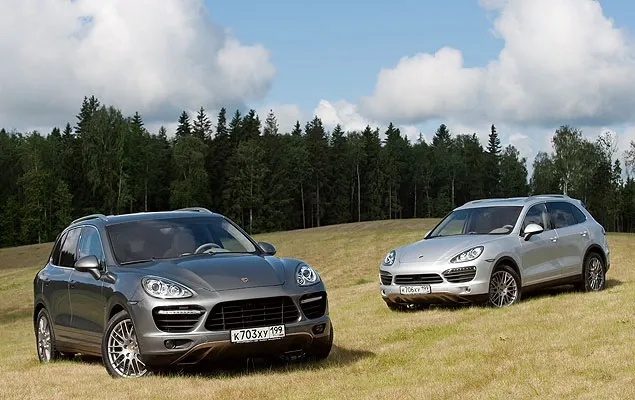
the new "Cayenne" cuts the air with sharp hood edges
The diesel, by the way, in the combined cycle is content with only 7.4 liters of fuel per hundred, but at the same time is not deprived of dynamics worthy of the Porsche brand — acceleration to a hundred takes 7.8 seconds. And it would also be interesting to take a ride in the hybrid Porsche Cayenne S, regardless of how its fate turns out on our market — premium "hybrids" are still a curiosity for domestic buyers.
In any case, it would be a sin to complain that we got exactly the "charged" modifications of the Porsche Cayenne. Not every day you get the opportunity to test two cars one after another, one of which hits a hundred in 5.9 seconds, and the second — in 4.7!
Higher, wider, longer
To understand which cars will occupy the parking lots of fashionable metropolitan restaurants in the coming year, it is worth carefully examining the Porsche Cayenne S from the front. This version has a trapezoidal radiator grille and air intakes — the same as all other new-generation "Cayennes." But the flagship Cayenne Turbo got a larger radiator grille. As they say, noblesse oblige — position obliges.
In profile, the car looks more squat, although in fact it has become 5 millimeters higher (1705 millimeters). This deceptive impression arises because the "Cayenne" has stretched in length by 48 millimeters, with 40 of them falling on the wheelbase. As a result, the elongated body visually seems closer to the ground. The Porsche Cayenne also added in width — by 11 millimeters (1939 millimeters).
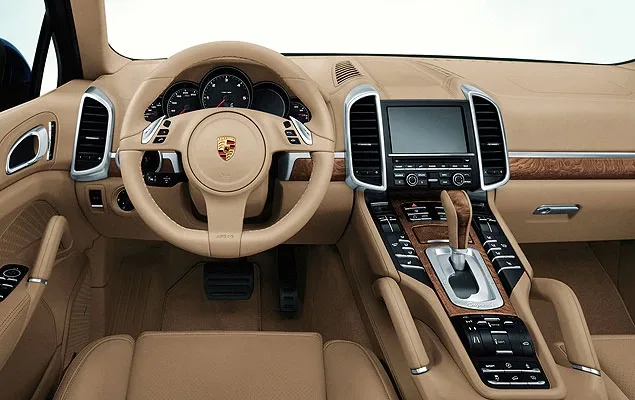
Inside — at least at first glance — the added millimeters are hard to notice. Especially in the front, where the space is noticeably "eaten up" by the high console above the central tunnel, dotted with levers and buttons, ideologically borrowed from the four-door Porsche Panamera coupe. But in the driver's seat, complaints about this "pedestal" disappear — the feeling of a low seating position it creates and the excellent ergonomics of the workplace turn the massive console dimensions into an advantage.
Changes also affected the "Cayenne's" trunk — its volume increased from 540 liters to 670 liters in the five-seat configuration, and from 1770 liters to 1780 liters with the rear sofa folded. By the way, the backrest is now divided in a 40:20:40 ratio, and each section can adjust the tilt angle, and the "sofa" cushion, divided into two parts in a 40 to 60 ratio, can move longitudinally by 160 millimeters.
Barefoot through puddles
As for the "filling," it has changed even more in the new Porsche Cayenne than the exterior and interior. The main news is that the SUV has lost its "adult" transfer case, which on the diesel and hybrid versions has been replaced by a permanent mechanical all-wheel drive with a Torsen differential, and on all other modifications (Cayenne, Cayenne S, and Cayenne Turbo) — by an electronically controlled multi-disc clutch.
A logical step — why carry extra "iron" with you if the average Porsche SUV owner sees off-road only on TV. However, the company itself claims that even such intervention did not turn the "Cayenne" into a crossover.
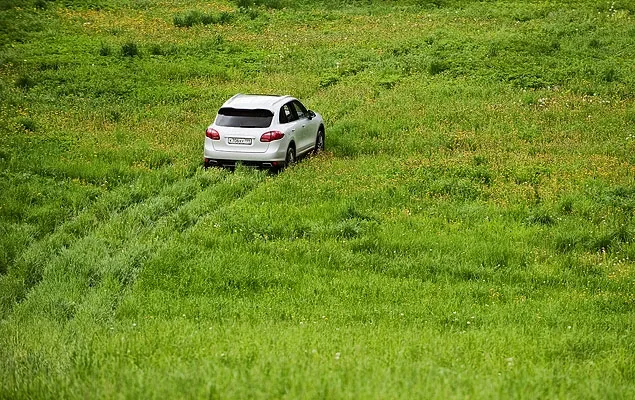
Unfortunately, the Moscow region test drive program did not include checking the off-road qualities of the test cars — for such purposes, a special proving ground with calibrated obstacles is needed. After all, prices for the new "Cayenne" start at three million rubles — giving such expensive cars to journalists for testing on "wild" off-road is, to say the least, imprudent. Moreover, the low-profile "rubber" in which the Cayenne S we got was shod was poorly suited for muddy "rides."
But on cars with air suspension, ground clearance can still be increased to an impressive 268 millimeters. In addition, on the Cayenne S and Cayenne Turbo, for an additional fee, the Porsche Dynamic Chassis Control (PDCC) system inherited from the previous generation is installed with active anti-roll bars that are clamped or released by hydraulic reversible motors.
The main task of this system is to reduce body roll in corners. In this case, hydraulic cylinders twist the stabilizer links so as to level the body that has "fallen over" on the arc. But it also works off-road, allowing an increase in the axle articulation angle, which, in turn, improves the vehicle's cross-country capability. In general, in terms of geometric suspension parameters, calling the "Cayenne" a "crossover" — the tongue does not turn.
Born to drive
However, this car is still not intended for swampy forest paths or soggy dirt roads. Its element is paved roads, for which, in fact, the German SUV was created. That is why the main function of the electronically controlled rear differential lock PTV Plus (Porsche Torque Vectoring Plus) is not at all to help the car in a soggy rut, but to reduce the car's understeer during high-speed cornering. PTV electronics, working together with the stability control system, brakes the rear inner wheel, allowing more traction to be transferred to the outer one, and thus increases the yaw moment arising around the vertical axis of the car.
The engine with twin turbocharging, which is installed on the Turbo version, has not changed in power. But, as they claim at "Porsche," it has become 23 percent more economical and emits 25 percent less carbon dioxide into the atmosphere compared to the engine installed on the second generation.
Unfortunately, the 500-horsepower Cayenne Turbo with the PTV system and active stabilizers came to us only at the final stage of the test drive, which took place on a multi-lane highway, where it was impossible to evaluate the operation of these systems. But now we know how the "bare" Cayenne S behaves on narrow Moscow region roads, which has only all-wheel drive and a stability control system with ABS among the proprietary "Porsche" auxiliary systems.
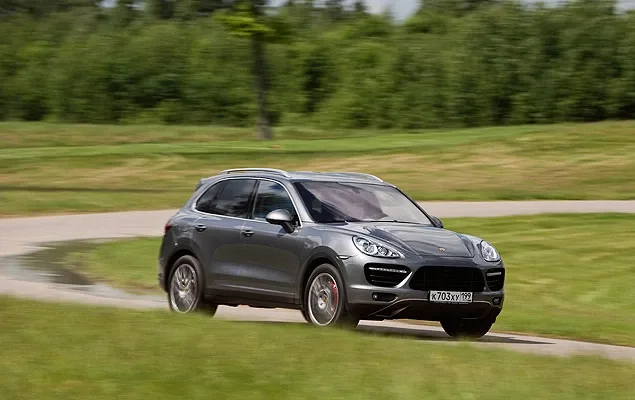
The two-ton SUV with a V-shaped "eight" with 400 horsepower turned out to be surprisingly easy to control even on a broken and winding road. Thanks to the suspension settings, whose elastic elements were additionally reinforced to more effectively resist lateral loads without worsening ride smoothness, the "S-ka" not only calmly "swallowed" large bumps, but also accurately traced arcs, showing miracles of stability even on the road wet after the rain that had passed the day before.
Moreover, behind the wheel of the German sports SUV, thanks to good sound insulation, excellent directional stability, and a high seating position, speed is poorly felt. On the one hand, this is a compliment, and on the other — it is fraught with serious consequences. After all, no one has canceled the Administrative Code and the laws of physics for "Cayenne" owners. Well, or at least only the laws of physics...
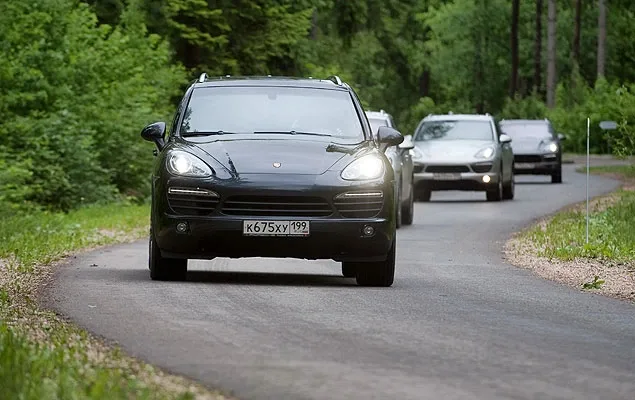
feels at home on the roads of the Moscow region
After getting acquainted with the Porsche Cayenne, I caught myself thinking that the tachometer, which traditionally sits in the center of the instrument panel for the brand, should be swapped with the speedometer. It would be much more convenient and logical. Especially since the six-speed manual gearbox can now only be ordered for the base version with the 300-horsepower engine, while all other modifications make do with the eight-speed automatic from Aisin. However, this is more of an observation than a reason for serious complaints.
To be honest, finding flaws in the Cayenne is not an easy task. And that is completely understandable. The base SUV with a naturally aspirated 3.6-liter engine producing 300 horsepower is priced at a minimum of 3 million 103 thousand rubles. For the hotter versions — the Cayenne S and Cayenne Turbo — you will have to pay from 4 million 117 thousand and from 6 million 476 thousand rubles, respectively. For that kind of money, German engineers managed to combine in one car the comfort of a business sedan, ground clearance befitting a true off-roader, locomotive-like dynamics, and sports car handling. The result is a vehicle that fully deserves its own legend.
But according to the laws of the genre, such feats are usually not rewarded but, on the contrary, punished. Take Prometheus, for example: he gave people fire — and was chained to a rock where an eagle pecked at his liver for thirty thousand years. For Porsche engineers, a different punishment was devised: they are doomed to watch their technically flawless Cayennes crawl for hours in endless traffic jams of European metropolises.
Technical specifications of Porsche Cayenne S and Porsche Cayenne Turbo
| Cayenne S | Cayenne Turbo | |
| Length, mm | 4846 | 4846 |
| Width, mm | 1939 | 1939 |
| Height, mm | 1705 | 1705 |
| Wheelbase, mm | 2895 | 2895 |
| Engine displacement, cm3 | 4806 | 4806 |
| Power, hp/rpm | 400/6500 | 500/6000 |
| Torque, Nm/rpm | 500/3500 | 700/2250-4500 |
| Maximum speed, km/h | 258 | 278 |
| Acceleration from 0 to 100 km/h, s | 5.9 | 4.7 |