
The chassis of this car is truly exemplary. The kinematics, spring rates, and anti-roll bar diameters are selected with jewel-like precision. The car seems not to fly over bumps, but gently envelops them, while the trajectory remains unchanged. And the steering effort is so informative and honest that there is no doubt about the correctness of actions — this is the merit of the modernized steering. Previously, there was a mechanism with a progressive characteristic, but it was borrowed unchanged from the 911 model and not adapted to different conditions. Now the settings are made taking into account the different weight and weight distribution.
Driving the Boxster is perhaps slightly less thrilling than the 911. However, it is perceived as more understandable and more willing to obey the driver, and thanks to the mid-engine layout, it is also noticeably more agile. Naturally, almost neutral handling is maintained both with the roof open and closed. By the way, why not equip the Boxster with a rigid folding top, as Mercedes-Benz did in the SLK model and now BMW in the new Z4?
Porsche has weighty reasons for this, and the first of them is money. The fact is that the body was designed a long time ago, still for a fabric roof, and since then it has not fundamentally changed: only individual aluminum elements and parts made of high-strength steel appeared, but the base remained the same. And most importantly, as brand representatives claim, is weight. In the Boxster, the roof together with all folding mechanisms weighs only 27.9 kg, while competitors have this figure reaching fifty kilograms or more. And this is a direct path to raising the center of gravity, which is not a plus for handling.
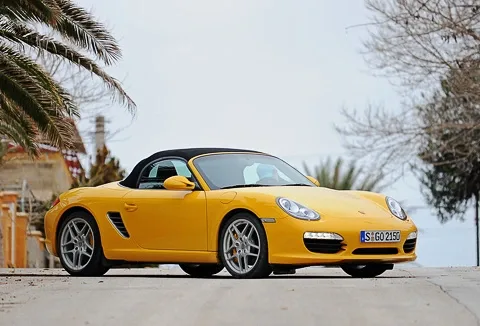
The fabric of the soft top has become more wear-resistant. For an additional fee, a rigid aluminum "cap" is also available.
And what about the promised body rigidity? After all, this is a clear advantage. The engineers just chuckle at this: "Believe me, this is all absolute nonsense. If you make the structure of a rigid folding top such that it really strengthens the body, you will have to ensure a very tight fit in the area of the windshield frame, and then there will be plenty of noise and vibrations. No one will go for that."
So, a rigid roof is purely a matter of practicality. However, the material of the Boxster's top has become more resistant to wear. But the mechanism itself is not yet perfected: the latch has to be unfastened manually. Unlike the 911, where the process is fully automated. But the interior is indistinguishable even from three steps away. The same dashboard architecture, the same options, including a new navigation system and ventilated seats.
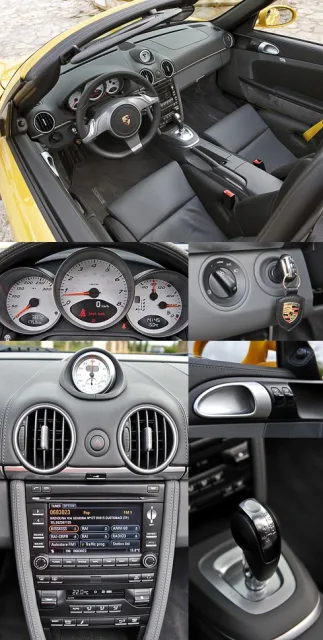
Inside, almost everything is like in the 911. The only noticeable differences are the three instrument pods instead of five and the round air vents on the center console. The rest (steering wheel, gear lever, navigation system, and most buttons) is the same. The driving position is comfortable, and the accelerator pedal is floor-mounted.
When the Boxster first appeared in 1996, many people unfairly labeled it a "fake Porsche." They said the engine was in the wrong place (which sounds doubly strange, given that the famous Nummer 1 was indeed mid-engined) and that it didn't drive the same. But it was the Boxster that saved the company, as Porsche's fortunes were then at a low ebb. It was a shot right on target. Due to growing demand, production even had to be partially moved to Finland, to the Valmet plant.
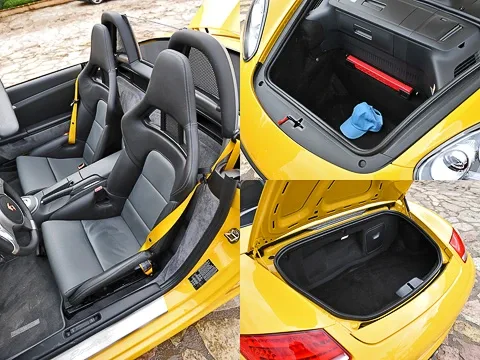
- Our Boxster has optional sport bucket seats, adjustable only longitudinally. The lateral support and profile are ideal, but getting in and out of the car over their high bolsters is not very convenient.
- The Boxster has two trunks — front (150 L), exactly like the 911's, and rear (130 L). However, there is no spare wheel or jack — only sealant and a compressor.
So the Boxster is the most direct heir to the mid-engined Porsche racing cars that competed in the Sicilian Targa Florio race. It also made the company a winner. In the market. Thanks to it, Porsche was able to expand its model range and become the most profitable company per car sold. For that, its father, Wendelin Wiedeking, now chairman of the board, should also be awarded a doctorate. But he already has one.
More than twelve years have passed, and we have almost the same body. But it hasn't aged; it has matured, become more refined, and earned a well-deserved degree: if it used to have an engine with only 204 hp, now it has over three hundred. Race-like squeaking ceramic brakes with impeccable performance and stability, perfectly tuned chassis with active PASM dampers, PDK gearbox. Over these thirteen years, everything in the Boxster has become as mature as it can be. So I can't bring myself to say that the Boxster is worse than the Carrera. Simpler in places, yes, but at the same time, it's wonderful in its own way.
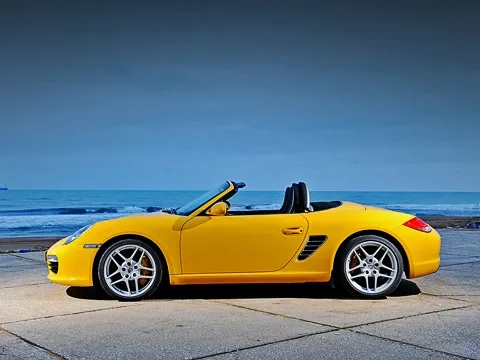
And after driving it, I decided that I would dream not of the 911, but of the Boxster. It's more affordable (the base Boxster costs 2,250 thousand rubles, almost half the price of the 911), more understandable, and finally, more practical. And most importantly, when you buy it, you'll still have something to dream about. Dreams, after all, should also evolve.
Specifications
| Characteristics | Porsche Boxster | Porsche Boxster S |
|---|---|---|
| Body | ||
| Number of doors/seats | 2/2 | 2/2 |
| Length, mm | 4342 | 4342 |
| Width, mm | 1801 | 1801 |
| Height, mm | 1292 | 1292 |
| Wheelbase, mm | 2415 | 2415 |
| Track front/rear, mm | 1490/1543 | 1486/1528 |
| Curb weight, kg | 1335 | 1355 |
| Gross weight, kg | 1635 | 1645 |
| Trunk volume, L | 130+150 | 130+150 |
| Engine | ||
| Type | petrol, with distributed injection | petrol, with direct injection |
| Location | rear, within the wheelbase, longitudinally | rear, within the wheelbase, longitudinally |
| Number and arrangement of cylinders | 6, opposed | 6, opposed |
| Number of valves | 24 | 24 |
| Displacement, cm3 | 2893 | 3436 |
| Max power, hp/rpm | 255/6400 | 310/6400 |
| Max torque, N•m/rpm | 290/4400–6000 | 360/4400–5500 |
| Transmission | ||
| Gearbox | manual, six-speed (automated, seven-speed) | manual, six-speed (automated, seven-speed) |
| Drive | rear | rear |
| Chassis | ||
| Front suspension | independent, coil spring, McPherson | independent, coil spring, McPherson |
| Rear suspension | independent, coil spring, multi-link | independent, coil spring, multi-link |
| Front brakes | disc, ventilated | disc, ventilated |
| Rear brakes | disc, ventilated | disc, ventilated |
| Ground clearance, mm | n/a | n/a |
| Performance characteristics | ||
| Maximum speed, km/h | 263 (261) | 274 (272) |
| Acceleration time 0–100 km/h, s | 5.9 (5.8) | 5.3 (5.2) |
| Fuel consumption, L/100 km | ||
| — urban cycle | 13.6–13.8 (13.3–13.6) | 14.1–14.4 (13.9–14.1) |
| — extra-urban cycle | 6.8–6.9 (6.4–6.5) | 7.0–7.2 (6.5–6.6) |
| — combined cycle | 9.2–9.4 (8.9–9.1) | 9.6–9.8 (9.2–9.4) |
| Emission standard | Euro-5 | Euro-5 |
| Fuel tank capacity, L | 65 | 65 |
| Fuel | AI-98 | AI-98 |
Technology 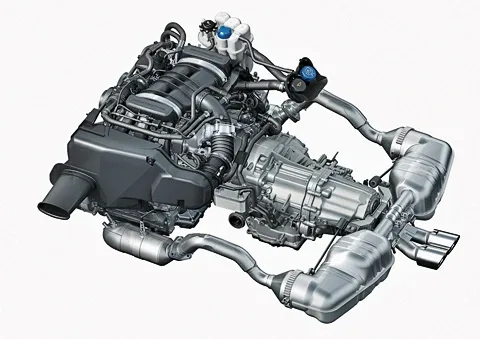
The Boxster engines now belong to the same family as those in the 911: the cylinder block consists of two parts instead of four, as previously — there is no longer a separate housing for the main bearing caps. The engine mass compared to previous versions has decreased by almost 6 kilograms, and internal friction has been reduced. As in the 911, the Boxster uses an oil pump that operates "on demand" — this also helped reduce fuel consumption.
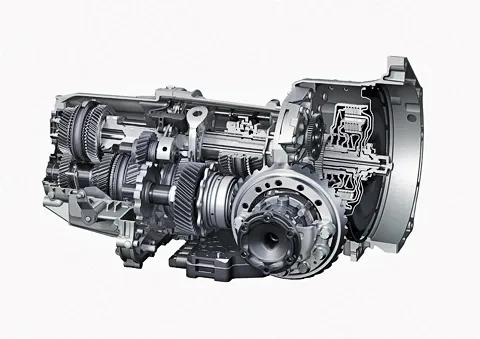
The PDK gearbox is based on the same one used in the 911 Carrera: two clutches (153 and 202 mm in diameter) and the hydraulic control unit are the same. Compared to a conventional automatic, PDK shifts gears 60% faster and weighs 11 kg less. And in combination with Launch Control, the acceleration time from standstill to 100 km/h is reduced by another 0.2 seconds.
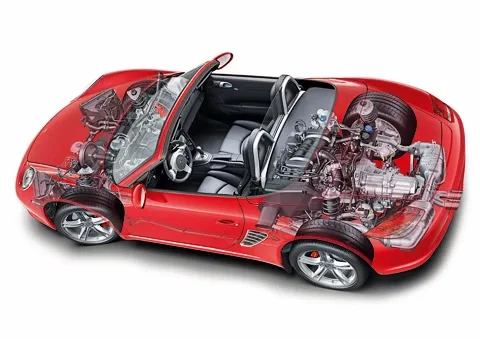
The body, despite numerous refinements, remains the same as that of the first Boxster from 1996. Thanks to aluminum, high-strength steel grades, and laser welding, it has been made lighter and stiffer. Head protection airbags for side impacts have also been added.
History
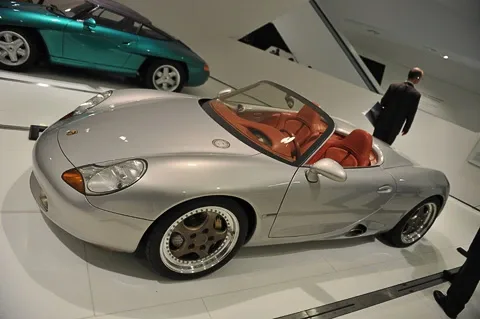
The Porsche Boxster concept debuted in 1993 at the Detroit Auto Show. At that time, production of the 928 had already ended, and the brand's lineup consisted of only one car — the 911 of the 993 series.
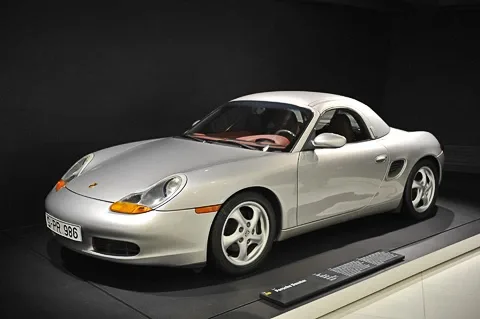
The production Boxster with the index 986 appeared at the end of 1996. Its development and production preparation cost 1.5 billion marks — for comparison, the entire company was then valued at 300 million. The plan was to sell 15,000 cars a year, but there were almost twice as many buyers, and some cars were assembled at the Finnish Valmet plant. Initially, it had a 2.5-liter engine with 204 hp. In 1999, it was replaced by a 2.7-liter unit (220 hp), and the S version with a 3.2-liter engine and 253 hp was also released. Engines only grew from there: by 2004, the base Boxster had 231 hp, and the "S" had 264.
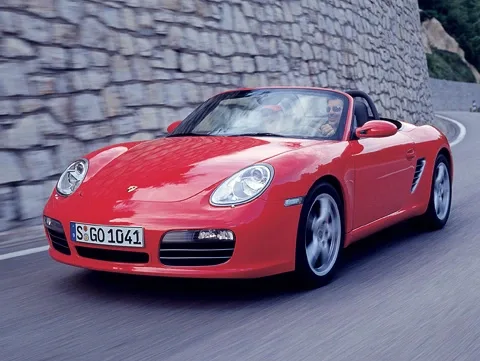
The second-generation Boxster (index 987) was shown in 2004 in Paris. It differed from its predecessor primarily in its round headlights in the style of the 997 model. The engines were updated again: the base produced 240 hp, the top one 280. Two years later, output increased further — by 5 and 15 hp, respectively. And in 2005, the Cayman coupe was built on the 987 platform.
Behind the scenes
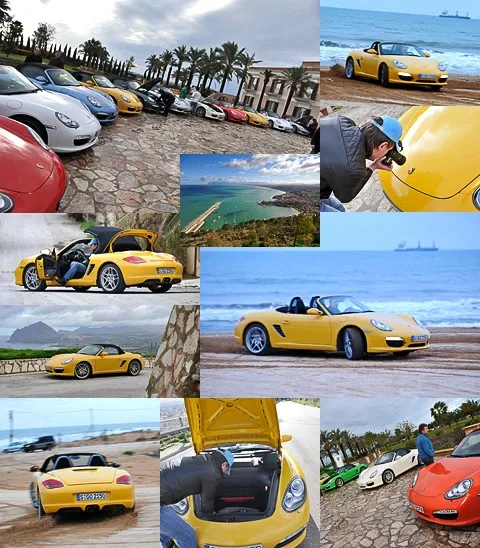
We arrived in Sicily directly from Stuttgart, where the Porsche Museum opening was taking place. The Boxster in the famous Gulf livery — exactly the paint scheme in which the 908/3 set a record on the Targa Florio track — blue, with an asymmetric orange arrow on the hood and black wheels, was waiting at the hotel. But, to my regret, it was assigned to the Chinese group of journalists. I got the yellow one.