The engines have been noticeably reworked: now they feature a DFI badge, and fuel is injected directly into the cylinders. Output has increased — the base Carrera delivers 345 hp instead of the previous 325, and the Carrera S has raised the bar to 385 hp (previously 355). The brakes are more responsive, the suspension has been recalibrated, the seats now have ventilation, and the navigation is new. All-wheel drive, meanwhile, is unabashedly borrowed from the Turbo version.
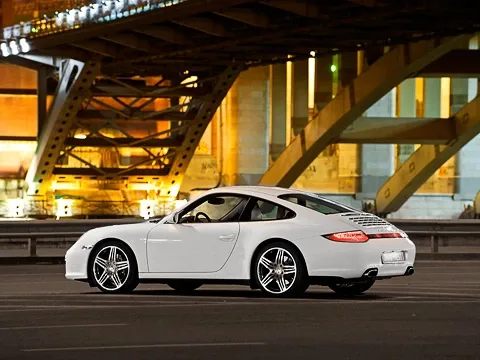
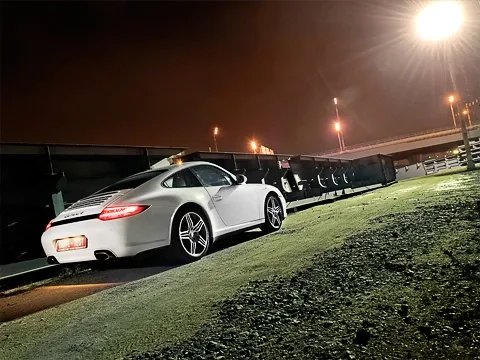
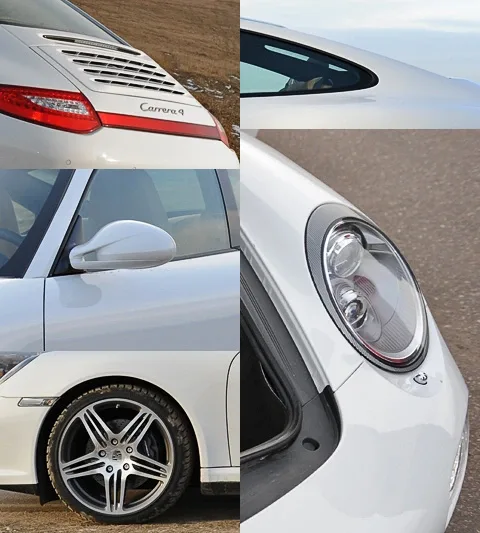
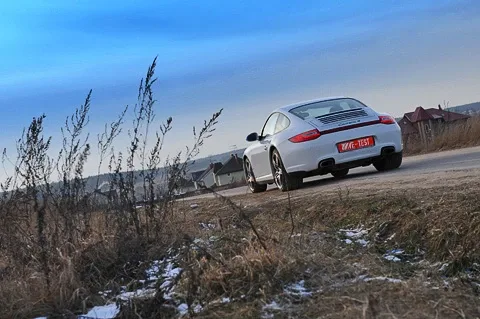
Identifying the all-wheel-drive version of the 911 is now easy — by the red stripe between the rear lights.
And here's the main thing. While you're trying to pronounce "Porsche-Doppelkupplungsgetriebe," the 911 will have time to cool the seats, reach top speed, and meet a pole. Porsche-pudelklungusgertrude? This option costs 160 thousand rubles, and it means that the test 911 Carrera 4 is equipped with a new seven-speed ZF gearbox with two wet clutches of different diameters. This unit replaced the "automatic" that Porsche previously ordered from Mercedes.
Inside — complete order and sanity. You look through the windshield at the smooth curves of the front fenders — and you realize you're sitting in a true sports car. But you're not glued to the asphalt, and the seating position doesn't turn into a circus act. Visibility is excellent, as is everything else. The interior is entirely upholstered in leather — it's even on the bridges between the air vents. Everything you need is there. The only ergonomic complaint is that the brake pedal protrudes too much: you can't quickly move your foot from the gas. You want only one thing — to lose a couple of kilograms: you spread the side support bolsters with electric adjustments to the maximum, but it's still a bit cramped. The rear seats are a torture chamber: you can sit there only with great desire and for a short time. But it's convenient for storing things if the front trunk isn't enough (and it probably won't be).
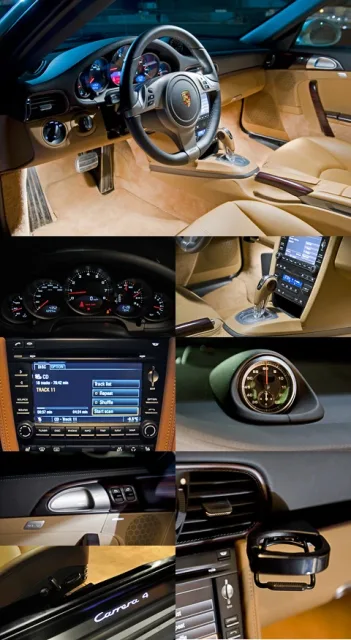
Inside — all leather and wood (though I'd prefer metal to the latter). The steering wheel is very good, but the gearshift paddles on it are inconvenient. The new navigation system has a clear interface and nice graphics, though we've seen better.
But there's enough performance for anyone. Even the most "modest" Carrera 4 with the "kakeyotamgetribe" accelerates impressively: 4.8 seconds to 100 km/h — two-tenths faster than with the "manual." And there are also S, Turbo, GT3, and GT2! But the most interesting thing is how the gearbox reads the driver's mind.
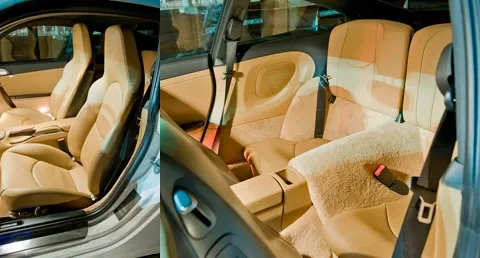
The front seats have a full set of electric adjustments: even the side support is adjustable. In the back, of course, it's very cramped, but with great desire, you can even fit an adult there.
I crawl in a traffic jam like a lazy vegetable in evening traffic, and the car understands — it's better not to touch me. Shifts should be smooth and imperceptible. But (suddenly!) the road clears, and I floor the gas. The gearbox thinks for a second, then seems to say, "Okay, you asked for it." And now the 911, roaring its engine, presses me into the narrow seat with every press of the gas. But as soon as you release the pedal — the Porsche retracts its claws. We drive calmly again, as if nothing happened. Fantastic mutual understanding!
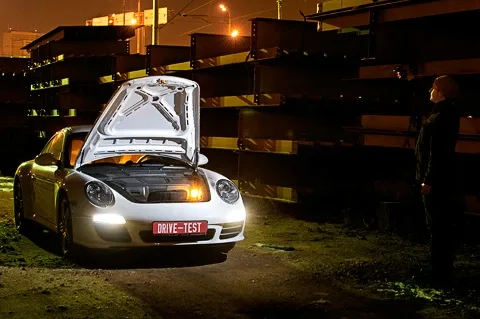
Trunk volume is 105 liters. Not much? We managed to fit all our photo equipment, tripods, and lights in there!
This is the standard Drive mode. There are two more, which are included in the optional Sport Chrono Plus package. They are called Sport and Sport Plus. But I would call them Psycho and Psycho Plus. In the first, you already have to sweat to drive calmly. And in the second, if you're not on a race track, you're a pole hunter. Throttle responses sharpen like mental disorders in spring, shifts are like boxer's punches, and the stability system allows the car to slide freely. When braking, there are aggressive downshift rev-matches. If you're a staunch follower of Don Quixote, but prefer poles to windmills — this mode is for you.
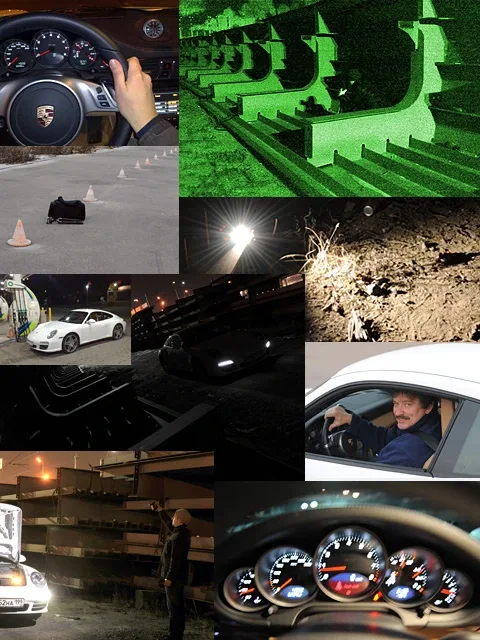
Understanding the 911 is easy: in each mode, it gives exactly what you expect. But making friends with it is much harder. Yes, in normal mode with stability control on, it's a "get in and drive" car. But is that interesting? Let's go to our acquaintance, Alexey Kolontay, to figure it out.
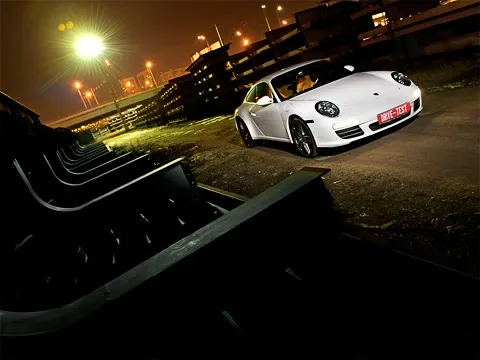
Over 40-plus years, Porsche has perfected the 911 with its specific layout. It no longer tries to kill you for every piloting mistake. But a housewife who decides to try what the button labeled PSM off means will be scared to death. You lift off the gas in a corner — and the Porsche behaves as if the engineers didn't teach the car that it should go nose-first. And it sweeps the road with its tail. And if you don't correct in time — you'll spin like a top.
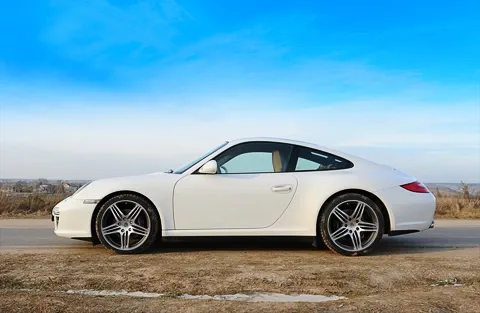
All-wheel drive is barely felt. In most modes, the car is rear-wheel drive. Although the Germans claim that the new multi-plate clutch can transfer up to 100% of torque to the front wheels, and it locks not after rear wheel slip but proactively. Essentially, all-wheel drive only helps during acceleration or in power slides.
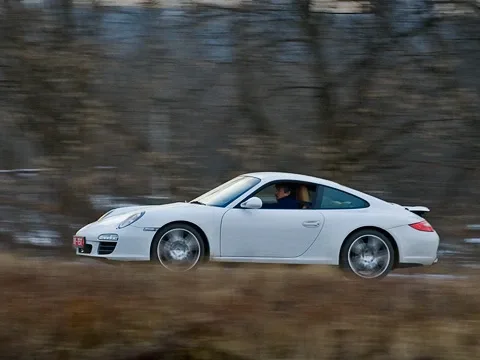
But initiating a drift with the gas on asphalt might not work — there's not enough torque on the rear wheels. Plus, in sport modes, the gearbox is still a bit thoughtful: it responds to gear change commands with a delay, and sometimes it arbitrarily switches from manual to automatic mode. But these are nitpicks.
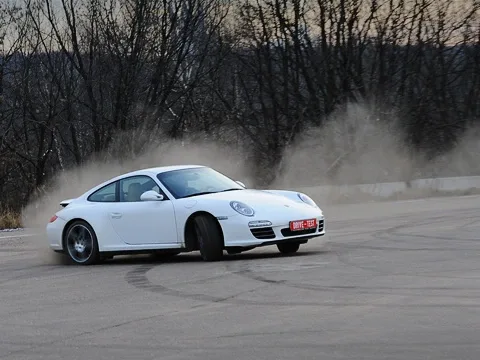
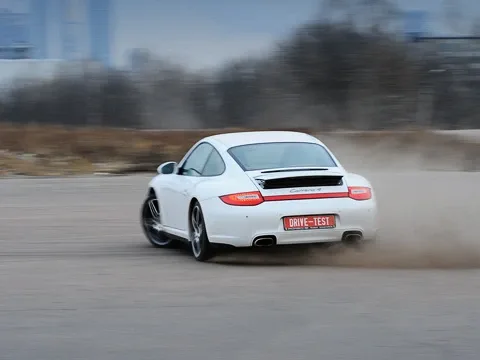
Otherwise — delight! Once you learn to control this mechanism, you understand its versatility. Want to drive on the line, want to slide. And special pleasure is correcting the trajectory with the gas. It's as if you're controlling not the front wheels but the rear ones. If you correctly "place" the rear in a corner, the front wheels will adjust themselves. Full control in any phase of the corner, and complete clarity of reactions!
But what else to expect from a 911? A suspension soft as a bed? Yes! True, if you compare it to a bed, it's only an orthopedic one, which is no softer than stone. And in standard mode, the electronically controlled PASM dampers aren't shy about slapping your rear on every bump, and in the stiffer mode...
Yet the suspension is amazingly energy-intensive — the 911 flies over speed bumps at speed (not forgetting, of course, to slap your rear once more). Moreover, the word "rut" is absent from its vocabulary. On our roads, the Porsche behaves much more confidently than many sedans! Apparently, the time when Ferdinand Porsche worked on tanks wasn't wasted.
The engine of the base Carrera modification is not only 50 "horses" weaker than the S version. It's not equipped with an acoustic resonator on the intake and sounds simpler.
Only one thing bothers me about this character — the noise. Not from the engine. I could listen to it for hours, although, honestly, I expected more. But even at very calm driving, talking to a passenger at speed is problematic. I have nothing else to complain about.
All the improvements made to the 911, in a good way, haven't changed anything. Yes, it's more powerful, faster, and more comfortable, and the "doppelkupplungsgetriebe" (I managed to pronounce that word!) is damn good — even I, a fan of the "manual," would most likely choose this gearbox. The concentration of nuances in it has reached a record level. But its multifaceted character, whose new sides you discover every day, remains. Exactly every day — the car is perfect for that!
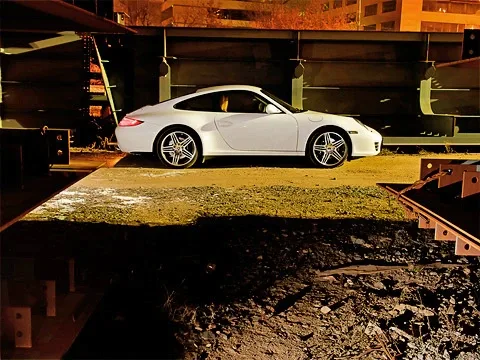
Yes, the 911 is a dream. And it's not about it costing five million. Not about speed, not about lateral G-forces — for that money, there are faster cars. To appreciate this car, you need to grow into it yourself, learn to savor all the nuances of handling that make up the whole thrill of driving. This mechanism is alive, and understanding it gives you incomparable pleasure. And pleasure is the most important thing in a dream car, isn't it?
Lyrical stupor (Anton Bolotov) 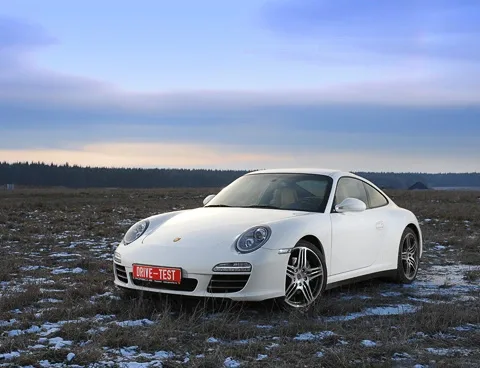
I have my own scores to settle with German engineers. Many years ago, when we moved into our first rented apartment and got a washing machine, I experienced a real shock. That childhood nightmare called Laundry Day was etched into my memory forever. That terrible 'Siberia' machine required first half a day of boiling water, then washing several batches of laundry in it — from white to black, then manually rinsing things in a bathtub of ice-cold water, and finally, rinsing the machine myself and draining the water from it. And the finale was for the strong of spirit: the heavy beast had to be lifted off the floor to drain the remaining water into a special triangular 'tray' that came with the kit... Years later, I sat and watched through the round 'porthole' as smart technology calmly ground up my childhood memories, and tears welled up in my eyes.
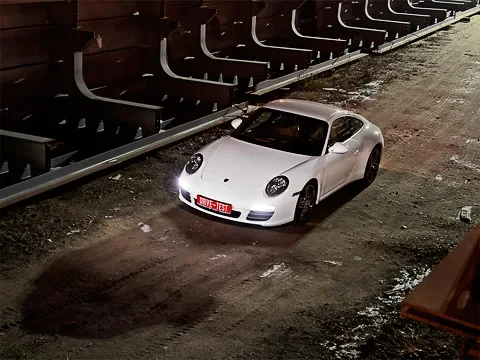
But for God's sake, don't think I'm putting the Porsche 911 in the same league as a washing machine. These are absolutely incomparable things. It's clear that a washing machine is a much more necessary and practical appliance. But somehow, after driving a couple of hundred kilometers in the Carrera, I'm again sitting and looking at the round headlights of a car as white as that washing machine, and again thinking about engineers. About those guys fanatically devoted to their craft, who brought the simple rotation of wheels to a state where perfection, the pinnacle, and absurdity merge into one.
| Specifications | Porsche 911 Carrera 4 |
|---|---|
| Body | |
| Number of doors/seats | 2/2+2 |
| Length, mm | 4435 |
| Width, mm | 1852 |
| Height, mm | 1310 |
| Wheelbase, mm | 2350 |
| Track front/rear, mm | 1488/1548 |
| Curb weight, kg | 1470 |
| Gross weight, kg | 1870 |
| Trunk volume, l | 105 |
| Engine | |
| Type | petrol, with direct injection |
| Location | rear, longitudinal |
| Number and arrangement of cylinders | 6, flat |
| Number of valves | 24 |
| Displacement, cm3 | 3614 |
| Max power, hp/rpm | 345/6500 |
| Max torque, N•m/rpm | 390/4400 |
| Transmission | |
| Gearbox | robotic with dual clutch, seven-speed |
| Drive | all-wheel drive |
| Chassis | |
| Front suspension | independent, spring, McPherson |
| Rear suspension | independent, spring, multi-link |
| Front brakes | disc, ventilated |
| Rear brakes | disc, ventilated |
| Ground clearance, mm | 116 |
| Performance characteristics | |
| Maximum speed, km/h | 282 |
| Acceleration time 0—100 km/h, s | 4.8 |
| Fuel consumption, l/100 km | |
| — urban cycle | 15.2 |
| — suburban cycle | 7.1 |
| — combined cycle | 10.1 |
| Toxicity standard | Euro-5 |
| Fuel tank capacity, l | 67 |
| Fuel | AI-98 |
- Front airbags
- Side airbags and inflatable 'curtains'
- ABS
- Dynamic stability system
- Immobilizer
- Rear-view mirrors with electric drive and heating
- On-board computer
- Xenon headlights
- Steering column with tilt and reach adjustment
- Climate control
- PDK gearbox
- Sport Chrono Plus package
- Electronically controlled shock absorbers
- Multifunctional steering wheel
- Leather and wood interior trim
- Leather headliner
- Seats with electric adjustments and memory
- Seat heating
- Rear parking sensors
- Alloy wheels R19, Turbo model
- Bose audio system with 13 speakers
- Auto-dimming rear-view mirrors
- Navigation system
- Built-in phone
Price of tested car — 5,229,620 RUB Technology
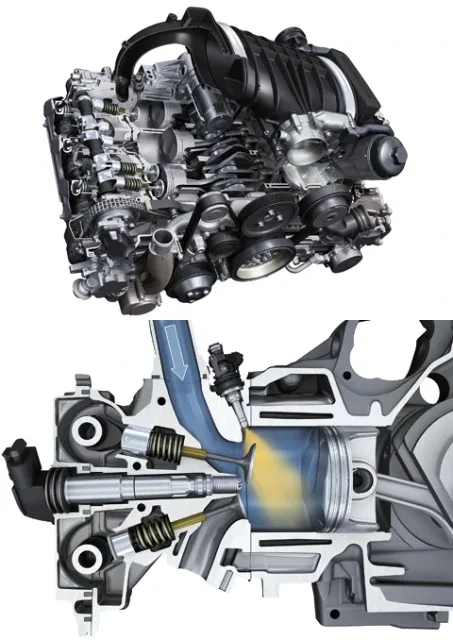
New naturally aspirated engines — with direct injection. They are lighter, with a shorter piston stroke, and the rev limiter is now at 7700 rpm. In addition, environmental friendliness has been improved: fuel consumption has decreased by 12%, and CO2 emissions by 15.
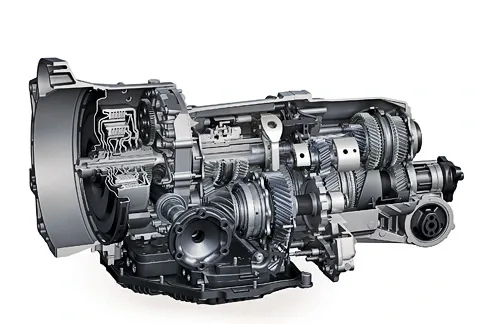
The PDK gearbox was developed by Porsche specialists in close cooperation with ZF. As on Audi cars with a longitudinal engine layout (Q5, S4 models) equipped with a similar S tronic gearbox, the clutches are of different sizes: the larger one is responsible for odd gears, and the smaller one for even gears. It's logical: the heaviest loads on the clutch occur precisely on first gear at the moment of start. By the way, the PDK gearbox turned out to be even lighter than the classic 'automatic'.
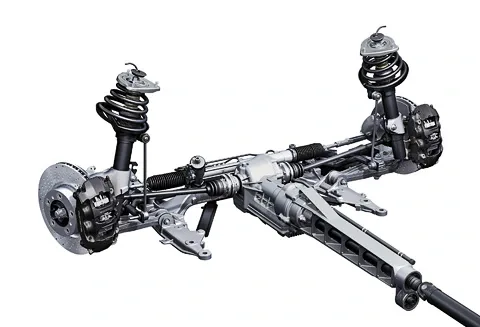
Torque is sent to the front axle by a multi-disc clutch with electronic control. The response time is only 100 milliseconds, and up to 100% of the torque can be sent to the front wheels. But mostly the Porsche remains rear-wheel drive. And very understandable to drive.