
What's the point?
This question arose by itself when at a speed of 80 km/h in a Porsche 911 Targa with the sunroof open it became noisy. Not windy — just noisy.
Why do you need a Targa if there is a Porsche 911 Carrera Cabriolet? The answer is obvious, and I know it. It's enough to step twenty paces away from the Porsche and look back.
Wow... Beautiful!
Once, when Porsches were not officially sold in Russia, I read reports from Porsche presentations in foreign car magazines with bewilderment. Why cover the appearance of each new modification of the "nine-eleven" in such detail? And why should an ordinary person, who dreams of saving up for a used Golf and is eating the last bread without salt, know about the nuances of behavior of different Porsche 911s?
 But now we at Autoreview are doing the same thing. Look: first — the "just" 911 Carrera/S (see AR No. 12, 2004), then the cabriolet (see AR No. 4, 2005), then the all-wheel-drive 911 Carrera 4/4S (see AR No. 12, 2005), the "track" version 911 GT3 (see AR No. 9, 2006) and the flagship powerful 911 Turbo (see AR No. 11, 2006)... And now — the 911 Targa.
The lavishly spread fan of Porsche presentations is a sign. It is a symbol. It is evidence that you and I live in a civilized country. Or rather, in a country implicitly ranked among the civilized along with China — for its prospects and rapid market growth. People from Porsche hope that in Russia there should be a sufficient number of gourmet buyers and connoisseur clients who, when choosing a Porsche 911 version, will take into account the opinions of journalists they know.
Meanwhile, everyone perfectly understands that 95% of all Porsches sold in Russia are Cayenne SUVs. And the problem of choosing these cars often comes down to one thing: finding a color to match a favorite handbag. Or a favorite nail polish.
But Porsche does not make a tragedy out of this. The Germans admit: yes, the Cayenne is a compromise product. But it allows them to earn good money for the future of "real" cars — such as the Porsche 911. And the string of 911 presentations is just a reminder: this is what the Porsche company exists for in the world. For the "nine-eleven"!
 |  |  |
| Porsche 911 with an "automatic" is not for connoisseurs. You cannot shift gears manually with the lever... | ...and the buttons on the steering wheel spokes are extremely inconvenient | The sharp angle of the window line and the wide chrome molding are a privilege of the Targa version |
True, the Targa in the Porsche 911 lineup stands apart. Closer to the Cayennes with ladies at the wheel.
Once, in the 60s and 70s, the Porsche 911 Targa with a powerful protective roll bar above the occupants' heads and a removable roof panel was a "safe" alternative to regular convertibles — so successful that the name "targa" became a common noun. Take the Chevrolet Corvette and Camaro, Datsun 280ZX, Fiat X1/9, many Ferrari models — they were all targas. But by the end of the 70s, the anti-convertible hysteria in the US subsided, and today's real targas can be counted on the fingers of one hand — for example, the Lotus Elise or Lamborghini Murcielago Roadster. And in the Porsche 911 model lineup, a real Cabriolet has been present since 1982.
Why then do you need a targa?
And there isn't one. The word exists, but the targa — does not!
For ten years now, the Porsche 911 Targa has not been a targa. Starting with the 993 series car of 1996, under this name an ordinary coupe is produced — just with a large sliding glass sunroof instead of an all-metal roof. This type of body could be called a cabrio-coupe — by analogy with the ancient cabrio-sedans. Remember, there were such Moskvich-401 and Pobeda cars, where the roof was fabric, but the sides were ordinary?
The new Targa of the current 997 series is exactly the same as its predecessors of the 993 and 996 series. The steel roof sides are retained from the coupe (inside which steel tubes are laid for reinforcement), and the "core" is filled with a glass structure from CTS, Car Top Systems. It is attached to the body with 16 bolts — a steel frame and two panes of glass. One of the panes is a sliding roof section that, with the help of an electric drive, slides down and back along aluminum guides. And the second pane is the rear one, and it opens upward like the tailgate of hatchbacks.
The point?
The advertising slogan of the Targa on the American market is Skydriving. Heavenly driving. You drive — and above you, slightly darkened by tinted triplex, the bottomless Sky looms. Want more Sky? You press the button between the seats — and the sunroof slides back, diving under the rear glass. Don't want more Sky? You close the sunroof and pull the black curtain over it. It turns out almost an ordinary coupe.
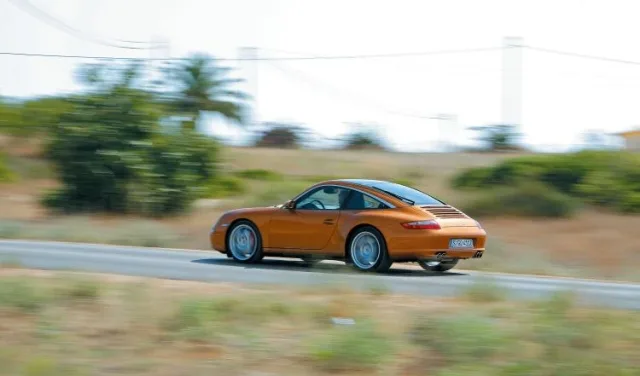
On the move, the Targa is magnificent — like any Porsche 911. But of all versions, the Targa is the "softest" — both in acceleration and in reactions to steering turns, and in slides
Tempting?
And how beautiful...
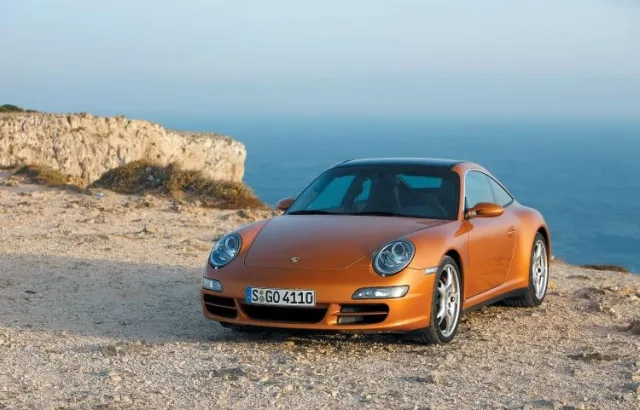
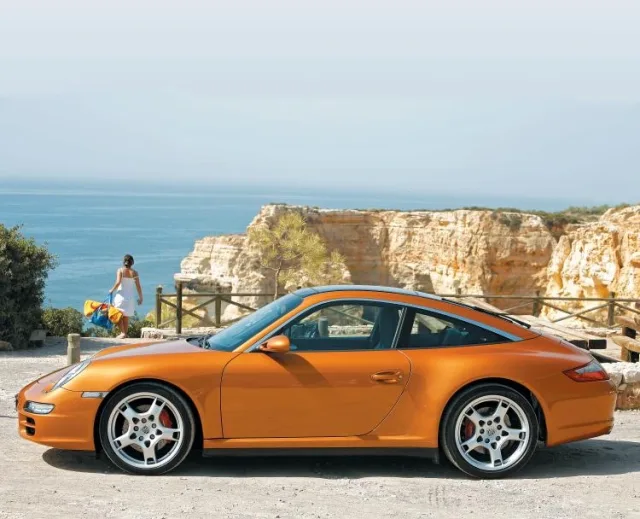
A black roof on a red, white, or yellow Porsche 911 is masterful. Moreover, the differences of the Targa from the regular "nine-elevens" are designed to emphasize the sharp corners of the rear triangular side windows — and the wide chrome moldings of the upper window line. Chrome, perhaps, is superfluous here. But the sharp-angledness is quite appropriate.
Moreover, from now on the Porsche 911 Targa is only all-wheel-drive, in the "wide" body of the Porsche 911 Carrera 4/4S. So the full names of both versions are Porsche 911 Targa 4 (3.6 L, 323 hp) and the more powerful Porsche 911 Targa 4S (3.8 L, 355 hp).
Why all-wheel drive? Firstly, it's simply beautiful — the all-wheel-drive body has wider wheel arches. Look at how they harmonize with the black roof strip!
And secondly, it's safe. You need not fear a slide under power even with the stability system turned off. You fly up to a corner, provocatively sharply lift off the gas while simultaneously turning the steering wheel, the Targa gently goes into a slide, but... A short corrective flick of the steering wheel, full throttle — and in a moment the Porsche grips the asphalt with a death grip, with all four wheels. You can't tear it off!
Actually, the Targa is not about this at all. Not about slides and not about active driving. But about Skydriving — about Heavenly driving. Do you feel the difference?
The fact is that the glass roof on the 997 series Targa, although it has become 1.6 kg lighter, still adds 60 kg to the all-wheel-drive car. What is most unpleasant, all the additional mass is concentrated on top. And for designers of a sports car, this is like a sharp knife — because the center of mass becomes higher, and this significantly worsens handling.
Of course, if the wizards from Porsche themselves take on the matter... For the Targa version, the anti-roll bars are made stiffer to control body roll. And the shock absorbers, on the contrary, are "loosened" — so as not to worsen ride smoothness.
And if the Targa is your first "nine-eleven", then you will experience nothing but delight. Fantastically "transparent" steering: you savor every millimeter of steering wheel deflection. Confident flights along highways, exciting attacks on the apexes of mountain corners. Powerful acceleration — and the all-wheel-drive Porsche 911 4 and 4S differ from each other in traction and engine sound much less than the rear-wheel-drive Carrera and Carrera S. The only remark: I don't understand how you can spoil a masterpiece called the Porsche 911 with the Aisin automatic transmission. Yes, it is well tuned and shifts adequately. But the magical "engine feel" disappears completely! But clicking through the massive lever of the "manual" is no less pleasure than listening to the rock vocals of the six-cylinder "boxer".
But, no matter how you look at it, the Targa yields to all other versions of the "nine-eleven" both in specific power-to-weight ratio (the ratio of power to mass) and in chassis tuning. Slides are smoother and softer, acceleration is not so exciting. All other versions, including the rear-wheel-drive Cabriolet, are even more magical, interesting, and exciting.
Then what makes the Targa better? Only design?
Exactly that. Because with Heavenly driving — there are big problems. You open the sunroof — and the view in the interior rearview mirror disappears completely, obscured by a "sandwich" of tinted glass. Moreover, the kinematics of the sunroof are such that its lower edge also cuts the view in the mirror in half.
 | |
| On the threshold of the Targa — an additional button for opening the rear glass |
The classic Targa of 1967 is a real targa: the rear cover was unzipped, and the vinyl top could be removed. The last truly "targa-shaped" model of the 964 series with a rigid rear glass and a removable roof came off the assembly line from 1989 to 1993. But the Targa of the 993 series (1996—1998) and its successor of the 996 series (2002—2005) with water-cooled engines — that's already a completely different story: in essence, it's a coupe with a large sliding sunroof.
The sunroof and its shade are operated by a button located between the front seats. If the sunroof is closed, the rear window can be raised — this makes it easier to reach the niche behind the seatbacks, which has a volume of 230 liters. The sunroof itself, with an area of 0.45 square meters, does not open upward but downward and backward, sliding under the rear window. True, when doing so, it almost completely blocks the view through the interior mirror.
And what about overhead? Just a sunroof. Moreover, the most expensive in the world — the Targa costs exactly 10,000 euros more than the equivalent all-wheel-drive coupe. Yes, the sunroof is large. But, despite all the tricks of Porsche's aerodynamicists, the air in the open rectangular opening still makes a lot of noise: already from 80 km/h it becomes annoying, and on the autobahn it even interferes with talking to a passenger. The open 911 Cabriolet turns out to be quieter! Not to mention that very "heavenly driving," which in a convertible becomes truly heavenly.
So the only real plus of the Targa is the folding rear window. An indispensable thing for a lady who comes out to her Porsche from a shopping center with bags — they can simply be thrown into the cabin through the glass. But only if the sunroof is closed. When it is open, the electronics block the rear window lock.
In short, the current Targa is a car from the same series as the Cayenne. Glamour, prestige, luxury. Or, as they said in the old days, — chic, shine, beauty.
And now the most important thing: why do the readers of Autoreview need this secret knowledge?
Everyone should know this. Every true lover of real cars. Because the Porsche 911 is an ideal. This shining peak is worth striving for by everyone, regardless of age and current wallet thickness. Even we at Autoreview understood this only recently — when Russia was accepted in absentia into the club of civilized powers, whose journalists track every nuance of the 911 lineup. And we understood this only because before that we had driven almost all other cars, including supercars.
So — dream about the Porsche 911 too. Just not about the Targa! The justification for this purchase can be one thing: if in about 20 years you will be looking for a used all-wheel-drive Porsche 911 and then you come across exactly a Targa 4 or 4S — in surprisingly good condition. You will dig into the Autoreview archive, find this article, sigh... And buy it. Because circumstances in this case are stronger than you.
And in all other cases — either Carrera S, or Carrera 4/4S, not to mention the Turbo. But not the Targa! Especially since in reality it is not a targa at all. Just a name...
Proper name
The Porsche 911 Targa debuted at the Frankfurt Motor Show in 1965 — two years after the appearance of the model 901 (later becoming 911) and almost a year after the start of serial production of the "nine hundred eleventh." From the rigid body, a wide safety arch was left, to which a black vinyl roof section was attached on top, and a soft section with a celluloid window was fastened at the rear. The arch, by the decision of the chief designer, junior Ferry "Butzi" Porsche, was trimmed with stainless steel.
The name Targa reminded of Porsche's numerous victories in the crazy mountain rally Targa Florio in Sicily. In addition, the Italian word targa means a plate, number, or award shield — such an award for the Targa owner was a removable vinyl top that was hidden in the trunk. The "semi-open" body with a developed safety arch allowed killing two birds with one stone: protect the occupants in a rollover and increase body rigidity.
By the way, the first car with a rigid arch behind the seats and a removable roof section was the English two-seater Triumph TR4 of 1961. But it was the Targa that gave the name to this class of cars, and over time the Italian word became a common noun. In the specialized press, this type of body was called targa top or coupe targa.
Serial production of Targas with a two-liter six-cylinder "boxer" engine began in December 1966. In Germany, the Targa was 1,400 German marks more expensive than the coupe. In parallel, the 912 Targa was also sold — with a four-cylinder "boxer" engine of 1.6 liters from the old Porsche 356 model. Interestingly, even then for the Porsche 911/912 such a rare option at that time as the Delanair air conditioner was offered — in the States its installation cost $588, about 10% of the then price of the car. And a Porsche with a coupe body could be ordered with a sliding electric sunroof.
In 1968, again by special order, the Targa began to be equipped with a rigid rear window with electric heating — this option became so popular that the soft cover was quickly abandoned. The two subsequent generations of Targas were the same — the last Targa with a targa body was produced in 1994 in the 964 series. And the Targas of the last three series — 993, 996, and 997 — are coupes with a large sliding glass sunroof.
But the creators of real targas, such as the Lotus Elise or Lamborghini Murcielago Roadster, do not have the legal right to use this term. In the early 90s, Porsche got tired of the word targa being used "anyhow" — for example, Nissan flaunted it in advertising its Z-cars without a twinge of conscience. After several court proceedings, the name Targa was officially assigned to Porsche as a trademark. As they say, what God gave, God took away...