
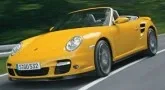
The list of physical pleasures available to wealthy people has been expanded. The Porsche 911 Turbo Cabriolet features a dry-sump lubrication system, two turbochargers with variable turbine geometry, and 98 kW of power extracted from each liter of displacement. You need to get used to this. Especially to the accelerator pedal. Press it very slowly!
Surprisingly, this open-top car perfectly combines racing behavior and suitability for daily city driving. Perhaps the model range update should have started with it, rather than putting it at the very end of the queue? After all, fans are waiting. But no — brand development strategy also requires investment and is just as important for the image as the recognizable silhouette of the 911, which has not changed for decades.
It seems that marketing runs everything, including the automotive industry. Otherwise, how can one explain that the fresh 911 Turbo Cabriolet reaches the first hundred 0.1 seconds faster than its Turbo Coupe sibling? And the open version with the Tiptronic S automatic transmission accelerates to the psychologically important mark of 100 km/h another 0.2 seconds quicker than with the familiar manual. Absurd? Not at all — it's politics. Demand for sports cars is falling, and in the Russian market, the Stuttgart-based company has long been earning mainly from the Cayenne (90% of sales). Even the fastest 911 must be made as accessible as possible to the general public. After all, since the GT supercar was taken off the assembly line (and here marketers managed to spite adrenaline lovers), decent people simply have nothing to drive out in style!
However, now you can breathe a sigh of relief, especially since the 911 Turbo Cabriolet compared to the GT has only one drawback — a price two and a half times lower. But that's not a problem: those who are still saving up for the GT (now only used) will be able to afford also a cabriolet with a turbo engine (just in case), and there will still be money left for a Cayman.
Let's return to the question of dynamics. The Tiptronic S is beyond praise — it shifts gears more accurately, nimbly, and comfortably than the vast majority of drivers on the planet can. Moreover, if you activate sport mode (the Sport button on the center console) and take control into your own hands, this automatic transforms into a real manual, without any concessions. When approaching the red zone (6600 rpm), it does not rush to engage a higher gear, and when releasing the throttle at mid-range revs, the electronics also do not hurry to shift up. Such deliberate engine braking will please even a die-hard manual fan. You can even take your foot off the pedal — the tachometer needle will smoothly drop almost to idle. And no CVTs are needed — the Tiptronic S, a representative of the dying class of classic hydromechanical automatics, can bring pleasure to ordinary drivers, professionals, and even the chief mechanic. I would drive and enjoy, but...
The engineers from Stuttgart managed to spoil their own certification. And not just spoil it, but put a big blot on it.
Strangely enough, the automatic version does not have paddle shifters — apparently, they decided to save weight. Therefore, you can shift gears either with the automatic transmission selector or with one of the two "+/-" buttons located on the steering wheel spokes. But here the driver faces an unpleasant surprise. Not only are these buttons made of cheap plastic that stands out from the impeccable interior finish, but they are also almost impossible to reach, no matter how you hold the steering wheel — at "quarter to three" or with a classic rally grip, when your hands are positioned at a 120° angle to the center of the hub. The "plus" buttons can still be pressed with your thumbs, but the "minus" ones — hardly. Moreover, many drivers will likely find the steering wheel rim too thin. For some reason, there are no characteristic thickenings in the correct grip zones. There are other complaints: the climate control is common for driver and passenger, and the navigation, which is harder to use than regular analog maps. Otherwise, everything is at the usual highest level for the brand.
The driving pleasure of the 911 Turbo Cabriolet grows with speed. And this is despite the deafening noise. True, up to 280 km/h, the standard Bose audio system works perfectly: you can safely turn up the volume — words and phrases are clearly distinguishable even in a foreign German language, with no extraneous noise. Raised door windows and the wind deflector keep turbulent flows out of the cabin. Reading the speedometer is not easy: with divisions in multiples of 50 km/h, it is perceived more as a decorative element than a functional one. However, after the 250 km/h mark, the driver, frankly, has no time for instruments. Closer to 300 km/h, peripheral vision begins to blur, and the car itself turns into a go-kart that shakes, throws from side to side, and bounces on the slightest irregularities. And this is on an ideal German autobahn. At such speeds, it is better to control speed using the onboard computer data, whose display is built into the tachometer dial. By the way, the manufacturer's stated maximum is 310 km/h. Our editor managed to accelerate the Porsche 911 Turbo Cabriolet to 320 km/h, and it could have been faster — the slow Germans were crawling too slowly. This was not a hallucination, because, as it turned out later, a journalist from a friendly publication achieved the same result independently of our employee. When asked about the speedometer error, the technicians assured that both "record holders" were definitely traveling faster than 300 km/h. We hope that in the near future, 13 Russians will be more prudent. The number of Porsches allocated for Russia is, as always, limited.
All in overboost
One can argue for a long time about the pros and cons of the 353-kilowatt engine (480 hp), but you cannot argue with the facts: its specific power is the best among production units today (98.1 kW/l). Just numbers: 98.1 kW per liter of displacement. Skeptics will say: can an engine in which electromagnetic injectors spray fuel into the intake manifolds at a pressure of only 4 bar be considered modern? Shame on you. The presence of such an anachronism only confirms what reserves are hidden in this 6-cylinder boxer engine. Meanwhile, with the accelerator pedal fully depressed at certain revs, the pressure rises by 0.2 bar (standard is 1 bar). The result — torque "jumps" from 620 Nm to 680 Nm.
Driving
On dry surfaces up to 250 km/h, the car behaves almost exemplary.
Interior
Except for the too-thin steering wheel rim, there are no complaints. Ergonomics and build quality are top-notch.
Comfort
At high speeds, engine noise and aerodynamic hum become excessive. And it does not matter whether the roof is up or down.
Safety
The level of active safety and the operation of electronic systems are at the highest level.
Price
Despite the significant price difference between Russia and Europe, the car will sell like hotcakes.
Advantages and disadvantages
+ It is difficult to single out anything separately — the car is excellent in all respects.
- No separate cruise control and no paddle shifters for the automatic. On the manual version, the clutch is long-travel and stiff.
Our opinion
Without a doubt, all 13 units of the 911 Turbo Cabriolet allocated for Russia for the next year will be sold out instantly. Given the fact that, by the manufacturer's strategic decision, the car with the automatic is more spirited and faster than with the manual, one can confidently predict that demand for automatic versions will be higher.