
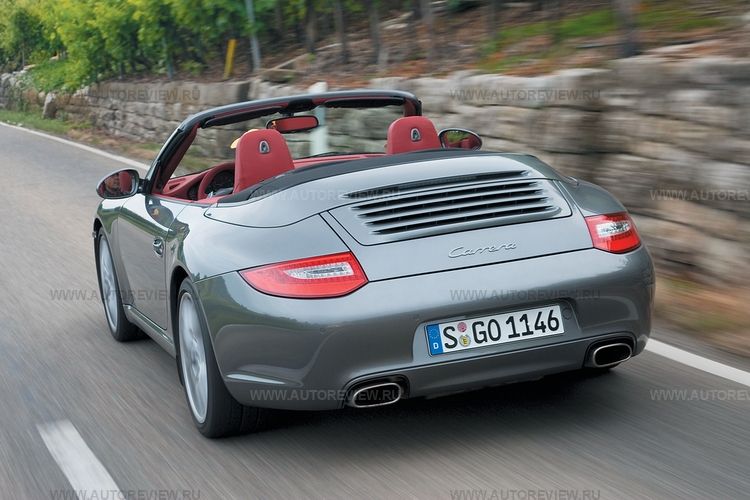
We have long been accustomed to the fact that even a slightly updated car is called "new" by marketers and engineers they have persuaded, and we have already learned to distinguish real changes from PR. However, in the case of the Porsche 911, behind the almost imperceptible external touches (and who would dare to claim that this appearance needs changes at all?) there is so much new "hardware" that it would be enough for a change of index from the current 997 to 998. Fresh engines with direct injection, refined brakes and suspension, front seats with ventilation... But the most important thing is the PDK preselective gearbox with two clutches. Perhaps this is the most radical step since the time when, ten years ago, "air-cooled" engines gave way to liquid-cooled ones.
How is acceleration dynamics usually measured, say, the time to 100 km/h? First gear, throttle pedal to the floor, sharp clutch release, hitting the rev limiter, "impact" shift to second... Try telling this to our expert Ivan Shadrichev! Uncle Vanya will stroke his beard, squint slyly, and, being a delicate person, will answer: "In principle, yes, but..."
Conducting 20-30 measurements monthly, he each time painstakingly, by trial and error, finds the only correct algorithm. At what rpm to start? How to release the clutch - gently or harder? When to engage second? Slightly missed, allowed excessive wheelspin, let the revs "drop" - and the result is not counted. Moreover, the more powerful the car, the more difficult it is to choose the right method. There are also nuances with "automatics".
 |
 |
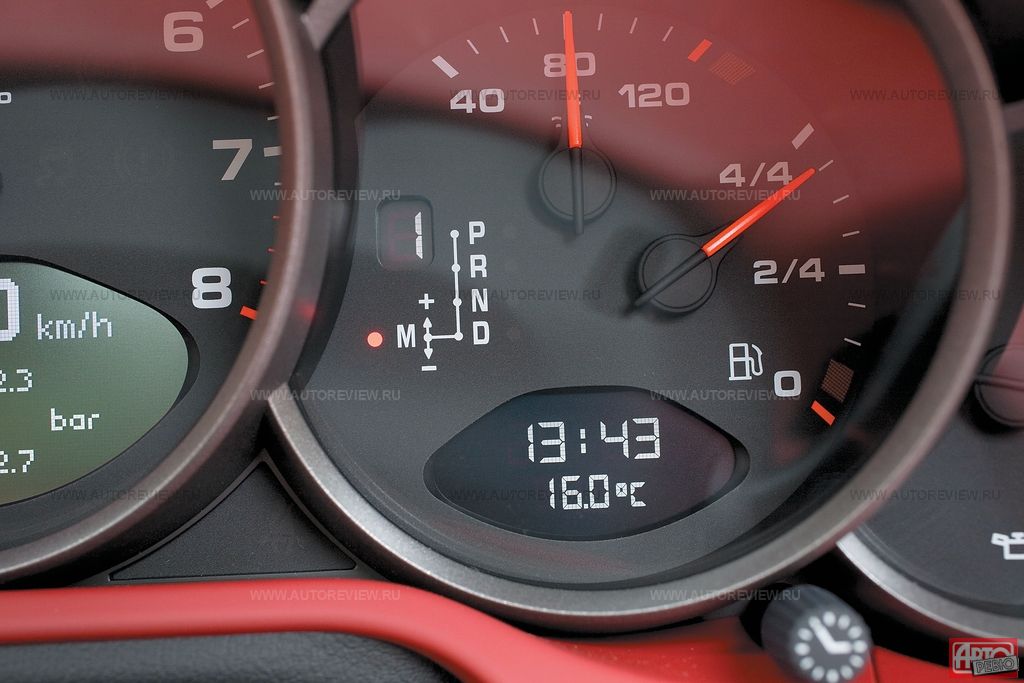
| The gearbox mode indicator has become different - instead of a column of small numbers with LEDs on the display, now just the gear number. As before, the base version is distinguished by black instrument dials, and the Carrera S by white ones |
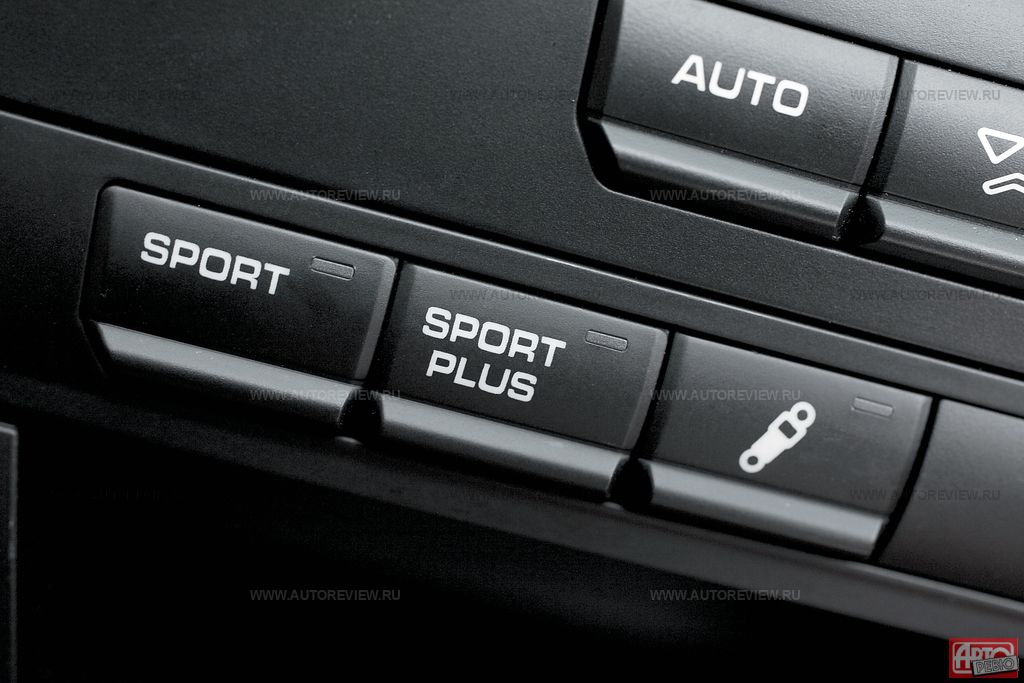
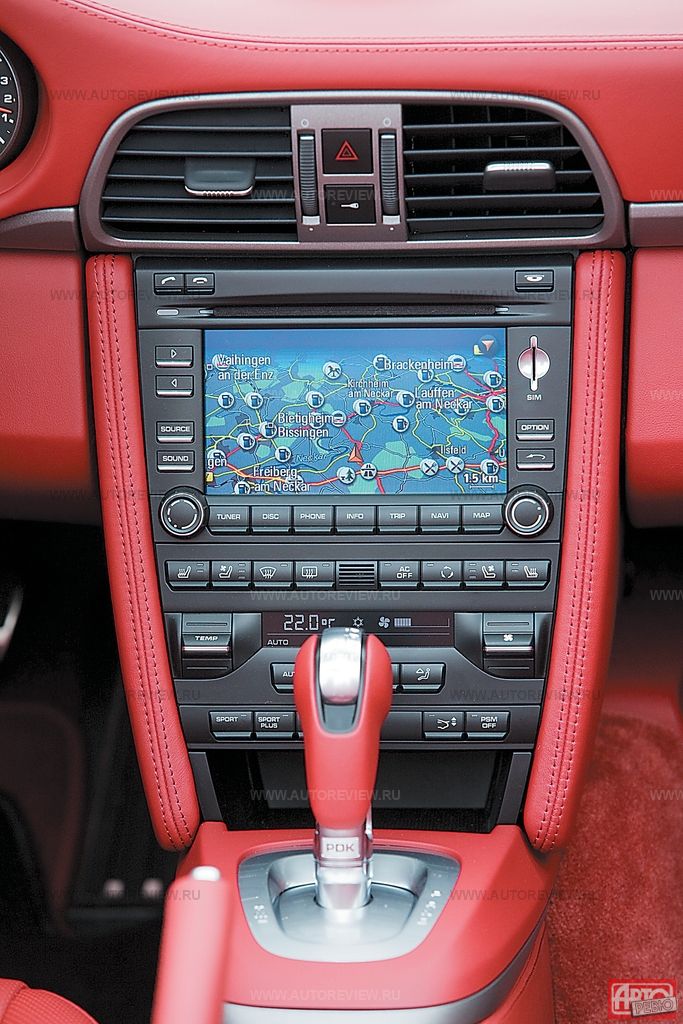
When the Sport Plus button is pressed, the PDK gearbox switches to a racing algorithm - with engine revving to the limiter and hard shifts. Sport mode is a compromise between dynamics and comfort |
 |
 |
| New multimedia system with hard drive, touchscreen (fewer conventional buttons) and iPod connector |
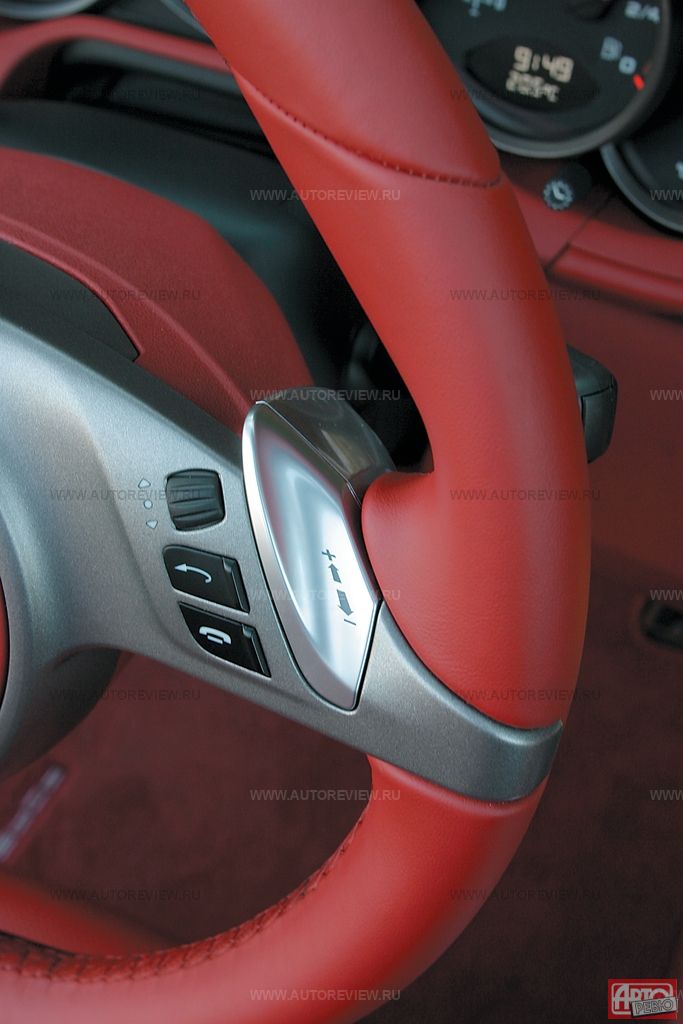
The shift paddles on the steering wheel have become neater, but using them while driving is inconvenient, especially when downshifting, when the paddle has to be pushed away from you with your thumb |
In my hands are the keys to the updated Porsche 911 with the PDK preselective gearbox, and it seems that this time I will be able to meet the standard without Uncle Vanya's help. I press the Sport Plus button on the center console, activating the Launch Control efficient start program, set the gearbox selector to Drive, hold the brake with my left foot, and floor the throttle with my right. When the engine revs up to 6500 rpm and the electronics signal readiness for "takeoff" with a short beep, I release the brake... My mission ends there. Slightly wagging its rear, the Porsche 911 surges forward. After a couple of seconds - a noticeable push in the back: second gear engages. 4.3 seconds after the start, the speedometer shows 100 km/h. That's 0.4 seconds faster than a similar Porsche with a manual gearbox!
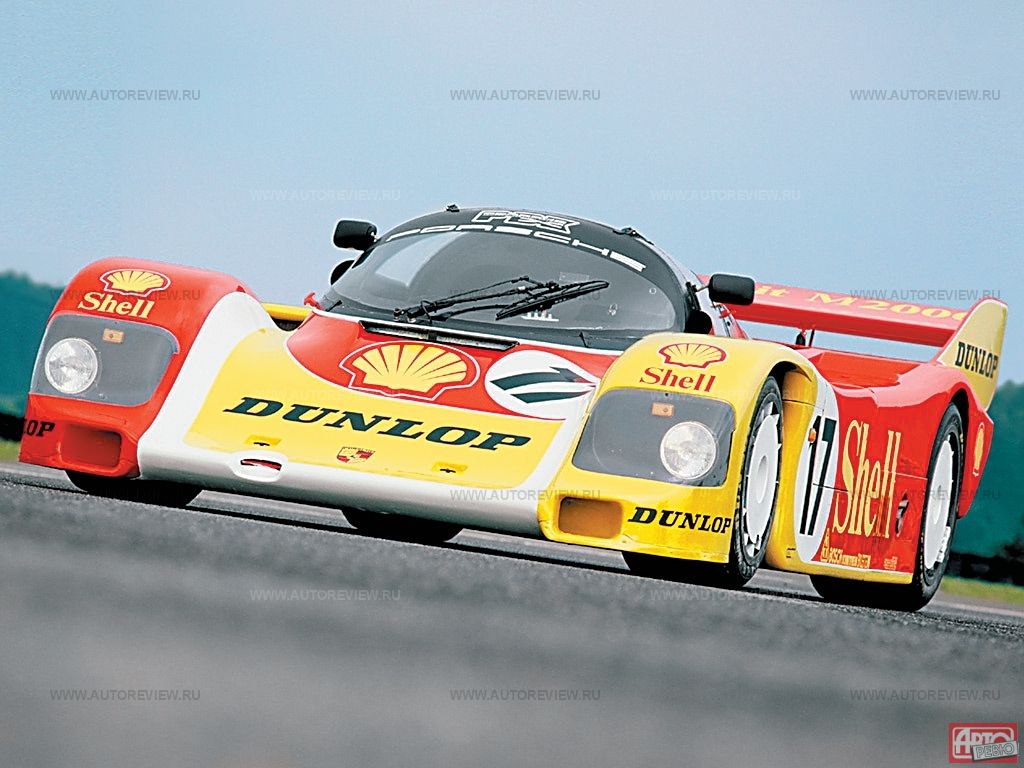
About how much the development and refinement of the new transmission cost, Zuffenhausen is silent, but they happily indulge in memories. Today, few remember that back in the early 80s of the last century, Porsche engineers tested preselective gearboxes on Group C racing cars. The basis was a 1939 patent from ZF, which described a gearbox with two clutches (Doppelkupplung). The first sports prototype Porsche 956 hit the track at the end of 1983. And a year later, such a Doppelkupplung was installed on the famous Porsche 962.
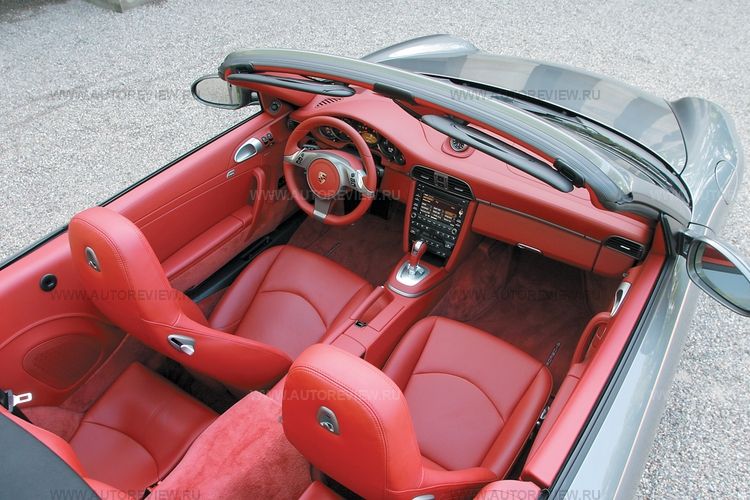
As before, the classic interior can be enlivened with leather of an unusual shade or original panel trim
| Among the innovations are ventilated front seats: air is drawn into the seats through perforated upholstery |
Interestingly, in long endurance races, gearboxes with two clutches were used not at all for a quick start or even to reduce shift times - the drivers coped with that themselves. It was much harder for them to keep the gearbox alive until the finish: for example, during 1000-kilometer races, almost every third retirement was due to transmission failures.
But the athletes themselves were scared of the Doppelkupplung: the gearbox turned out too heavy. The famous Porsche factory team driver Derek Bell recalls: "It seemed like a loaded trailer was attached to the rear of the car!" Nevertheless, in 1984, on a Porsche 962 with the PDK gearbox, they managed to win a race at the Nürburgring, and two years later - a round of the world championship at Monza.
So why, in the late 80s, was the PDK gearbox not brought to production, instead of installing a regular "automatic" on the Porsche 911, albeit with manual shift paddles on the steering wheel? Porsche simply did not have the money for its development, testing, and launch into production. In those years, the company set a course for expanding its model range (as is now clear, this is what saved Porsche), which required huge investments: first came the Porsche 968, then the Boxster, then the saving Cayenne... And only a few years ago, having firmly regained its footing (Porsche is the most profitable company per car produced) and with the support of the related Volkswagen concern, Porsche managers decided to introduce PDK.
The manic desire to give every new component a "proprietary" name already brings a smile. Only people from Porsche seem able to fluently pronounce the name of the gearbox Porsche-Doppelkupplungsgetriebe. However, the gearbox could have received an even more intricate name: Le Changement de Vitesse Hydro-Mecanique Automatique Kegresse. Proud Porsche historians are silent about this, but the fundamental scheme of a manual gearbox with two clutches was proposed more than 70 years ago by the French engineer Adolphe Kégresse - the same Kégresse who served as the personal chauffeur of Nicholas II, installed half-track drives on the tsar's cars, and later worked closely with Citroen. Kégresse proposed installing a gearbox with two clutches and hydromechanical control on the Citroen Traction Avant. But in those years, introducing such a gearbox was completely unrealistic. It turns out that PDK gearboxes, like Volkswagen's DSG, are a development of Monsieur Kégresse's old idea.
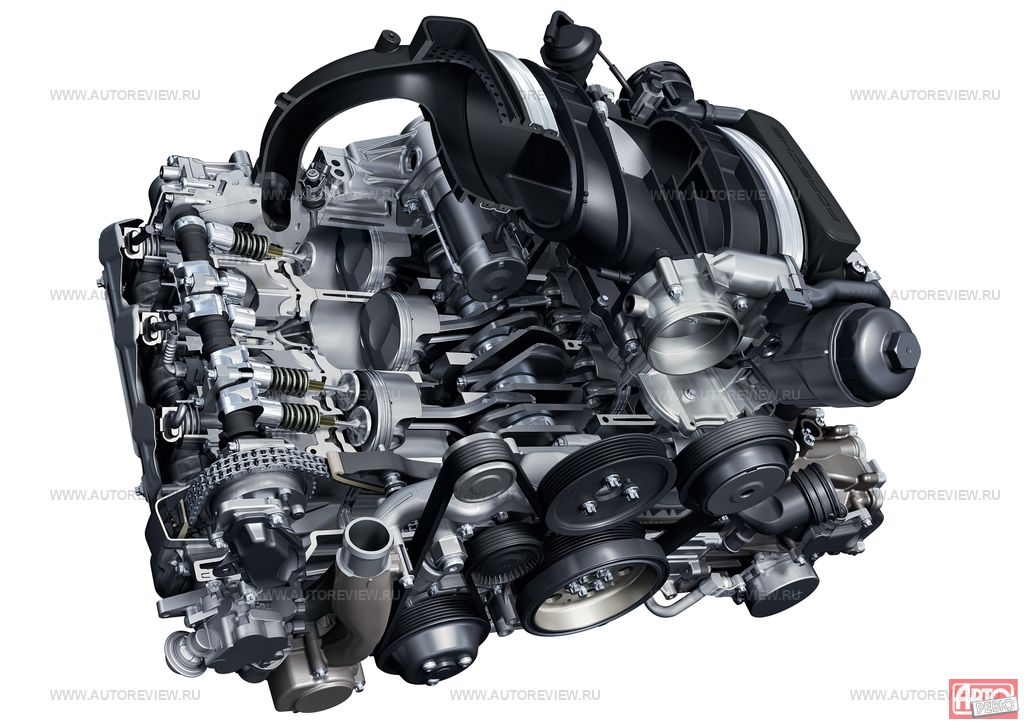
A revolution, albeit on a smaller scale, can also be called the new DFI (Direct Fuel Injection) engines with direct fuel injection (truly strange that they were not given the name PDFI). The flat-six engines with a displacement of 3.6 L and 3.8 L were completely overhauled. Thanks to an increased compression ratio of 12.5:1, reduced friction losses, a new lubrication system, and a more efficient cooling system, power was raised to 345 hp and 385 hp respectively (previously 325 hp and 355 hp). These engines helped shorten the distance that remained between the Porsche 911 and more powerful competitors, while meeting the upcoming Euro-5 standards.
The union of DFI engines and the PDK gearbox is wonderful: CO2 emissions are reduced by 15%, and fuel consumption by 12%. For the first time, the Porsche 911 fits into 10 L/100 km: the coupe with the 3.6 engine consumes 9.8 L/100 km in the average European cycle, and the cabriolet - 9.9 L/100 km.
The gear ratios of the PDK gearbox are almost the same as those of the manual, but a seventh gear has appeared - an "overdrive" for fuel economy at high speeds.
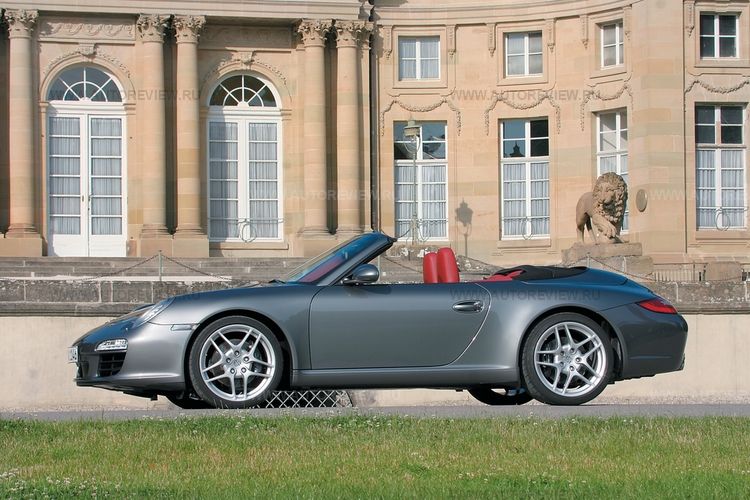
The design of the cabriolet's soft top has not changed, but the material from which it is made is even more wear-resistant than before
Controlling acceleration is a rare pleasure. It all depends on your mood. Lyrical? Please - smooth, albeit with a slight delay, starting off, extremely soft shifts both "up" and "down". Only the transition from first to second is clearly felt. By the way, the hill-holder system helps fight against rolling back when starting on an incline, which is now standard on all cars - including those with manual gearboxes. No doubt Porsche wants to convert more blondes to their faith.
Porsche engineers claim that the new PDK gearbox shifts 60% faster than the previous Tiptronic. So you're driving, say, in seventh gear at a cruising 80-90 km/h, sharply press the throttle - and the gearbox instantly, even without kick-down, jumps to second. Everything happens swiftly, collectedly, but without any hint of a jerk or roughness.
 |
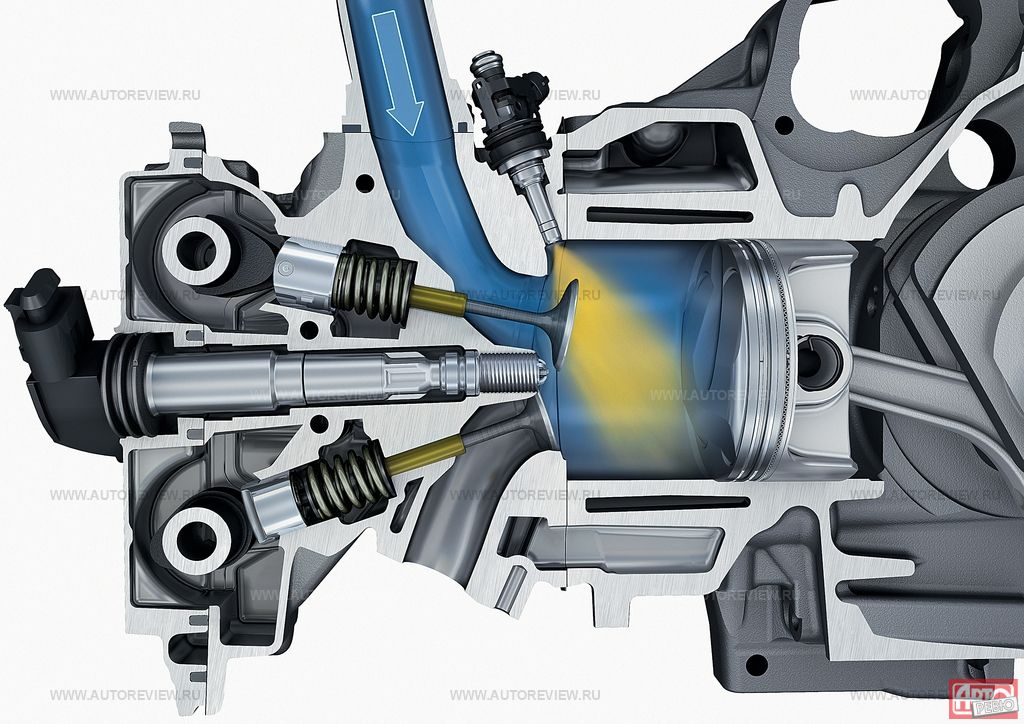 |
| The engines in the Carrera and Carrera S are identical in design, differing only in displacement, electronics calibration, and intake system — the higher-spec version, as before, features an acoustic resonator that enriches the exhaust note. The cylinder block used to be assembled from four parts with a separate bearing carrier, but now it is cast from two halves. As a result, the construction lost 6 kg but became stiffer. Pistons were made larger in diameter, while the stroke was shortened — the engines became noticeably more responsive, and the rev limit increased from 7500 to 7700 rpm. The combustion chambers received a new shape, and the compression ratio was raised to 12.5 — the DFI engines are both more powerful and more economical | The injector sprays fuel from the side of the combustion chamber, with system pressure reaching up to 120 atmospheres. When load is high — for example, when the driver opens the throttle wide at low revs — the injectors deliver fuel in a series of short bursts |
| The oil pump now has variable displacement: hydraulics shift one of the gears along its axis to regulate delivery volume. Electronics calculate the required oil amount, accounting for longitudinal and lateral g-forces, which reduces losses from driving the pump. Four additional sections handle scavenging oil from the cylinder heads and the dry sump | Air in the new engines passes not through a flat filter as before, but through a pair of round ones. Breathing became easier, and the filter replacement interval increased from 60 to 90 thousand kilometers |
And what if you want some extreme? The test cars were equipped with the optional Sport Chrono Plus package (for 50,611 rubles), which stiffens the gearbox operation in two modes: Sport and Sport Plus. Sport Plus is truly harsh. Gears engage with a jolt and much faster: in the sprint to 100 km/h, the Carrera S beats itself by 0.2 seconds. Downshifts now occur with much less throttle pedal travel — even kick-down is not needed. And if you lift off the gas, the gearbox does not rush to shift up, holding the engine at high revs in anticipation of the next surge.
The Launch Control function from the Chrono Plus package works excellently — especially in combination with the self-locking differential (for which they ask 52,261 rubles), which does a good job of quelling tail slides during starts on uneven surfaces. There are no jerks in the steering or shocks in the drivetrain, as on some "robots." Only the tachometer needle dances wildly across the scale. And this system works equally confidently on the 345-horsepower version and on the 385-horsepower "S."
 |
|
| The Porsche 962 prototype won several races. But its dual-clutch gearbox (right in the photo) proved too heavy for racing and too expensive and finicky for production | |
However, Launch Control is nothing new: a similar feature exists, for example, on the BMW M6. But there you cannot really let loose — the electronics allow a third or even second "launch" only after a long pause for transmission cooling. On the Porsche, you can hammer away in the harshest mode (accelerate to second gear and stop) seven times in a row! And how many such starts can the PDK withstand?
— Honestly, I don't know, — admits Jan Peter Hoffmeister, one of the gearbox's creators. — But on one of the cars we did about seven hundred launch starts, then disassembled the gearbox — and everything was in order.
The brakes were also refined: the rear calipers were borrowed from the Porsche 911 Turbo, the discs were increased in diameter, and the cooling air ducts were widened. Plus, a brake preparation mode for emergency braking appeared, like on BMW: upon sudden throttle release, the pads automatically move closer to the discs, reducing response time. However, the difference can only be felt in hard driving on a track or mountain serpentine, and even then only in comparison with the pre-facelift car. For now, it is clear that the brake reserve is sufficient even during repeated intense decelerations from high speed, and the pedal feel remains clear and predictable.
In fact, this is where the main magic of the Porsche 911 lies. From the first minutes, you find a common language with the car, and only engineers with gasoline in their veins can achieve this. It was the same before, but now, with the advent of PDK... Every serious automaker should buy themselves a Carrera to understand what to strive for.
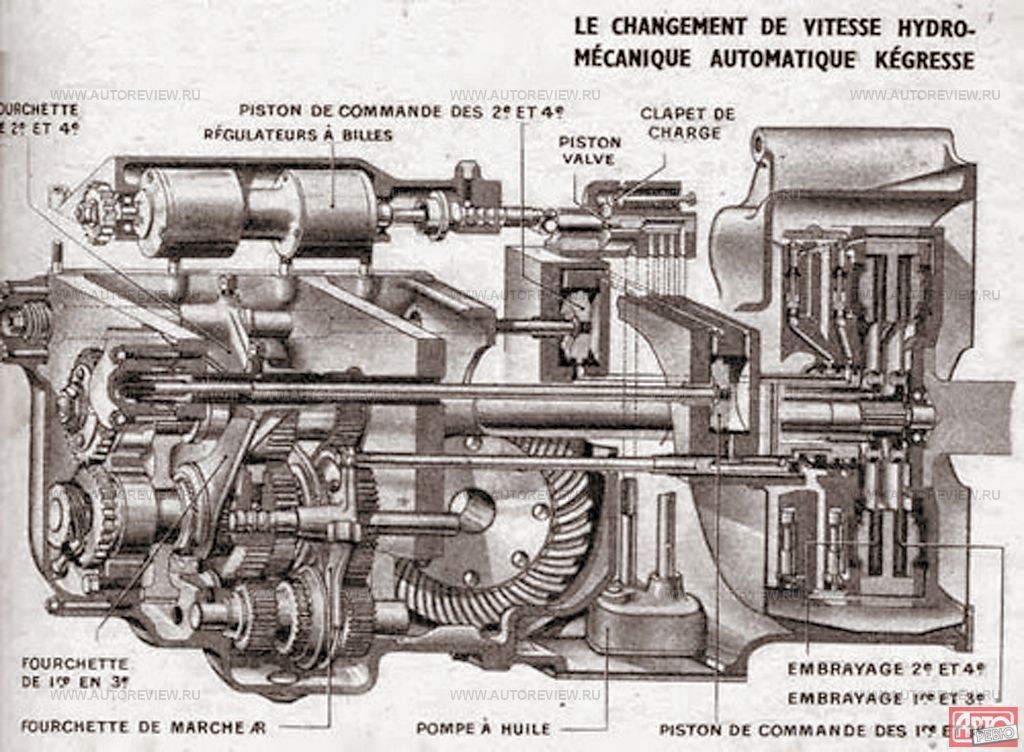 |
Back in 1935, Adolphe Kégresse proposed installing a four-speed dual-clutch gearbox on the front-wheel-drive Citroen Traction Avant (the driven gear of the final drive is clearly visible in the diagram). But it never went beyond experiments. In the pre-war years, Professor Rudolf Franke from Darmstadt also worked on a preselector gearbox and filed a patent application. And in 1969, Porsche engineer Imre Szodfridt took up the Doppelkupplung with the support of the then technical director Ferdinand Piëch. Nothing worthwhile came of the bold idea, and they returned to it only in the mid-80s |
What I did not like, however, were the manual shift buttons on the steering wheel — they are unfortunate both in shape and placement on the spokes, just like on the pre-facelift cars. Upshifting by pressing the back side of the paddle is tolerable, but downshifting is a problem: you have to reach, shifting your hand around the rim. Accidental presses during active steering rotation are also possible. The algorithm of the main selector on the tunnel also disappointed — it is reverse to racing: push the lever away from you to upshift, pull it toward you to downshift. At Porsche, they say that owners with Tiptronic are already used to this scheme... But should they cater to those who chose a "smearing" automatic instead of an honest manual? Apparently, yes.
The Porsche 911 is gradually turning into a mass-market product: of the more than 130 thousand cars sold of the current generation (997 series), about 40% went to customers with "automatics." And in Russia, the share of "manual" coupes and convertibles is even less than 1%!
With the advent of the excellent PDK gearbox, the last contingent of staunch adherents of the "Porsche spirit," for whom the stick shift was its embodiment, may melt away. But now this is understandable. I also drove cars with a regular gearbox, worked my left leg with a heavy clutch, but after returning to a car with PDK and crawling through suburban traffic jams, I decided I would choose PDK.
By the way, PDK will soon appear on the Porsche 911 Turbo, and preselector gearboxes will also equip the Cayenne and the "five-door sedan" Panamera, although those will have different layouts. Which ones exactly? We will find out soon: the Panamera hits the market next year.
And for those who hold on to the "manual" until the last, I would advise waiting for our Russian test. Something tells me: with the "stick," Ivan Ivanovich will squeeze out a respectable hundred faster than with PDK. Even earlier, on a Porsche 911 with a regular gearbox, he managed almost the impossible — beating the factory figures. True, he himself explains this not by the subtleties of launch and acceleration, but by Porsche's approach: they work honestly, he says, and few such remain today. By the way, the manual gearbox on the Porsche 911 remains unchanged.
| Passport data | ||||
| Parameters | Vehicle | |||
| Porsche 911 | Porsche 911 | Porsche 911 | Porsche 911 | |
| Modification | Carrera | Carrera S | Carrera 4 | Carrera 4S |
| Body type | coupe (cabriolet)* | |||
| Number of seats | 4 | 4 | 4 | 4 |
| Dimensions, mm | ||||
| length | 4435 | 4435 | 4435 | 4435 |
| width | 1808 | 1808 | 1852 | 1852 |
| height | 1310 | 1300 | 1310 | 1300 |
| wheelbase | 2350 | 2350 | 2350 | 2350 |
| track front/rear | 1486/1530 (1486/1534)* | 1486/1516 | 1488/1548 | 1488/1548 |
| Trunk volume, l | 135 | 135 | 105 | 105 |
| Curb weight, kg | 1415 (1500)* | 1425 (1510)* | 1470 (1555)* | 1480 (1565)* |
| Gross weight, kg | 1820 (1880)* | 1830 (1890)* | 1870 (1930)* | 1880 (1940)* |
| Engine | petrol, with direct injection | |||
| Location | rear, longitudinal | rear, longitudinal | rear, longitudinal | rear, longitudinal |
| Number and arrangement of cylinders | 6, opposed | 6, opposed | 6, opposed | 6, opposed |
| Displacement, cm³ | 3614 | 3800 | 3614 | 3800 |
| Cylinder bore/piston stroke, mm | 97.0/81.5 | 102.0/77.5 | 97.0/81.5 | 102.0/77.5 |
| Number of valves | 24 | 24 | 24 | 24 |
| Max power, hp/kW/rpm | 345/254/6500 | 385/283/6500 | 345/254/6500 | 385/283/6500 |
| Max torque, Nm/rpm | 390/4400 | 420/4400 | 390/4400 | 420/4400 |
| Gearbox | manual, 6-speed/preselective, 7-speed | |||
| Drive | rear | rear | all-wheel | all-wheel |
| Front suspension | independent, spring, McPherson type | |||
| Rear suspension | independent, spring, multi-link | |||
| Front brakes/disc size, mm | disc, ventilated/330x28 | disc, ventilated/330x34 | disc, ventilated/330x28 | disc, ventilated/330x34 |
| Rear brakes/disc size, mm | disc, ventilated/330x28 | |||
| Front tires | 235/40 ZR18 | 235/35 ZR19 | 235/40 ZR18 | 235/35 ZR19 |
| Rear tires | 265/40 ZR19 | 295/30 ZR19 | 295/35 ZR18 | 305/30 ZR19 |
| Maximum speed, km/h** | 289/287 | 302/300 | 284/282 | 297/295 |
| Acceleration time** | ||||
| 0–100 km/h, s | 4.9/4.7 (5.1/4.9)* | 4.7/4.5 (4.9/4.7)* | 5.0/4.8 (5.2/5.0)* | 4.7/4.5 (4.9/4.7)* |
| 0–200 km/h, s | 16.6/16.3 (17.5/17.2)* | 15.2/14.8 (16.1/15.7)* | 17.3/17.0 (18.2/17.9)* | 15.7/15.3 (16.6/15.9)* |
| Fuel consumption, l/100 km** | ||||
| urban cycle | 15.5/14.7 (15.6/14.9)* | 15.9/15.3 (16.2/15.5)* | 15.9/15.2 (16.2/15.5)* | 16.5/15.8 (16.8/16.1)* |
| extra-urban cycle | 7.4/7.0 (7.5/7.0)* | 7.6/7.2 (7.7/7.3)* | 7.4/7.1 (7.6/7.2)* | 7.7/7.4 (7.8/7.5)* |
| combined cycle | 10.3/9.8 (10.4/9.9)* | 10.6/10.2 (10.8/10.3)* | 10.6/10.1 (10.8/10.3)* | 11.0/10.5 (11.2/10.7) |
| CO₂ emissions, g/km | 242/230 (245/233)* | 250/240 (254/242)* | 249/237 (254/242)* | 259/247 (263/251)* |
| Fuel tank capacity, l | 64 | 64 | 67 | 67 |
| Fuel | petrol AI-98 | petrol AI-98 | petrol AI-98 | petrol AI-98 |
| * In parentheses — data for cabriolet body | ||||
| ** For versions with manual transmission/with PDK | ||||
Red-striped
We had just shared our impressions of the “preselective” Porsche 911 with colleagues when a fresh invitation arrived — to test the all-wheel-drive versions. It turned out that almost half of all “nine-elevens” produced go to customers in this configuration, so there was no point in delaying the arrival of Carrera 4 and Carrera 4S with PDK gearboxes. In Russia, the share of all-wheel-drive cars reaches almost 80%. Previously, the drive could only be identified by badges or by eye — all-wheel-drive coupes and cabriolets have rear arches wider by 44 mm. Now Carrera 4 and 4S have received a more noticeable distinguishing mark: a red reflective strip appeared between the taillights at the rear, like on all-wheel-drive models of the 90s.
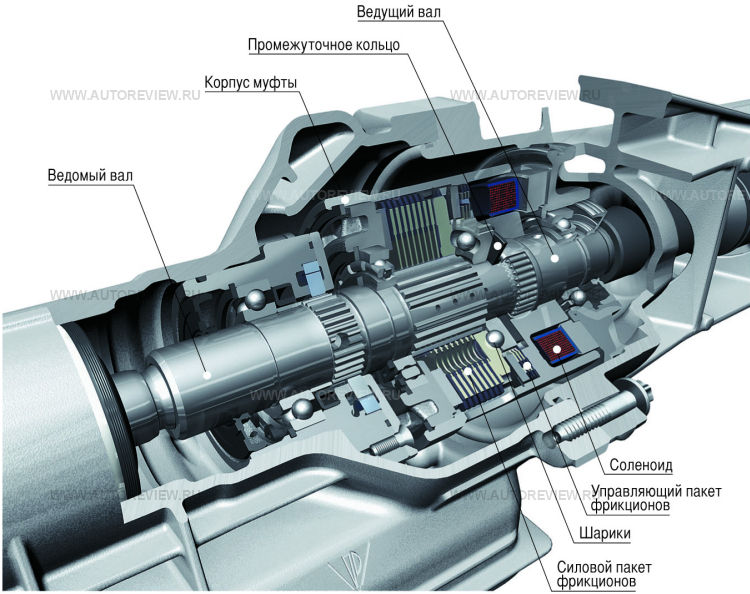
The multi-plate clutch that transfers torque to the front wheels is taken from the Porsche 911 Turbo — only the control unit was recalibrated. Inside the clutch is a solenoid that controls a pack of friction discs, an intermediate ring with variable-depth grooves in which balls lie (this is a mechanical amplifier), and a power friction pack that directs torque to the front axle. When power is applied, the solenoid compresses the discs of the control friction clutches, and they lock. The freely rotating ring slows down, the balls roll along the grooves and shift the pressure plate of the power clutch. The greater the displacement, the less slippage and the more torque goes forward.
Interestingly, the history of all-wheel-drive “nine-elevens” also began with electronics. The first Carrera 4 used a transmission with a multi-plate clutch and electro-hydraulic control — like on the Porsche 959. Under normal conditions, torque was split between the axles in a 31:69 ratio. But in 1994, the system was replaced with a cheaper and simpler viscous coupling, which was due to the company's difficult financial situation.
Now the viscous coupling is a thing of the past. It could send a maximum of 40% of traction to the front wheels, and only after the rear wheels began to slip. The new transmission can lock the clutch in advance, based on an electronic signal, and in extreme cases — send all 100% of the torque to the front axle. PTM also wins in reaction speed: it needs only 100 milliseconds. During a sharp start, the clutch manages to lock even before the engine responds to the gas pedal. As for weight and simplicity, engineers claim that PTM is only three kilograms heavier than the previous viscous coupling, and almost a quarter of this mass (700 grams) comes from the control unit and wiring.
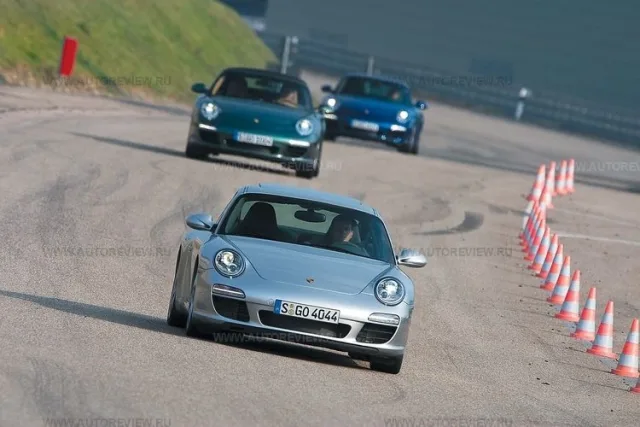
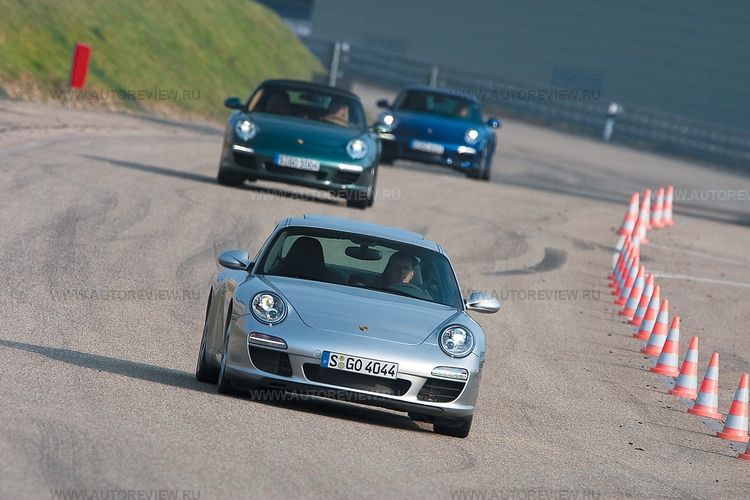
To show what the all-wheel-drive Carrera can do, the Michelin test site near Berlin was rented for the test. Two decades ago, there was a Soviet military airfield on this site — as reminded by abandoned barracks and concrete hangars for fighters at the edges of the airfield.
First, we were put on the "slalom" — weaving around cones on special concrete that becomes almost like ice after being watered. It's clear that at such speeds you can't draw conclusions about the character of such a powerful car, but I learned one important thing: even on an all-wheel-drive car, it's better not to turn off the stability system. The engine hanging at the rear doesn't forgive mistakes — if the car slides deep, it's very hard to catch it. Although it's worth noting that even with PSM enabled, the electronics allow the car to slide quite intensely, but at the same time protect against fatal errors.
Next on the plan — drag racing, or rather, a demonstration of the capabilities of the new PDK gearbox with Launch Control mode.
It's done the same way as Maxim Kadakov already described using the example of rear-wheel-drive versions: you press the Sport Plus button, press both the brake and gas simultaneously, and then, on the command of the onboard computer, simply release the left pedal. On all-wheel drive, this turns out to be even easier. The car starts without a single wheelspin, the rear doesn't wag, and by the end of the straight, the Carrera 4 manages to accelerate to almost 240 km/h!
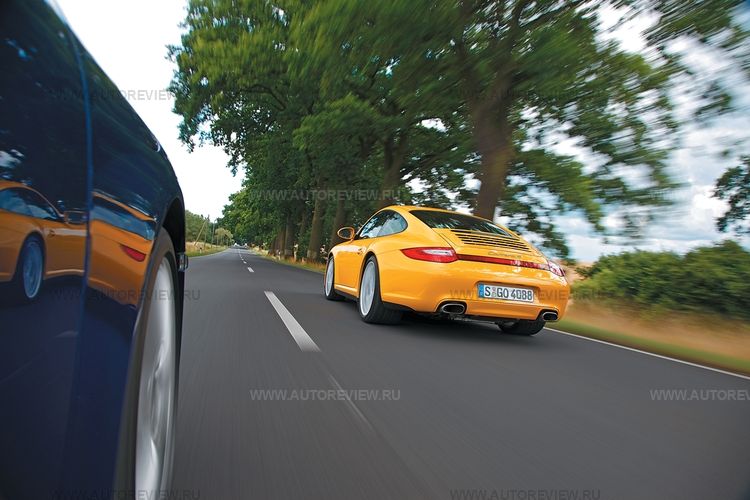
Special respect to the brakes! On a single Carrera 4 coupe with base cast-iron, not ceramic, discs, we ran Launch Control in a circle. Each of us accelerated and then braked "to the floor" from 240 km/h, then quickly swapped with a colleague — and again acceleration, again braking. I deliberately stood at the end of the queue to check if the brakes would start to fade, but I never noticed any signs of overheating!
The final chord was laps around the ring. Yes, we drove behind an instructor and not as fast as we'd like, but the all-wheel-drive Porsche feels like a fish in water on the track, no matter what they say about the car being "civilized" and sacrificing some primordial values for comfort. There's not a trace of that "civility" that many other sports cars show after just one lap. You switch the PDK to Sport Plus mode and forget about the gearbox completely. It revs the engine to the limiter, shifts up, and on braking with rev-matching downshifts, it will friendly hold the right gear while you go through the corner on steady throttle. All-wheel drive makes the 911 fantastically stable in corners. The rear-wheel-drive coupe needs throttle management on corner exit, but the Carrera 4 doesn't try to slide even at full throttle. You can safely clip curbs at apexes — the car doesn't deviate from the line. But you still shouldn't relax: if you suddenly lift off the throttle in a corner, the car easily slides, and instant reaction is needed. This is worth remembering, especially on slippery surfaces.
Sales of the updated rear-wheel-drive cars officially start in September. The Russian premiere of the coupe and cabriolets with "red stripes" is scheduled for October 25. For the rear-wheel-drive Porsche 911 Carrera coupe, they ask from 3 million 888 thousand rubles. The all-wheel-drive Carrera 4 costs 4 million 191 thousand rubles. Versions with the S suffix are on average 510 thousand rubles more expensive than their less powerful siblings. The most expensive of the new 911s is the Carrera 4S cabriolet: 5 million 212 thousand rubles in base trim. And the list of options is headed by the PDK gearbox, for which you'll have to pay an extra 162,284 rubles. Judging by first impressions, it's worth its money.
Catch up and PDK it!
Work on PDK began four years ago, when Audi TTs with DSG gearboxes were already coming off the assembly line by the thousands. The Germans at Volkswagen needed eight years for development, but Porsche managed in four — and it seems they not only caught up but even overtook their colleagues.
PDK actually has two lubrication systems. The "wet" clutches and hydraulics work on special ATF oil, while the bearings and gears are lubricated with regular "transmission" oil. The latter doesn't need to be changed at all, but the friction clutch oil needs changing every 90 thousand kilometers. However, engineers promise that this interval will increase to 180 thousand kilometers this year.
Development was carried out in close cooperation with ZF, which will produce PDK in series. A whole year was spent just on layout: a pair of "wet" clutches and seven gears needed to fit into a housing no larger than the old five-speed automatic. ZF engineers were responsible for the "internals" — component strength, materials, cooling. There was also a task not to make more noise than a regular manual. And in Zuffenhausen, the gearbox was adapted to the engine, other transmission components, and its electronics were written.
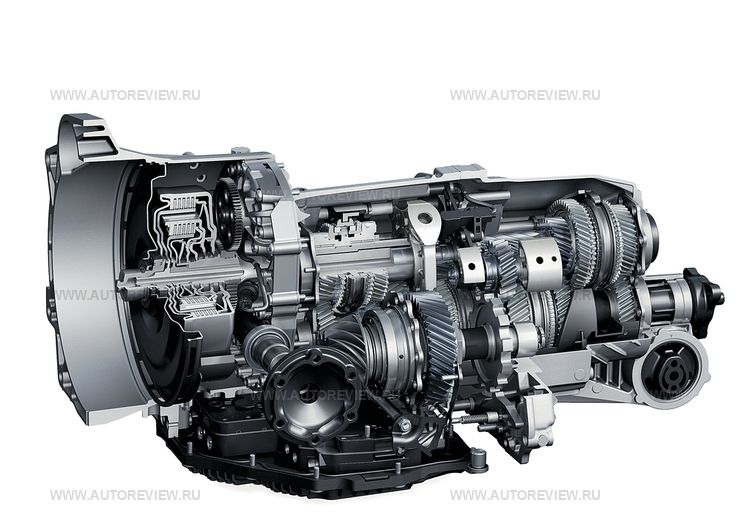
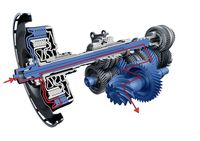
Formally, the PDK gearbox is twin-shaft. The input shaft, like on other preselective gearboxes, consists of two parts, each responsible for its own gears. The drive shaft for the front axle is attached to the solid output shaft. And the third shaft is auxiliary, ensuring the "correct" direction of rotation for the rear wheels.
The gears are divided between the "wet" clutches on the "odd-even" principle: one works with I, III, V, VII gears and reverse, the second with even ones. Since the peak load at launch falls on first gear, the diameter of the "odd" clutch is a third larger than the "even" one. For the same reason, the electronics prohibit starting from second gear — the previous Tiptronic automatic in Drive mode just started moving from second.
All gears have carbon synchronizers. On the first three, they are triple, on the rest — double. The electronic control unit processes data from a bunch of sensors and commands the valves of the hydraulic actuator. The minimum time to shift to an adjacent gear is 200 ms. In automatic mode, the gearbox can skip several gears, for example, from seventh straight to second. Preselection also works in manual mode: the system analyzes whether the car is accelerating or braking and pre-selects the needed gear. During steady driving, the control unit is guided by crankshaft speed: if below 3500 rpm, it prepares a lower gear; if above, a higher one.
| Odd gears and reverse | Even gears |
 |
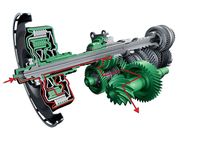 |
| The seven-speed PDK with twin-shaft architecture is structurally close to the S tronic gearbox installed on the Audi Q5 and S5. One pack of "wet" friction clutches is responsible for odd gears and reverse, the second for even gears | |
PDK turned out to be 10 kg lighter than the Tiptronic automatic, but 30 kg heavier than the manual. The differential, mounted in the same unit as the gearbox, can be either open or self-locking (option for rear-wheel-drive cars, standard for all-wheel drive): 22% lockup on acceleration and 27% on engine braking. Previously, the "self-lock" was only available with the manual.
Can PDK be installed on the Porsche 911 Turbo, whose engine produces up to 680 Nm?
"The 'ceiling' of the new gearbox is even higher," explains developer Jan Peter Hoffmeister. However, similar load occurs in the transmission of a regular Carrera, but not during acceleration, but during hard braking — due to the inertia of the engine's moving parts. So even in its current form, the PDK gearbox is almost suitable for the Turbo version, although some elements will likely still be strengthened.