
Russian dealers have already started taking orders, and the first cars will reach their owners in March. But there is predictably no hype. In our country, anything smaller than a "Focus" (unless, of course, it's a Lada Kalina) fails to impress people. In general, the smaller the car, the less attention it gets. But the French are an unusually optimistic people and have correspondingly high hopes for the new Peugeot 208. To get acquainted with the new model, we were invited to the holy of holies – the Peugeot plant in the Slovak city of Trnava.
The enterprise in Trnava, 60 km from Bratislava, is one of the main and newest plants of the PSA Peugeot Citroen alliance. At the entrance to one of the buildings, the previous 207th "Pug" is on display. On the hatchback's body are portraits of all the plant employees who took part in its creation. The country should know its heroes. After all, in 2008, the Peugeot 207 became the best-selling car in Europe! A little further away, the new 208th, which should move the sales bar in the European B-class to a new level, looks at the 207th with a sly squint of its shining headlights.
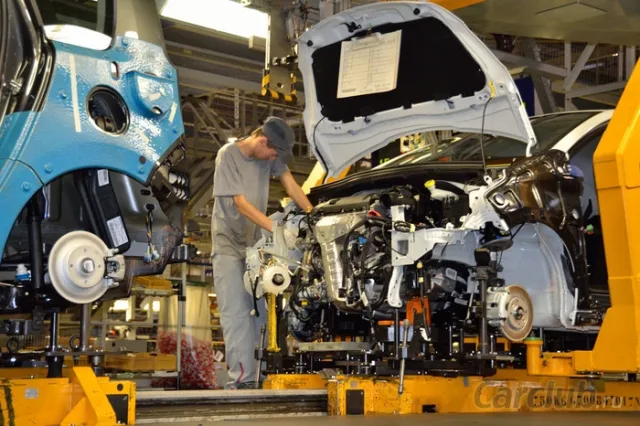
Passing through the workshops where stamping, welding, and painting are done, we are led straight to the workshop from which finished cars emerge. By the way, along with the new Peugeot 208, the platform-sharing Citroen C3 Picasso is assembled on the same line.
It all starts with an anonymous frame arriving in the workshop via an overhead conveyor, only vaguely resembling the outlines of a future car. Slowly moving around the area, the body is sequentially equipped with everything necessary (wiring, sound insulation, exterior parts, etc.). At the same time, a chassis moves towards the body, also accumulating various units (transmission, exhaust system, suspension, wheels). At the meeting point, following laser guides, the body and chassis merge into a single whole. After that, seats, steering wheel, headlights, and doors are installed in the car. This is how the "birth of a new star" happens.
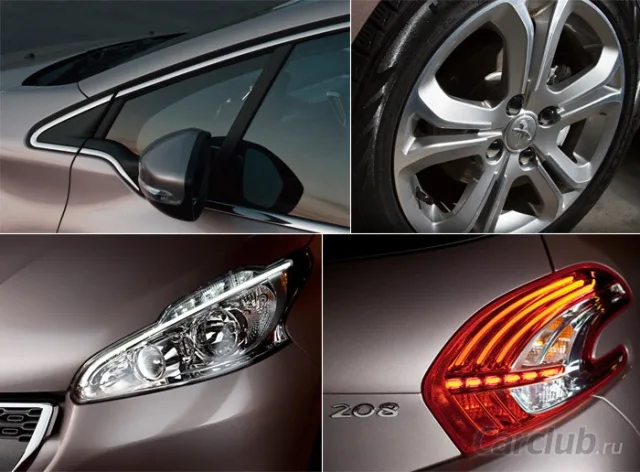
The beltline, the quarter window in the front door, the headlights, and the taillights are the main elements shaping the exterior of the new Peugeot 208. In Europe, this design has already found favor.
The final stage, after which the finished car leaves the assembly shop, is quality control. PSA Peugeot specifically noted the work of this department, thanks to which it was possible to significantly reduce the percentage of defects in new cars.
After the plant tour, a 400-kilometer test drive around the outskirts of Bratislava awaited us. Looking ahead, I note that the roads of Slovenia are far from ideal: this allowed us to test the car in conditions as close as possible to Russian ones.
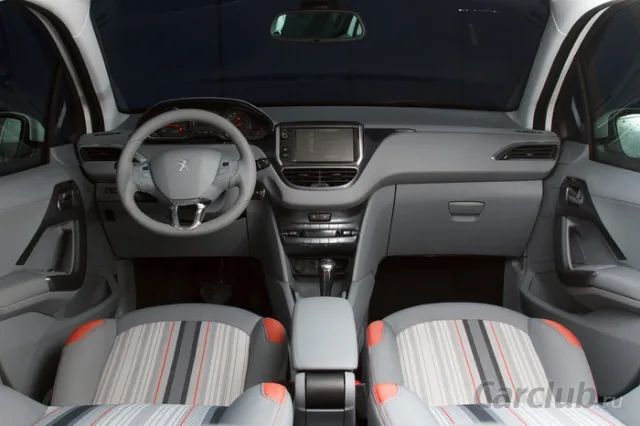
The multimedia screen was moved closer to the driver, the steering wheel was reduced in size and flattened, and to prevent the wheel from blocking the view of the instrument cluster, it was simply raised higher. Why was all this done? It's simple: to make access to the touchscreen easier. Nowadays, drivers' needs for multimedia convenience are unusually high!
Glancing at the "two hundred eighth," you notice the numerous design solutions of the body elements, harmoniously integrated into the model's unified concept. And it really is good!
Juicy shapes, smooth lines, and the sly look of the headlights with LED "eyebrows" can make you fall in love at first sight. The design of the new Peugeot will definitely appeal to ladies and the younger generation of adventurers, who especially value a car's appearance. The three-door with its bright and expressive profile is more dynamic, while the five-door hatchback is a bit calmer. The main focal point of the three-door version is the original line running along the lower edge of the glass and ending with a striking "fin." By the way, the "three-door" is 11 thousand rubles cheaper than its five-door counterpart.
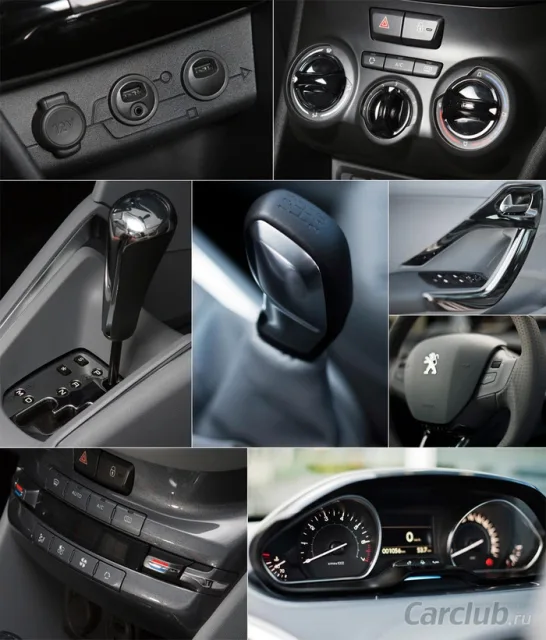
Depending on the trim level, the Peugeot can be equipped with a regular air conditioner or climate control. No matter how much Russian Peugeot fans would like more versions with automatic transmission, the main gearbox will for now be a regular manual, and only the top petrol engine 1.6 L will get a four-speed automatic. True, the debut of a new dual-clutch transmission, which is the French's own development, is not far off.
The French decided not to lag behind their German colleagues from Opel, who at one time quite successfully offered their customers to fantasize with accessories for the Corsa model. For the "two hundredth" series Peugeot, a wide list of styling accessories is now also available, including body decals, spoilers, a panoramic roof, sill plates, color solutions for interior elements, and much more.
Based on data according to which most people choose a car by its appearance, it's easy to understand the reason for the Peugeot 208's success in Europe. French designers under the leadership of Gilles Vidal have undoubtedly managed to create a bright and memorable car – and that's already half the success.
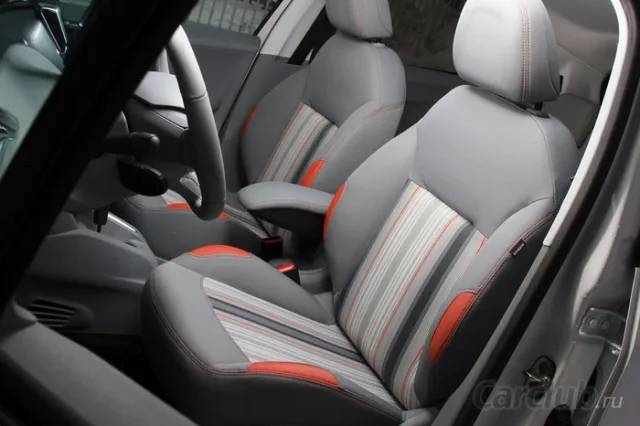
A wide range of interior trim color combinations is offered. Visually, the seats have decent lateral support, but in reality, the bolsters, like the cushion, are too soft.
The interior is no less original than the exterior; the quality of materials and their fit are at a very high level. Several interior options in light and dark finishes can satisfy the most discerning car enthusiast. In my opinion, the best option is a light interior with bright red and gray vertical stripes on the seat backs. The seats themselves have become much more comfortable compared to the 207th.
The main "feature" in the cabin is the 7-inch multimedia touchscreen moved closer to the driver, available already in the Active trim. The convenient and intuitive interface allows not only displaying on-board computer data, playing multimedia, and interacting with other devices via Bluetooth, but even viewing photos. By paying an extra 22 thousand rubles, you can install a navigation system with Russian maps and an additional USB port.
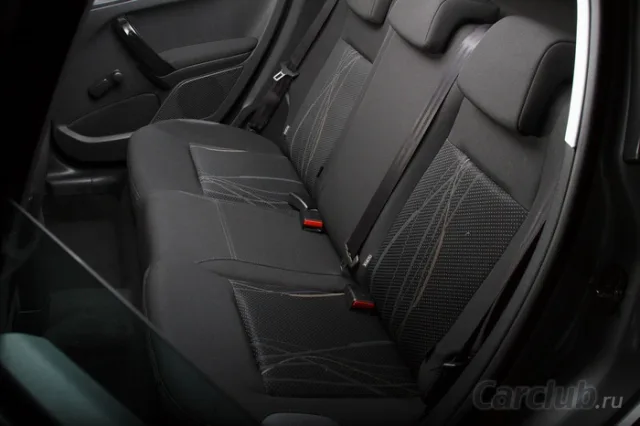
In the back, it's neither hot nor cold. In terms of rear space, the Peugeot 208 is an average representative of the B-class.
The instrument cluster, raised high with a color screen between the speedometer and tachometer "rings," reads perfectly, and the coolest thing is the small, slightly flattened "donut" steering wheel, whose size could be envied by some sports cars. From lock to lock, it makes just over two turns – moderately sharp, precise, and quick, almost like in karting.
The wheelbase is similar to the 207 model, and thanks to optimized component layout, there is significantly more space in the cabin. For example, my colleague, 182 cm tall, managed to sit comfortably in both the front and rear seats. The exception is the modification with the optional panoramic roof (for 20 thousand rubles), where the ceiling in the rear row area is slightly lower than in the standard version. The luggage compartment of the Peugeot 208 has also increased; its useful volume is 285 liters, which is slightly more than that of the main European competitors: VW Polo and Ford Fiesta. The rear seatback folds in parts, but a flat floor is not achieved.
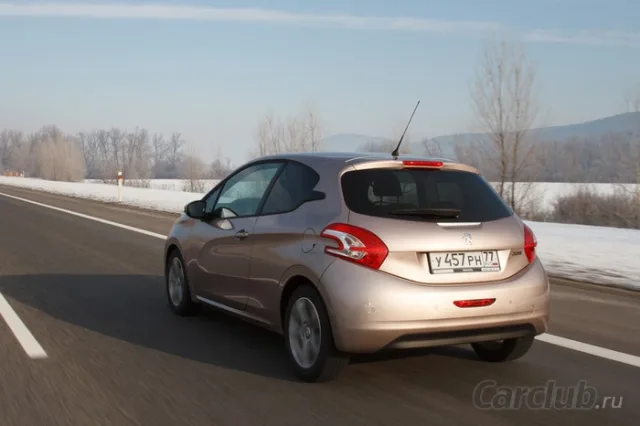
The Peugeot 208 drives briskly and cheerfully. The European school of suspension tuning is felt from the first turns. Due to the overly sharp steering wheel, there is sometimes a lack of feedback on an arc.
Although Peugeot representatives stated that this is a completely new car, in reality, it is based on a modernized platform of its predecessor. However, the use of new materials and high-tech welding processes significantly increased the strength of the structure and reduced the body weight by 25 kg. Another 11 kg were saved on seats, and bumpers became 5 kg lighter. Despite the obvious advantages of the Peugeot 208's suspension, all new models of the concern will be mounted on a new, now modular platform EMP2 (Efficient Modular Platform 2).
MacPherson struts in front and a semi-independent beam in the rear are standard equipment for B-class cars. The chassis swallows small potholes and bumps well, but it is not lacking in density either. Some might say it's overly stiff, but then again, the handling of the new car in city traffic is almost flawless; the Peugeot 208 was clearly tuned for driving pleasure.
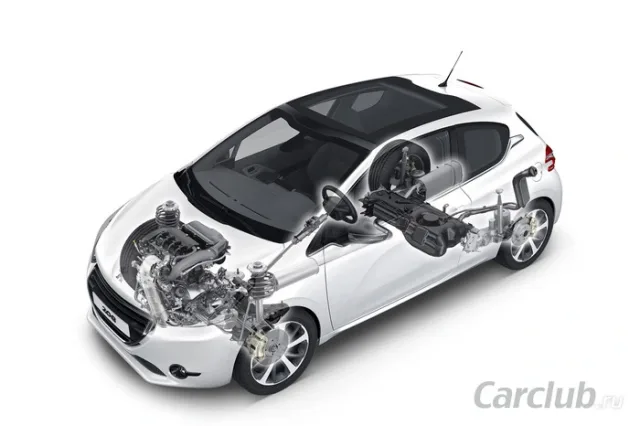
In Russia, the "two hundred eighth" will be available with three petrol engines of 1.0, 1.2, and 1.6 liters, producing 62, 82, and 120 hp respectively, as well as a 92-hp 1.6-liter turbodiesel. The suspension is traditional - MacPherson in front, semi-independent beam in the rear.
The car behaves somewhat differently on the highway: after exceeding 100 km/h, the "pug" begins to demand increased attention, forcing you to return it to the initially set trajectory. Insufficient feedback on the steering wheel does not allow accurately calculating the angle of rotation to return the car to its place.
In Russia, the "208" will be available with three petrol engines with a displacement of 1.0, 1.2 and 1.6 liters, producing 62, 82 and 120 hp respectively, as well as a 92-hp 1.6-liter turbodiesel! All engines except the petrol 1.6 are equipped with a manual gearbox. For the top petrol engine, an old 4-speed "automatic" AT8 is offered, which is a modernized version of the problematic AL4. By the way, this automatic is already familiar to fans of French cars from the 308 model, and, unfortunately, not from the best side. Nevertheless, for an inexperienced buyer who leisurely maneuvers in city traffic, the gearbox will not create discomfort.
For those craving a more technological tandem, I advise you to "patch up old bast shoes" and wait for the second half of 2013, when modifications with a modern 6-speed EGS robot should appear on our market. Later there will be a "hot" GTI version with a 200-hp 1.6-liter turbo engine.

The EuroNCAP crash test series awarded the Peugeot 208 the maximum five stars. The weak points were insufficient pedestrian protection and low protection of the neck vertebrae of the driver and front passenger in a rear collision. In other disciplines, the car showed quite high results.