
Peugeot 207 CC. Ladies' Man
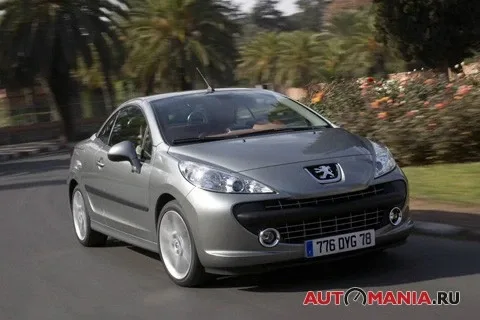
Apparently, at Peugeot, style is considered the main motive for purchase. And there's no arguing: the 207 hatchback is beautiful and has even more charm than its predecessor with the "six" at the end, and in coupe-cabriolet body with a folding hardtop — it's just a dream! A female one.
The designers worked hard, and it's no wonder that 90% of coupe-cabriolets have been sold into the tender, manicured hands of truly the fair half of humanity — most of them were under 35 years old. Moreover, almost every one is sure that her car with a folding top is, without exaggeration, a sports car. But hardly.
Additional reinforcements in the windshield pillars, doors, sills, and floor increased the body rigidity important for road stability: even in cabriolet guise, it is higher than that of the hatchback, and with the roof raised, it increases by one and a half times, but as a result of all these modifications, the two-door gained 180 kg (1350 kg) in weight compared to the five-door. Even a quick glance at the sheet with technical characteristics is enough to bring impressionable natures back down to earth — acceleration to 100 km/h takes a long 12.6 seconds, and the "max speed" doesn't reach the second "hundred" — hardly matching sports car standards. This would be a good place to insert a big laughing smiley, but it's better to look at the "Peugeot" once more — "I'm glad to be deceived"!
The designers certainly worked hard: widely spaced 17-inch wheels, like powerful paws, a noble lion's smile of a huge air intake across the entire width of the bumper, clear graphics of the side panels, a mighty stance transitioning from the roof into the continuation of the trunk. The red color only enhances these personifications. The picture is complemented by "sporty" jewelry like chrome trim on the headlights and safety arches behind the passengers' heads — they perform not only a decorative function but also automatically shoot up in a rollover, thereby protecting the occupants' heads.
In a cozy environment
In the coupe-cabriolet's interior, everything is like in the hatchback: comfortable seats that hold the body well, soft upholstery materials, but if you don't skimp on leather seat trim, a white instrument panel with red needles, aluminum pedal covers, a plump three-spoke steering wheel, and a branded air freshener with vanilla aroma built into the central air vents (like on the test car), the Frenchman will reward all your senses with hypnotic charm. Honestly, only after spending time behind the wheel of the 207 CC did I finally feel the true meaning of the word "charm." And in road behavior, it manifests excellently, but somewhat mixed... The "Peugeot" drives superbly — it holds the straight line clearly, the ride smoothness is excellent, even large potholes are voiced by the suspension only as a distant muffled thud, not to mention the standard road trifles — the cabin is completely isolated from this unwanted information — it just gets lost somewhere in the depths of the chassis. But for some reason, at city speeds, the "electric" steering wheel is too light; with increasing speed, the wheel gets heavier, but a slight nervousness in reactions prevents full unity with the car. Although in corners, the precious feedback between driver and road does appear, and body rolls are commendably small.
A fun company
But the Franco-Bavarian 1600cc petrol engine (exactly the same ones are installed on the MINI) perfectly matches the image of a bright two-door. In turbocharged form, it develops 150 hp, but it is only paired with a five-speed manual gearbox, while we got its 120-horsepower naturally aspirated sibling. By the way, it is the one that mates with the optional automatic. This engine more than compensates for the shortfall in claimed acceleration seconds with excellent smooth torque from the very bottom. True, the old four-speed torque converter developed by PSA-Renault is adaptive only sometimes: missing desired downshifts is common for it, it doesn't always respond immediately to throttle input at the start, but it has a manual Tiptronic mode patented by Porsche back at the end of the last century. Only by activating it can you get driving pleasure, making high-speed overtakes on German autobahns — you flick the lever, the gearbox jumps from fourth to third, pedal to the floor, and in response you get a noble bassy growl and increasing surge, making the crimson needle confidently float from the 120th to the 170th mark of the snow-white speedometer dial.
At certain moments, there was even a feeling that there were more "horses" under the hood than stated in the technical passport. Not to say it was sporty, but accelerations were given to the unloaded car quite easily, and with such convenient throttle control, we found mutual understanding with the 207 quite quickly. By the way, I had to get used to the brakes: in emergency modes, under the chattering of ABS, the car stopped as it should, but in the usual smooth rhythm, the pedal seemed soft and uninformative, with constant pressure, braking efficiency increased not linearly but in jumps.
Alone with the sky
Carried away by testing the 207's driver ambitions, we moved a bit away from its main purpose — the ability to bring a little sun and joy into everyday existence. Actually, the idea of equipping a car with a rigid folding top was embodied back in the 30s of the last century. Perhaps the first not only for the "lion" brand but also in the world coupe-cabriolet appeared in 1934 — it was the Peugeot 402 Eclipse. However, having assembled fewer than 700 units, its production was abruptly stopped. More than half a century later, experiments with open body excesses continued, and in 2000 the idea was finally revived in the form of the 206 CC. The car was received very warmly — over 6 years of production, Europeans purchased about 360 thousand 206 coupe-cabriolets with a rigid folding roof, and then the successful experience was transposed to the older family, producing the 307 CC and now the 308 CC.
To see the sky above the 207 Peugeot instead of the ceiling, it took me only 25 seconds to hold the button located on the tunnel between the front seats. First, the side windows lowered, then the triangular windows slid into the depths of the rear fenders, the trunk lid opened against the direction of travel... And here I am already in a cabriolet. This operation is allowed not only in static mode but also at speeds up to 10 km/h. The fundamental difference from the 206 is that the entire operation is automated — there is no need to unfasten a special clip at the junction of the windshield frame and roof before pressing the button.
Of course, in summer, the sensations of driving without a top are excellent: a pleasant breeze, a free solarium, and a feeling of boundless freedom. The flip side of the coin is a layer of dust on all interior panels, and if you drive a cabriolet around a metropolis, be prepared for frequent visits to the car wash. But even if it suddenly gets cold outside, raised windows will allow you to maintain the internal microclimate.
In cramped quarters, but not offended
The declared seating formula "2+2" means that only the front seats are full-fledged, and the rear "bench" with a short cushion and almost vertically placed backrest will more often serve as a shelf for bags and clothes, but if life still forces it, you can put at most a child in a child seat or just a small child in the back — even slender adults will find it difficult to squeeze in. And in general, you'll have to get used to the fact that the transformation of the interior in a coupe-cabriolet is a very conditional thing; the determining factor is the position of the roof. In coupe format, the trunk is quite spacious — 370 cm³ of useful volume, not counting the spare wheel, but in cabriolet, the roof folded in half eats up most of this space, so you have to be content with only 145 liters. By the way, don't forget to pull the limiter curtain, which lets the electronics know that the top can be stowed without risk.
The one and only
Given that the Opel Astra TwinTop, Ford Focus CC, Peugeot 308 CC, and Volvo C70 are not only physically larger but also noticeably more expensive, the whole group of models competing with the 207 CC in Europe, like the Nissan Micra C+C, Mitsubishi CZC, Opel Tigra, are simply not supplied to Russia, and comparisons with the rear-wheel-drive Mazda MX-5 are still not entirely correct, and it's not even about the noise of the latter — it's just that the philosophy of the cars is different. Among coupe-cabriolets with a practical rigid folding roof in the compact class, the Peugeot 207 CC simply has no competitors.
For those who are not scared by the cocktail of all the above difficulties and joys of owning such a car, and who decided to stand out from the crowd by purchasing the 207 CC, it's worth knowing that retail prices start from 832,000 rubles. For this amount, the Dynamic version with a 120 hp engine and manual gearbox, 4 airbags, ABS, air conditioning, electric windows, and MP3 radio is offered. You'll have to pay extra for the automatic — 28,000 rubles, alarm — 10,600 rubles, stability control system — 19,500 rubles.
The Sport version is already equipped with electronic safety means, but externally it differs with a chrome radiator grille, 17-inch wheels, and a price from 915,000 rubles. And the cost of a well-packed car with a combined leather interior, automatic, and other pleasant little things will surely exceed a million rubles.
Vladimir Palkin
Technical specifications
| Length, mm | 4037 |
| Width, mm | 1750 |
| Height, mm | 1397 |
| Wheelbase, mm | 2540 |
| Curb weight, kg | 1955 |
| Trunk volume, l | 145-370 |
| Engine displacement, cc | 1598 |
| Power, hp | 120/6000 |
| Torque, Nm/rpm | 160/4250 |
| Maximum speed, km/h | 195 |
| Acceleration time (0-100 km/h) s | 12.6 |
| Average consumption (l) | 7.2 |
| Price (RUB) | from 832,000 |
Source – AUTOMANIA.RU