
Peugeot 207. Agent 207
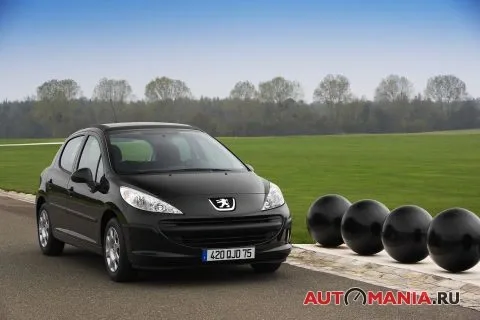
All these details are brought in line with the current brand style, which Peugeot's design center specialists began building with the 407 family sedan. And hardly anyone would argue that the teardrop profile, the rear door contours, the shape and placement of the taillights, and the entire rear end in general strongly resemble the Peugeot 206. In any case, the French have created an intriguing character—a sort of newly minted James Bond: powerful, athletic, slightly rough, a bit expressive, but already with a sense of style and playboy pretensions.
Speaking of technology, compared to its predecessor, the 207 has become taller, wider, and longer. Thanks to the extended chassis from the Peugeot 1007, the new model has gained a full 200 mm in length. The freed-up space, though not entirely, has mostly gone to rear passengers. It's clear that the French are far from a limousine, but given all the changes, the new model offers occupants a completely different level of comfort.
The trunk has also grown, but the main thing is not the 10% increase in volume, but the ergonomics. The engineers have introduced an option in the rear door design that was previously found only on expensive station wagons and SUVs—an opening window. This significantly simplifies access to the cargo area, especially when you need to load something light and small. I'd also note the front seats. The 206 set a good standard in its time, and the French didn't necessarily need to radically redesign the interior. But they didn't limit themselves to small details: the seats have become firmer, lateral support has improved, and the range of adjustments has expanded.
The most serious changes in the cabin are, of course, its appearance. First, it's noticeable that the French have carefully worked on the quality of materials and assembly, eliminating the rare but still present flaws. Now everything looks and feels decent. From a functionality and aesthetics standpoint, the progress is colossal. The designers didn't experiment with the architecture, staying true to the proven layout, but the interior styling harmoniously fits the overall "mood" of the car, continuing the aggressive line.
The massive front panel, slightly rounded on top, seems to be divided into two almost equal horizontal halves, giving it "predatory," aggressive, but quite elegant contours. Depending on the trim, it can be finished with polished aluminum—this clearly adds appeal. The almost flat center console, traditionally topped with a built-in display, despite a fair number of buttons for controlling the heater and music, is quite ergonomic. At least, adaptation for a more or less experienced driver won't take much time, especially since the stereo controls are duplicated on the steering wheel switches.
The instrument panel is also familiar and understandable. As on older models, you can display a tire pressure drop indicator here, though unlike the 407, this option is for an extra charge. The panoramic glass roof also made it into the list of additional equipment—due to the low price of the base version. For the same reason, adaptive headlights, rain and light sensors, parking sensors, climate control, ESP, curtain airbags, a JBL audio system, and much more have been moved to the "paid" group. And the base Urban trim doesn't even have air conditioning. However, the next four versions will surely satisfy even the most demanding.
The Peugeot 207 engine lineup nominally includes six engines, but in our country there will be half as many—due to fuel quality, we traditionally don't get the economical turbo diesels. However, most buyers will be satisfied with the three petrol engines already familiar from the Peugeot 1007. The entry-level is a 1.4-liter 75-hp with two valves per cylinder, followed by a similar 16-valve version with 88 hp. The list ends with a 1.6-liter engine producing a very respectable 110 "horses" for its size. As it turns out, this is not the limit: in the future, a jointly developed with BMW 1.6-liter turbo engine with 150 hp will appear, which will go under the hoods of "hot" versions. But that's a matter for the future, and for now, the modification with the 88-hp engine will likely be the most popular. It can be paired either with a regular manual or with the brand's robotic gearbox (the latter, however, is still only nominally in dealer price lists). For a car weighing a ton, this is, in my opinion, the optimal option: on one hand, the hatchback gets a sufficiently dynamic acceleration; on the other, it doesn't burden the owner too much with fuel costs. Of course, due to the small displacement, there's a slight lack of torque at low revs, and you have to rev the engine, but this is mainly noticeable outside the city; in the metropolis, the power reserve is more than enough. You'll also likely appreciate the precise gearbox operation and the decent ride smoothness for such a car.
On the road, the 207 handles well, doesn't annoy with strong body rolls, and handles bumps not harshly but composedly. However, you shouldn't get carried away with imaginary permissiveness—the short wheelbase at high speeds leads to noticeable pitching, and on serious potholes, it shakes more noticeably. This isn't better for the suspension or the passengers. The sharp steering, thanks to the electric power steering, is very handy in city traffic; with increasing speed, it becomes stiffer and more informative, but in my opinion, it still lacks feedback.
Another feature of the French car is the brakes. The base 207 comes with disc brakes, so braking efficiency is beyond reproach, but a novice driver will need certain skills. The system is very sensitive to pedal inputs and requires an adequate perception of the situation. In general, you shouldn't literally slam on the brakes—otherwise, the car will stop dead and put other road users in a difficult situation. However, this doesn't spoil the overall impression of the car. Spoiling the impression of the Peugeot 207, it seems to me, is generally impossible—it turned out so bright and extraordinary. The expected balance of driving characteristics promises it not only leadership in its class but also success comparable to that achieved by its predecessor.
Specifications:
Peugeot 207
Dimensions:
length (mm) 4030
width (mm) 1720
height (mm) 1470
Wheelbase (mm) 2540
Weight (kg) 1155
Trunk volume (l) 270/925
Engine displacement (cm3) 1361
Max. power (hp) 88 at 5250 rpm
Max. torque (Nm) 133 at 3250 rpm
Max. speed (km/h) 180
Acceleration 0-100 km/h (s) 12.7
Average fuel consumption (l) 6.4
Price ($) 15,400-21,100
Source – www.automania.ru