
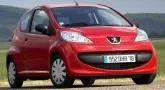
A newcomer to the Russian market, the Peugeot 107 rolls off the assembly line at a Czech plant, where it is built alongside its relatives, the Citroen C1 and Toyota Aygo. This enterprise is a joint project of the PSA Peugeot Citroen and Toyota concerns. The "brothers" of the 107 have not officially reached us yet, but the Peugeot itself is already on sale, and there is even a small queue. The same cannot be said for the Peugeot 1007, which, despite a loud advertising campaign, has not found demand in Russia (perhaps the price is to blame).
The Peugeot 107 is an extremely compact car: its length is only 3430 mm. However, it reaches 1630 mm in width, which is 135 mm more than the Daewoo Matiz. Thanks to this, you feel quite at ease in the front. My height is noticeably above average, but the only inconvenience, albeit minor, was the protruding center console — I kept hitting it with my knee.
The front seats lack lateral support, but they do adjust for length and backrest angle. Finding a comfortable position is easy; the seating position is high, but there is still headroom. Ergonomics are in perfect order. When I slid the seat all the way back, I found that I could barely reach the pedals — what a range of adjustment! It is clear that with the seat in this position, you cannot seat anyone behind you, but city minicars typically carry no more than two people. However, passengers of average height can quite fit one behind the other — suitable for a short trip around town. The trunk, of course, is tiny — 130 liters.
The quality of the interior assembly pleased me: at low speeds, I did not hear a single extraneous squeak. But as soon as you press the gas pedal properly, the intrusive singing of the engine, accompanied by external noises, bursts into the cabin.
The instrument panel is a large speedometer with a small LCD display that shows the fuel level and the selected gear, plus a scattering of warning lights in the center. For an additional fee, you can order a tachometer that attaches to the speedometer on a thin stalk. Calling this a striving for sportiness is hard; rather, the composition resembles a visual aid for molecular chemistry.
The car drives well, with lively responses. The electric power steering, of course, slightly blurs the picture of what the front wheels are doing, but there is still enough information for feedback. The suspension is excellently tuned, confidently swallowing bumps and maintaining comfort even at decent speeds. At the limit of a turn, the car grips the asphalt tenaciously, and with a provocative lift-off of the gas, it smoothly dives into the arc.
To get real pleasure from driving the Peugeot 107, you will have to make friends with the 2-Tronic robotic gearbox. Its advantages are that it adapts to the style of pressing the gas and can work in manual mode. But the disadvantages are noticeable pauses during shifts, both in manual and automatic modes. Only after some practice can you find the right algorithm for working with the gas, and then the "robot" becomes almost imperceptible. The brakes, however, pleased without any reservations.
For Muscovites considering this or a similar car, there is good news: rumors say that the city authorities, in the fight against traffic jams, will start encouraging owners of small cars from next year. True, in what exact form this will materialize is not yet clear. Be that as it may, today such cars are usually bought with a sober calculation. But the story with the Peugeot 107, it seems to me, is somewhat different — partly from the realm of emotions.
Prices and trim levels of the Peugeot 107
The starting price of the car is $11,590. For this money, they offer a three-door hatchback in the Urban version, with ABS and two airbags as standard. The test car, however, was a Peugeot 107 in the top Trendy trim with a robotic gearbox and all options: six airbags, air conditioning, electric windows, central locking with key control, tachometer, audio system, alloy wheels, and metallic paint. Such an example will cost $15,970.