
Peugeot 107. The Lion Cub
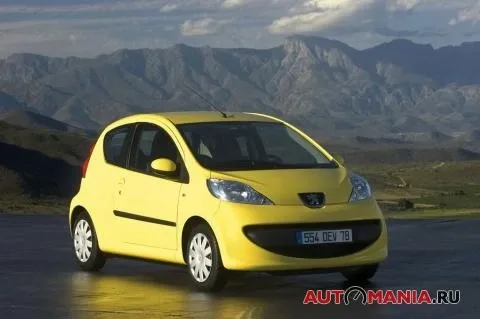
The Russian representative office of Peugeot surprised everyone by suddenly announcing sales of this model in our country. Usually, cars of this class appear on our market either as new models or after a major overhaul, as was the case with the second coming of the Toyota Yaris. But with the Peugeot 107, it turned out differently: in Europe, this car has been on sale for several years, the facelift is not coming soon, and suddenly - an unexpected premiere... However, the French motives are quite understandable. First, the company is doing great right now - sales are pleasing management more and more every year. Second, the dynamics in the popular C and B segments are encouraging, especially in the latter. The Peugeot 207, largely owing its success to the wild popularity of its predecessor, immediately gained good momentum, and the Iranian 206 sedan is also selling well. So the prospects for the 107 look bright, provided, of course, that it appeals to the domestic buyer.
Although this little one is similar in size to the Chevrolet Matiz, in Europe it is classified in the B1 segment, while in our country it is usually placed in the most compact class A. In the Old World, the car enjoys steady, albeit not frenzied, demand. Its main trump cards are compactness and maneuverability. For example, it needs a ten-meter roadway to make a U-turn. Acceleration to 100 km/h takes 13.7 seconds, and the top speed is 160 km/h. And that's with a one-liter engine. The second plus is spaciousness. True, not all classmates can boast the same. Thanks to a well-thought-out layout, four adults can comfortably fit in the cabin. The third trump card is fuel efficiency. Due to the modest size, such cars have small engines under the hood that do not require constant refueling with expensive fuel. In Europe, it would be a turbodiesel, but for our expanses, a gasoline engine is assumed by default, because the folks from PSA never brought one of their excellent diesels to us.
The first thing Peugeot bet on when bringing the car to our market was its appearance. The Uzbek Matiz wins in both compactness and price, so the French can only rely on their traditionally strong exterior. Everything is clear here: the design of the 107 is in line with the modern corporate style common to all current models of the brand. The front is adorned with a cute "face" with a charming "smile" and cat-like elongated headlights. The profile reminded me somewhat of the Peugeot 1007, although that one is noticeably taller and slightly longer. In part, the features of the fresh 207 can be discerned in the look, but it's worth remembering that the 107 appeared before both models, so it should be considered a kind of progenitor.
It makes sense to compare the 107 with its closest relative-competitor, the Citroën C2. The cars are similar not only structurally but also stylistically. True, the Citroën looks a bit more aggressive and harsher. Against its background, the Peugeot seems more feminine, although in the three-door version it is not devoid of dynamism and sportiness. By the way, unlike its sibling, it also comes in a five-door version. This significantly expands the circle of potential buyers, because from a practical standpoint, five-door cars, albeit less extravagant in appearance, will give the three-door a hundred points ahead. This is especially true for the comfort of rear passengers: squeezing into such a compact compartment is already difficult, and when you have to squeeze between the pillar and the seat...
However, enough theory, let's move on to practice. I hope it's no secret to anyone that the space for rear passengers in the 107 directly depends on the build of those sitting in front. Although, if, say, a petite girl gets behind the wheel, the passenger behind her will travel with truly royal comfort. There will be enough room for legs and feet, and in the shoulders and at elbow level, given the initially two-seat sofa, it will also be spacious. The only snag is headroom (though the average passenger won't even notice it). As for the front seats, everything is predictable: there are enough adjustments for anyone, the seats are comfortable, although the cushions are quite firm. The trunk also didn't surprise: 140 liters up to the shelf level and about two hundred if loaded up to the backrest of the rear sofa. However, it's unlikely anyone will use this car as a workhorse, so the maximum it will carry is five or six bags from a hypermarket. This is especially relevant when you remember that under the hood of the Peugeot 107 in our market, there is only one power unit - a one-liter engine developing 50 kW or 68 hp at 6000 rpm. Peak torque comes at 3600 rpm, so decent dynamics should be expected at medium revs, which naturally makes driving with a full load difficult. Overall, the car will disappoint only a truly "hot" driver who expects any car to behave like a civilian supercar or even a Formula car. Realists should like the 107: 13.7 seconds to 100 km/h is not a brilliant result, but for such a car, it's far from a failure. It covers the same 400 meters in less than 20 seconds.
The chassis settings also speak of temperament - the car holds the road very well, and body roll is almost absent. True, this came at the cost of ride comfort: on bumps, speed bumps, and joints, it noticeably "bucks." But given that it will mostly travel on paved streets, where road surface issues are not as acute as outside the city, passengers are unlikely to be seriously bothered. The brakes, for example, are more uncompromising, although the French have always been known for this. You shouldn't hit the pedal, let alone press it "to the floor" without need - the car will instantly stop dead, and the driver behind won't have time to react. In short, you need to get used to this system, otherwise, the reaction of fellow drivers may be inadequate. As for the steering wheel, it's not even worth mentioning. Handling is at a quite decent level: sharpness, reactions - everything is on point. Although, it was hardly worth expecting anything else from this Peugeot.
Well, that's basically it. It remains to clarify the usually most unpleasant financial question. The starting price of the 107 (three-door body with a five-speed manual) on our market is 299,000 rubles (due to the widespread transition of car dealers to local currency, we'll take it as the nominal unit). The base Urban trim will include front airbags, ABS, EBFD (electronic brake force distribution), CSC (cornering stability control), power steering, and a full-size spare tire. Various power drives, an immobilizer, and air conditioning appear in the second, top-end Trendy trim, which is priced at a minimum of 324,000 rubles. At the same time, a standard radio with a CD player and an auxiliary input jack for both versions is offered only as an option. The five-door body is 8,000 rubles more expensive, and the robotic gearbox is 23,000 more. In general, there is something to pay for, but also something to choose from. The most expensive option, for your information, will cost the buyer about 420,000 rubles, which at the Central Bank exchange rate is about $16,500.
Technical specifications:
| Dimensions: | Peugeot 107 |
| Length (mm) | 3430 |
| Width (mm) | 1630 |
| Height (mm) | 1470 |
| Wheelbase (mm) | 2340 |
| Weight (kg) | 790 |
| Trunk volume (l) | 139/140/751 |
| Engine displacement (cm3) | 998 |
| Max power (hp) | 68 at 6000 rpm |
| Max torque (Nm) | 93 at 3600 rpm |
| Max speed | 157 |
| Acceleration 0-100 km/h (s) | 13.7 |
| Average fuel consumption (l) | 4.8 |
| Price (rub.) | 299,000–420,000 |
Magazine "Autogid" August 3, 2007 No. 27(27)
Source – www.automania.ru