
New Opel Zafira
Number of doors/seats 5/7
Curb weight, kg 1550
Acceleration to 100 km/h, s 11.5
Dimensions, mm :
4467x1801x1635
Ground clearance 155
Engine:
displacement, cc 1796
Number of cylinders 4 in line
Power, (hp) /rpm
(140)/6300
Max. torque, Nm/rpm 175/3800
Manual transmission 5-speed
Front-wheel drive
Fuel consumption l/100 km
Combined cycle 7.6
Urban cycle 10.1
Marat
Driving experience 9 years
 Back in the days when the "VAZ 21093" was still distinguished between "long-wing" and "short-wing", I bought my first foreign car, an "Opel Vectra". It was a supercar for those times — a two-liter engine that allowed overtaking any car on the highway in 5th gear, electric sunroof, power steering, ABS, a cabin with trim, headlight washers, in short, a dream, not a car. And since then I have had warm feelings for cars of the "OPEL" brand, so I gladly agreed to take a ride in the "OPEL ZAFIRA NEW".
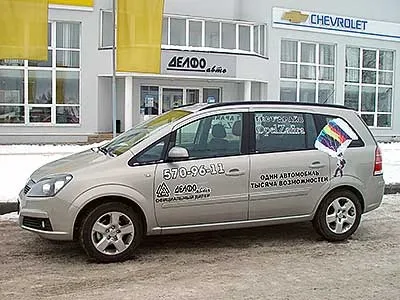
First impression — the car looks like a small private airplane.
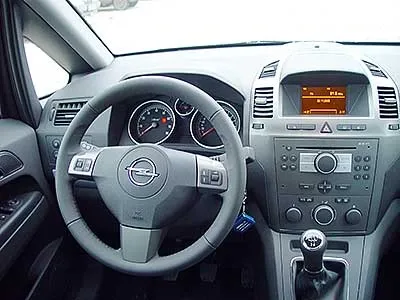
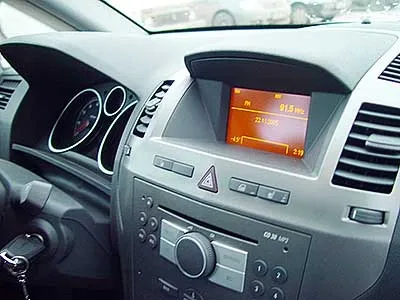
The design is typically German, but if higher-class cars look like tanks, the "Zafira" looks like a "Messerschmitt". Everything in the cabin is convenient: the steering wheel adjusts in two planes, the seats adjust in all planes, visibility is good, although from the sides it is somewhat limited by the front pillar. Climate control is somewhat unusual; the fan speed and airflow distribution patterns are not marked on the control knobs but are displayed on the computer screen. Rear passengers are not forgotten either: comfortable seats, additional air vents, a third row of seats for the mother-in-law and her little dog.
On the move, the car is quite distinctive; the engine has good acceleration, but if you stop pressing the gas, the dynamics drop sharply. The brakes are informative, the ABS is typically Opel, the suspension is stiff, it enters corners easily, and the car handles excellently. In conclusion, one can say that the car is made well, conscientiously.
This is a spacious car for a large family that loves outdoor activities and long trips by car.
Amir
driving experience 10 years.
 I admit that before this I had not had the chance to drive cars of the OPEL brand. And this brand is not among my preferences. In my "track record" there have been many excellent cars, and of course, I have something to compare my driving sensations with. I will immediately note that the car left a good impression. The spacious, roomy cabin, seats without side support initially suggest that this is a family car for trips out of town, to the countryside. For a calm and non-sporty driving style. Although, as they say, you just need to step on it, and the car accelerates quite briskly. I liked the excellent view of the rear side space thanks to the spherical mirrors. The steering mechanism responds quickly to the driver's movements. The braking system works perfectly and allows you to quickly reduce speed while driving. Moreover, there is practically no element of getting used to the brake pedal. Speaking of the brake pedal, I want to note that it is located inconveniently. When moving your foot from the "gas" pedal to the brake pedal, you have to tilt your foot back significantly. This can lead to additional loss of time during emergency braking. While driving, all road irregularities are felt, and noise from the tires is audible. It is clear that the manufacturers expected operation on normal roads, but the sound insulation of this car is clearly not up to par.
Albert
driving experience 12 years
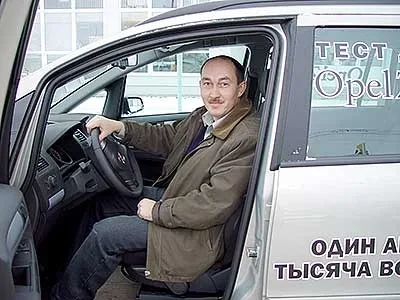 Being a long-time fan of Opel cars, I tried not to miss the opportunity to participate in the test of the new Zafira model.
First of all, I want to note that Opel, in my opinion, like no other company in Europe, knows how to make inexpensive, beautiful, and harmoniously built cars, while distinguished by timeless design, fairly rich equipment, and generational continuity. Therefore, the number of adherents of this brand in Russia is constantly increasing, as confirmed by statistical data from well-known automotive publications.
The fashion for minivans, as is known, came from America, and later became widespread in Europe as well. Over time, the concept of choosing a minivan has undergone significant changes. If earlier, a minivan was positioned more as a family station wagon, then the modern concept of choosing a minivan, as it seems to me, involves using it as a car for an active lifestyle, sports, travel, and trips to nature, and precisely in a large company. And this concept, in my opinion, brings minivans closer to SUV-class cars ("jeeps - crossovers").
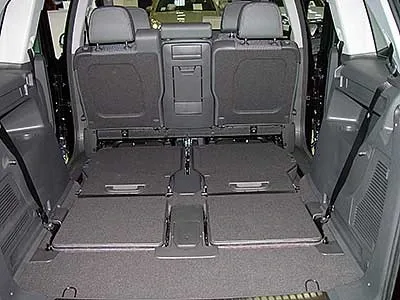
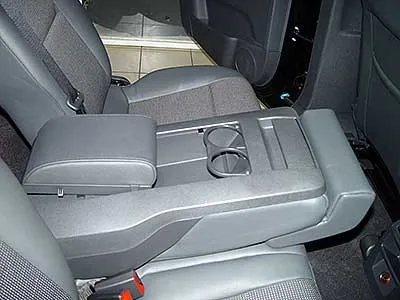
When considering the offers of car companies for minivans on the market, with a high degree of probability many will come to the conclusion that it is the Opel Zafira that is distinguished by an almost ideal combination of its consumer qualities. Namely, the price-quality ratio, style, dynamics, and economy in operation. And of course, one should note the famous Flex7 cabin transformation system, which allows seven adults to move freely in the Zafira and transport various luggage options.
The Zafira that participated in the test was of interest to me precisely as a transformer car, naturally without diminishing its rich technical equipment and driving characteristics. The car is equipped with the well-known and proven engine from the first-generation Zafira, the 1.8 Ecotec, with modified (more powerful and meeting Euro 4 standards) characteristics. The engine, of relatively small displacement for such a fairly massive car (gross weight 2075 kg), produces 140 hp, which allows confident movement both in a city congested with "traffic jams" and on the highway. The engine is very torquey; in fifth gear it pulls from 50 km/h. During acceleration, it also behaves very decently. The suspension is very energy-intensive, allowing you to "not notice" fairly deep potholes on our roads.
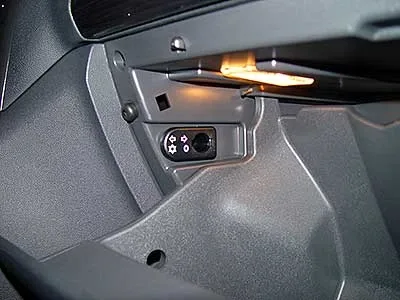
The brakes are very responsive, the operation of the ABS is practically not felt, although the presented car was on summer tires. In this regard, I want to note the rather high noise level in the cabin even at low speed, probably associated with the car being equipped with summer "Bridgestone" tires. As is known, summer tires significantly lose their properties at sub-zero temperatures, simply put, they "harden". To be fair, it must be said that the poor sound insulation of the Zafira is perhaps the only significant drawback of the car. If we touch on other disadvantages of the car, I want to mention the inconvenience of replacing a punctured wheel. The spare tire is located under the car body, like in some "French" cars (although I understand that this stems from the design features of the car). I don't know about Europe, but here, the operation of replacing the "spare" in rainy autumn weather, I think, will definitely entail a visit to the dry cleaner. And continuing the topic — the not-so-clean shoes of passengers can spoil the appearance of the transformable seats for a long time.
While driving the Zafira, I involuntarily compared it with the Mercedes ML, which I had to drive due to my duties. The sensations are the same: a soft and at the same time elastic suspension, a high seating position behind the wheel (there is a feeling of driving a large SUV), a spacious cabin made of very high-quality materials, decent dynamics, and even the specific smell of a German car. Only all-wheel drive is missing, although, perhaps, Opel engineers will eventually get to that too.
All sorts of seat and steering column adjustments allow you to drive the car comfortably, and the powerful heater will not let you freeze even in severe frost. The non-fixed turn signal switching system, negatively noted by many, personally did not cause me any discomfort; I think you just need to get used to it. The convenient, three-spoke multifunctional steering wheel with the ability to control the audio system and mobile phone undoubtedly increases the passive safety of the car. However, active safety is also at a high level — numerous airbags and curtain airbags, adaptive headlight systems (allowing you to "look" around corners), traction control, stability control, and much more.
I would like to note an interesting point. Examining the engine compartment, I noticed a rather flimsy hood (without any sound insulation) covered with hexagonal holes on the inside, which also closed with an unpleasant rattling sound. I automatically attributed this to the car's drawbacks, but later I was surprised to learn that Opel engineers, for the first time in cars of this class, used the muffin tin system — the hood crumples when hitting a pedestrian. It's no wonder that the Zafira received five stars in EuroNCAP crash tests.
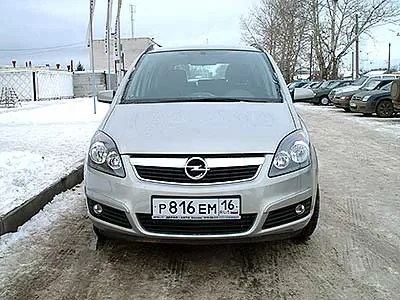
The design of the Zafira corresponds to the company's concept aimed at a kind of "unification" of the appearance of the family of produced cars. The Zafira cannot be confused with other minivans. An abundance of chrome, high-quality paint, a swift appearance. Even the roof rails are covered with a plastic casing, which will have a beneficial effect on protection from aerodynamic noise and ease of car washing. By the way, about the roof. The Zafira we tested, unfortunately, did not have the advertised panoramic glass roof. I think there would have been more impressions from the car.
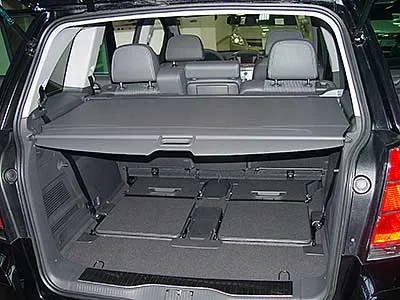
Considering the possibilities of transforming the interior, I unexpectedly encountered a problem in carrying out this transformation. It is not entirely intuitive what to press and what to move. I involuntarily recalled words from various brochures on the operation of household appliances about the need to read the instructions before using the device. After the manager of "Delfo-Auto" kindly agreed to demonstrate the possibilities of transforming the interior, everything seemed clear. The possibilities exceed all expectations. The designers thought through the interior details to the smallest detail. Everything is in its place, even the curtain covering the luggage compartment has its place when the interior is transformed for transporting seven people or bulky cargo. I think that the new owner of the Zafira will have an exciting game of demonstrating the car's capabilities to others in the first time.
"Pros" of the car — the best price-quality ratio (the price "in the base" is $19,990 — only "Koreans" are cheaper), rich basic and additional equipment (sometimes having no analogues), affordable service.
"Cons" of the car — poor sound insulation, inconvenience of using the "spare tire", increased requirements for the cleanliness of shoes in particular, and the cleanliness of the entire car as a whole. <\/em><\/p>