
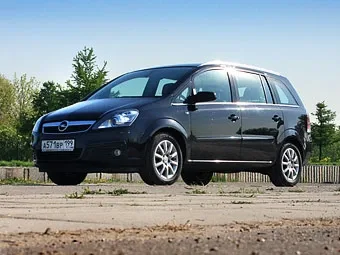
Diesel Power
I confess honestly: my objectivity in this material will probably suffer. Rather, I will be openly biased. This is because diesel engines are the benchmark of an everyday car for me. For those who drive a lot on highways, or for a family that loads up every weekend and heads to the dacha, in my opinion, there is simply no alternative.
I spent just over a week with the Opel Zafira with the new 1.9 CDTI turbodiesel (the letter D in the name is exactly what 'diesel' means), and during all this time I never regretted that I got this particular car for the long holidays. Who would refuse a car that can cover about 900 kilometers on a full 58-liter tank!
 |
Mmm!
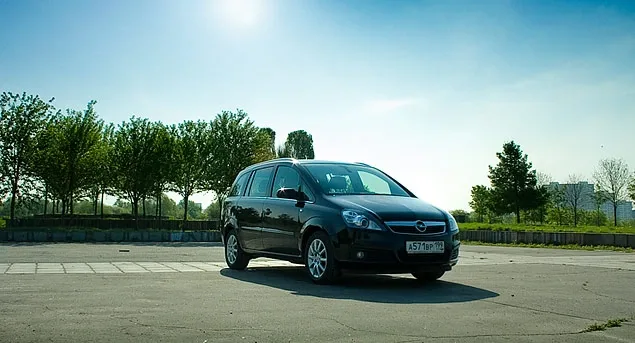
And all this is thanks to the 150-horsepower engine with a simply inexhaustible reserve of torque, which is also quite modest in appetite. On the highway, you can engage sixth gear once and forget about the gear lever until the end of the journey. The engine pulls equally briskly at 90 and 180 kilometers per hour, and behaves not at all diesel-like: it revs happily up to five thousand rpm and doesn't die at the top end.
If you maintain a cruising speed of 100–110 km/h, the average consumption will be only 5.5–5.8 liters per hundred. This is, of course, a bit more than the stated 5.2 liters, but it's quite explainable — real driving conditions on a busy highway were taken into account.
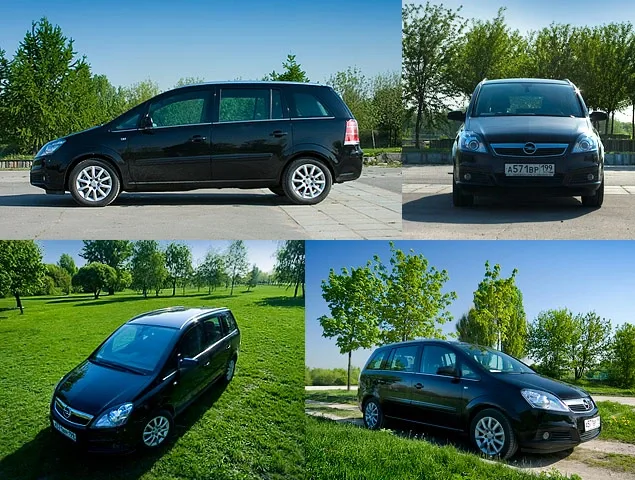 |
At first, the suspension of the diesel Zafira seems a bit stiff — definitely so for a family car. The dense, European-tuned chassis meticulously follows every curve of the road surface, transmitting every bump to the steering wheel and seats, albeit in a somewhat smoothed form. But this firmness also has an undeniable plus: the suspension has excellent energy capacity, and even on a broken road, the Zafira doesn't bother you with impacts or longitudinal body sway.
Moreover, the Zafira handles not at all as one might expect from a minivan. The feeling of sitting behind the wheel of a bus is certainly present — due to the high seating position, the unusual tilt of the steering column, and the gear lever located on the protrusion of the center console. But in the behavior of the Opel Zafira, there is no hint of that heaviness you subconsciously expect from a car of such dimensions and with such a high center of gravity. On the contrary — responses to steering input are quick and precise, body roll is minimal, brakes are convenient and informative, and the clutch pedal is clear. And most importantly — confident acceleration in almost any situation. For a diesel minivan, the character is, frankly, atypical.
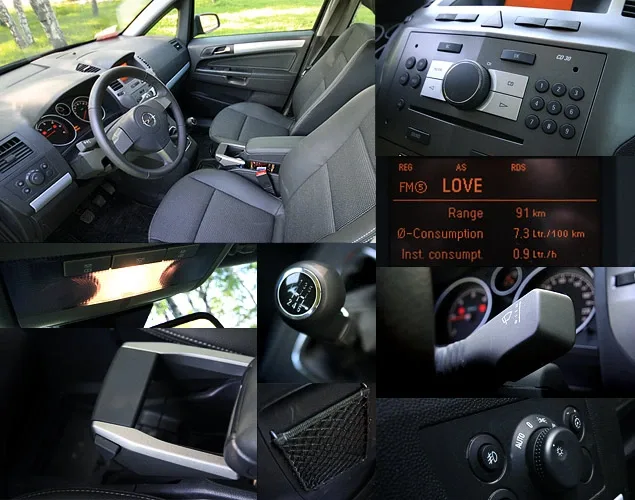 |
It will be comfortable for second-row passengers and for those who end up 'all the way in the back' — on the third-row seats, which fold away into recesses in the floor. I had read a lot about the Flex 7 interior transformation system, but I saw it in person for the first time. It turned out to be unexpectedly simple but very sensible. The backrests of the third-row seats, when folded, are placed under the cushion of the second-row bench, so they don't eat into the trunk volume — the usable space remains fully preserved. And it's not cramped in the 'gallery' in the Zafira either — I checked personally. Special stampings in the floor for feet make seating natural, and the seats themselves, though compact, are equipped with headrests and are quite suitable for a long journey.
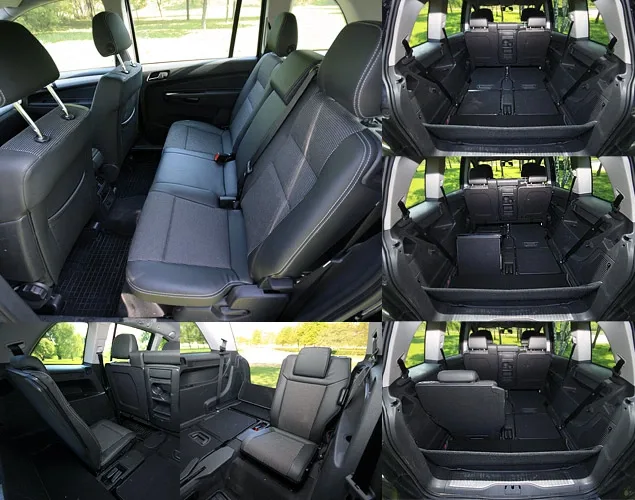 |
True, in our car in the Cosmo trim, the second-row bench was solid, so its transformation was limited to sliding back and forth and lifting the cushion — this is needed to get to the third row or increase the trunk for large items. On more expensive versions, the second-row seats are separate, which is certainly more practical.
Well, and of course, the Zafira also offers a panoramic glass roof, a fancy 'piano lacquer' finish on the front panel, a modern multimedia system with a large color screen, and many other useful or simply pleasant little things...
Arithmetic Lessons
Having read the first part of the material, you probably decided that diesel is a great way to save money. I hasten to disappoint: this is a misconception. Because owning a diesel car in Russia is not as profitable as it seems at first glance.
Firstly, diesel versions cost more. Take the same Zafira: our Cosmo trim with a diesel will cost 799 thousand rubles, while an identically equipped minivan with a 1.8 petrol engine (140 hp) is 110 thousand rubles cheaper.
Secondly, the fuel itself. Yes, the Opel Zafira 1.9 CDTI in the city cycle officially uses 2.2 liters less than the petrol version, and in real life the difference turns out to be even greater. But even if the diesel owner saves three liters of diesel per hundred kilometers, with equal prices for diesel and A-95, that's only 75 rubles. Or 20–22 thousand rubles per year with an average annual mileage of 25–30 thousand kilometers. So the average driver will be able to recoup the price difference between a diesel and a petrol car only after about five or six years. And most people change cars much more often.
 |
And finally, maintenance. For most diesels sold in Russia, service intervals are shorter than for their petrol counterparts. For the Zafira with a diesel, this is 10,000 kilometers versus 15,000 for the petrol version. The maintenance itself is also 15–20 percent more expensive. And if, God forbid, you fill up with low-quality diesel, the repair of the fuel system will fall on your wallet; you shouldn't count on the warranty.
And the blame for this lies not with automakers, but with domestic oil companies. It is precisely because of the unstable quality of Russian diesel that automakers shift responsibility for the operation of diesels onto buyers — by introducing special warranty conditions or reducing service intervals. However, the situation is gradually changing for the better: the same Opel relatively recently lifted regional restrictions on the operation of diesel cars (previously they were allowed only in the Moscow and Leningrad regions), and in 2008 several other well-known brands began selling their diesel models in Russia.
And in general, the clatter of diesel engines on our streets is now heard more and more often. And that's great! Because diesel is the right thing. Even if it's not as profitable as it might seem at first glance.
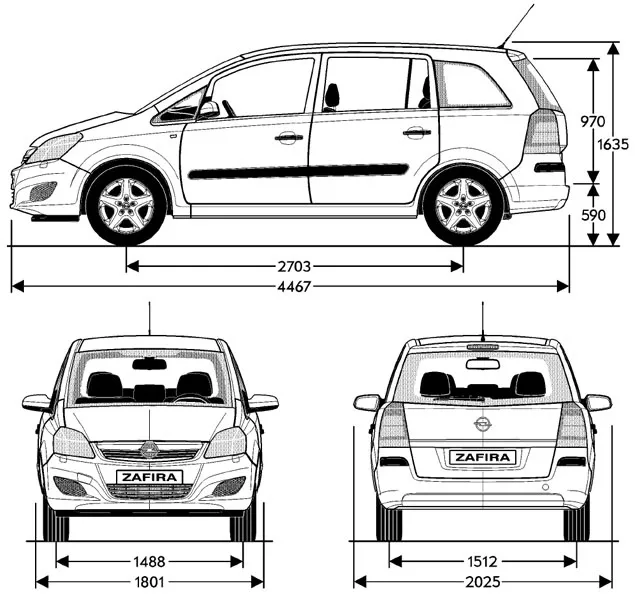
Technical characteristics of Opel Zafira 1.9 CDTI
| Length, mm | 4467 |
| Width, mm | 1801 |
| Height, mm | 1625 |
| Wheelbase, mm | 2703 |
| Curb weight, kg | 1503 |
| Engine displacement, cm3 | 1910 |
| Power, hp/rpm | 150/4000 |
| Torque, Nm/rpm | 320/2000 |
| Acceleration time from 0 to 100 km/h, s | 10.4 |
| Maximum speed, km/h | 202 |
| Fuel consumption in combined cycle, l/100 km | 6.1 |
 |