
Opel Vectra. Vector analysis
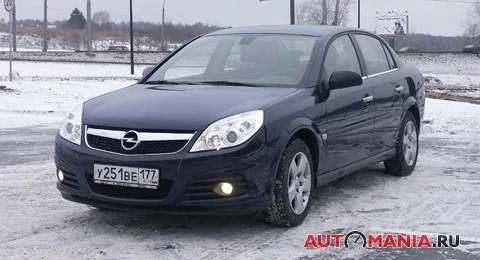
The version with xenon and parking sensors can, of course, be taken for $34,000, but whether the price matches the quality is a separate question, and it's far from idle.
Why did we so persistently look for this particular Vectra New from the ad? The thing is, I've been driving a Vectra B of the previous generation for seven years. When a couple of years ago I got behind the wheel of a Vectra C for a test, I was, to put it mildly, disappointed. And I wasn't alone — my fellow journalists were too. Maybe in the new version, Opel's engineers fixed the mistakes? Let's see...
They did manage to do something. For the test, we took the middle version of the "people's German" — with a 2.2-liter engine producing 155 hp (we didn't even consider the 1.6 and 1.8 engines: they can't even handle the Astra, and for the heavier Vectra they definitely won't be enough). The turbocharged 2.0 and 2.8 also didn't interest us: on an Audi or BMW, such engines make sense, but on an Opel, only the most desperate brand fan would overpay for dynamics for the sake of the lightning-bolt badge on the grille. I'm not a fan; I'm just a consumer.
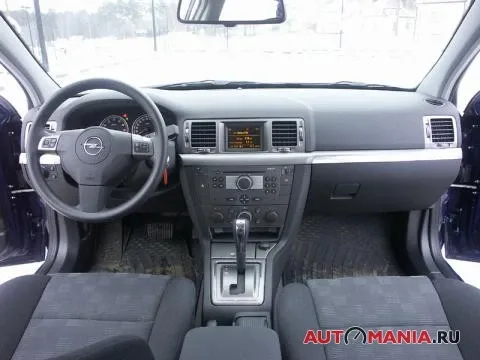
Getting behind the wheel and driving a couple of dozen kilometers, I immediately remembered the Ford Mondeo. Everything is almost the same, but slightly worse. And when a customer learns that the Opel in Cosmo trim with the 2.2-liter engine costs $29,200, while the Mondeo with the 2.5-liter costs $29,500, then "discussion is inappropriate." I immediately called the car a "poor man's Mercedes" and tried to relax. But that wasn't to be...
Of course, the updated Vectra C (outside — the vertical headlights have become horizontal again, chrome was added, inside — a new center console) is in many ways better than my 1998 Vectra. But in some ways it's inferior to it.
Despite the criticism, the new version still has non-latching turn signals on the left steering column stalk. Controlling the onboard computer has become even more complicated: each operation takes several minutes, and you have to make a bunch of unnecessary movements with your right hand. Doing this while driving is unrealistic — you could crash. If on the Vectra B switching the FM radio wave was a matter of seconds, here you'll have to spend a lot of effort and time. Although you can save 30 stations and control them with the wheel on the steering wheel. But you won't need most stations — the radio works so poorly that even in the city center it loses strong frequencies, like 104.7 or 106.2.
The car now has cruise control, which isn't the most necessary thing in Russia, dual-zone climate control, a light sensor in the central and side mirrors, and the turning radius has significantly improved. But it's unclear why a mid-class car for thirty grand doesn't have parking sensors, headlight washers, or even hydraulic shock absorbers (all of this was on my car seven years ago).
If it weren't for the excellent acceleration dynamics (torque has grown to 220 Nm) and fuel efficiency (11.6 l in the city, about 8 l per 100 km on the highway), the Vectra with horizontal headlights would have completely disappointed me.
Honestly, over 300 km of driving, the new Vectra even tired me out. Not so much the turn signals or the computer, but the crazy reflection of the air duct under the windshield. Even in cloudy weather, the glare is strong, and when the sun came out, driving became simply impossible.
Dmitry Shavyrin
Technical specifications of Opel Vectra 2.2:| Dimensions (mm) | 4611x2036x1460 |
| Wheelbase (mm) | 2700 |
| Engine displacement (cm3) | 2200 |
| Power (hp) | 155 |
| Average fuel consumption (l/100 km) | 10.3 |
| 0-100 km/h acceleration time (s) | 9.4 |
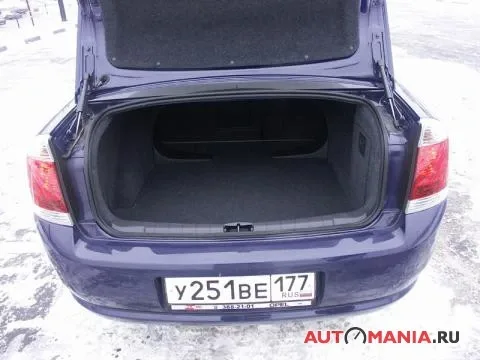
| Trunk volume (l) | 500 |
| Tires | 205/55 R 16 |
| Price (rub) | from 710000 |
Source – AUTOMANIA.RU