
Opel Meriva. Tom Thumb
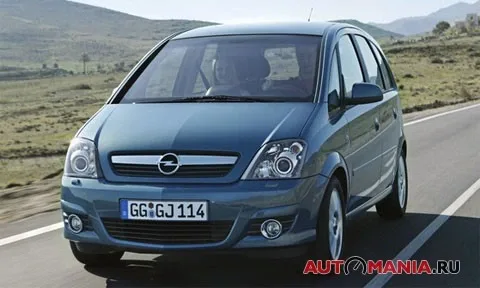
Today, it seems, everything is being bought on the imported car market. Even those cars that, by conservative taste, should not be in particular demand. For example, frankly family compact vans on B-class platforms. Nevertheless, manufacturers are vying to boast of stable sales growth for such products. Last year was especially successful for the eternal middle-of-the-roader — German Opel, which finally got a return from a radical change of concept several years ago. Back then, the "down-to-earth" brand fired off a whole range of diverse "vans," among which were the expected Zafira, the pompous semi-estate Signum, and the smallest of the one-box models available to the domestic buyer — the Opel Meriva.
The latter car, from a European's point of view, is rather unusual. Such compact vans were first loved by the Japanese, and residents of the Old World "savored" them relatively recently, but immediately appreciated the advantages of the design and excellent functionality. So the designers from Russelsheim only had to develop the theme and fit it to corporate standards.
Usually, compact one-box models, like their subcompact counterparts, do not spoil with their exterior: they are boring and absolutely unemotional. The Meriva, on the contrary, turned out to be quite interesting on the outside. With its sloping rear, it slightly resembles a small bus. True, the designers tried to veil this — as a result, the car got a touching and cute "face" with almost alive "eyes" and a charming "smile," as well as quite athletic body contours. By the way, the Germans already have a new generation of the model almost ready. More precisely, a concept of the same name, presented in Geneva at the very beginning of March. In essence, it differs nothing from the current Meriva, but at the same time it can be considered the next step in the evolution of compact one-box models — even more versatile, stylish, and functional. In the press release before the premiere, the Germans also emphasized a lighter and airier interior.
The same, however, can be boasted by the still living predecessor. By the way, it is only 7 cm shorter, only 1.5 cm narrower, but as much as 20 cm (!) higher than the Astra, so while maintaining the notorious bus-like seating position, at least four adult passengers will fit in the Meriva, and they will be quite comfortable. The driver, of course, is most comfortable: an anatomically correct seat, perfectly readable instruments, logical arrangement of equipment, a grippy steering wheel... But you still have to find a compromise between the comfort of rear and front passengers, although, despite the modest dimensions, the car is quite spacious inside. There is plenty of space above the head, and the necessary minimum in the legs, unless, of course, the seats are not pushed all the way back (they slide by 13 cm).
The sofa is divided into three completely independent parts, and in the most practical proportion — 2:1:2. Actually, this is the main advantage of the fifth version of the proprietary Opel Flex Space transformation scheme. The backrests of the outer seats are adjustable in angle, and the central part folds down, forming a kind of armrest. There, by the way, you can install the Travel Assistant box for storing a dozen CD discs or other small items. But even if you refuse this option, small items will not roll around the cabin. Firstly, each door has a separate pocket, and secondly, there are luggage nets on the center console and in the cargo area. If necessary, to take "on board" bulky luggage, the cargo area will come to the rescue. Moreover, buyers are offered an extremely simple algorithm for transforming the second row of seats. First, the headrests are removed, then the backrests are folded, after which the entire seat "sinks" into the floor — as a result, a completely flat platform for placing cargo is formed. You can also fold the backrest of the front passenger seat, thereby maximizing the useful space for transporting long items.
It is also gratifying that all the listed advantages are supported by a very attractive execution. At first and even second glance, the car's interior design is graphic and somewhat cold: the interior is made in the traditional Opel style of recent years (remember, for example, the current Vectra). But apparently, the external "toy-like" nature of the compact van requires some counterbalance — and that is what the interior became. The choice of materials for the interior trim is not bad at all. It is clear that there is no soft polyurethane or leather here: for such a budget car, they are too expensive. But the proposed plastic looks quite decent. There are no complaints about the assembly either — everything is done in a German, precise and correct manner. As a result, for their money, the buyer gets a cute, almost feminine car with a very strict but respectable cabin.
The modified Opel Corsa platform, of course, implies the presence of an appropriate set of power units and transmissions. In principle, if desired, the client can order a "super-hot" 180-horsepower compact van from the proprietary OPC tuning center, but most potential buyers, of course, will prefer the "down-to-earth" versions. In the fall of 2007, turbodiesels also appeared, but currently, domestic motorists are usually offered only two petrol engines of the Twinport family with a displacement of 1.4 and 1.6 liters. In principle, 90 "horses" of the base engine with a manual gearbox is enough for such a car. However, unlike most classmates, the Opel Meriva turned out to be quite heavy (1300 kg), so when choosing a power unit, it is worth paying attention to the more voluminous 105-horsepower example. It pulls well both at low and mid-range revs. Even despite the fact that such a compact van reaches 100 km/h only in 13 seconds, it is pleasant to drive both in the city and on the highway. The quite moderate fuel consumption is also pleasing...
The only drawback is the optional Easytronic "gearbox." Unlike a simple torque converter automatic transmission, it is designed for movement not in automatic but in manual mode. The main mistake of clients ordering it is that they assume they will get an equivalent replacement for an "automatic," whereas the "robot" is essentially a regular "manual" equipped with an innovative clutch. The absence of the left pedal here, by and large, is only intended to ease the driver's lot in "traffic jams." "Automatic" movement in traffic is accompanied by strong jerks during shifts. Moreover, when trying to accelerate sharply, the gearbox begins to frankly "lag." In short, in such a situation, it is easier and, probably, safer to shift gears yourself. Fortunately, for this you only need to slightly rock the gear lever. The secret of smooth movement is simple: when shifting from one gear to another, you should handle the gas the same way as with a regular manual gearbox — release, shift, press... Then the car will go without jerks.
The buyer always has the opportunity to equip the Meriva with the optional IDS chassis and become the owner of not only a full set of safety systems, but also an electronic shock absorber control system that provides simply phenomenal comfort. However, the compact van also drives quite decently with the regular suspension. The body elastically works through almost all road surface defects. Small potholes and bumps are completely unnoticed.
In general, this car provides its owner with a quite decent set of qualities for reasonable money. This is what motorists of the Old World bit on in their time. Our citizens, however, are also gradually getting involved.
Technical specifications:
| Dimensions: | Opel Meriva |
| Length (mm) | 4052 |
| Width (mm) | 1948 |
| Height (mm) | 1624 |
| Wheelbase (mm) | 2630 |
| Mass (kg) | 1330 |
| Trunk volume (l) | 350—1410/2005 |
| Engine displacement (cm3) | 1598 |
| Max. power (hp) | 105 at 6000 rpm. |
| Max. torque (Nm) | 150 at 3900 rpm. |
| Max. speed | 181 |
| Acceleration 0-100 km/h (s) | 14.3 |
| Average fuel consumption (l) | 6.7 |
| Price (rub.) | 424,000—514,000 |
Magazine "Autogid" 07 March 2008 No. 56
Source – AUTOMANIA.RU