Herald
The three incarnations of the Opel Vectra, as well as the Signum estate built on its basis, are a thing of the past. They have been replaced by the Insignia, which can no longer be called just a successor — the car has been redesigned beyond recognition and has become noticeably better. I became convinced of this at the first European press presentation of the Opel Insignia, held near Salzburg, Austria.
And do you know how the new Insignia was shown to the public in London? A spectacular stunt: the car was dropped from a height of 45 meters, and six seconds of free fall made more than three hundred spectators freeze, as the flight was cut short only near the ground!
Night ride
Few automakers allow journalists to drive at night during a presentation. They say we don't know how to drive, we'll crash or something. Strangely enough, the only accident during the event (and they happen regularly) occurred during the day on the highway: a Mercedes-Benz S-Class rear-ended one of the test cars.
The test organizers took a risk and planned the route so that we would reach the overnight stop after dark. How else could we evaluate the new adaptive lighting system Adaptive Forward Lighting (AFL+)?
I liked AFL+, especially the automatic switching from high beam to low beam when oncoming traffic approaches. But this particular function, in my opinion, is categorically unsuitable for Russia. If the road is straight and flat, the low beam will turn on in advance as soon as someone else's headlights appear on the horizon. However, if an oncoming car emerges from around a corner or from behind a hill (which often happened on Alpine serpentines in Austria), its driver will be blinded before the electronics figure it out. Europeans took the late switching off of high beams with understanding, but Russians are used to "retaliating" for any incorrect behavior on the road, so be prepared for frequent flashing of high beams in response. Moreover, AFL+ sometimes mistakes signs with settlement names or paired road signs for oncoming traffic and switches to low beam. I love the automatic exterior lighting mode — set it and forget it. If only the Opel Insignia had a separate button for the "high-low beam" function...
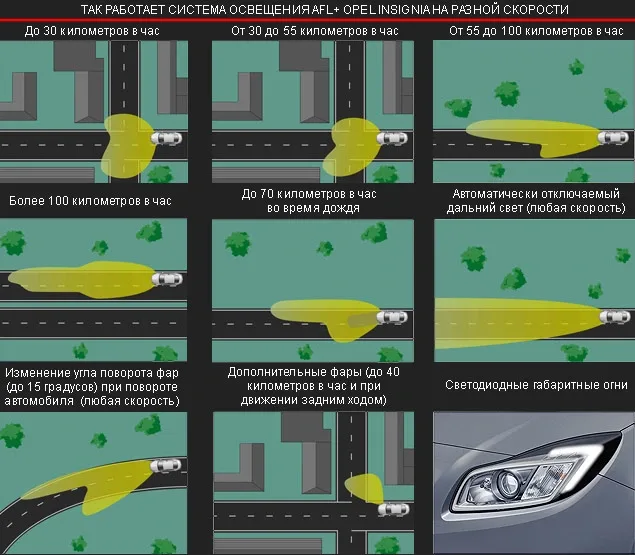
In addition to the described, the adaptive headlights have eight more modes. Up to 30 km/h, the "pedestrian mode" works: the beam spreads to the edges of the road, expanding the lighting area by eight percent. When accelerating to 55 km/h, the beam lowers and becomes narrower, allowing better visibility of people on the roadside. Further, up to 100 km/h, the headlights shine brighter, spreading light 70 meters ahead, and above a hundred, the beam length reaches 140 meters. In rain or snow, when the wipers are working, the beam spreads to reduce reflection from drops and snowflakes, saving the driver from temporary blindness. The headlights turn with the steering wheel at an angle of up to 15 degrees, and if you drive slower than 40 km/h and turn the wheel more sharply (for example, for a turn at an intersection), an additional lamp turns on, illuminating the road from the side. Both side sections turn on when reversing, and LED parking lights are built into the headlight block.
 |
AFL+ is an optional extra, but its operation (except for the "high-low beam" automatic) is unlikely to be noticed by the owner. Changes in light parameters are hard to catch with the eye, but there are no complaints about the headlights — meaning they illuminate the road well, and that's the main thing.
Class struggle
The base version 1.6 MT6 "Essentia" for 670 thousand rubles already includes ESP, four airbags, air conditioning, light sensor, electric driver's seat height adjustment, front electric windows, onboard computer, 16-inch stamped wheels, fog lights, and heated washer fluid "Hot Shot". But the Insignia will have to fight in one of the most saturated segments of the Russian market.
For example, for the same money you can take a Mazda6 in base with a 1.8-liter engine producing 120 horsepower, a Passat in Trendline trim with a 1.6-liter engine and five-speed manual starts from 650 thousand rubles, and a Ford Mondeo in Ambiente version with a 125-horsepower 1.6-liter unit will cost over a hundred thousand less than the "German" from Rüsselsheim. In the base Dynamique trim for 639 thousand rubles, the new Citroen C5 is sold with a 1.8-liter engine producing 127 horsepower, and from 637 thousand costs a Peugeot 407 "on the stick" with a 1.8-liter engine.
The Insignia estate will appear at dealers in spring 2009, along with another version of the 2.0-liter diesel with two turbos producing 190 horsepower and a 1.6-liter turbocharged engine producing 180 horsepower (almost the same is under the hood of the Opel Corsa OPC).