
I couldn't fall in love with the latest Opel models — Vectra, Astra, Corsa, or Zafira. On the outside, they looked attractive (I still consider the three-door Astra GTC one of the most beautiful in its class), modern, and technologically advanced. But once you sat inside, you got the feeling that instead of a charming girl, Miss Bock had come to the date. She might be kind at heart, but you don't realize that right away.
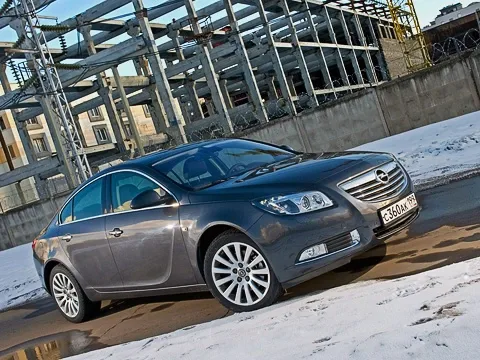
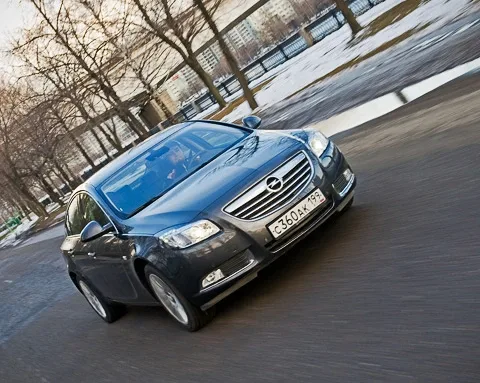
Here it is, the new face of Opel. Not as square as before, but not bloated either. The same grille, by the way, will be on the new Astra.
The aroma of tarpaulin boots in the cabin did nothing to endear it to me. The instrument lighting was harsh, the engine hummed monotonously and tiresomely at high revs, the leather was rough, and the logic of the onboard computer controls was as confusing as a labyrinth. Add to that the fact that there was absolutely nowhere to put your phone. The result was a complete lack of coziness.
The exception was the "hot" OPC versions. But they didn't flirt with the driver; they got straight down to business — offering a stiff and uncompromising drive. Here, other smells matter: burnt rubber and hot engine oil.
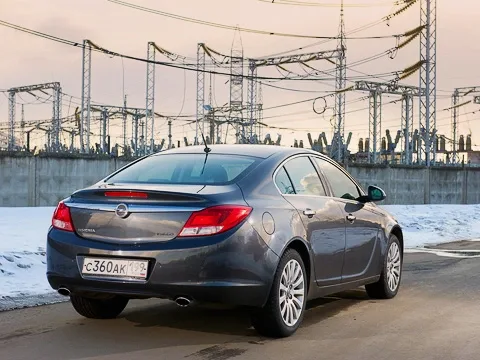
Two exhaust pipes and a Turbo badge reveal the powerful version.
The Insignia greets you completely differently. A sweetish aroma reminiscent of Volvo, the quiet whisper of the turbo engine, plenty of compartments for small items, and large, logically placed buttons on the center console. Even the emblem has changed — now the letters O, P, E, L are arranged in a circle, as in the old days.
In some incomprehensible way, the Insignia managed to charm the jury of the "Car of the Year — 2009" contest and won. Opel's own PR people apparently didn't expect such success: at the presentation of the sedan and hatchback last year, only a modest handful of journalists were invited, but the premiere of the Sports Tourer wagon, which took place after the triumph, gathered many more press representatives.
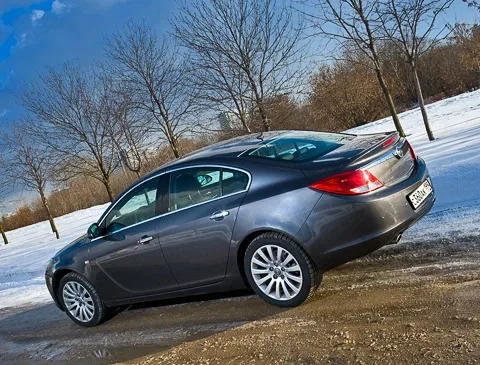
The Insignia is significantly larger than the Vectra, although it hardly looks massive. And the wheelbase compared to the Vectra has increased by only 37 mm.
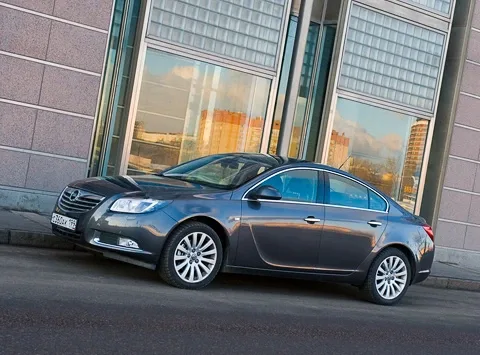
Design! Without having properly polished the sharp edges of the Astra, Opel took a step in the right direction. But the Insignia truly looks elegant only with a certain body color, at a certain viewing angle, and on optional 20-inch wheels, which, however, hardly anyone will order.
And yet you catch yourself thinking: no matter how much you argue about the appearance, the car turned out to be striking and is perceived as a designer piece. If Volkswagen had to create a separate niche model for this — the Passat CC — then the Insignia represents design available to the masses.
Base petrol engines: 115-hp 1.6 and 140-hp 1.8. The rest are turbocharged. In addition to the 220-hp two-liter, there's also a 1.6 (180 hp) and an Australian 260-hp V6, familiar from the previous Vectra and Saab 9-3. There will also be an Insignia OPC. Most likely, it will pack around three hundred horses. But diesels (110–190 hp) are not for us.
True, the cramped rear row doesn't fit well with the concept of a mass-market car. There's little room for legs, and for the head too: just like in previous generations of the BMW 3 Series and Audi A4! You say the Passat CC is cramped? Here it's no better! And thick rear pillars also hinder passengers from looking around.
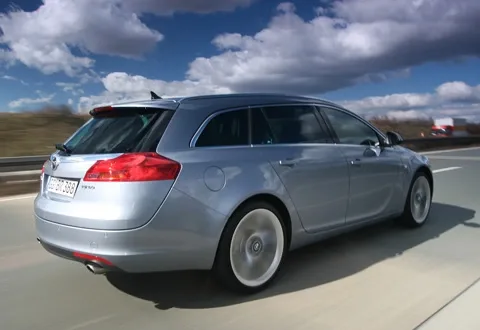
The wagon, now called not Caravan but Sports Tourer, is more pleasant in this regard: there's more headroom. And it looks even more designer-like! Beautiful profile, taillights integrated into the fifth door. Harmonious. Legroom, however, hasn't increased. Unlike its predecessor — the Vectra Caravan — the Insignia wagon's wheelbase is no longer than the sedan's (2737 mm). But the rear overhang has grown by 80 mm, and the trunk (540 L) is even more spacious than the Vectra's! But despite the modest space, the interior makes a strong impression. I usually don't use phrases like "the cabin literally envelops you." But what can you do if it really is so?
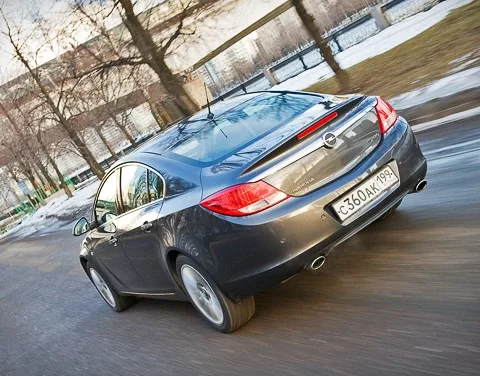
Despite the excess of sharpness in the city, the Insignia holds a high-speed straight well. The 220-hp engine is more than enough for it.
The leather on the steering wheel is delicate, as if taken from cows previously butchered by Volkswagen. The plastic is high-quality. The buttons and knobs are rubberized, with chrome — top-notch. And note, the steering column stalks are the usual ones with detents. As for the plastic "wood" in the cabin — not a single complaint: it's the best wood substitute I've come across lately.
All this doesn't mean that Opel has caught up with and surpassed Volkswagen in quality. Although the materials are good, every part of the Insignia "breathes," creaks, and whines when pressed. Not like the Astra, which felt more solid. But what coziness! For a complete sense of comfort, only dirty socks thrown under the seat are missing.
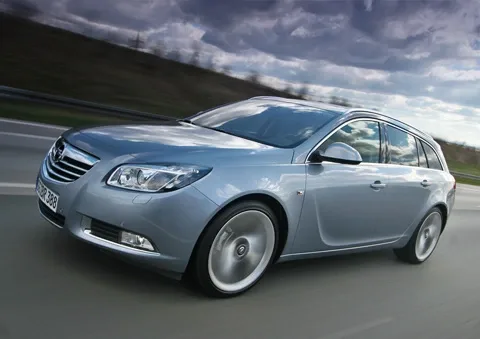
The name Caravan was used by the company for wagons for over 50 years. And now it was decided to change not only the "base" name but also the suffix.
You sit comfortably behind the wheel, the only thing — at my height of 190 cm, I want to move the steering wheel closer. But visibility is just terrible. Neither through the side mirrors (they're sacrificed to aerodynamics: the drag coefficient of the sedan is only 0.27) nor through the rearview mirror can you see almost anything.
What completely doesn't match the car's character are the seats! They're not ideal in themselves, and they also suffer from a lack of lateral support — there's no grip in them. In this regard, they're no better than chairs from Louis XVI's interior. For base versions, such might be acceptable, but I have the 220-hp one!
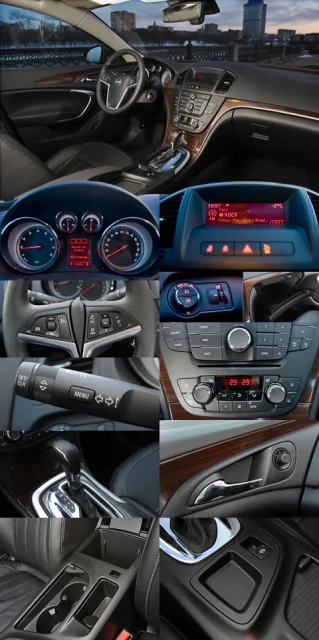
- The cabin is beautiful and delights with carefully crafted details.
- The instruments are perfectly readable, and in the version with the FlexRide system, their backlighting in sport mode becomes red instead of white.
- The steering column stalks are round in cross-section and have detents.
- The climate control display is located a bit low, and the symbols on it are small. But the main annoyance is the delays when changing parameters.
- In expensive trims, the Insignia is equipped with a kind of analogue of the iDrive system, and in simple ones, instead of it, there's a niche where you can't really put anything.
And the chassis is sharp! And the steering wheel — even too much. You turn it slightly, and the car sharply changes course. But that's at low speeds, and on the highway, reactions become calmer. Here, the power steering comes in handy. It's a regular hydraulic one, and on expensive modifications — with variable performance: the effort on the wheel increases with speed, and nervousness disappears.
I got the version without the active FlexRide chassis, but with Sachs shock absorbers equipped with electromagnetic valves. Such an Insignia has three modes selected by pressing a button: Tour, Normal, and Sport. Everything changes: the color of the instrument backlighting, the algorithm of the stability control and power steering, the resistance of the shock absorbers, and for all-wheel-drive versions — the torque distribution between the wheels. Tour mode is for calm driving, Sport for spirited driving. Moreover, the rear suspension of all-wheel-drive modifications is more advanced, with transverse H-shaped arms. And front-wheel-drive ones make do with the same as on the Vectra.
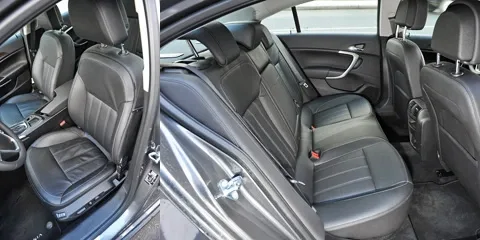
- The front seats are decent, but for a powerful car with fairly sharp steering responses, you want something sportier. Fortunately, contoured seats with an adjustable-length cushion and ventilation are offered as an option.
- In the back, it's frankly cramped, both in the sedan and the wagon. But the latter is more advantageous due to the less sloping roof.
Even in the front-wheel-drive version, the Insignia has almost managed to get rid of the disease of many Opels — poor directional stability on bad roads. The car pulls less at the wheel in ruts, even despite the wide 235/45 R18 tires. Thanks to the retuned front suspension with a reduced scrub radius. The rear suspension correctly "licks" bumps, and the car no longer jumps off the trajectory when braking.
But that's only in terms of handling. The trouble is serious bumps: the car doesn't like them. And it's not just potholes with sharp edges; sometimes even sharp waves in the asphalt make the suspension "sit" on the bump stops. Although on good surfaces, there are no questions about ride smoothness. A bit stiff, but without pitching.
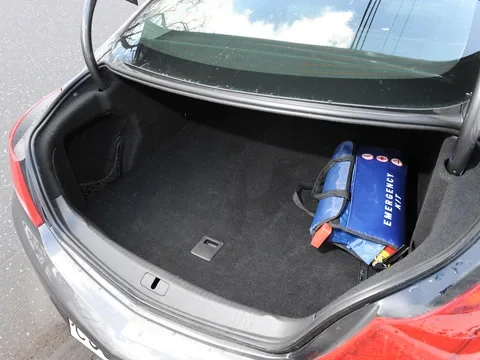
The trunk volume is the same as the Vectra's. In the European version without a full-size spare wheel, it's 500 liters (520 for the hatchback). The opening is not the most convenient.
The Opel Insignia replaced the Vectra, whose first generation (with the A index) debuted back in 1988. It was assembled not only in Rüsselsheim but also in the UK — where the car bore the name Vauxhall Cavalier — and in Brazil under the Chevrolet Vectra brand. At the start of sales, the base engine was a 1.4-liter unit with 75 hp, but later the range was supplemented with serious powertrains — for example, a 2.5-liter V6 (170 hp) and a two-liter turbo engine producing 204 hp. The latter, by the way, could be paired with all-wheel drive. The body range included a sedan and a hatchback, and in 1989, the Calibra coupe was built on the basis of the "first" Vectra.
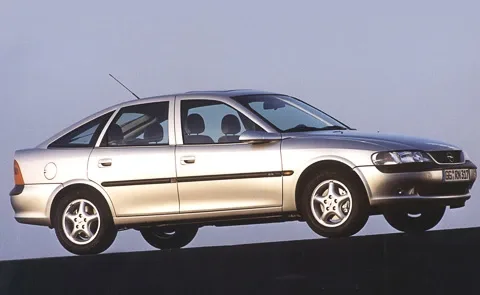
The second generation of the model — the Vectra B — came out in 1995 and was remembered for its unusual appearance, especially the original side mirrors. A station wagon was added to the sedan and hatchback, and the model was also sold in Australia under the Holden brand.
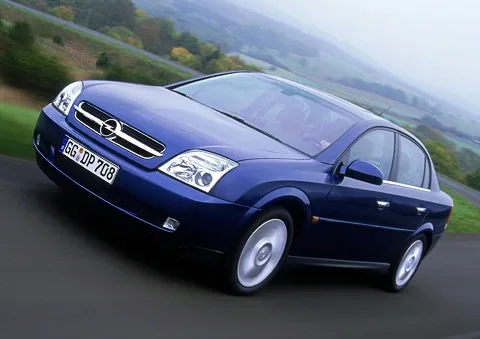
The third generation, which appeared in 2002, again claimed to be a breakthrough: fresh design, up-to-date equipment, an extensive list of engines. But it seems the vector wasn't quite right — buyer interest quickly faded, and even the facelift along with powerful OPC versions (2.8 liters, 255–280 hp) didn't save the situation.
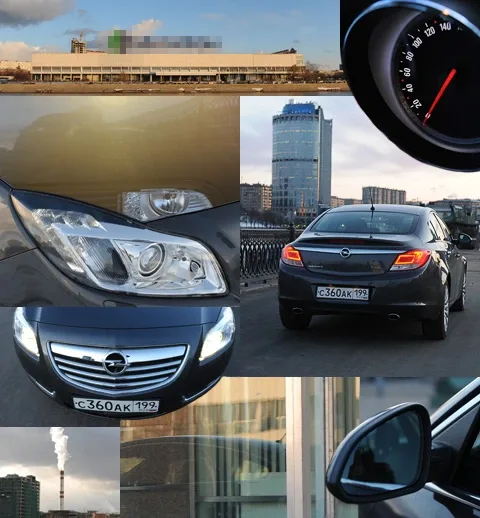
I got acquainted with the Insignia sedan almost immediately after the station wagon was shown in Germany. The meeting happened in Moscow — that's why most of the photos are from here: in our region, the sedan will likely be more popular.