
Opel Astra Sedan. A Pole for third-world markets
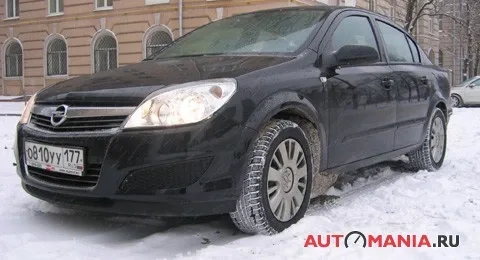
Why did the Astra with a trunk appear? For a very simple reason. In Europe, demand for sedans is four times lower than for hatchbacks (roughly 20% to 80%), but in the aforementioned countries the picture is completely different – 70% of potential buyers want sedans, and only 30% want hatchbacks. GM marketers did not particularly bother to figure out why discerning Europeans do not need a full-sized spacious trunk. They took the wheelbase from the Astra Caravan and made the Opel Astra Sedan – a completely new player among C-class cars with this body type, surpassing even the D-class Vectra in dimensions by 83 mm. It would be cool if only the engine were not so underpowered – 1.6 L (115 hp) or 1.8 L (140 hp), but something more powerful. The tested car was equipped with a 115-horsepower engine. The same one, by the way, is in the KIA Spectra, which is almost 400 kg lighter and 250 mm shorter.
The car evokes very contradictory feelings. On the one hand, it is the largest among its competitors (Hyundai Elantra, Ford Focus, Mitsubishi Lancer, Chevrolet Lacetti) and even surpasses its older sibling, the Opel Vectra, in length. At the same time, it is almost the most expensive even in the mid-level trim and has a bunch of both minor and major drawbacks that its class rivals managed to avoid.
But let's take it in order. The new car is an addition to the Opel Astra model range. There were 3- and 5-door hatchbacks, station wagons, and even convertibles. But the Astra never had sedans (we do not count the Tolyatti Chevrolet Viva).
It is not assembled in Germany at all, but in Poland at a new plant in Gliwice, the same place where the Zafira and the tiny Agila, which is not sold in Russia, are produced. If we believe the assurances of GM marketers, almost 90% of the new model's exports will go to the markets of Turkey and Russia. But if that is the case, then why is the price set at 552,000 rubles ($23,000), which significantly exceeds the price of the mentioned competitors? And this is the price for a car with a 1.6 L engine producing 115 hp. The car with the 1.8-liter engine naturally costs even more (in full trim – over $31,000). Even a completely bare car (without a radio, seat heating, or power windows) costs 497,000 rubles ($20,350), which is incomparably higher than the price of rivals with their base trims. The most expensive Astra Sedan with the 1.8-liter 140-hp engine will cost you 717,000 rubles. And you will not get many options for that (more on this below).
The base black sedan in the mid-level Enjoy version with a manual transmission that I got for the test cost 528,000 rubles. The car did not have an onboard computer, which, of course, can be installed if desired for an extra 5,500 rubles. However, it is hard to call this "miracle of modern technology" a full-fledged onboard computer. It cannot show you the average fuel consumption, the daily mileage, or how many kilometers you can drive on the remaining fuel in the tank. The rear doors have crank handles. If you want rear power windows – get ready to pay another 8,000, 11,000 for a CD 3D stereo, add 10,000 for a headlight washer (which was not on the tested car), 4,500 for fog lights, 8,500 for parking sensors (rear only). A whole range of other options can be installed for an additional fee. For example, 16-inch alloy wheels (another 22,000 rubles). In general, everything that in the 80s made an ordinary car a comfortable "foreign car" for a Soviet person and created that comfort for the driver and passengers is, in this case, considered some kind of "excess," and you get all of it for extra money.
We made do with what we were given. On the second day of the test, a terrible snowfall began, then road services generously watered the roads, and all road users found themselves in a real mud bath. Probably, there is no such dirt in Poland. Otherwise, why would the car's creators have been too lazy to test it in a wind tunnel for dirt accumulation before putting it on the assembly line? On a dirty road, the side windows and mirrors instantly become covered with a layer of dirt, and you have to clean them literally every 20-30 km. Not to mention the door handles and sills – getting out of the car clean is a real art. Refueling the car did not add to the mood. The fuel filler cap opens manually (not by pressing a button in the cabin, as in Korean and Japanese cars). Not only was it covered in dirt, but it also had no tether – the question is, where do you put it while refueling? Do you have to hold it in your hands?
You will feel like a real Cinderella (regardless of gender) when taking out or loading luggage. Some cars have a "clean hands" function. You press a button – the trunk opens and closes smoothly without your participation. In the Opel Astra, apparently, they installed the "dirty hands" package. There is also a button in the cabin, but it only releases the lock, which you must then open manually. Moreover, there are no recesses for your hand under the chrome trim with the Astra 1.6 inscription. There are also no handles inside the trunk. It also cannot be opened with the key, and if something happens to the electric lock drive, you can only access the trunk with the help of a car service. In general, the process of loading and unloading the trunk (which is very spacious, second only to the Renault Megane Sedan and Skoda Octavia in volume) can create unnecessary problems.
The advertising slogan of the new Opel Astra Sedan says – "more pleasure, comfort, and possibilities." Believe me – the creators are somewhat exaggerating. Acceleration and braking are a jolt for both the driver and passengers. Everything is too jerky and nervous. The ride comfort is highly questionable – the suspension is very stiff (you will feel all the "speed bumps" and joints of the Third Ring Road with your rear). Competitors do not have this problem. In addition, it is difficult to get comfortable in the driver's seat – it clearly lacks adjustments, and the ceiling is a bit low.
Another drawback appeared as soon as the sun came out. The windshield defroster vents are located in the center above the console and are strongly reflected in the windshield, obstructing the view.
The other drawbacks of the sedan were also inherent in other Astras before. The same non-latching turn signals (to the left of the steering wheel), vague wiper control, crank handles on the rear doors, hard plastic, low ceilings, lack of a full-fledged onboard computer, and an inconvenient air vent control algorithm. And, of course, the bone-jarring suspension.
But that is not all. The car does not even have an engine temperature sensor. Thank God they at least installed a tachometer. Visibility suffers not only from dirty side windows but also from small rearview mirrors. Almost nothing is visible through the rear window. Firstly, due to its very unfortunate angle, and secondly, due to the poor performance of the rear window defroster, which does not heat the glass completely, thawing only narrow strips in it.
The wide center console constantly presses against your right leg. If you like to switch radio stations while driving – forget about it. The audio system and onboard computer controls are so inconvenient and complex that you can only search for the desired station when parked. While driving – an accident is guaranteed.
When returning the test car to the dealership, I honestly thought that I would not advise anyone to buy a car with so many drawbacks for a considerable amount of money. It is better to add 2-3 thousand and buy not a 1.6-liter Polish Astra, but a Nissan Teana or Toyota Camry (2.3 and 2.4 liters, respectively).
Technical specifications:
| Dimensions (mm) | 4587 x 1753 x 1458 |
| Wheelbase (mm) | 2703 |
| Curb weight (kg) | 1314 |
| Gross weight (kg) | 1740 |
| Engine displacement (cm3) | 1598 |
| Maximum power (hp) | 115 |
| Max. torque (Nm/rpm) | 115/4000 |
| Maximum speed (km/h) | 191 |
| Acceleration time 0-100 km/h (s) | 11.7 |
| Average fuel consumption (l/100 km) | 9.1-9.5 |
| Tires | 205/55 R 16 |
| Fuel tank volume (l) | 52 |
| Trunk volume (l) | 470/870 |
| Price (RUB) | from 497,000 to 552,000 (without options) |
Dmitry Shavyrin
We thank the dealership «Klarus Trading» and personally Yuri Solovyov for providing the car for the test.
Source – AUTOMANIA.RU