
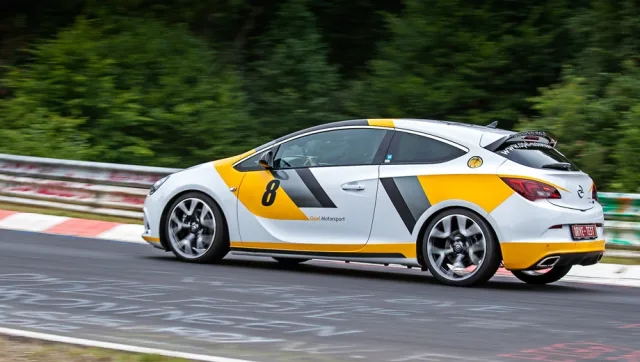
This short story is about how our perception changes depending on circumstances. The first test of the new Astra OPC on Drive made a depressing impression on me, even though I didn't even drive the car. That material broke all records for the number of returns to the author for revision. I had to almost pull impressions of the hot hatch out of Timur Sabirov with pliers. Is it really all so colorless? And it doesn't drive, they say, with its 280 horsepower, and the operation of the differential lock isn't felt enough... Why then does Opel invite us to drive the Astra at the Nordschleife?
OPC trainings are held here, led by Sascha Bert and Klaus Panchirc, whom we already know from events with other brands. It was with them that we drove Jaguars here last spring. Both have extensive experience in various racing series, and both regularly compete in long-distance races at the Nürburgring. Bert, it turns out, is Opel's chief instructor and even participates in the fine-tuning tests of road-going Opels.
Sascha Bert was a factory Opel driver back in the German Formula 3 of the late 1990s. And he has been an OPC instructor for five years now. He got the position of chief instructor, I believe, not only for his speed but also for his booming voice. He can be heard perfectly without any microphone. If the track radios weren't working, he'd surely shout to us from his car.
Trainings is a strong word. A few runs of two or three Nordschleife laps behind the instructor's car. The instructors don't put much faith in our personal experience; they drive deliberately safely, but that's no reason to be upset. After all, the main thing here is the mileage. My ten-year romance with the Nürburgring becomes richer by ten laps. And rare, full laps of 20.8 km: Opel holds its event as part of a track day when the two-kilometer Döttinger Höhe straight is open.
Klaus Panchirc is older and calmer. Unlike Bert, he trusts his charges more: it was with him that we did our fastest session.
We have all OPC models at our disposal: Astra, Corsa, and Insignia. But if I could choose one car for the whole day, it would be the Astra. The Corsa — what a funny little iron! But lo and behold — the OPC Nurburgring Edition. Indeed, a very sporty "bug." Nimble, with a differential lock. It bounces briskly over bumps, and under braking it tends to go sideways.
The Corsa Nurburgring Edition features a boosted turbo engine, a differential lock, and passive Bilstein dampers.
By the end of the lap, as the dampers warm up, the oversteer becomes more pronounced. Despite its name, the Corsa is too nervous for the Nürburgring. With such a character, it belongs somewhere like Myachkovo near Moscow. Sascha Bert agrees but assures that if you drive really fast, the necessary understeer appears. So let's go faster, for heaven's sake!
Due to the narrow operating range of the 210-horsepower 1.6 turbo engine, the Corsa often lacks the right gear. For example, uphill on third gear it no longer pulls, and when you shift to fourth, you sit in turbo lag. A three-hundred-meter (!) elevation change is no joke. A tough test of elasticity for a turbocharged engine.
The Insignia OPC has more torque: the "turbo-six" 2.8 develops up to 435 N•m. Yes, the car is heavier, but the gear ratios suit our task today better. But here there are other problems. The all-wheel-drive Insignia lacks a front differential lock, and therefore its behavior is more front-wheel-drive than the Corsa's. When guiding the big sedan into a corner, I have to find it room for a wide exit. The car rolls heavily and generally struggles to keep up with the instructor's Astra.
The Insignia falters under braking: the ABS is too sensitive to the road profile, and the discs overheat quickly.
Still, I regretted that Drive doesn't have a road test of the Insignia OPC — it could be a good city car. Decent ride comfort, all-wheel drive, soft responses to steering inputs... Ergonomics are mediocre, but some might like the countless buttons on the center console and the soft action of the manual gearshift. After all, there's an automatic version. Very soon we'll drive the updated Insignia and, hopefully, get to the OPC...
The steering wheel is free of parasitic corrections, even though there are 280 horsepower, 400 N•m, and a lock that allows you to get on the gas before the apex. (Instructors, by the way, forbid doing that: they protect us from excessive speed on the exit. But try to check!) There's no hint of laziness. The power-to-weight ratio is correctly balanced. I don't really like the characteristic hissing sound of the Astra OPC, but somehow it makes it more fun. As if the car spurs you on.
Finally, our main heroine — the Astra OPC. In such company, it shines! It's in its element: handling, stability, and powertrain calibration — everything is tailored to the demands of the Nordschleife. Behind the wheel of the three-door, you understand why the pair of Astras at the head of the column constantly pulls away from the rest. Following the instructor is easy: the car always has torque in reserve for acceleration, and braking is both stable, like the Insignia's, and effective, like the Corsa's.
The task is to follow the instructor's line exactly, maintaining a minimal safe distance.
The lateral grip reserve is more than decent: on Pirelli R Zero tires, cornering loads reach 1.3 g. What matters isn't even the limits, but the balance. The Astra is easily corrected both with the steering wheel and the throttle. It's very stable under power, and when you lift off, it seems to rise on its toes, ready to respond to any steering input with doubled zeal. This partly works against the instructors...
For those who, like me, love watching onboard videos — a tourist lap (BTG) in a modest 9:34. But if we hadn't waited for the stragglers and hadn't so politely let faster cars pass, we'd easily have gone under nine minutes. After warning us that accidents most often happen on the last laps, Sascha brakes a couple of times in front of me in the most unexpected places so that I almost reach his Astra.
They keep us at some intermediate pace that develops wrong skills. We accelerate at full throttle: I notice that after gaining some decent speed, I close the throttle because I need to maintain distance to the car ahead. The car becomes unbalanced and demands more attention than if we were driving the same section at full tilt. And you have to brake where you shouldn't. And in the proper places — noticeably earlier, because there's no faith in the stock brakes. Especially in the heavy Insignia.
Sascha knows the OPC technology better and trusts it more. Turning his Astra into a ring-taxi for five laps, he doesn't even turn off the stability system, just settles for the sharpest OPC mode. He drives at 80%, as he puts it. Indeed, he starts calmly, but by mid-lap he gets into a fight with some prepared "M3" and then goes flat out. You need to know the car very well to brake so confidently on uneven sections and throw it from side to side in high-speed combinations. It seems the Astra was tuned specifically for Bert (or he tuned it for himself) — so well they work together.
Sascha's 80 percent is a very respectable eight and a half minutes (BTG). The guy seems to yawn in places, but he's very surprised when I try to shoot something for Instagram on the move. Usually, he makes passengers sick, we've seen... At the bottom right of the video is a telemetry display: speed and lateral g-force are readable.
The drive in the Astra even rekindled my taste for front-wheel drive. In such an unobtrusive form, it's perfect for mastering a demanding track like the Nordschleife. It's known that Opel isn't the fastest hot hatch here. The leader of this pack is considered the Renault Megane RS. But for someone starting their descent into the Green Hell, I'd confidently recommend the Astra OPC. Surprisingly, it turned out to be more appropriate at the Nürburgring than the special Corsa bearing its name... By the way, my first car at the Nordschleife in 2003 was exactly an Astra OPC, but a wagon. Happy anniversary, dear! Meanwhile, the next car is already waiting for me at the Nordschleife. Rear-wheel drive.
Behind the scenes
Our session coincided with a practice day before classic car races, which are held at the Nürburgring several times a year. Our Boris Ulzibat told you what it's like. What machinery, what people, what atmosphere! The cream of Western society gathers to shake up the old days and burns rubber to the fullest. And those whose age no longer allows them to race themselves hire professional drivers to walk their dinosaurs.
This is a very powerful themed event: there are souvenir shops, parts manufacturers for retro cars, and auction houses... For example, the British auction Coys. Oh, what rarities are up for bidding! For instance, a one-of-a-kind BMW 328 from 1938 with a post-war aerodynamic body (top right). Or a Lancia Aprilia Riva roadster from 1946 (bottom right) — there are only two in the world! And the Alfa Romeo 6C (1930, left) or the Lancia Appia Sport Passo Corto with an aluminum body by Zagato (center) can hardly be called mass-market...
Listen to some classic sounds, and photos can be viewed in the album on Drive's Facebook page.