
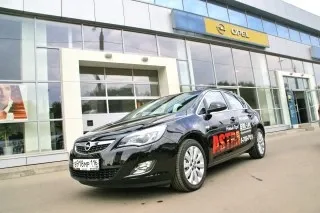
 Opel Astra
Dual-zone climate control, power steering, ABS, ESP, 4 power windows, front fog lights, heated mirrors, Audio system CD 400 with graphic information display, central locking + alarm, USB port, electric parking brake, heated front seats, leather steering wheel with audio controls, rain and light sensors, cruise control, parking assist system.
Service 1- 5 500
Service 2 — 6 300
Service 3 — 5 500
Service 4 — 8 300
Service 5 — 13 000
Service 6 — 9 000
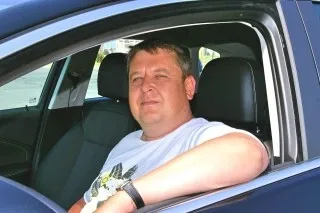
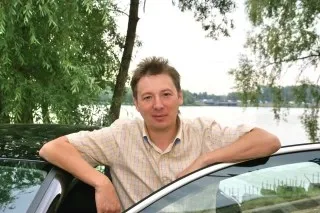
Igor Garipov
There is a joke: nothing ages a car faster than time, but the appearance of a new model from a neighbor. But now I would say differently: nothing devalues your car as much as a facelift from the manufacturer. This is because about three years ago I became the owner of an Opel Astra GTC, and having considerable operating experience under my belt, I eagerly seized the offer from the newspaper "Autoclub-Kazan" to test the new Astra. I admit honestly, I was skeptical.
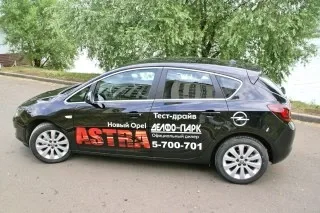
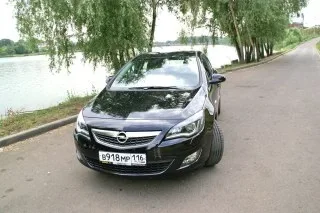
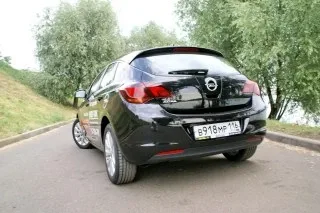
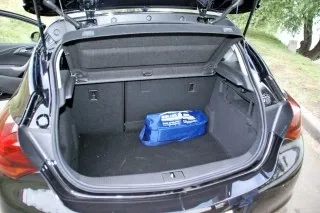
First about the design. The kinship with the flagship Insignia is immediately visible. The side silhouette has become more sloping than the previous five-door, the headlights are slanting, the radiator grille is fully chrome-plated, with the brand's signature embossing on the badge. Due to the smaller windshield rake, blind quarter windows appeared on the doors. At the rear — LED taillights. I reached for the trunk handle — and here's a surprise: the same electric button under a rubber cover. The only question is how much more sealed this rubber has become — on my old car I replaced the button along with it, and at the mechanic's I saw a whole bucket of them. I open the trunk — the volume is about the same, but there's no spare tire, now only a "space-saver". The savings at purchase are questionable, but the downside is obvious: if a tire is "killed" by a side cut on our roads, you can't put a full-size wheel. And another note on wheels: the rims have grown from 16 to 17 inches, but the ground clearance visually seems smaller.
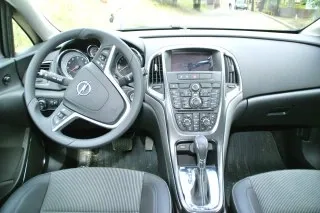
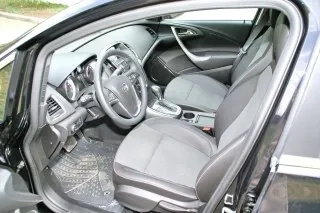
I get behind the wheel. The seats are familiar — combined upholstery of fabric and vinyl: the leather doesn't stick to your back in the heat, and it looks expensive. Overall, a good solution from Opel, but only in the Cosmo trim. I look around. The instrument panel pleases with a modern crimson backlight. An analog temperature gauge has appeared — a necessary thing, given the peculiarities of the Astra's cooling system, trust my experience. There are noticeably more buttons on the console — more functions, but it's hard to figure everything out in a short time. At the bottom, the cigarette lighter is barely visible — reaching it will be problematic, and I didn't find an ashtray at all. In general, the car is clearly not for smokers, and that's perhaps for the best.
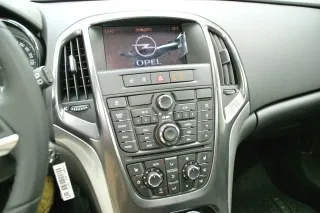
The screen of the information system is large, color, and importantly, Russified — everything as it should be. Finally, normal steering column stalks for turn signals with the familiar detent have returned, not that legacy from the Vectra C that I couldn't get used to in three years! A funny detail: the side mirror adjustment knob sticks out alone in the upper corner of the driver's door, reminiscent of the volume knob of an old radio point. It's nice that there's a factory alarm with volume sensors and key control, which even allows you to close and open all windows.
Let's drive around the city! The steering wheel seemed too light, maybe it fills up at speed? Not sure. On bumps, something seems to kick back into it. Visibility is better than in the GTC. I press the gas. For a 1.6 with a six-speed automatic, I expected more. The settings are clearly in favor of economy, not dynamics. Overall: convenient, comfortable, functional, an excellent city car — but without a spark. If you want driving excitement — get the 1.6 turbo, I think the settings are different there.
Vadim Sadykov, "Autoclub-Kazan"
Progress, however: 1.6 and a whole 115 "horses". I remember the first half of the 90s: the Opel Vectra A (weight 1100 kg) had a two-liter engine with the same 115 hp (though at 5200 rpm), and the car was quite lively. Now the new Astra (1400 kg), again 115 hp (but at 6000 rpm) and a modern 6-speed automatic. And the driving character is measured and calm. That's what extra weight and Euro 5 standards do to a car. According to the specs, the 1.6 with automatic should consume 9.8 L in the city. For us, considering traffic jams, it came out to 10.6 L. True, the mileage was only 600 km, so the appetite should decrease.
In the city, the car pleased: the automatic keeps low revs, and with a light press on the gas, the response is adequate. True, being the first off the line at a traffic light or quickly crossing an intersection from a secondary road is hard. But the sound insulation is good, visibility is decent, and the suspension is quite comfortable. The tires have become slightly taller: 205/60/16 instead of 205/55/16, which should also have added comfort. However, at the rear on bumps, something was knocking. Maybe it was the gift bag from the dealer (Delfo-Park) with a first aid kit and fire extinguisher rattling in the trunk. By the way, the spare tire is only a "space-saver". That's fashionable now; some have only a repair kit. But personally, I'd feel more at ease with a full-size wheel.
Unfortunately, I couldn't test the "slalom". But in normal modes, there are no complaints about the suspension: behavior is predictable and reliable. On the highway, I entered a not-so-smooth turn at 150 km/h. I admit, I thought I was going about 110, and glanced at the speedometer only when Igor (the Astra H owner) sitting next to me quietly said: "Maybe not?". The car handled the turn perfectly.
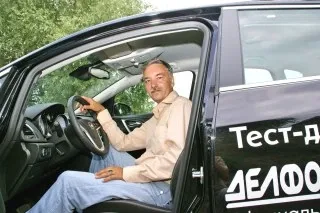
Highway acceleration is very reminiscent of the Opel Corsa 1.2 with a robot: lots of noise, but little effect. However, turbo engines will soon appear: 1.4 (140 hp at 4900 rpm) and 1.6 (180 hp at 5500 rpm). Turbo is also a fashionable trend: they are economical and easier to fit into Euro 5. But note: the peak torque of the 1.6 turbo starts at 2200 rpm and ends at 5400. The engine is clearly tuned for "ignition" and high-rev driving. For purely city cars, a different setting is usually made — with a torque peak from 1500 rpm. And also: the 6-speed automatic is only installed with the 1.6, while the 1.4 turbo has only a six-speed manual. Honestly, a naturally aspirated 1.8 (140 hp) from the previous Astra would be very useful here.
Still, the 1.6 with 115 hp is strictly a city car, without pretensions to racing or long trips. Therefore, the interior "aura" and cabin design are important here. The quality of the plastic (in the Cosmo trim) was very pleasing. The seats made of combined material are comfortable. The front panel is beautiful, but perhaps overloaded with small buttons. And if you step outside and assess the appearance... Swift, "streamlined" lines. Surprisingly: in the showroom, the white Astra looked almost as compact as the white Corsa. But the black Astra on the street seemed smaller than the black Astra in the previous body. Such an optical illusion.
Alfred Mardanov, "Autoclub-Kazan"
I first saw this car in person at a mass test drive in Kazan, where about 13 cars were gathered. I remember how reverently the manager treated the car: the Astra had just arrived at the showroom in a single copy and was a display model. The fashionable white color suited the rounded but swift forms well. I liked the car, although I didn't get a chance to interact closely. Now there's an opportunity to supplement and refresh my impressions. The new Astra, due to its design, looks more compact than it actually is — that's the designers' doing: the high beltline and massive sides optically make the car lower. Vadim correctly noted that in size it seems a bit larger than the Corsa, but that's just an optical illusion. Once you get inside the cabin, everything falls into place.
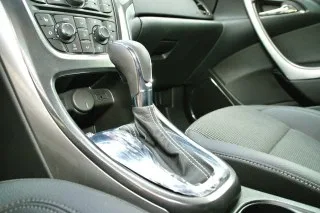
This will be especially felt by those sitting in the back: in the previous generation, rear passengers had noticeably less room. Now, even with the front seat fully pushed back, there is quite decent knee room, and there is also enough headroom. The interior makes a strong impression: a bunch of smooth lines folding into intricate patterns, and the execution and choice of materials are top-notch. The senior Insignia immediately comes to mind. A typical European that takes interior design and style seriously. It seems Insignia set the direction, and the next Opel updates will be in the same style (these are just my guesses). The abundance of buttons on the front panel is confusing at first. But once you start figuring it out, it all seems logical, although I would gladly exchange this whole set, including the central button that also works as a joystick, for a regular touchscreen. I several times mechanically tried to poke the display with my finger, but, as you understand, to no avail.
Opel's pride is the new six-speed automatic, which is in our test car. Six gears are gradually becoming the standard for modern cars. Let's see how it performs! I don't expect any special miracles, but it's interesting to check. The electronic handbrake and the "navigation" button pleasantly surprised me. While photographing the car, I caught myself just admiring it.
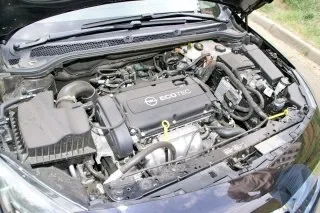
I have warm feelings for Opel — it's a true people's car of the nineties. And those who badmouth it simply don't understand. I recall a guy who drove a Nexia for three years and acted smug, saying, "Now this is a car, not some Opel." I laughed heartily when I explained to him that he was, in essence, driving an Opel that was about twenty-five years old at the time — that's how much time had passed since the Kadett, from which that very Nexia originated. Real changes in the company happened with the arrival of new models, or rather, new models became a consequence of the changes. I remember that five to seven years ago, Opel built perhaps the most robotized plant in the world, where the previous Vectra was assembled. And what do we see: the past Astra still looks fresh, even after five years on the assembly line. And the fact that its assembly was transferred to the "GM-Avto" plant in St. Petersburg is not bad at all. GM is going through tough times now, but they still release new models, albeit on a shared platform. I mean this Astra and the much-talked-about Chevrolet Cruze: they are not just relatives, but literally twins in terms of base. Externally, the Astra has noticeably "younger," become more daring and aggressive, if you will. The Insignia motifs are clearly readable, but the headlights here are even more interesting. LED "eyelashes" in the Audi style look modern. The rear also reminds of several cars at once due to the shape of the taillights. Time to hit the road; it's a pity that this time I won't be able to push the car on a special site — I would really like to. From the first impressions, unlike its predecessor, the chassis is no longer so "evil."
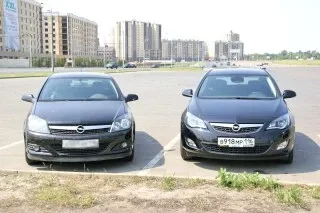
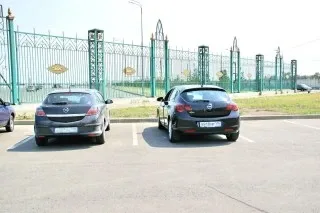
It's clear that the engineers have clearly leaned towards comfort. And here Igor with the previous Astra would have come in handy — we could have compared the cars directly. They also noticeably worked on sound insulation, especially in the area of the rear wheel arches. The steering wheel has also become different. Not worse, just different — lighter, but at the same time less informative. On the highway in a calm mode, it's just a song. But if you need to overtake, especially with a move into oncoming traffic, then you have to calculate everything. I played with the cruise control — it works correctly, it's immediately clear how to set the desired speed. Switching the automatic to manual mode livens up the car: you can rev the engine to the redline, which gives faster acceleration — useful for overtaking. In the city, this car feels like a fish in water. Maneuverable, easy to start, brakes are perfectly tuned. It doesn't annoy, but on the contrary — it pleases. Summing up, when I return the keys, I realize that there's not much to criticize. But the appearance and quality of materials are beyond all praise, and that's already a lot. Yes, the automatic is clear and responsive, oh, if only it had a two-liter engine — then it would be simply ideal in its class.