
Flowering period
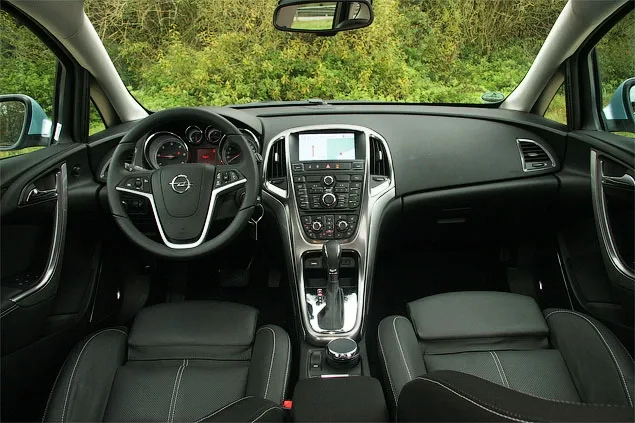
"So where is it?" — this was the exclamation with which our acquaintance with the new Astra began in the parking lot near Frankfurt Airport. As funny as it may seem, among the array of buttons on the central console, we were only looking for the "OK" key. According to the design, pressing it was supposed to launch navigation so we could get onto the autobahn and then reach the suburb. We pressed, scrolled, pushed up and down both round regulators responsible for navigation, audio system, and multimedia — all in vain.
Having lost a few minutes and mentally sending the Opel designers far away, we gave up and called colleagues for help. As usually happens, what we had been looking for so long turned out to be in plain sight: we just needed to press the thin ring around the largest "knob".
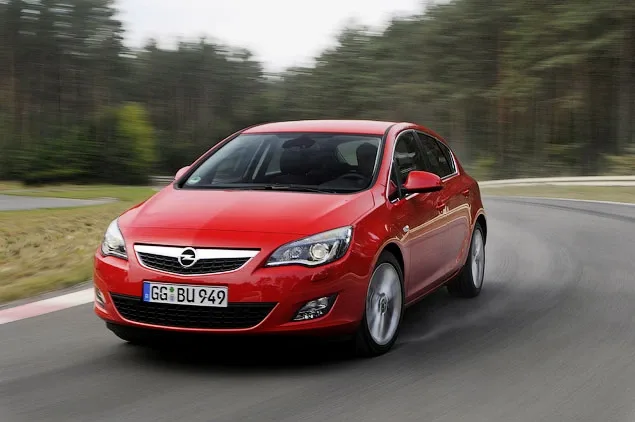
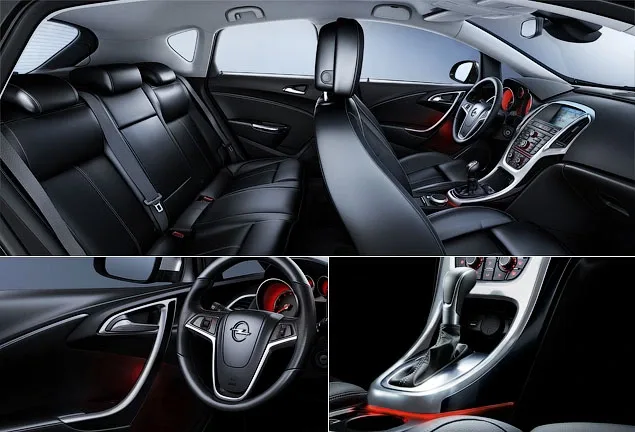
Otherwise, the interior of the new Astra was liked immediately: pleasant-to-touch trim materials, sports seats from the Insignia (optional), diffused red backlighting of door handles and the central tunnel near the gear lever, as well as many compartments for small items that the predecessor lacked.
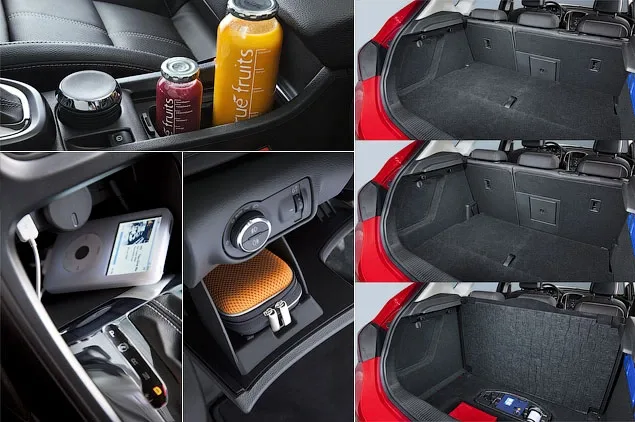
There are door pockets that can hold 1.5-liter water bottles (rear ones only liter bottles), a "shelf" on the central console, a spacious box under the front passenger seat, a niche to the left of the steering wheel, and cup holders with a secret "underground" where a mobile phone, wallet, or GPS navigator can fit.
And to completely appease practical drivers, Opel engineers came up with the FlexFloor system. Simply put, it is a movable trunk floor that can be set at three levels and withstands loads up to 100 kilograms.
In the lower position, it is just a regular cover, level with the curtain covering the repair kit. In the middle, the shelf is set flush with the folded rear seat backs, removing the step and facilitating the placement of long items. Due to the floor level being slightly raised, an additional compartment 55 millimeters deep and 52 liters in volume is formed under the shelf.
In the uppermost position, the shelf levels the trunk floor with the rear bumper, allowing heavy cargo to be loaded without bending. The section under the shelf in this case increases its volume to 126 liters and depth to 157 millimeters. During the demonstration in Dudenhofen, the FlexFloor system seemed like a very convenient thing, allowing proper distribution of space in the trunk. Gardeners will like it. Even despite the fact that for the cheapest versions, FlexFloor will be offered as an option — in Germany it costs only 90 euros.
The Astra has become not only more practical but also more spacious — the new interior is wider both at shoulder level for passengers and at hip level, and the adjustment ranges of the front seats are simply huge. For example, my colleague, about 1.8 meters tall, with the driver's seat pushed back all the way, could reach the pedals with his feet but could no longer press them. If you need dry numbers, here they are: front seats move forward-backward by 28 centimeters and up-down by 6.5 centimeters.
Overall, the new Astra bears little resemblance to its predecessor — both inside and out. The new model inherited almost no parts, unlike, for example, the restyled Mazda3 or VW Golf VI, which still retained recognizable features in their appearance. I honestly admit, when the new Opel Astra was shown at the Frankfurt Motor Show, I did not like its design — the "correct" image of the pre-restyling hatchback, produced for five years, was so firmly rooted in my mind.
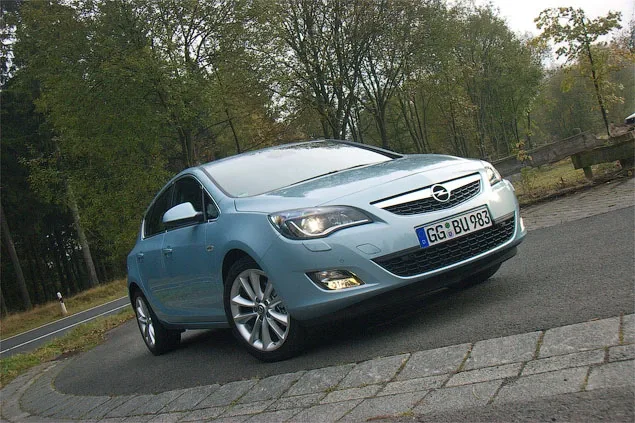
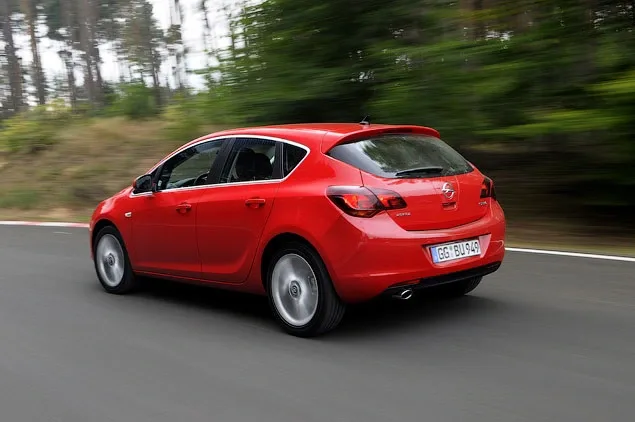
But then — having "tasted" the new car, you understand that the new car looks not only more modern and "softer". Even in the five-door version, it has become noticeably sportier — a dynamic roofline, a heavily raked rear window enhancing the "coupe" effect, deep stamping on the doors, sharp edges of the hood, and fashionable LEDs in the headlights. The "three-door" will likely look even more dynamic, and the OPC version simply must become super-aggressive.
But for now, the Astra does not show aggression. At the beginning of the test, we got a car in an impressive red color (which suits it very well), equipped with a new 140-horsepower 1.4-liter gasoline turbo engine — it will replace the 1.8-liter unit of similar power — and a six-speed manual gearbox. Soft clutch, precise transmission, and smooth but far from sparkling acceleration. From zero to a hundred, such an Astra accelerates in 9.7 seconds, its maximum speed is 205 kilometers per hour, and average consumption of 95-octane fuel in the urban cycle is 7.8 liters. In general, economical and not fast, but not slow either — an ideal city option. Such an engine, by the way, will also be offered on the European market with a six-speed automatic. We managed to test it paired with a two-liter diesel, which has every chance of appearing in Russia as well.
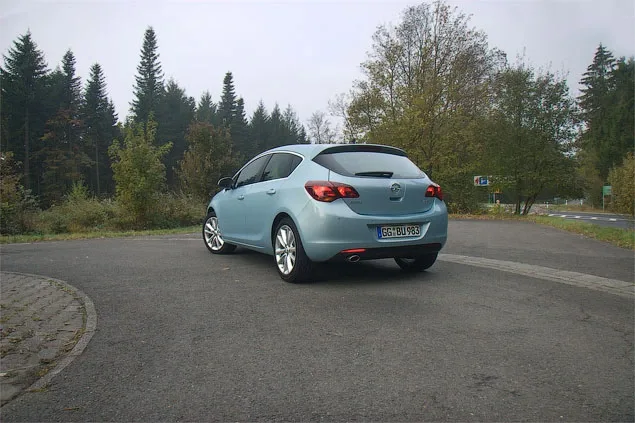
And this 160-horsepower four-cylinder diesel (maximum torque of 350 Nm is achieved at 1750 rpm) is just excellent! Even the slightly thoughtful automatic, which shifts down with a delay during sharp acceleration, does not spoil the impression. The Astra with diesel and automatic accelerates to a hundred kilometers per hour in 9.2 seconds and requires only eight liters of fuel per hundred kilometers in urban mode.
In Europe, the new Astra will also be offered with three more gasoline "fours": naturally aspirated 1.4- and 1.6-liter engines with 100 and 115 horsepower respectively, as well as with the most powerful turbocharged unit in the range with a volume of 1.6 liters, developing 180 horsepower. Plus three diesels — 1.3, 1.7-liter engines with 95 (190 Nm), 110 (260 Nm), and 125 (280 Nm) horsepower.
As for Russia, we do not yet have exact data on the engine range. Most likely, on the Russian market, the Astra will be sold with all gasoline engines except the weakest naturally aspirated one and, possibly, with the two-liter diesel.
Adaptation to Watt
Platform and body
The Opel Astra hatchback is built on the new front-wheel-drive Delta II platform of the GM concern. The wheelbase of the car compared to its predecessor has increased by 71 millimeters (to 2685 millimeters), and the front and rear tracks have widened by 56 and 70 millimeters respectively. In addition, the angular rigidity of the front and rear suspension has increased, and the body of the new Astra has become 43 percent stiffer in torsion and 10 percent in bending. |
After listening to a lecture about the significantly improved sound insulation of the car (new seals were installed, hollow sections in the body were insulated, and the aerodynamics of external elements such as rearview mirrors and even door handles were thoroughly worked out), which claimed that the noise level decreased by as much as 50 percent, we headed to the autobahn and accelerated to the allowed 120 kilometers per hour. Inside, it is indeed very quiet — so much so that you can talk to passengers even in a whisper. At speed, only the rustle of tires and wind noise around the side mirrors are barely distinguishable.
The new Astra on asphalt behaves impeccably: it confidently holds a straight line, and in high-speed corners it stays on the intended arc until the very end, so the stability control system hardly needs to intervene. That said, the predecessor was also quite good in handling, but the current model is based on a fresh platform familiar from the Chevrolet Cruze. However, the new model has an important difference — a different rear axle design.
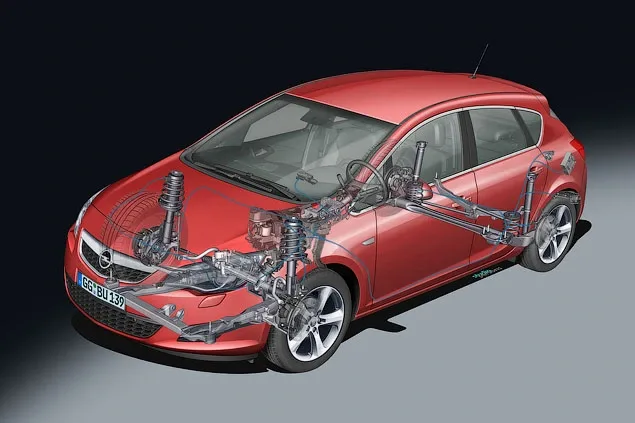
At the rear, there is a torsion beam supplemented by a Watt's linkage. This is a pair of rocker arms connected by a central pivot lever with ball joints at the edges. This design makes the rear suspension stiffer, improving cornering behavior, reducing lateral beam displacement felt during maneuvers, and damping impacts from road irregularities. Thanks to this, engineers were able to use softer bushings, which reduced noise and vibration levels. Most importantly, according to the suspension developers, they managed to combine comfort and handling — something difficult to achieve with a regular beam: usually you have to choose one or the other, either smoothness or sharp responses.
Up front, a standard McPherson setup is used with two upper mounts that distribute load between springs and shock absorbers. To reduce unsprung mass, the steering knuckles and lower arms are made of aluminum, and the steel anti-roll bar is hollow.
Another interesting option for the Astra is the FlexRide adaptive dampers borrowed from the larger Insignia. They have three modes: standard, sport, and tour. In normal mode, the chassis adapts itself to driving style and surface: the electronics decide whether to keep soft settings for smoothness or, conversely, stiffen the dampers and make the steering heavier.
In Sport mode, the instrument panel changes its backlighting from white to red, the steering wheel becomes noticeably heavier, throttle response and adaptive headlights (also an option, as on the Insignia) sharpen, and the suspension noticeably stiffens. Moreover, the driver can disable any of these options via the onboard computer, tailoring the sport mode to their preferences.
Tour mode, on the contrary, is maximally comfortable. The steering responds less quickly, road imperfections barely reach the body, but in sharp corners the car starts to lean noticeably.
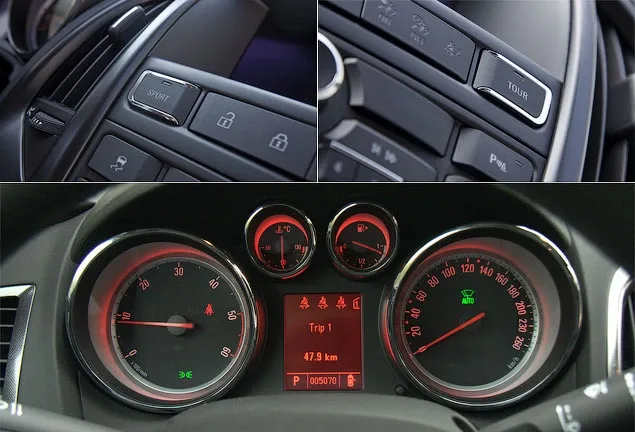
Unfortunately, we were unable to try the car with the standard suspension. However, at the Opel test track, the FlexRide system performed excellently — on fast sections, the Astra with a stiffened suspension and the 180-horsepower engine was not inferior to the previous-generation hatchback in the OPC version, confidently holding its line and only occasionally squealing its tires. On a track simulating a bad road — from cobblestones to ordinary patches — the car in automatic mode moved without bottoming out and did not annoy with shaking. How the car with the standard suspension will behave in such conditions, we will definitely check when the new Astra appears in Russia.
Bloom
Coincidence or not, the European premiere of the new Opel Astra in a five-door body coincided with the flowering time of the plant of the same name — from late July to late autumn. It seems the Astra has also blossomed: the exterior is attractive, it drives wonderfully, and in the cabin, if you don't pay attention to the scattering of small buttons on the center console (you quickly get used to them), you feel quite cozy.
The new Astra is an obvious step forward. The engineers clearly tried to address all the complaints that were directed at the predecessor. And for most of our nitpicks, for example, the poor visibility due to massive front pillars, they always have a ready answer: "thicker pillars increase safety in a crash."
How much the new Astra will cost in Russia has not yet been announced. According to preliminary data, prices for the hatchback will be approximately at the level of the Kaluga-built VW Golf — that is, around 700 thousand rubles (possibly slightly less) for a decently equipped base version. If that is the case, the new model has every chance to remain among the sales leaders in the golf class. According to AEB statistics for September, over nine months, 16.6 thousand Astras were sold in our country, Mazda3 — 11.7 thousand, Toyota Corolla — 13.6 thousand, and the Golf did not even make it into the top 25 most popular cars.
The new model will likely reach dealers in January-February next year, and a bit later its assembly is planned to be launched at the GM plant near St. Petersburg. So buyers will have a choice: the new Astra at a higher price or its predecessor, whose production was recently set up at Kaliningrad's Avtotor, but cheaper. Is it worth paying extra for the fresh model? I think yes — you don't buy wilted flowers...
Technical specifications (petrol engines)
| Opel Astra 1.4 | Opel Astra 1.6 | Opel Astra 1.4 Turbo | Opel Astra 1.6 Turbo | |
| Length, mm | 4419 | 4419 | 4419 | 4419 |
| Width, mm (excluding mirrors) | 1814 | 1814 | 1814 | 1814 |
| Height, mm | 1510 | 1510 | 1510 | 1510 |
| Wheelbase, mm | 2685 | 2685 | 2685 | 2685 |
| Engine displacement, cm3 | 1398 | 1598 | 1364 | 1598 |
| Power, hp/rpm | 100/6000 | 115/6000 | 140/4900 | 180/5500 |
| Torque, Nm/rpm | 130/4000 | 155/4000 | 200/1850-4900 | 230/2200-5400 |
| Maximum speed, km/h | 178 | 188 | 205 | 221 |
| Acceleration from 0 to 100 km/h, s | 14.2 | 11.7 | 9.7 | 8.5 |
| Fuel consumption l/100 km (city/highway/combined) | 7.2/4.5/5.5 | 8.3/5.1/6.3 | 7.8/4.8/5.9 | 8.8/5.6/6.8 |
Technical specifications (diesel engines)
| Opel Astra 1.3 | Opel Astra 1.7 CDTI | Opel Astra 1.7 CDTI | Opel Astra 2.0 CDTI | |
| Engine displacement, cm3 | 1248 | 1686 | 1686 | 1956 |
| Power, hp/rpm | 95/4000 | 110/3800 | 125/4000 | 160/4000 |
| Torque, Nm/rpm | 190/1750 | 260/1800 | 280/2300 | 350 (380 - overboost)/1750 |
| Maximum speed, km/h | 170 | 181 | 195 | 215 |
| Acceleration from 0 to 100 km/h, s | 14.7 | 12.6 | 11.5 | 9.0 |
| Fuel consumption l/100 km (city/highway/combined) | 5.1/3.6/4.2 | 5.7/4.1/4.7 | 5.7/4.1/4.7 | 6.4/4.1/4.9 |
| DISCUSS | [ comments: NONE ] |